Sovereign Hill: an historical amusement park near Ballarat, Australia

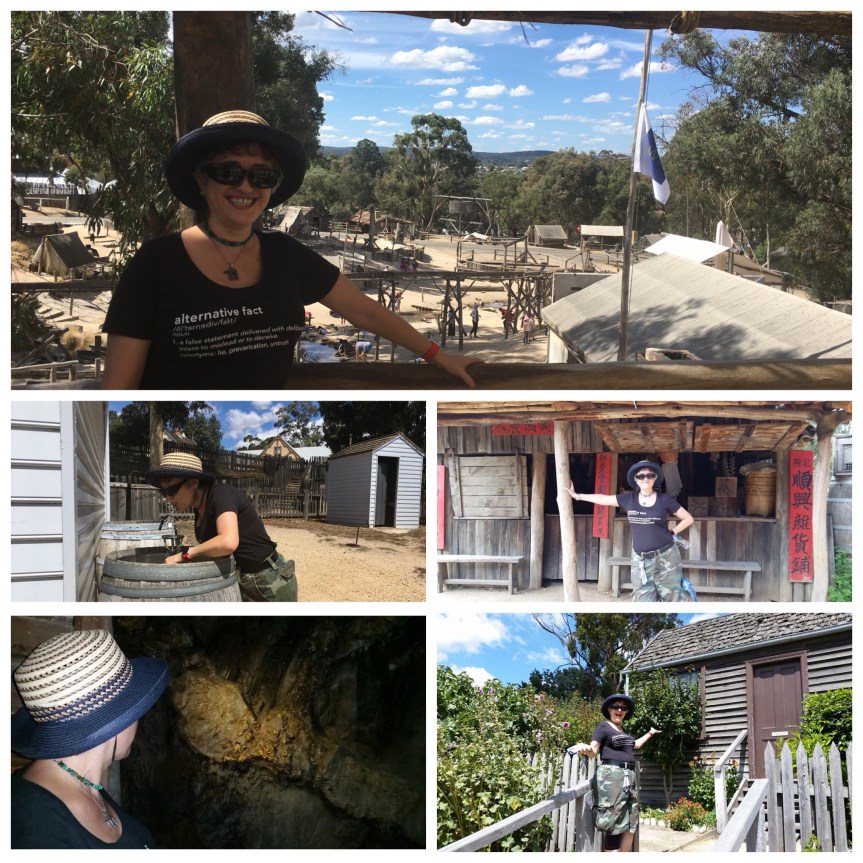
Sovereign Hill is located in Golden Point, a suburb of Ballarat (a small city located about an hour northwest of Melbourne, by train). This attraction is a bit like a Disneyland for history geeks, and probably the best living history parks I’ve been to yet, i.e., right up my alley and definitely would like to come here again.
IMG_1105To be realistic, in any other part of the world Ballarat is so small that it should have swallowed up Golden Point, making it a neighborhood within the city, the same way that for efficiency reasons modern Chicago has swallowed up what were its numerous surrounding villages, such as the Pilsen neighborhood, and New York has swallowed up Harlem, etc., … but this process of city expansion for some reason hasn’t happened yet in Australia. When I look at Melbourne and Sydney neither seems to have done the same to the towns and villages that surround them.

[NOTE: That said, I’m writing this blog post well AFTER my visit. I was in Sovereign Hill about 5 months ago, on Feb 13, 2018, which was only 19 days after my accident on Jan 25th which resulted in a sever concussion.  As such, I wasn’t really able to appreciated it in fullness (we were there only for about two hours, and it really was all I could manage at the time before having to head back to bed). That said, I would really love to come back here at some point, buy a one year pass and spend a good few days there, just like I do at Disney. BUT, that said, because of the accident I couldn’t really focus the way I needed to in order to blog about much of what I saw for the next month after, and as such have fallen woefully behind on the posts the Australia trip … but as I’m currently holed up in the Chicago area (i.e., my home base) doing things like doctor’s visits — including some related to the post concussive syndrome which I am STILL suffering from (albeit very mildly at this point, thankfully) and the fact that I hit the ground so hard that I dislocated my jaw (requiring some expensive visits to my dentist who is trying to fix the damage) —  I am taking the opportunity of being back on my home turf to rectify that lapse.]

Sovereign Hill actualizes for its visitors the history of Australia’s Victorian gold rush (1851 – 1860’s) which had the same impact on Melbourne that Sutter’s Mill had on San Francisco.

IMG_1110.JPG

(The video above is a TV ad for the attraction, and while it won’t be AS inhabited as when you arrive, a lot of what it shows is in fact visible… candy being made, metal being worked, etc., as my pictures show)

This is a video I found on YouTube shot by a tourist

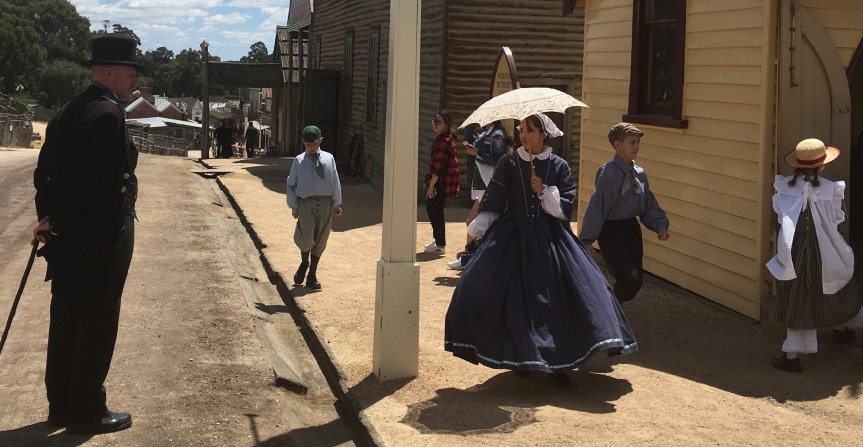
One of the distinct aspects of Sovereign Hill, is that while “visitors” of course includes basic tourists (both Australian and international), more importantly it means groups of Australian school children;

IMG_7716.jpg
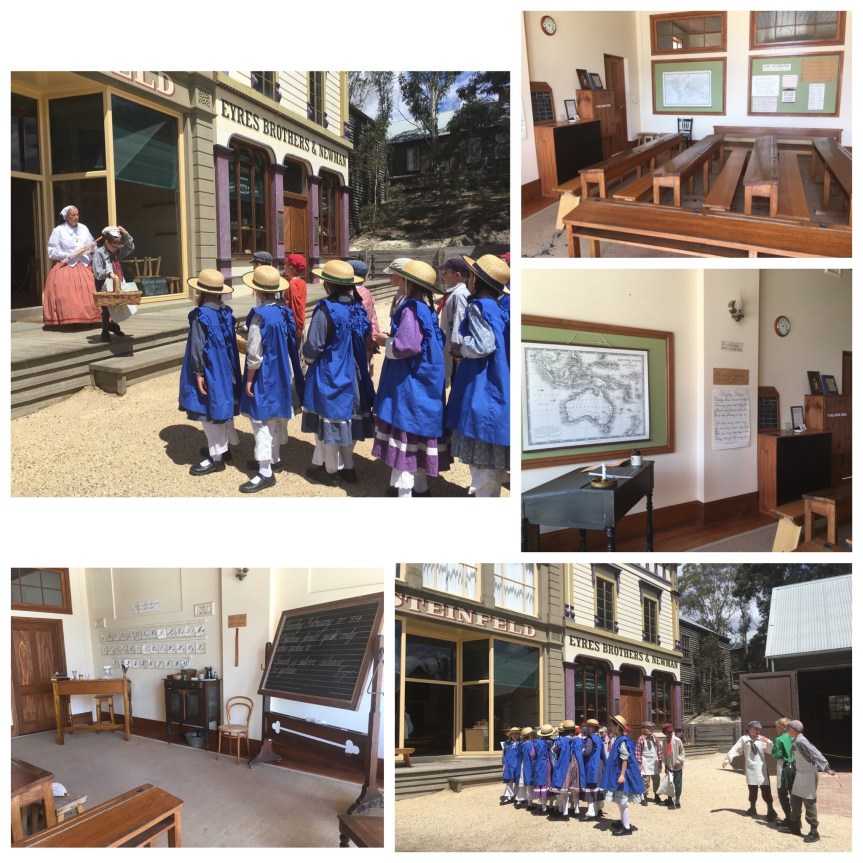
One of the four school rooms in the park

they are sent here (and other not quite as nice locations scattered around the country, this according to my travel buddy for Australia, who is also an Aussie but who did not join me on this leg of the trip) to spend two days in (what my friend told me was) government subsidized experiential learning programs.IMG_1106.JPGThe above is the 2nd of the four schools in the park, located in an abandoned shop, and shows children lining up to attend a class; I spoke with the girls as they waited for their teacher and they said that each of them had been given a “story line” of who they were, and that all the students in this class were the ‘less affluent’ students in town, miner’s children, orphans, etc.
IMG_7804.jpg

They told me that these children (below), on the other hand, were playing children from more affluent families. The woman in blue is their actual accompanying teacher/guardian from home, while the man on the left is a teacher who works full-time at the park. I found this newspaper article about talks not only about him, but verifies some of what the children told me, and adds how the different groups have different curricula, with the richer students being taught genteel skills, like drawing and sewing, while the poor “ragged” students spend half their day being taught trade skills.

IMG_1107.JPGFor those tourists who don’t know what’s going on, these teachers and students just become part of the overall show

IMG_1108.JPG
The third school room (I never saw the fourth one), held in a church

The following is a video I actually took, and uploaded to YouTube of these kids being taught cursive (a form of writing soon to be relegated to history):

This next ‘Welcome to Sovereign Hill’ Video, is actually the seven minute introductory video shown to students when they first arrive. It gives an overview of the town with an explanation of the historical evidence they relied on for its construction, as well as some basic instructions to the students on how interact with the tourists they will be sharing the space with, who will think of them as part of the show and hence will want to take their pictures (the video is well worth watching):

In fact (according to my friend who brought me here who has worked here for years as volunteer) it is these educational programs, more so than general tourism, that constitutes the bread and butter funding for the park and keeps it profitable enough that they can keep it in top repair, and pay for things like upgrades to the experience and professional actors and animal experts to work there.

IMG_1109.JPG
The woman clutching the jug plays the role of the town drunk

In support of their educational mandate, Sovereign Hill’s web page also offers up a large selection of teaching/educational videos that they produce including various performances at the park’s theater, a musicologist discussing the songs miner’s sang, an informational video on how to pan for gold, a historian discussing how the industrial revolution changed Australian life, and a video that offers up quotes from writers of the time exemplifying how what the park offers is an “improved” version of history, etc.

Sovereign Hill is not only about the time period of the gold rush; because of its location, the park has a specific focus on the events of the Eureka stockade, which Australians are in general taught (correctly or incorrectly, historians dispute this) as being the birth of the movement towards democracy in the country.

This video (above) gives you an overview of the historical events that occurred not far from where the park is located (the specific location is still debated but it was definitely a location visible from the park)

While these video’s below talk the special ticket night-time sound and light show devoted to events of the Eureka stockade, which they call Blood on the Southern Cross

A vast section of the park is devoted to Victorian homes of the sort that more affluent town’s member might have lived in. Every home is decked out with historical elements designed to make it look as though it’s actually being lived in, but the owners just happen to be out at the moment.

IMG_1126

Other parts of the park are devoted to trades that one might expect to find in just such a town, in this case either there are people working there, or it tends to look more like a museum (with signs explaining what you’re looking at).

IMG_1125
bottom right is broken wheel, supposedly waiting to be fixed; this shop occasionally has a craftsman on staff explaining the craft, but not today
IMG_1128
The undertaker’s, my friend says no one actually ever works here

IMG_1132.JPG

One part of the mining camp section of town is the Chinatown district. While there was no one working in this section when we visited, it was clear that a tidy sum of money had been invested into its development, as each aspect of it comes complete with multimedia aspects to make up for the lack of staff.

IMG_1135
Inside the temple is multimedia show, worth listening to

IMG_1134.JPGWhen you stick your head into these tents, you’ll hear the voices of the non-existent Chinese miners speaking to each other. If you pay attention you’ll actually learn things about the prejudices and injustices these miners faced, as Chinese.

IMG_8043.jpg

In this tent you can listen to the Chinese miners arguing amongst themselves about the choices they were having to make, and about how they organised themselves into self-help organizations, since they couldn’t count on the white to treat them fairly. It was fairly obvious from the items in some of the stores to the composition of the tourists, that Chinese tourism constitutes a fairly large percentage of who comes to this park, and their concerns and interests were therefore fully met.


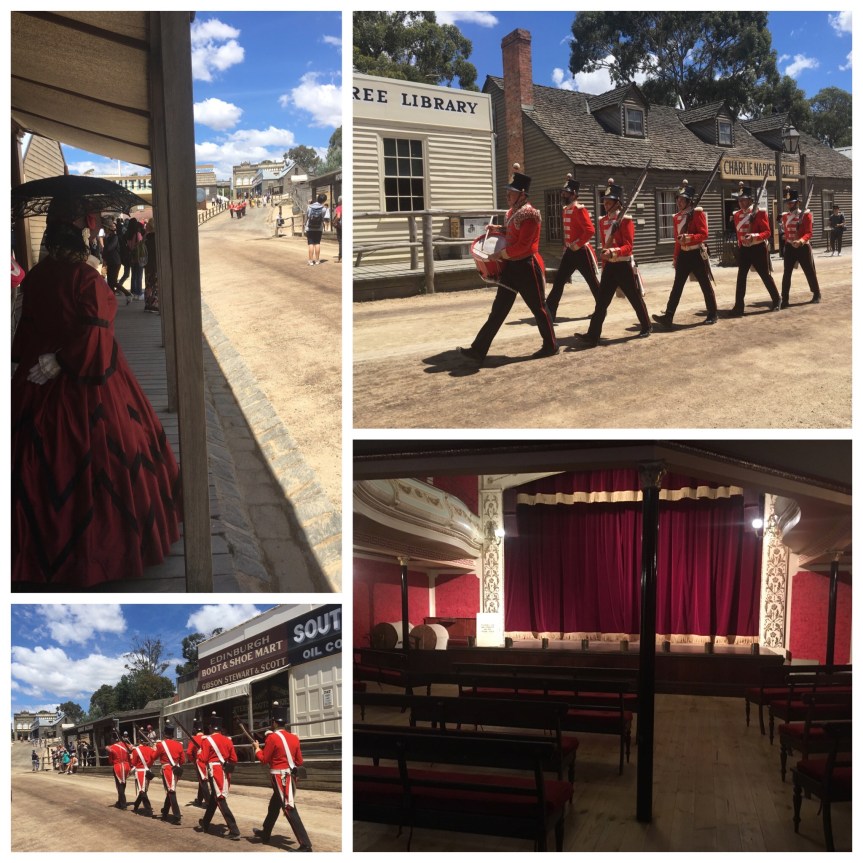
That said, Sovereign Hill, while it has a huge educational mandate and is a living history museum, it is also first and foremost an amusement park type attraction — A Disneyland for history geeks, and hence must provide its visitors with amusements. As such, it provides the obligatory schedule of free of charge performances that visitors can attend during the day.

 

IMG_7881.jpg

IMG_1120.JPG

One of the interactive activities that the park offers is the opportunity to pan for gold in their stream. According to my friend, this isn’t a real stream and gold that’s there is seeded, but no one really cares. You’ll find any number of people happily devoting at least a good hour to panning for gold.

IMG_1133

If you want to cheat there’s also a gift shop set up as a miner’s tools shop, where you can buy little vials with tiny bits of gold in them, but what’s the fun in that?

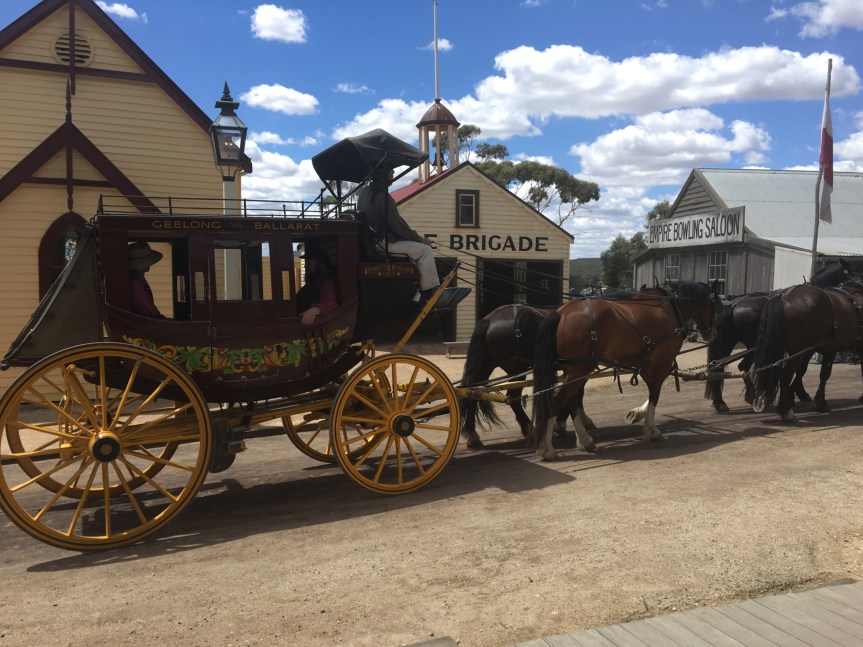
And in addition, even though Sovereign Hill –unlike Disney — is a non for profit, they take every reasonable opportunity to separate you from your money after you’ve paid your entrance fee (which is almost as high as some of the smaller Disney parks). That said, most of the payment-to-go options (after the initial entry) are all very reasonably priced…
IMG_7823.jpg
Coach Rides: $5.50 Adult, $4.00 Child (5-15), $17.00 Family

There are also tours that take you into a genuine historic gold mine that sits beneath the entire park, and constitutes one of the other “highlight” things to do in the park

IMG_1121
There are three different tours; well, 1 tour, but with a choice of 3 different movie endings

IMG_7975

According to my friend all of the tour guides who lead chinese tourists through the park (this one is about to lead a group into the mines) are required to dress the way this woman is dressed, i.e., what is historically accurate clothing for a Chinese resident of the town, just as the tour guide for our group was required to dress the same way a miner of the day might have.

IMG_1122
Everyone takes the same walk through tour, lead by a guide

At the end of the tour you watch what is essentially a VERY fancy Powerpoint presentation with all the animation bells and whistles on one of three topics (see above). You do this while standing in a small hollowed out, rounded but still craggy space (with the evidence of it having been mined out), deep inside the mine.  The presentation is projected onto the craggy rock’s face rather than a smoothed surface, which is pretty cool. It’s supposed to kind of make you feel like you’re in it with them. My friend and I opted for the presentation called the secret chamber, about Chinese minors and their trials and struggles with local prejudice; is the story of two brothers one of whom went home rich, the other who died in a mine collapse.
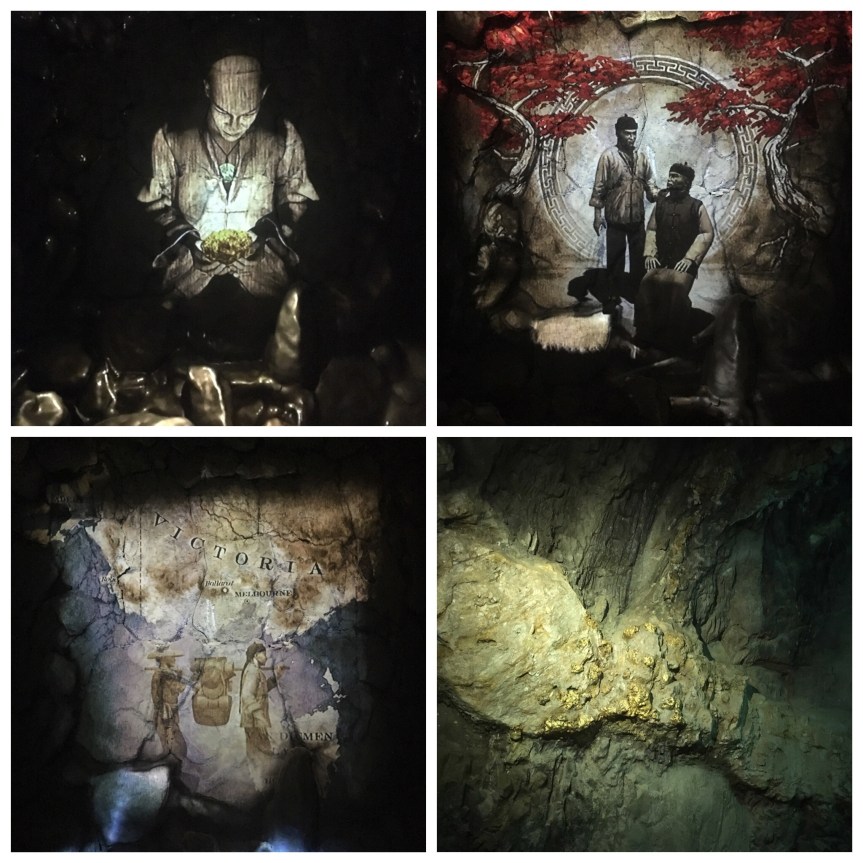
IMG_1123After the presentation you walk past a past a large patch of exposed gold still embedded in the quartz, so that you can see what it looks like… but that you are separated from by a bulletproof-glass wall and a whole bunch of security equipment which they make sure you can see.

28124785_10156212954714250_344949949_o.jpg
There’s GOLD in that wall… actually un-mined GOLD

After the tour you come back topside and are let out into the obligatory gift store, this one selling a lot of gold, with a very strong focus on their Chinese tourist customers (because I’m guessing they’re the ones most likely to buy some).

IMG_1124
The one thing I was tempted to buy was the snow globe full of gold flakes, the minor inside it looks SO happy, and it’s relatively affordable.

In addition to this obligatory “after a ride” gift store, there are two varieties of stores in town, those selling period specific goods that you could probably find outside of the park if you looked hard enough, but presented in the style of store in the 1800’s

IMG_1130

IMG_7941.jpg
I love this photo, note my friend in the reflection
IMG_7951.jpg
We ran into this same guy working at three different locations, but he’s so pretty we didn’t mind at all; he’s behind the counter at the Criterion (above), this jewelery store, and the candle works (below)

[Regarding my friend, it was almost karmic good luck that I was scheduled to stay with her for two weeks at exactly that point in my trip. She’s one of the few Facebook friends I ever made (we used to play this same FB-game, one of those that necessitate that you friend complete strangers, and we found we had so much in common that we continued to stay in touch long after both of us stopped playing). She had invited me numerous times to visit her in Australia, and she lives quite near to Sovereign Hill. In addition to being a successful realtor who has returned to University to obtain her undergraduate degree in history, AND a professional psychic (see the blog post for the tour of a haunted former Nun’s abbey, that she guides)… she also used to work as a registered nurse — which was infinitely useful for me in terms of her being understanding the needs and limitations of my health predicament while visiting her.]

The second variety of stores are those selling items that were handcrafted by the skilled craftsmen demonstrating by hand what in this day and age are almost lost arts

IMG_1131

IMG_1127

in the Town there are six different places selling food during the day (plus a seventh that’s only open for the sound and light show in the evening)
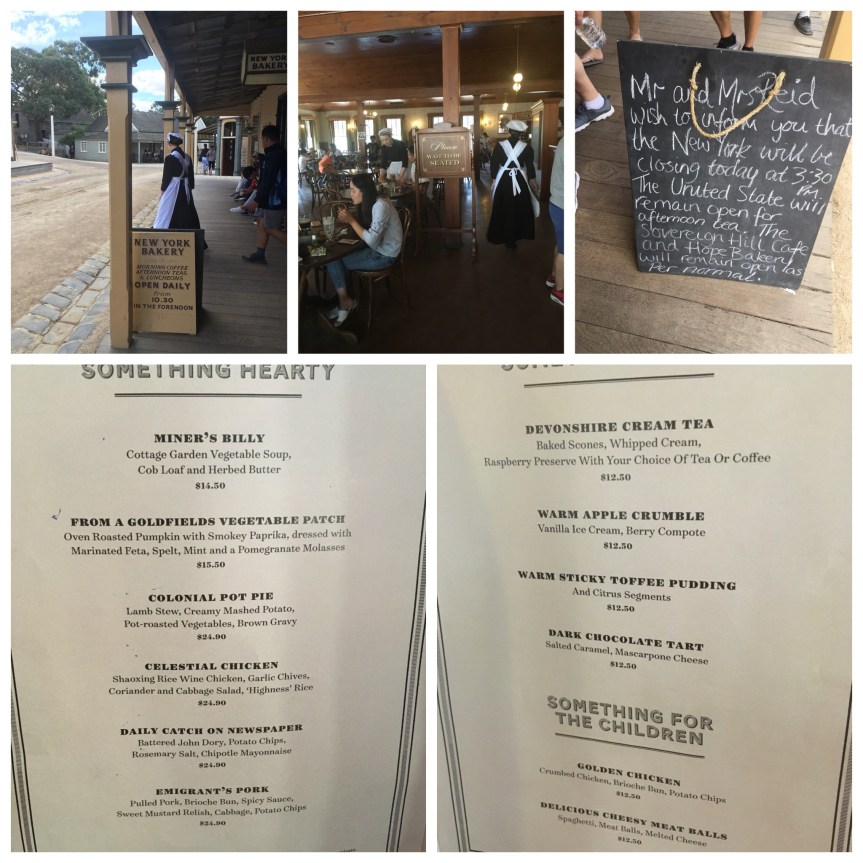
IMG_1111.JPG

IMG_8054.jpg
A candy store with historic candies
IMG_1112.JPG
This bakery was selling a full meal in a bun: one end was the appetizer, the other dessert

IMG_1119.JPG

IMG_1114

As we were touring through the town, my friend took me to the room where she would normally work while volunteering… the ladies lounge in the hotel. Normally my friend would sit there, doing needlepoint, and talking to any visitors who might wander in

IMG_1129

The day we visited we found this woman is doing what my friend normally does, so the two of them had a nice chat exchanging pointers.

Knob Creek, KY: Abraham Lincoln’s childhood home, from age 2

If you were on a Lincoln pilgrimage to the impressive memorial at Lincoln’s birthplace, and have some spare time, one of the places you might want to consider as part of your trip is  Knob Creek, KY, the homestead his family moved to when he was two years old; Granted, what’s currently there now is nowhere near as impressive as what stands at his birthplace, but it would have been the place he thought of as his childhood home, and unlike the birthplace, this is where he would have had an emotional connection to… and as such, it’s worth a few minutes.

fullsizeoutput_3ec9.jpeg

BOY do I fall behind in my “work” when it comes to this blog. WAY back in 2016 I visited this part of the country, and I had THOUGHT I had blogged about it, but when in 2018 I went to Springfield, IL, the site of Lincoln’s adult home, and his tomb… and found myself wanting to link to that blog post about the one I had done for his birthplace … and found myself wondering where in the hell that blog for it had gone to, only to realize I’d never written it … I decided to rectify that lapse (a few days ago), and today I’m doing the same for this satellite location where he grew up. That said, it’s been a LONG time since I was there, and although I’m looking back in my Facebook postings for notes, those were pretty scarce… so this post will mostly be about the pictures.

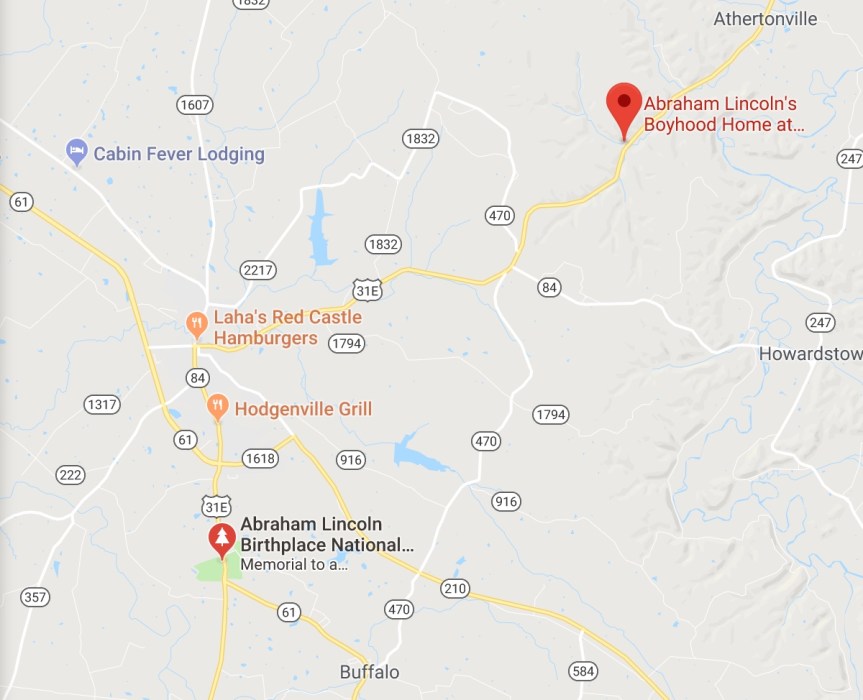
The site of Lincoln’s childhood home about 42.5 miles/about an easy 15 minute drive from his birthplace – where his family moved to when he was two years old. So if you choose to visit it (and why not) an important thing to keep in mind is that a horse walks about four miles per hour, and as such… in Lincoln’s time the distance between the two locations took was about 10 hours by horse, or about 14 hours by foot — so it’s likely Lincoln might have had no memory at all of the place of his birth, and as such, to him, Knob Creek would have been much more important to him emotionally.

lincoln.jpeg

That said, it is a quick nine minute drive from Hodgenville, KY, a very small town of around five eateries (two being fast food) and little “commercial” museum (basically a business set up by a local). That’s also worth stopping in.

As you’re driving down road 31E watch out for this sign on your left, as it’s fairly easy to drive past if you’re not paying attention (like I said, it’s unimpressive).

IMG_7020

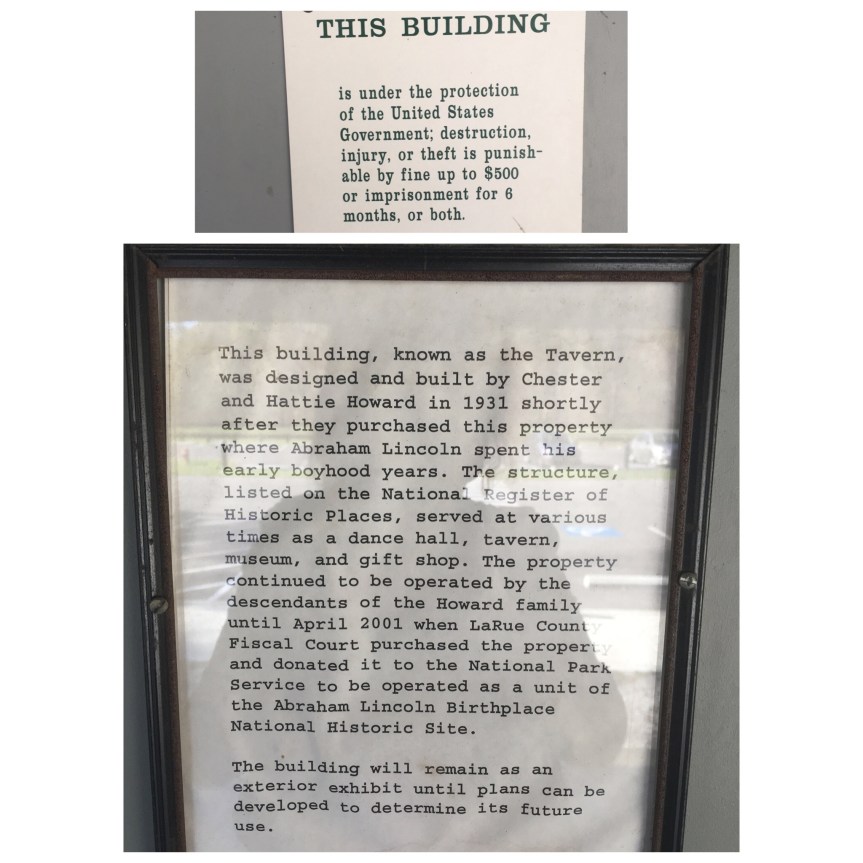
What you’ll see is a nondescript roadhouse type building that was built much later on the same property (sorry, I never bothered to take a picture of it, as it is NOT related to Lincoln) and some parking… At the time when I went to visit the building was essentially empty, but had some of these signs scattered around it explaining what it was

IMG_1545

Once you’ve parked and walked behind that front building, you’ll see this

IMG_7023

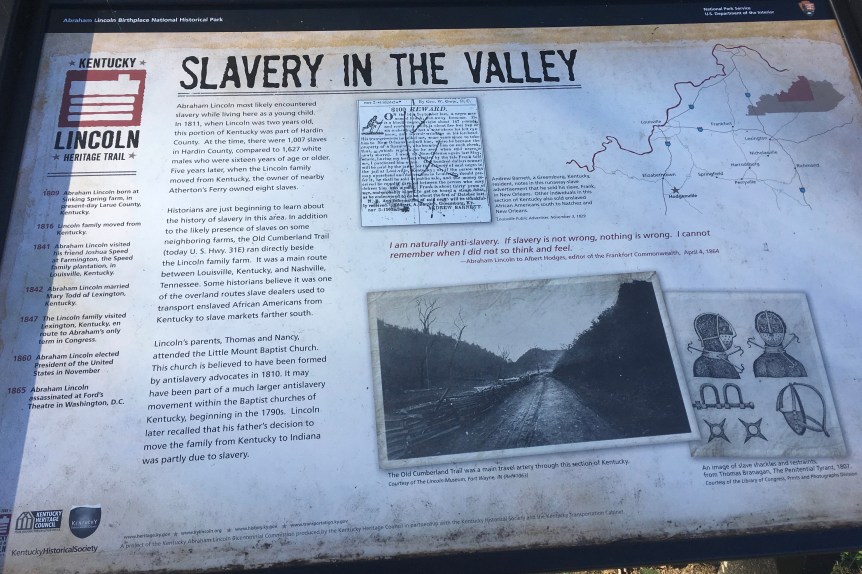
And then scattered around that are more official “tourist signs” offering information about the location.

fullsizeoutput_3eca

IMG_7026

fullsizeoutput_3ecb

IMG_7028

IMG_7027

After that you might want to consider a trip back into Hodgenville for a bite to eat, and to walk around the little museum they have there.

IMG_1541

There are TWO massive statues in the middle of town….One is very similar to, but different from the at the Lincoln Memorial in D.C.,  As I discuss in the blog post about his tomb, which I visited two years later, in Springfield, IL in 2018; one of the things I learned there from the docent giving the tour was that first statue of Lincoln that you see when you enter the tomb is NOT an exact copy of the one in the D.C., but rather a precursor to it… according to the docent, the artist, Daniel Chester French had actually presented various bronze versions of the statue, before one was chosen to be chiseled in marble, and the one in the tomb was one of them. I initially was guessing that this one here near the place of his birth was one of those other designs (because it’s almost a copy of it) …. but one should never assume, because according to Wikipedia, I was wrong…  I actually feel kind of sad for the artist of this statue, because AS a former artist myself, there’s nothing more disheartening than having a paying customer who only wants you to mimic someone else’s work.

lincolnstatueshodgenville1
Not my image, borrowed from this open source website dedicated to US presidents

Than, across the park (?) from the much older Lincoln, stands a newer smaller statue of Lincoln as the young boy he might have been when he lived here, sitting on a log, reading a book, and looking across a street to the statue of himself as an adult… almost as though he were dreaming of who he might be when he grew up. It’s really a very nice juxtaposition… and I’m guessing that artist (of the newer statue) has a lot of pride in his new creation. In fact, AS a former artist, I think the new statue sort of redeems the copycat older one.


IMG_1542
Keep in mind, when this picture was taken, Obama was still President

As is visible in the picture of the statue of the older Lincoln, behind it there is a museum dedicated to Lincoln. In fact it’s a sort of shop, really; as, it is a commercial/private enterprise rather than professionally curated museum, which is pretty obvious once you get inside. That said, I think it’s still worth looking at, especially if you have kids with you who are just learning about Lincoln.

First when you walk in there are a wide variety of art type objects related to Lincoln that are scattered pell-mell through the front rooms (like I said, NOT curated in any way shape of form)

IMG_7031.jpg

IMG_7033.jpg
One of my favorite pieces in the collection, it’s very conceptual and made with local stone

IMG_7032


IMG_7030

Two images… the first is a print where the artist has created a montage of Lincoln’s face using a variety of actual photographs taken of him, the second is an image of him made up of Lincoln pennies

Once you pass this area you enter a back section where a LOT more effort was put into creating the area. Each section is full of life-size constructed vignettes or dioramas full of antiques (authenticity or period-correctness be damned I am guessing, but again I’m not sure) with semi-realistic wax dolls, sort of like a mini Madame Tussaud‘s dedicated to Lincoln, at different points in his life

IMG_1544IMG_1543

IMG_7044

So, like I said, especially if you’re traveling with a child, and you know your history and can explain, I think the museum is definitley worth a walk through.


Is there a the connection between Lincoln logs and the log cabin Abraham Lincoln was born in? HMMMMMMMM…. a theory

I have just come up with a convoluted but not so unlikely theory regarding the invention of Lincoln logs and why they are called Lincoln logs…

So yesterday while Visiting Lincoln’s home in Springfield, IL I learned they were invented by Frank Loyd Wright’s son…

IMG_1551

Well I have been the memorial for Lincoln’s birthplace, inside of which stands a log cabin

IMG_7004

today I was wondering who were these Lincoln Farm Association folks (see the names in the photo above)…  and learned that…

According to Wikipedia:

Richard Lloyd Jones “From 1903 until 1911, he was a writer and associate editor for Collier’s Weekly, working under the publisher Robert J. Collier.[1] In 1905, Robert Collier and Jones collaborated to buy the old Abraham Lincoln farm at auction in Hodgenville, Kentucky. Then they organized a fundraising campaign to establish a historic site, which was opened during the Lincoln Centennial in 1909. The first board of trustees for the site included Jones, Jenkin Lloyd Jones [his dad]Mark TwainWilliam Jennings Bryan and President William H. Taft.[1]

AND….

Jenkin Lloyd Jones was not only a famous Unitarian minister, but was ALSO the uncle of Frank Lloyd Wright.

So what you ask?

I have been to Lincoln’s birth place, and according to both the staff member at the memorial  and Wikipedia the log cabin that is there is NOT the original, but according to this site it was — or at least the guys who made up the Lincoln Association, who were the ones that bought the building thought it was. Doing more research I found this site which sort of explains the confusion.

Apparently, in 1894 a speculator by the name of A.W. Dennett bought the farm where Lincoln had been born thinking people would want to see it, and had deconstructed a two-story log cabin found on a different part of the property, and moved its logs over to the spot where the original farm was thought to have stood (the original building had long ago been disassembled and he just assumed that this Lincoln cabin had been built using those logs). He then opened the spot for business, only no one came — because, no one was interested enough to shelp to rural Kentucky… So, as the saying goes, if you can’t bring Mohammed to the Mountain…. and at one point he added the logs from the cabin that was supposed to have been the childhood home of Jefferson Davis, the President of the Confederacy. But, with all the building and taking-apart and moving around, the Davis logs and the Lincoln logs got mixed up… so that by the time the Lincoln Farm Association got around to buying the land and the logs back from Dennett, it was anybody’s guess (by historical standards) which if any of the logs were from the original house, when they ‘rebuilt the house’ in Hodgenville.

SO, Frank Loyd Wright’s son is the cousin of the guy who started the foundation to buy up the property that had been Lincoln’s birthplace and original home which was on touring display (come see Lincoln’s cabin) both of which were owned by the same guy… oh and this guy also own the Jefferson Davis logs from his original home and would show them together… and in the South, Lincoln logs were not marketed as Lincoln logs, they were marketed as Jefferson Davis Logs… coincidence? I doubt it…


Abraham Lincoln’s birthplace; Hodgenville, KY

The Birthplace of Abraham Lincoln is located on the top of a hill just outside of Hodgenville Kentucky, in National Historical Park that safeguards both his birthplace and the first home he lived in. Other than that, there’s really not much there.

IMG_6990

Over a year ago, on Sunday Nov. 13, 2016, during one of my many road trips I had pit stopped at the birthplace of Abraham Lincoln, and for some reason COMPLETELY forgotten to blog about it. (I had been to Zachary Taylor’s Tomb the day before and THAT I had blogged about, but for some reason never did this.) I thought I had, but apparently Not so much. I didn’t realize till just yesterday, when I was blogging about his tomb and wanting to link to the post about his birthplace and wondering where the hell the blog for it had gone to … so I have decided to rectify that lapse now. That said, it’s been a LONG time since I was there, and although I’m looking back in my Facebook postings for notes, those were pretty scarce… so this post will mostly be about the pictures.

IMG_7009.jpg

So, one thing I did find in my Facebook notes from the day of my visit was that there had been NO WiFi or data accessible outside of the building (I have T-Mobile), although there was some free WiFi inside of it.

IMG_6994.jpg

Getting up to the top of the building was NOT easy for me. My legs were still very weak at this point, and all of the various ways up to the monument involved a lot of steps (handicapped accessible the place is not)….

IMG_6992

IMG_1508.JPG
The poor Dachshund belonging to these two people was not liking the steps either

Today I learned from Wikipedia that there are in fact 56 steps going up the hill, and that the number is intentional, as it was Lincoln’s age at the time of his death

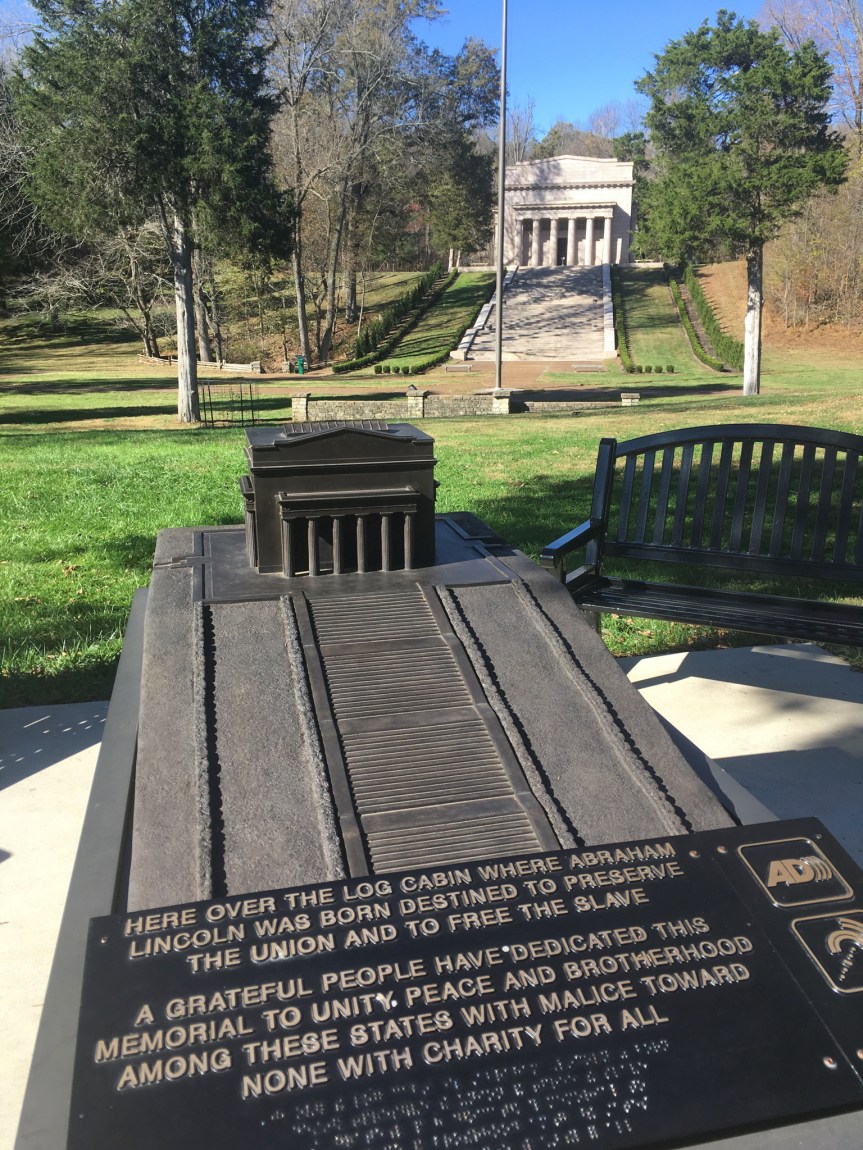
Once you got to the top you could read this dedication laid into the stone …
(only I remember at the time I was seriously wondering why almost all the R’s in it looked like P’s)

Here
over the log cabin where Abraham Lincoln was born
Destined to preserve the Union and to free the slave
A grateful people have dedicated this memorial
To unity peace and brotherhood among these states
With Malice toward none, with charity for all

IMG_7002.jpg

And when you got inside (according to my FB notes from that day) there was movie about Lincoln and his life, whose over-riding message was that “acceptance and inclusion are what makes America great”… something that had sounded particularly jarring to me at the time. (Keep in mind that Donald Trump beaten Hillary in the election for President JUST four days before, and I was in the state of Kentucky, a former slave state that had declared neutrality at the start of the Civil war, and where pro-Trump stickers and posters were common place — he won the state by 62.54%, and on that day every racist red neck in the state was still in a state of euphoria over the win).

There was a nice bronze of Lincoln’s family, when he was a tiny baby (having just been born of course)

IMG_6991.jpg

And then inside this huge structure stood what the staff member (I remember this person was particularly grumpy) told me and the other visitors was a reminder of the original house. We were like all amazed that it was the actual house and he was like, “No, it’s just a replica.”

IMG_7006.jpg

IMG_1509.JPG
You can see the cabin stands empty (no furniture), and in the bottom left the staff member who told us it wasn’t the actual home

So, while from the outside it’s a very nice looking building (there was a slab on the side of the building that gives you some of the history of the place… something about the whole thing had my hackles up… could a state that had just gone overwhelmingly Trump have actually put up a monument to Lincoln?

IMG_7004.jpg

According to this plaque on the outside of the building I still couldn’t be sure. It says that the memorial was built with funds raised by the Lincoln Farm association, the Cornerstone was laid by President Roosevelt in 1909, and it was dedicated by President Taft in 1911

However, now that I’m researching all of this I have learned that, the Association was founded in 1906 specifically to save this location, was headquartered in New York (NOT Kentucky) and included such notables as Samuel Clemens (aka, Mark Twain), Ida M. Tarbell, Robert Collier and Richard Lloyd Jones

According to Wikipedia: “From 1903 until 1911, he was a writer and associate editor for Collier’s Weekly, working under the publisher Robert J. Collier.[1] In 1905, Robert Collier and Jones collaborated to buy the old Abraham Lincoln farm at auction in Hodgenville, Kentucky. Then they organized a fundraising campaign to establish a historic site, which was opened during the Lincoln Centennial in 1909. The first board of trustees for the site included Jones, Jenkin Lloyd Jones [his dad]Mark TwainWilliam Jennings Bryan and President William H. Taft.[1]

So in other words, No, this memorial was NOT built by the state of Kentucky or even anyone who lived here.

According to both the staff member and Wikipedia the log cabin is NOT the original, but according to this site it was — or at least the guys who bought the building thought it was. Doing more research I found this site which sort of explains the confusion.

Apparently, in 1894 a speculator by the name of A.W. Dennett bought the farm where Lincoln had been born thinking people would want to see it, and had deconstructed a two-story log cabin found on a different part of the property, and moved its logs over to the spot where the original farm was thought to have stood (the original building had long ago been disassembled and he just assumed that this Lincoln cabin had been built using those logs). He then opened the spot for business, only no one came — because, no one was interested enough to shelp to rural Kentucky… So, as the saying goes, if you can’t bring Mohammed to the Mountain…. and at one point he added the logs from the cabin that was supposed to have been the childhood home of Jefferson Davis, the President of the Confederacy. But, with all the building and taking-apart and moving around, the Davis logs and the Lincoln logs got mixed up… so that by the time the Lincoln Farm Association got around to buying the land and the logs back from Dennett, it was anybody’s guess (by historical standards) which if any of the logs were from the original house, when they ‘rebuilt the house’ in Hodgenville.

So, all that said, back to the site…  At the bottom of the hill where the memorial to Lincoln’s childhood home sits, on what is known to have been the location of said home is a spring, which is still there….

IMG_1506

And worth walking down to…

Also, out by the parking lot, there is something actually pretty cool. It is a metal copy of the memorial specifically designed to allow blind people to see the memorial. Keep in mind blind people see by using the sense of touch…  Cool right? I seriously wonder why I haven’t seen more of these around the country. This would be my first.

IMG_7017


President Lincoln’s Tomb; Springfield, IL

All the presidential tomb’s I’ve seen so far have been highly impressive, and Abraham Lincoln‘s is no exception. If you’re going to Springfield, IL to do the Lincoln pilgrimage I strongly suggest it. Warning, it is really NOT walking distance from the downtown area where the rest of the tourist attractions are, it’s a good 2.5 miles away …. so you’ll need either a car, or to take the public bus (whose route does connect the Lincoln’s tomb to his house).

IMG_1558

IMG_1627

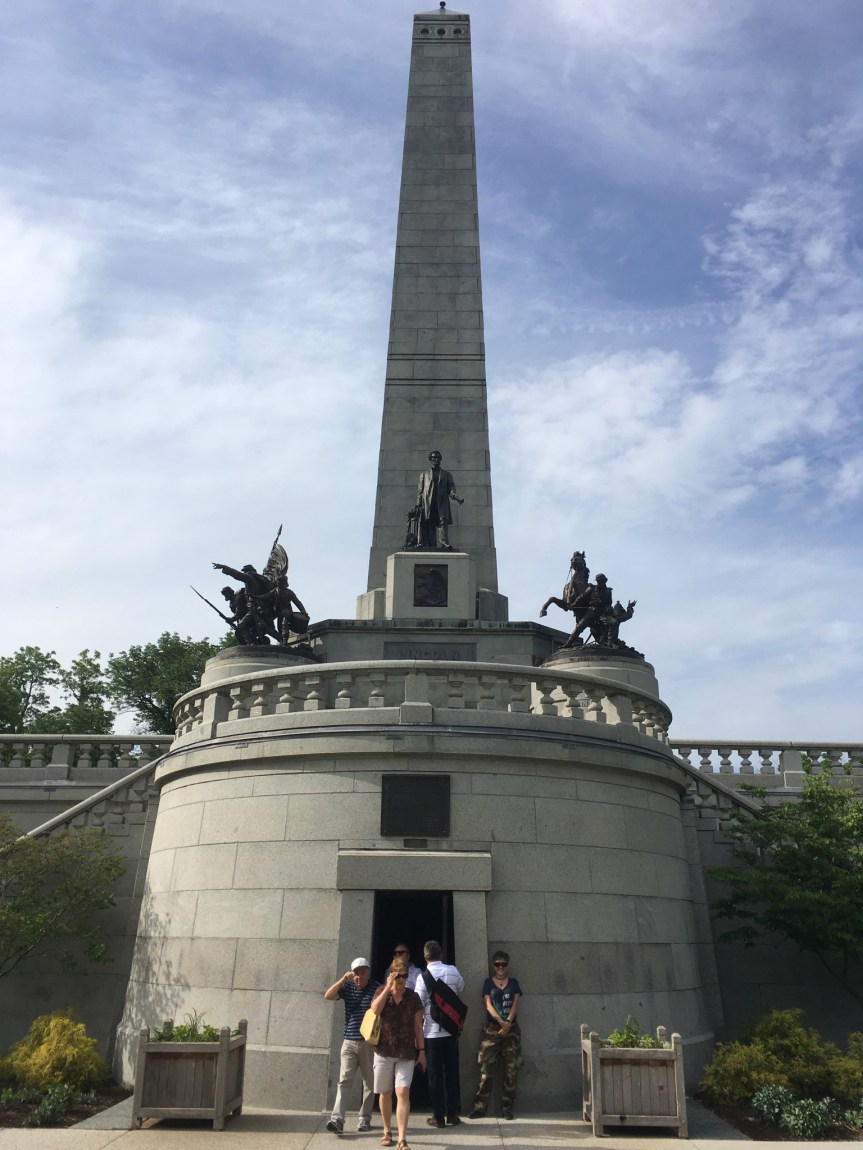
This small nondescript door is the entrance to the tomb, I was expecting something larger and grander, or to have to go up the stairs on its side to get to the upper level, but no…. apparently not


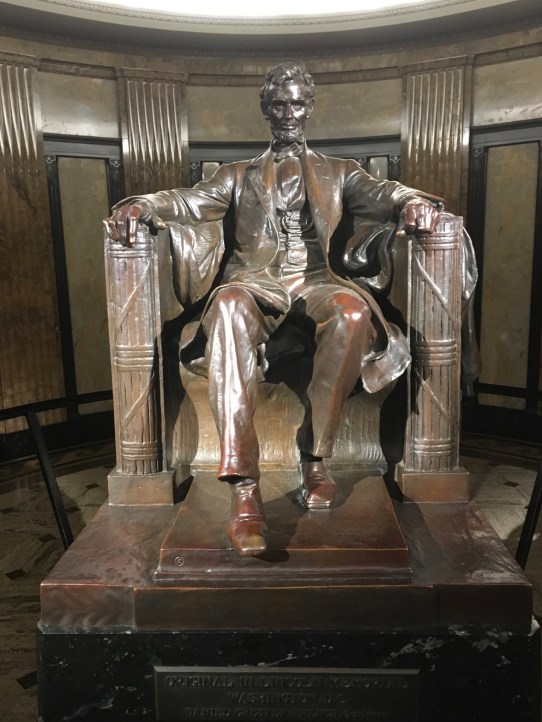
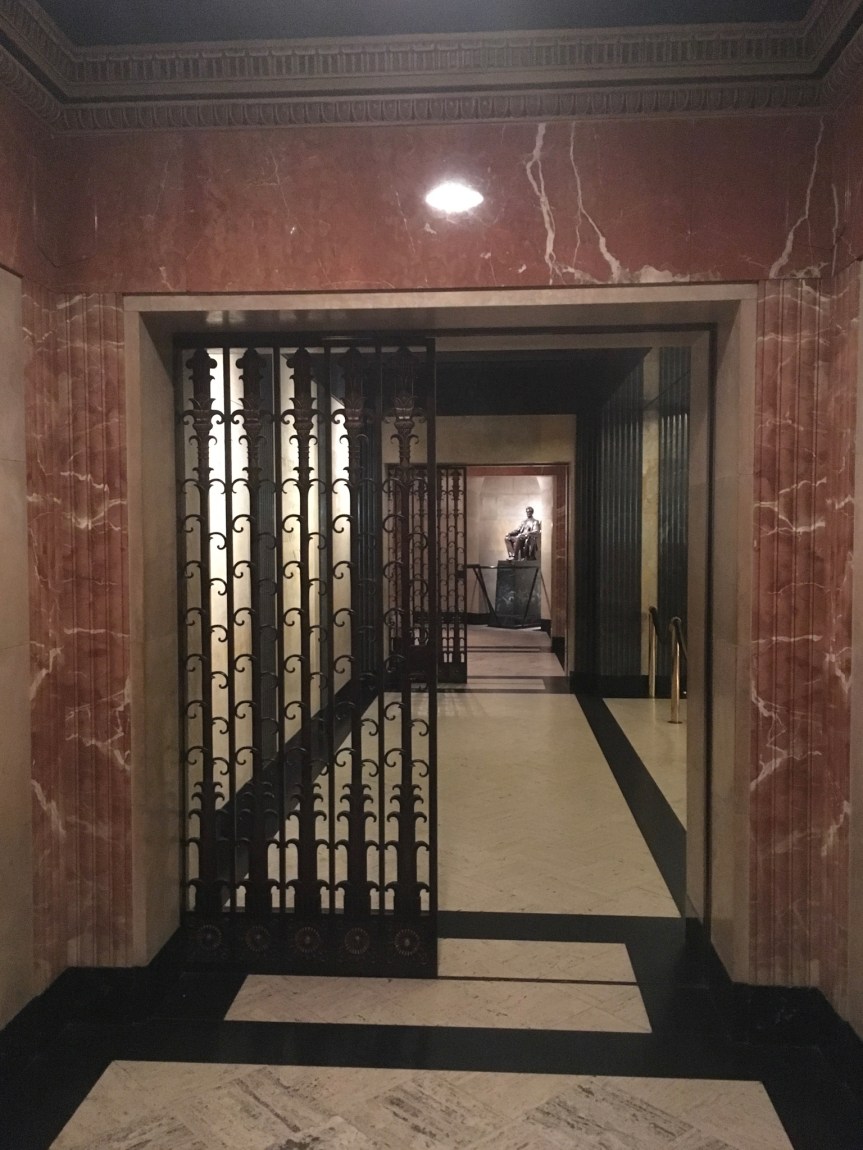
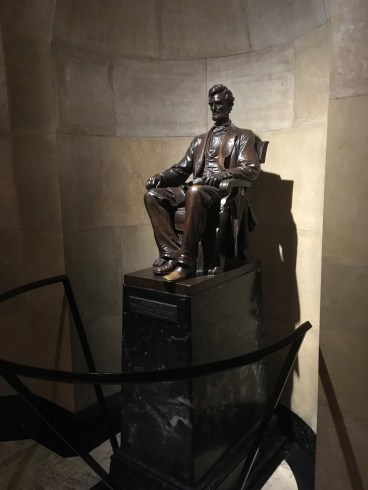
As soon as you enter you see a smaller bronze version of the famous Lincoln Memorial statue from D.C.. You then go through the doorway on the right, taking a circular path back to the crypt, and then keep going until you come back out via the doorway on the left (like the two people in the picture below)

IMG_1561

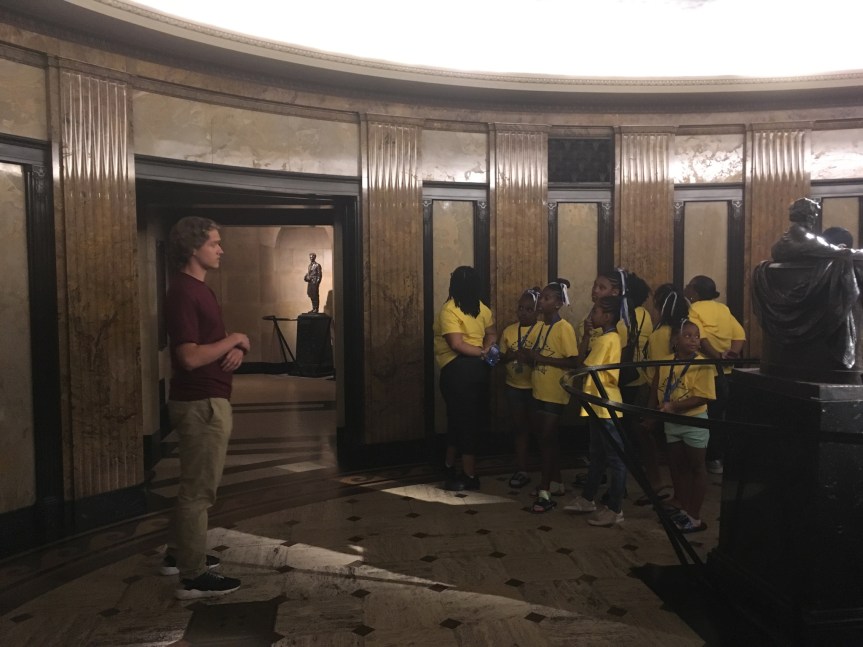
I got lucky, and right after I had walked through the whole monument on my own and was getting ready to leave, a school group came in, so the docent (he looked to be in his early 20’s), who had entirely ignored me, got up and started sharing information. So I stuck around and did it a second time, this time with a guide.

IMG_1603

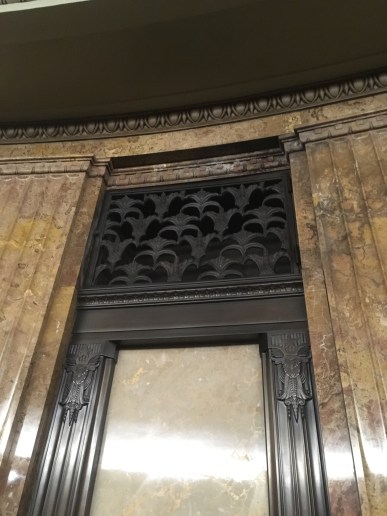
Things I learned: Firstly, there are 36 sets of the sort of caramel colored vertical design elements surrounding the room, representing the number of states in the union when Lincoln died; Secondly, the ceiling of the room is made of some sort of metal (platinum or something of the sort) that at the time of the building was more valuable than gold, and thirdly… the air conditioning vents are covered with wheat like designs, to represent the fields of the area (what is now the midwest)

IMG_1604

Most interestingly I thought, the statue of Lincoln is not a copy of the one in D.C., but rather a precursor to it… according to the docent, the artist, Daniel Chester French had actually presented various bronze versions of the statue, before one was chosen to be chiseled in marble, and this was one of them.

IMG_1562

As soon as I came in I had mentioned to him (before the school kids arrived) how I love that Lincoln has fasces below each of his hands. When the school children arrived he pointed them out, and I asked if I could add something (I looked at the teacher and said, “I’m a former teacher, she nodded her permission”), and I then told the students about how if you take a toothpick and break it, it’s easy to do. If you take a bunch of toothpicks and hold them together like the sticks in a fasces and try to break it, it’s MUCH harder to do. And then, if you then compare how hard it is to break that fasces made of 4 or 5 toothpicks with how hard it is to break a stick of the same width, you also find that it is HARDER to break the fasces than the stick. It’s physics, but it also represents an idea, that we are stronger as a union; that the total is greater than the sum of its parts. (I sware to G-d I saw tears come to the eyes of one of the teachers. She then came and thanked me. I’m guessing there’s a back story that I don’t know, but it was nice.)

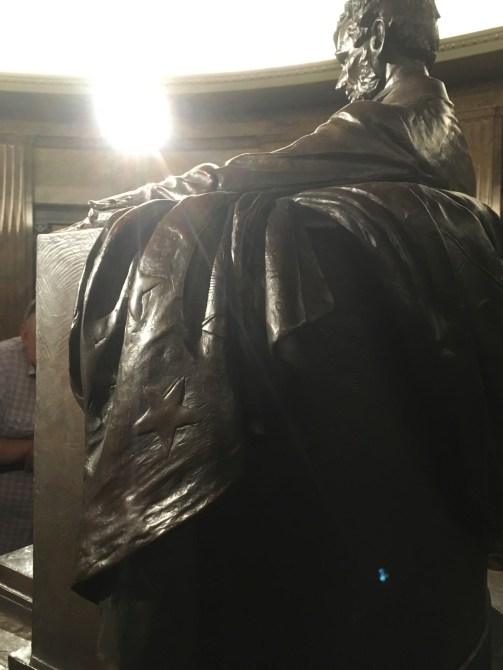
Also, according to the docent, if you go to the lincoln memorial in D.C. something you really can’t see is the back of the marble statue, and as such one important symbolic element of the piece is lost… Lincoln is sitting on an American flag.

IMG_1608

According to him, this was not intended to be disrespectful, but rather a manifestation of his fierce resolve to not allow the flag, with a star for every state, to be torn apart. I.e., by sitting on it, Lincoln is protecting it.

After viewing the statue, you then follow this sign into the pathway to the right

IMG_1565

IMG_1566

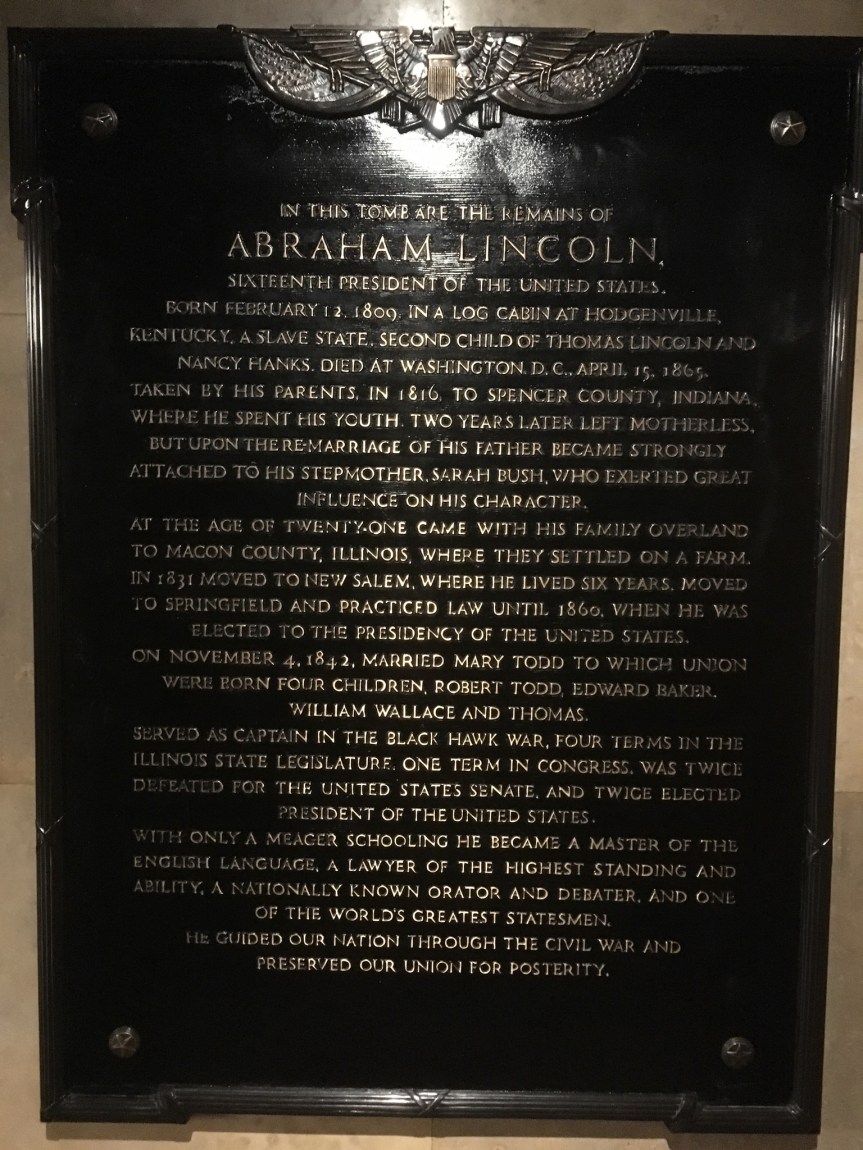
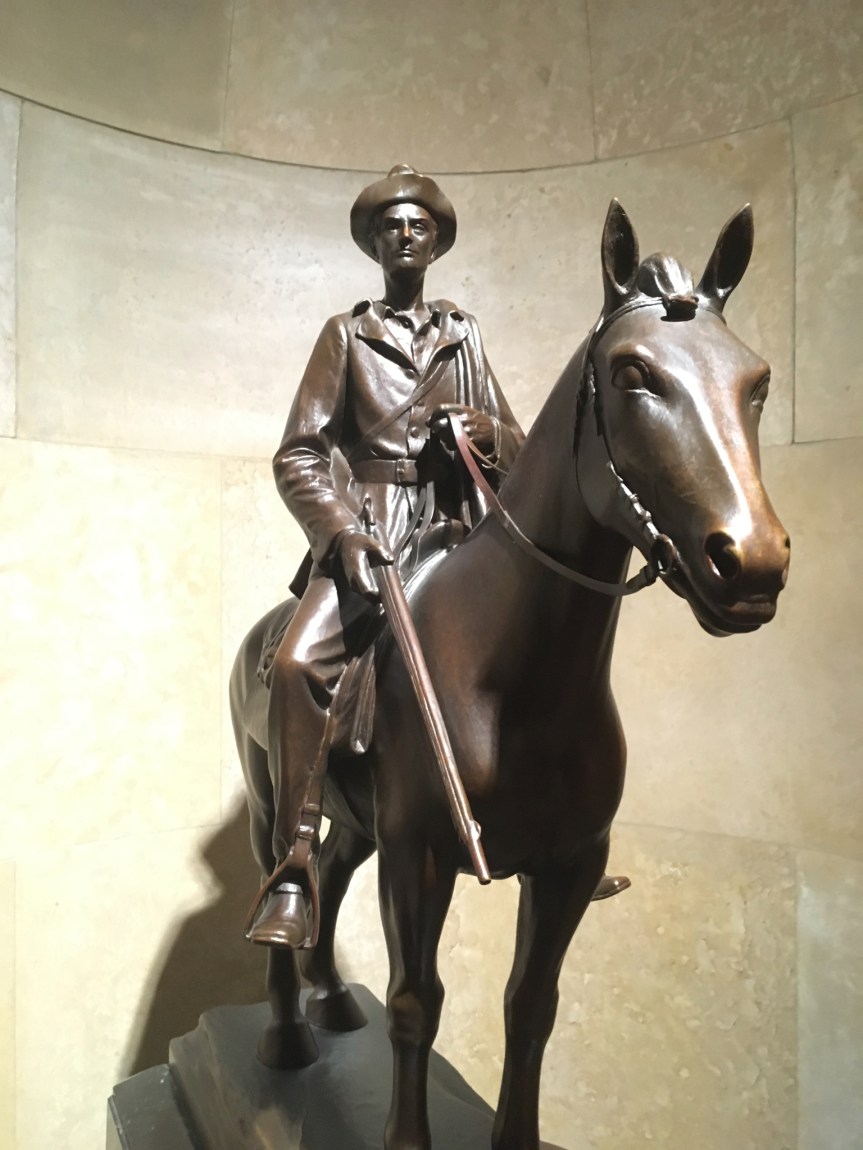
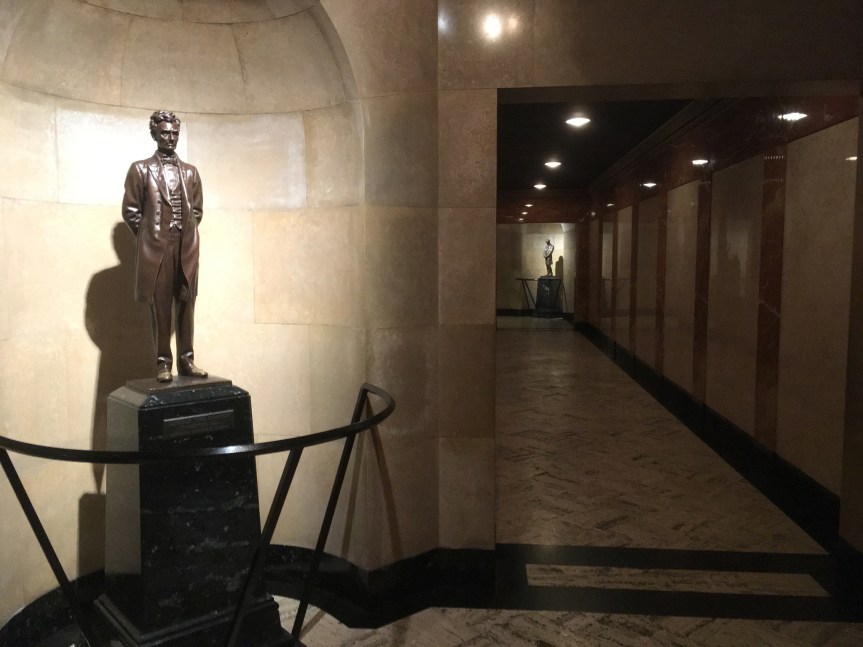
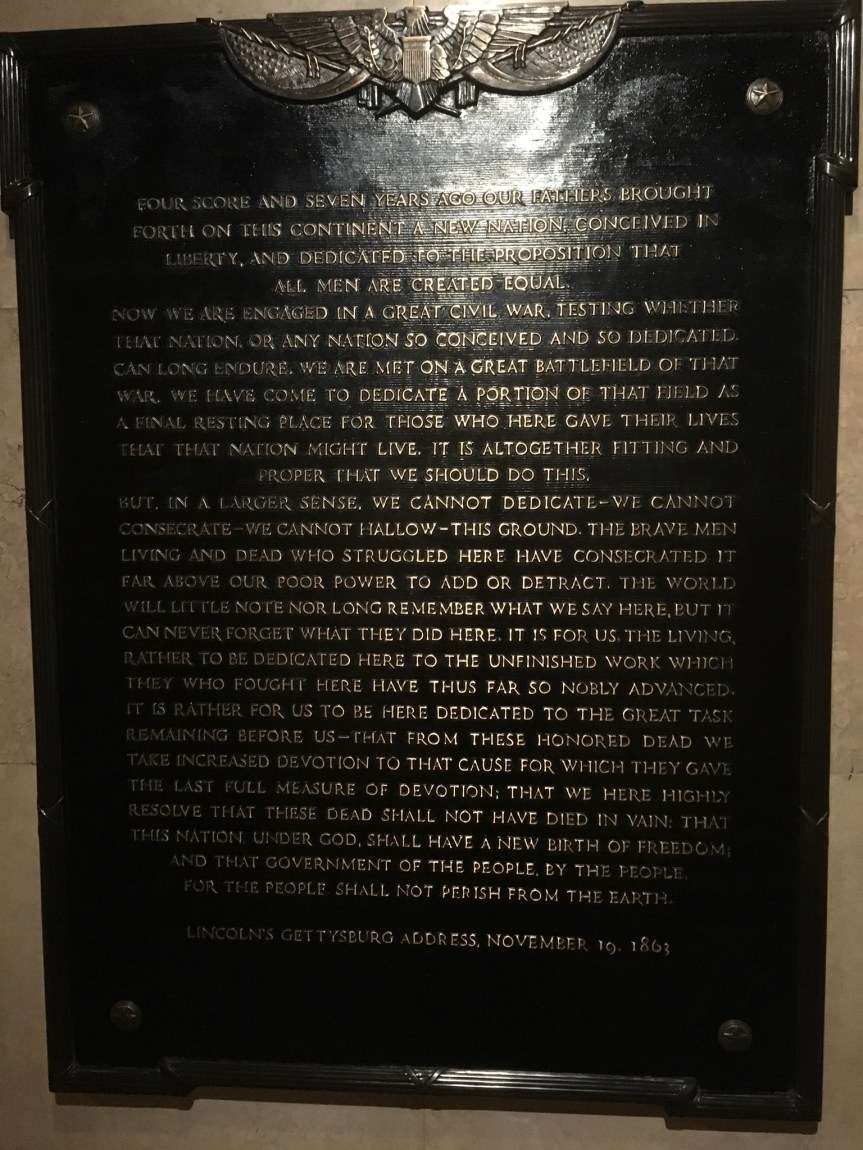
Along the path are black panels like the one above, and a whole series of Bronzes of Lincoln depicting him at various ages and stages of his life in sets of two, standing across from each other at various bends along the circular path


So the images above and below are of statues located right across from each other, and show him as a young adult starting his career, probably as he might have looked upon first arriving in Springfield.

IMG_1568

While the bronze below which was further along the path is him as president, and we know this because he was clean-shaven up until he shortly before he became President until convinced by a letter written by a 12-year-old girl convinced him to grow it:

Dear Sir
My father has just home from the fair and brought home your picture and Mr. Hamlin’s. I am a little girl only 11 years old, but want you should be President of the United States very much so I hope you wont think me very bold to write to such a great man as you are. Have you any little girls about as large as I am if so give them my love and tell her to write to me if you cannot answer this letter. I have yet got four brothers and part of them will vote for you any way and if you let your whiskers grow I will try and get the rest of them to vote for you you would look a great deal better for your face is so thin. All the ladies like whiskers and they would tease their husbands to vote for you and then you would be President. My father is going to vote for you and if I was a man I would vote for you to [sic] but I will try to get every one to vote for you that I can I think that rail fence around your picture makes it look very pretty I have got a little baby sister she is nine weeks old and is just as cunning as can be. When you direct your letter direct to Grace Bedell Westfield Chautauqua County New York.
I must not write any more answer this letter right off Good bye
Grace Bedell

IMG_1572

IMG_1591

IMG_1593

IMG_1598

After these statues you finally arrive at the crypt, which has more of those black panels on either side, only these have some of his best known speeches:

IMG_1576

IMG_1621

The guide basically told us what was written on the sign that was right next to him (read below) adding a few the facts, namely that the ceiling above the crypt was lined with 18k gold, and the reason the President was 10 feet down instead of six, and was also encased in concrete (which the sign didn’t say) was that between his burial and the completion of the tomb, there had been an attempted theft for ransom of Lincoln’s body

IMG_1584

IMG_1579

And then, after pointing out all the flags mentioned in the sign and describing their meaning. He asked us, “Do you know where Licoln was born?” … total silence till a teacher said, “Kentucky” and he pointed to that flag; Then he asked the room, “does anyone know which state he lived in after Kentucky but before Illinois?” again silence, and the teachers didn’t appear to know, so I said, “Indiana” and he said “right”; and then  he held out the Flag of the President of the United States that according to him, was placed there in order to represent not only Lincoln, but also all the Presidents since him who had come to visit the Tomb….

IMG_1615

He said he ‘thought’ that President Reagan might have been the one to have added it to the collection when he came to visit, but said he wasn’t actually sure which president had done it, so not to hold him to that

IMG_1589

And then he noted that on “the wall behind you”, just as the sign had said, there are the crypts of Mary Todd Lincoln and most of her sons, excluding Robert, who was buried in Arlington Cemetary (he was a veteran of the Civil War) … at which point I quietly added to the adults standing by me what I had learned about Robert from my visit to Mary Todd’s family home in May of 2016, about what an asshole he was and how he had tried to get control of her money.

IMG_1617


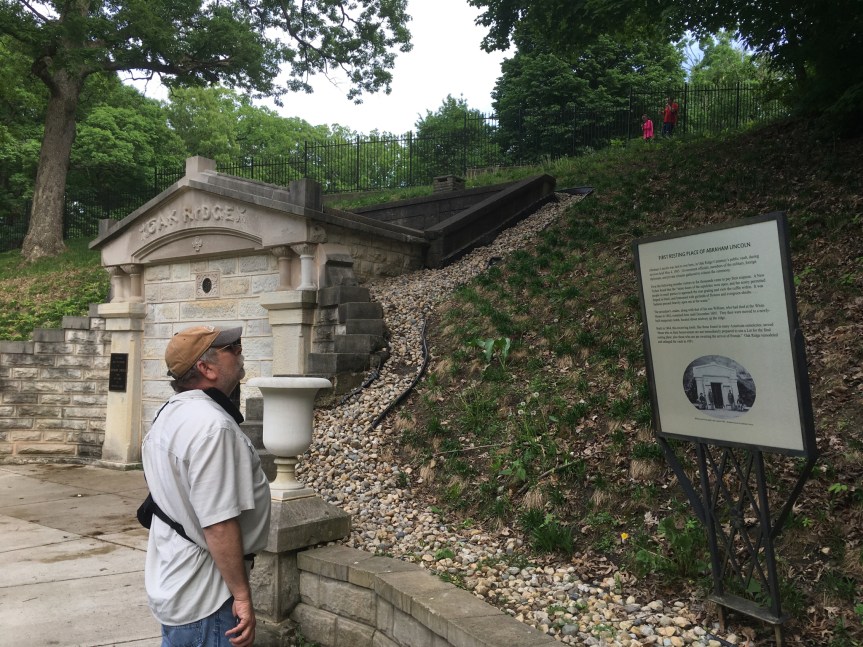
When I was finally leaving the tomb, I passed the manager of the younger guy who had been giving the tour and asked him if there was anything else in the graveyard I should see before leaving… he said that there was in fact a second tomb, where Lincoln had been buried the first time. That this was the second burial location (Lincoln died in 1865 and his body was moved around a few times — read the history of the Tomb until it reached it’s final resting place about 10 years later.) So this manager said I could take a walking path, that he pointed out, around to the back of the tomb and then go down a staircase of, I think he said 55 steps (!!!) to the bottom. (see the photo below, take from the bottom of said steps)

IMG_1650

Now, with my horrible balance, bad knees, weak legs, and a general level of out of shapedness (yes I know, that’s not a word), … So I just gave him a sort of a ‘look’ which I guess clearly communicated to him that this was probably not going to happen… so he said, “OR, you could get into your car, and as you exit the parking lot take a right hand turn, then another — you’ll see signs, and the road will wind down to the back of the monument where you can see it from your car…. So that’s what I did.

IMG_1635

IMG_1634

IMG_1642


So I have now been to Lincoln’s birth place and his home in Springfield, and Tomb…


Abraham Lincoln’s home in Springfield, IL

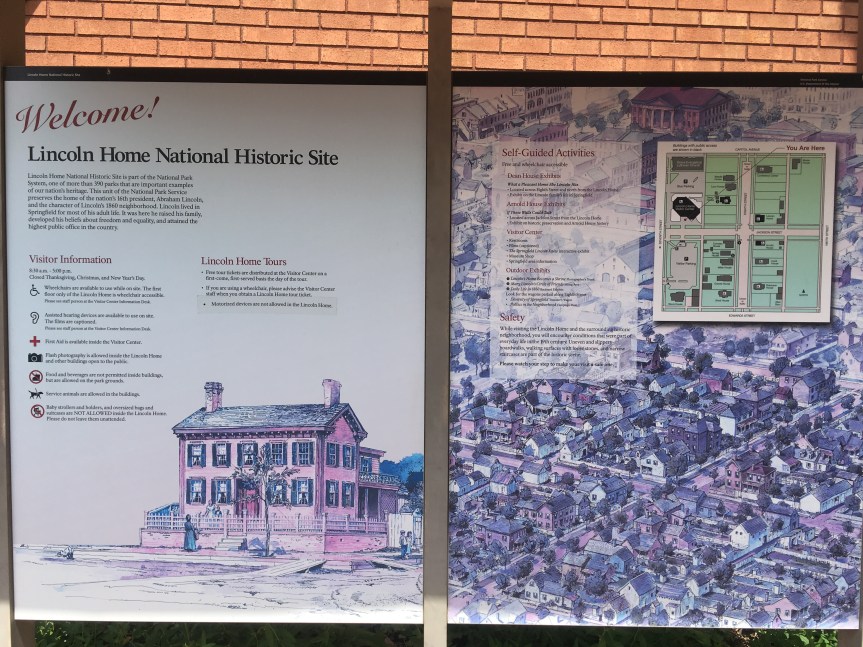
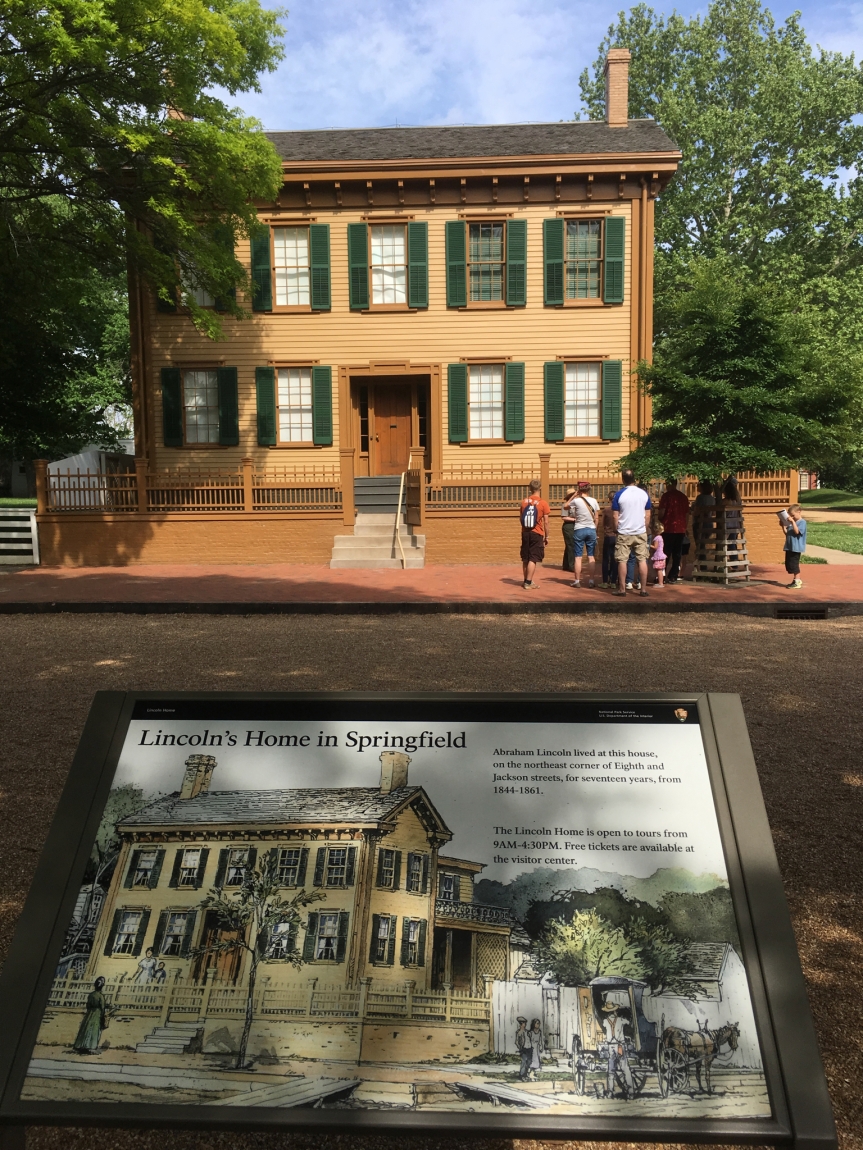
The Abraham Lincoln Home (the only home he ever owned) is a national historic site in Springfield, IL, and a must see for anyone from the state (see below), or anyone interested in his life. It is actually a preserved district that allows you to see his neighborhood as he would have, and contains: a visitors center, his home, and collection of preserved neighbors’ homes that surrounded his (although only the interiors of a few of those homes are accessible, and those constitute more museum space, than presenting them as they were) ….  Entrance is free to the public … i.e., your tax dollars at work.

IMG_1386.JPG

To preface this, I was born and raised in Illinois, I am in my early 50’s and this is the FIRST time I have been to my state’s capital, Springfield, IL. SERIOUSLY! Everyone else in my school went on the Springfield class trip, but not me. I didn’t get to go on the Washington, D.C., school trip either. My parents always complained that the cost was too high and that they’d take me, but they never did. It’s kind of embarrassing.

IMG_1527.jpg

The first thing to know is IF you drive your car, be warned, the parking lot on the property will charge you $2 an hour (in leu of an entrance fee), and you have to tell them how many hours you want to stay there and then put the receipt on your car’s window or be ticketed. That said, IF you come on a weekend street parking is free (not weekdays), and I came on a Saturday, and had no trouble at all find a spot no more than a block away from the site. Also, are a handful of covered parking lots not more than a block or two away, and the one I found (1 block away) was only $1/hour, with a maximum charge of $5 for the whole day, but you must have exact cash (which I didn’t) and it didn’t take credit cards.

IMG_1387.jpg

After you park, you head into the visitor’s center (this is where you pay for your parking if you used their lot), and ask for your free ticket for a tour of the house. I asked them why there was no fee (Andrew Jackson’s home in Nashville for instance was NOT free… nor was the childhood home of Mrs. Lincoln in Lexington, KY). And they said, IN UNISON, a spiel about how “Robert Todd Lincoln donated the family home… under the condition that it would forever be well maintained and open to the public at no charge” (while putting together this blog I found it pretty much word for word on the Wikipedia site). The Tours start every few minutes and the tickets are just to keep the groups at manageable numbers.
IMG_1390

That said, I told the staff member how just a few days ago I was at the Hermitage, the home of Andrew Jackson, and how they managed the same feat simply by setting up some chairs, and only allowing in at one time as many people as could comfortably sit in those chairs… a practice that is much greener, i.e., would save a lot paper.

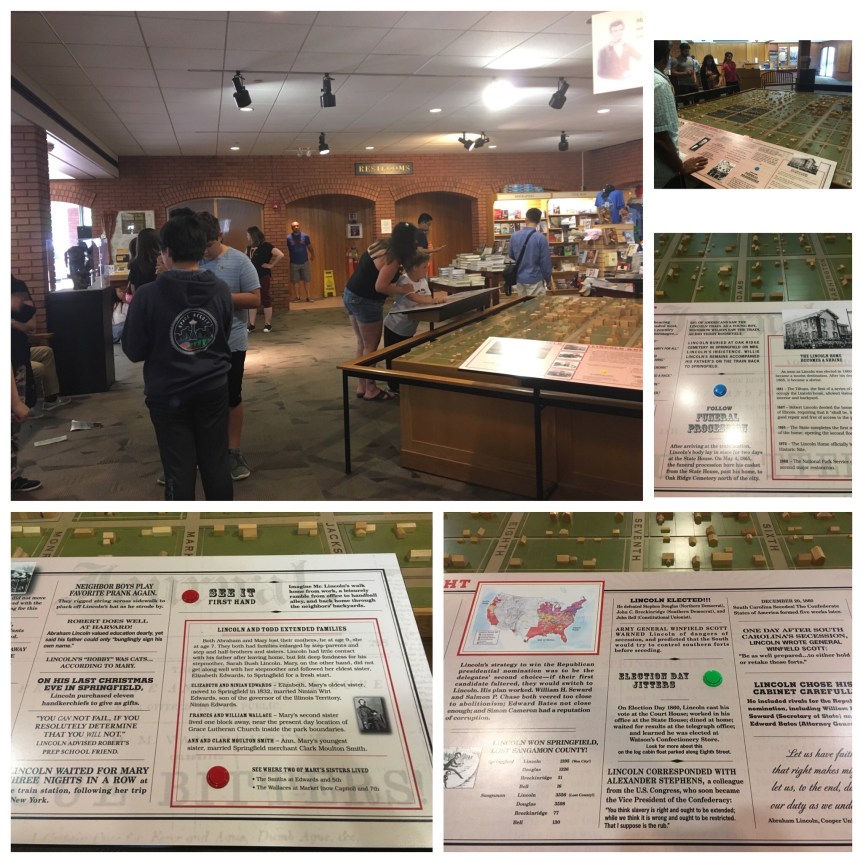
Inside the visitor’s center there is a massive map of the historic district, with displays around the edges where you can press button to light up various houses or routes, with explanations of what it is that’s lit up.

IMG_1668.JPGThere’s also a movie on the history of Lincoln, and about his relationship to the historic site and the Civil war ………..
IMG_1410.jpg
……….which offers an overly simplistic view of the man; it’s what I like to refer to as the middle school version of Lincoln, the one that says he was against slavery (full stop).

[Begin rant] The reality is a lot more complex. Lincoln really didn’t like slavery, he thought it was a bad institution, and he wanted to contain it (keep it from spreading to new states)… but he never said he wanted to end it (He thought that would happen naturally) … At least that was his stance until the realities of the fact that Union was essentially losing the war and house might in fact become divided drove him to it.

Lincoln’s House Divided Speech made before he became President was actually very specific, but few folks bother to really pay attention to it:

“A house divided against itself, cannot stand. I believe this government cannot endure, permanently, half slave and half free. I do not expect the Union to be dissolved — I do not expect the house to fall — but I do expect it will cease to be divided. It will become all one thing or all the other. Either the opponents of slavery will arrest the further spread of it, and place it where the public mind shall rest in the belief that it is in the course of ultimate extinction; or its advocates will push it forward, till it shall become lawful in all the States, old as well as new — North as well as South.”

So he was sure the Union would have to go one way or the other, all slave or all free, and he was very worried that it go all slave. That he could not abide.

In addition if you actually read the Emancipation Proclamation, which “freed the slaves” it actually doesn’t. It says any Confederate state that doesn’t end its rebellion by January 1, 1863 would lose the right to own slaves … which by default means that if the state DID end it’s rebellion, they could continue to own them… and by extension, the three slave states that had not rebelled, including Kentucky where he was born, could continue to own their slaves (at least until the 13th amendment was passed). AND, by doing so Lincoln ensured that the French and the British, would not come to the Confederacies aid (from whom both countries bought a lot of cotton) …. The British had publicly declared their support of the South’s right to secede. Keep in mind America pretty much owes its independence to French intervention in the our rebellion from the British.
… P.S., putting aside the whole slavery issue….  to this day lawyers STILL debate whether the South was within it’s right to secede from the Union, and very few believe Lincoln’s arguments for why they did not have the right were airtight (and most of them think Lincoln, who was a really good lawyer, knew it).
[End rant]

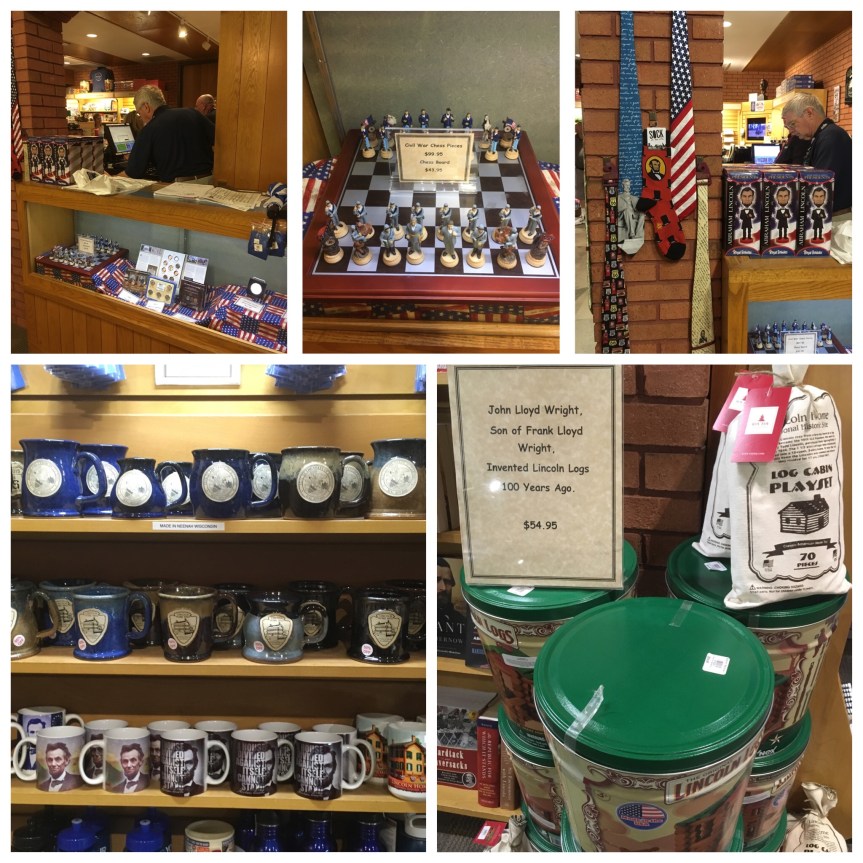
In addition to the movie and the interactive map the visitor’s center has a really good gift shop with a large selection of goodies

IMG_1671
Learning that Frank Loyd Wright’s son invented Lincoln logs led to a massive brain fart on my part that I blogged about (read here, it’s actually interesting I think)

And of course there a very large book selection about Lincoln and the Civil War (both written and recorded formats) … I bought a few of these useful things called BottleEze (they had them with Lincoln’s home printed on the sides) where you clip one end around the neck of your water bottle, and stick the other over your pants waistband, or in a tight pocket,

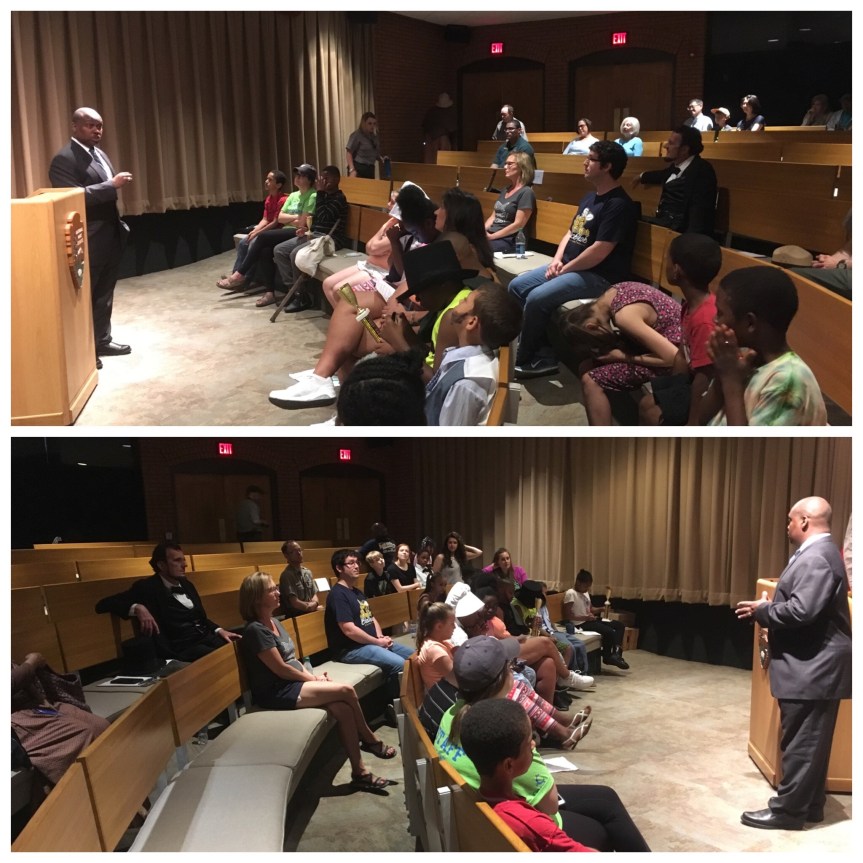
From time to time (you need to check their schedules) the historic site does special things, living history demonstrations. I was lucky enough to stumble onto one. The woman at the front desk told me that in the lecture room (adjacent to the movie theater) I would find Abraham Lincoln…. so I opened the door to find…

IMG_1669Martin Luther king talking to Abraham Lincoln and Harriet Tubman— apparently this is a regular event for the kids (who get to draw fake beards on to their faces before it starts).
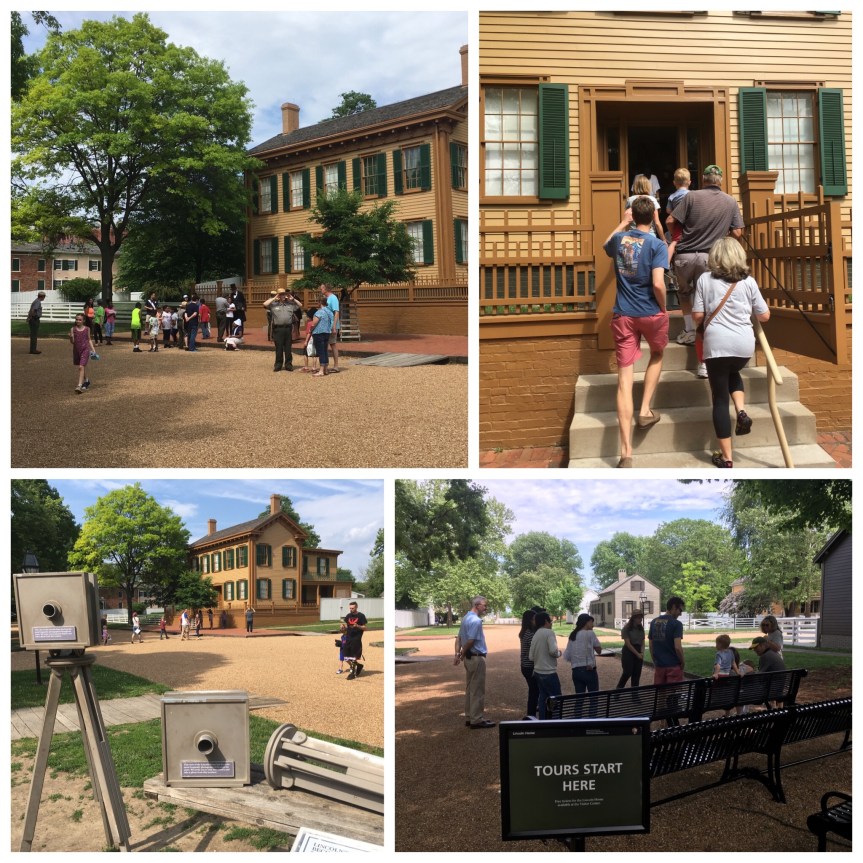
I only stayed for a little bit because it was about time for tour to start (and you are supposed to be there five minutes before the start time.

IMG_1670

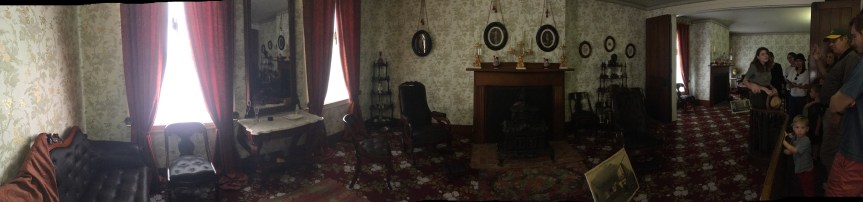
This was the first room we entered, the Lincoln’s divided living room area (there are big wooden doors that can be closed in the middle, if he needed to speak with visitors)

IMG_1424

IMG_1672.JPGOne of the things I learned, while listening to the tour guide gave us her introduction, wa that today is the anniversary of Lincoln being asked to run, in this room. The shelves against the living room wall are called apparently called whatnots — and I own some — they’re tucked away in storage till I settle down; my parents had a few of them, almost identical to these, and till today I never knew they had a specific name. (Last time I got this excited about a piece of furniture was when I visited Elvis’ kitchen Graceland and he had almost exactly the same interior design for his kitchen, down to the same brands of ovens and stoves).

That said, I asked the tour guide if in fact Mrs. Lincoln kept a bust of her husbands head in pride of place at the top of the whatnot… she smiled and said that it seems she did. When Lincoln was running for President a bust was made of his head and mass-produced for sale, and Mrs Lincoln is known to have displayed it in the living room. To which I said, “like a proud mama.” The tour guide agreed.

IMG_1440.jpg

This is the closest I will ever get to touching Abraham Lincoln. These banisters are original to the house.

This site gives you a good overview of the interior of the house

That said, according to the tour guide, very little of what’s in the house is actually original, although she pointed out to us every item that was. I found this one document which I think says the entire sum of original objects in the house is 48. The rest of the furniture pieces are similar or identical to things the Lincolns were thought to have owned, based on sketches that had been made of the rooms, or original items held in private collections. If you search on the internet you can see that the sale of Park passes, and the $2/hour parking fees are being used to slowly buy up bits and pieces of the Lincoln’s possessions from private collectors to return to the house.

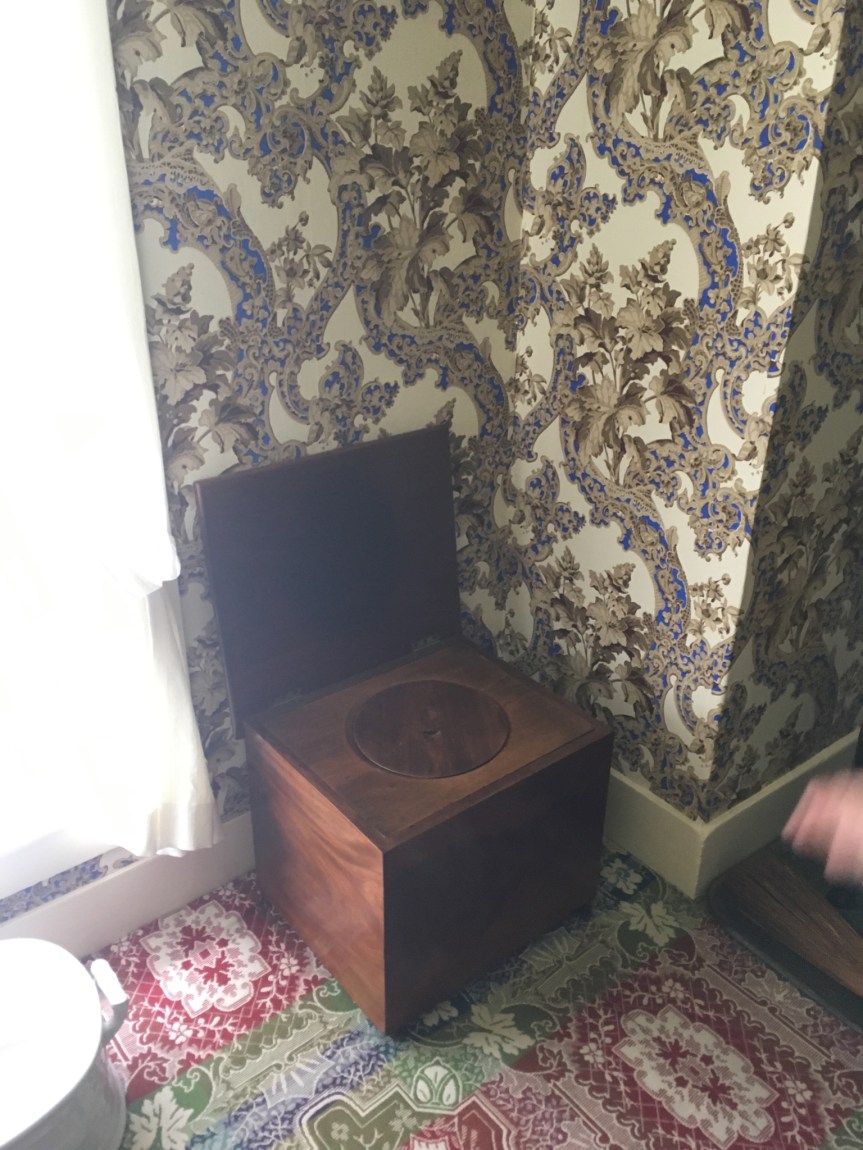
That said, one original item that they were able to obtain, according to the tour guide, was Mary Lincolns personal toilet … oh and apparently the Lincolns slept in adjoining but separate bedrooms. (No, I’m not going to go there)
IMG_1460.jpg
After viewing the house, I walked around the “neighborhood” making a point of stepping into any of the houses that were open for viewing, and reading the various informational signs scattered along the gravel road.
IMG_1487.jpg
The contents of each of the open homes had a different focus… sort of like rooms in a museum, with each house constituting a museum room.
IMG_1673
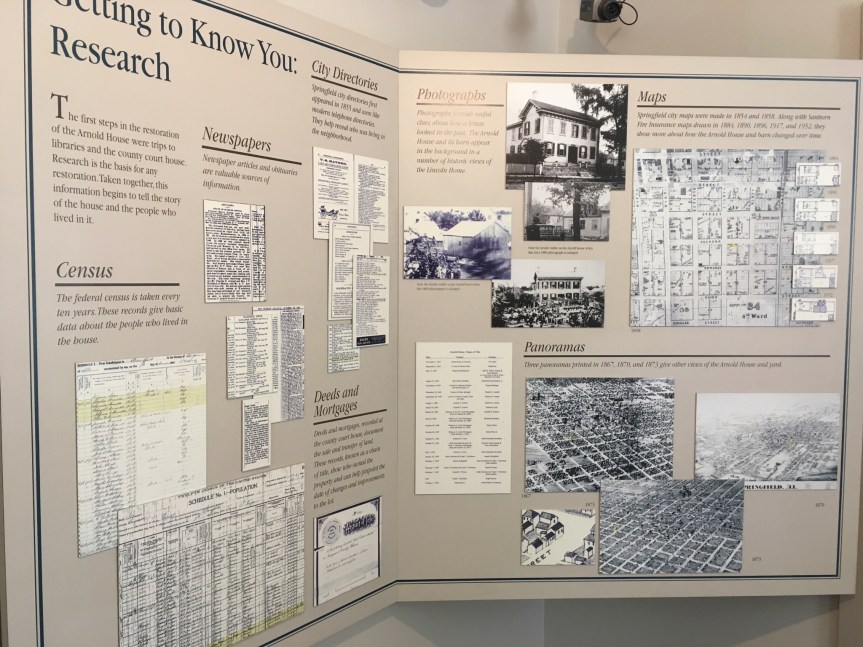
This house focused on the various families who lived in the neighborhood and shared some information about each of them, how we know what we know (the evidence), and items found during excavations, etc.
IMG_1493
While this next house focused on what was involved in restoring this heritage homes NOT to meet modern standards but to re-create the historic ones, historic building techniques, etc.
IMG_1674
This open corner shows the exposed walls, as originally built, with buttons you could push that would create red laser dots of light on the topic being discussed… in this case, she’s pushing on the button for the Nails… and there’s a red dot on one of the nail heads. (As luck would have it the woman standing there’s father had been a builder so she was all excited about it and telling me stuff)
Another of the walk through homes, the between the lincoln home and the visitor’s center, had a detailed display talking about who the Lincoln’s bought their home from and for how much; and how when the they first bought it, it was only a story and a half (a great starter home for a young married couple); but then, as Lincoln became successful and influential, they remodeled it, taking off the roof and expanding it to two floors, etc. (not going to bother posting pictures of it)
IMG_1495
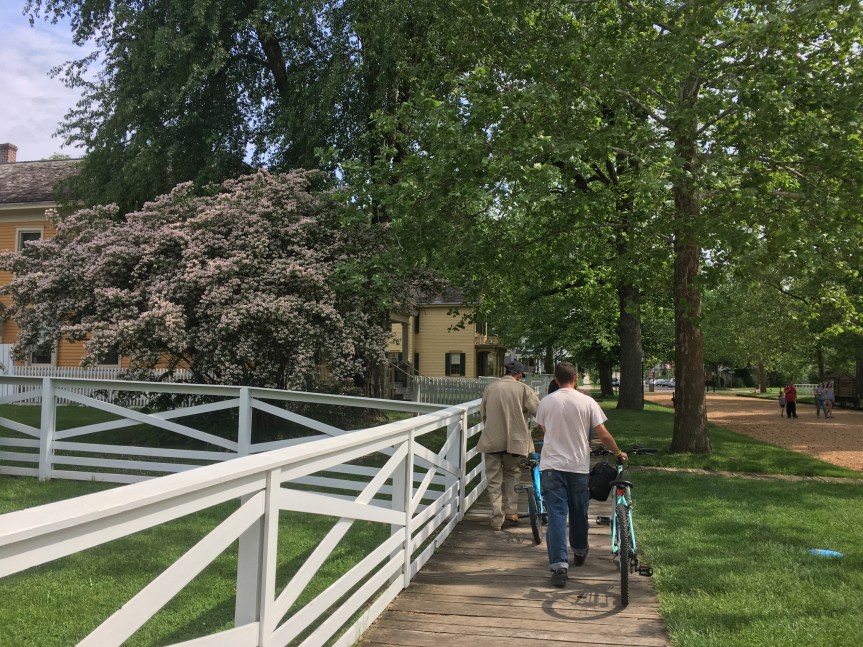
Walking around the neighborhood, it is a very pretty shaded lane, and I found that locals take advantage of it.
Most of the houses you could NOT walk inside of came instead with these interactive options, where you call a number and then listen to a description.
If you want a listen to it call:   +1 (217) 213- 3003   and then press 50#
IMG_1678.JPG
According to this guide, Springfield at the time of Lincoln’s having lived here was a fairly diverse population, with a large recent immigrant population which included quite a few African-Americans affluent enough to afford their own homes. (apparently, if you come with a group of children — or 15 or more adults, you can pre-arrange to have a park ranger guide you around)
IMG_1498
For instance, this currently empty plot (before the yellow house) is just a few houses away from Lincoln’s home and used to contain two homes — both of which were owned by a Mr. Jenkins, one of Springfield’s African-American residents (the 2nd home was for his sister). He was fairly prosperous (obviously) and was involved in the “trucking” industry, moving goods around the country.
Both the tour guid and recorded guide point out that he was on good terms with the Lincolns and transported them and their goods to the train station when they needed to move to Washington.
IMG_1499.jpg
The reflections on the glass made all my other shots utterly unreadable
That said, there’s also strong evidence that his home and his wagons were all part of the underground railway
To hear about all the details, call +1 (217) 213 – 3003 and then press 51#
fullsizeoutput_3ee7.jpeg
According to the guide this was one of the his wagons, and if you look carefully you can see air holes have been strategically drilled into the boxes
But for something REALLY cool, look below!!!
IMG_1502
Since in this case there was no home at the site (I’m going to take a guess that once the entire “district” and not just the Lincoln home, became a national park in 1971… and was turned into what is essentially an outdoor museum, that all of homes on the property that were not original to the Lincoln’s time period were removed. AS Jenkins’ home was a historically important one, the park service has gone to the effort of creating an artificial Reality tour using a freely available app, which is really kind of cool if you think about it. (I did find it in Apple’s app store, and tested it. IT WILL WORK, if you have your smart phone look at the picture above!!)
Another cool thing was how the locals take advantage of property. I kept seeing folks walking around in twos and staring at their smart phones, my brain went, Pokémon!! And I was right. They told me that the local bar was having a fundraising event that involved playing the game, and that as EVERY home and object had historic importance the park was a very rich Pokemon playing ground for the locals.
IMG_1676
The bar in question is less than a block away from the park’s visiter center (sort of kiddy corner from it) and there is a coffee-house, bar and restaurant, each in a separate house but all owned by the same people,  — I had eaten at the coffee-house, Wm. Van’s Coffee House, already that day. I’d had an avocado and tomato on whole wheat toast with an iced coffee before going to the Lincoln’s home. (You’d think that would be hard to screw up, but they used some sort of pureed and watered down avocado spread… kind of tasted like the stuff sold in plastic bags at supermarkets … instead of just spreading the real stuff)
IMG_1381
and was intending to hit the restaurant for dinner, so when they mentioned the bar’s name I knew which one they meant …
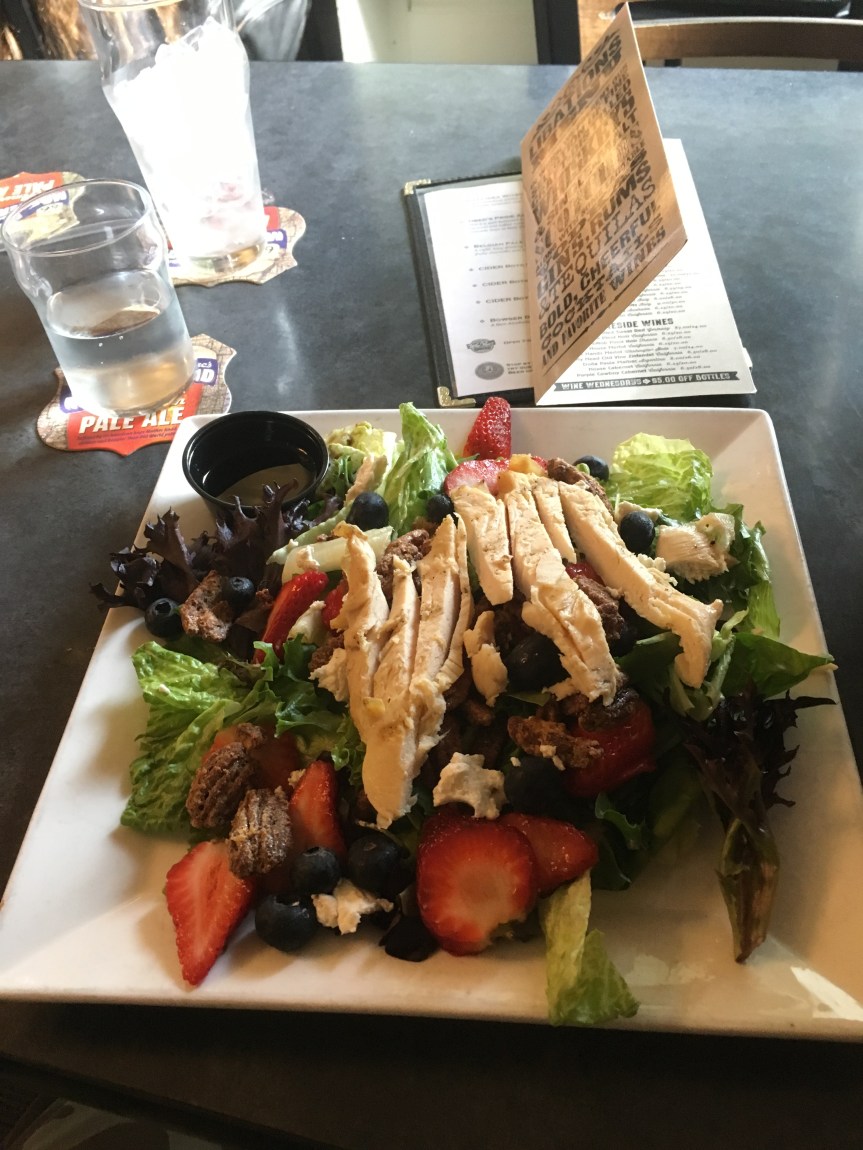
That said, Obed and Isaac’s Microbrewery & Eatery, was supposedly the best place in town. When I got there, I found the menu mostly consisted of unhealthy choices, everything deep-fried with a lot of carbs, etc … As a rule, anyplace that does the unholy triumvirate of salt, fat and sugar can make food that tastes good… it’s making healthy food tasty that requires skill.
I ended up defaulting to a grilled chicken & berry salad with blueberries, strawberries, candied pecans and goat cheese … and I had them substitute straight balsamic for the vinaigrette (i.e., it didn’t need more oil… the cheese, chicken and pecans already provided enough)
IMG_1651
 

A visit to the Hermitage: Andrew Jackson’s home in Nashville, TN

The Hermitage is the home of Andrew Jackson, America’s seventh (from 1829 to 1837, he served two terms) President of the United States, and possibly one of our most controversial ones. To put it in a modern context, Trump is a big fan of Andrew Jackson, and a lot of people compare the two Presidents as being similar, and will view that similarity with the same intensity of love and or hate for the man, depending on their political leanings.

IMG_0097

How people viewed President Jackson is part and parcel with the nicknames they gave him. So for instance his names among the whites varied from “Old Hickory” which was given to him by the soldiers who served under him and loved him, to “The Hero of New Orleans,” because of his successes in the Battles for New Orleans  (December 14, 1814 and January 18, 1815) as part of the War of 1812, notably his wins happened AFTER the treaty ending the war had already been signed (December 24, 1814), but apparently that didn’t (and still doesn’t) matter in the minds of his supporters …  to “King Mob,” by his white detractors, because his most avid supporters for position of President were considered the illiterate mob. While the names the Native-Americans gave him included  “Sharp Knife,” given to him by the Muscogee/Creek people, or his even more explicit Cherokee name of “Indian Killer.”

So for instance, during my travels I’ve spoken about the Trail of Tears in numerous posts, and that act of genocide was initiated by the state of Georgia, but could never have happened but for Jackson’s who hearted support …  His supporters (current day hard core republicans) will often point to his high respect for the constitution, and how he said, “The Constitution and the laws are supreme and the Union indissoluble” when speaking against a state’s right to secede from the union, but seem to completely forget that the Cherokee had fought their forced relocation by the state of Georgia all the way to the Supreme Court and won their case, only to have Jackson, who had as part of his campaign promised to support Indian removal (the same way Trump has promised to kick out illegal aliens and build the wall) completely reject the court’s findings, “supposedly” saying (but probably didn’t) “John Marshall has made his decision; now let him enforce it!” and then instructing the US military to forcibly remove the Cherokee anyway.

And yet, Andrew Jackson was a man of the people. In a government that had till then been run almost exclusively by men from America’s “best families,” essentially our upper classes … Jackson was quite the opposite. Without him Lincoln might have never been elected. The illiterate and unwashed populace supported him because he was one of them, hence the title “King Mob.” And even some of our most iconic liberal media TV shows, like The West Wing, are therefore forced to tip their hat to him.

My first visit to the Hermitage was in December of 2010, and there was snow on the ground. To be honest my desire to come here again was so I could blog about it here as part of my visiting sites around America related to our Presidents and First Spouses (in fact I’ll be doing more Lincoln stuff in a few days) and to see if there were any changes to the place. And there had been, although nothing particularly substantive.

When you first enter the property, you are now given a choice between two different sorts of tickets. The major difference being, one includes the older audio device for self guided tours (audio, but no pictures), while the new one includes a sort of smart phone like device, which adds images, a few more narrations with more information (much of it about relationship between Jackson and his slaves), and a 10% discount at the store which I wish they had actually told me about when I paid for the thing, because I bought about $80 worth of costume jewelry while there and that $8 discount would have paid for itself (I only just discovered it now).

IMG_1325

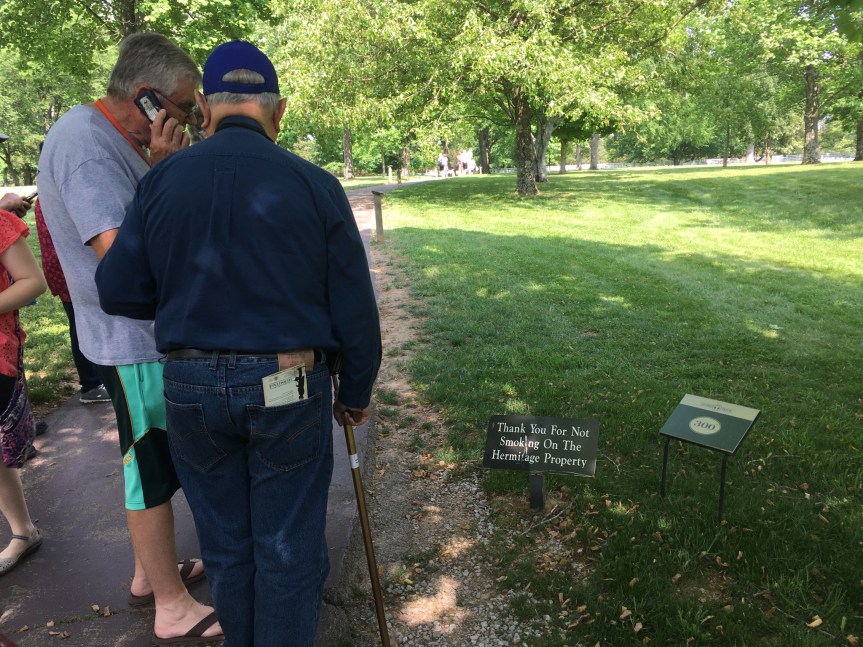
In the photo on the bottom left you can see a staff member demonstrating how to use the older audio device (on the wall behind her were the three sorts of tours information), while on the bottom right is one of the new smart-phone type machines, which is what I was using. Regarding the sorts of information offered, I found two things interesting: firstly, On adult devices do NOT allow you to hear the blue 200 series audio files, intended for kids, so that as a parent you can’t actually know what they’re telling your kids, or NOT telling them… that’s a problem! Also, if you think about it for a second, you get the feeling that the 300 series, the information about Andrew Jackson’s wife was added as an afterthought … as part of the whole, we need to pay as much attention to the first spouses as to the presidents movement.

After getting your headsets, or before, depending on how you time things, there’s short movie that provided a fairly level introduction to who Jackson was, pointing out that he could be mild-mannered and polite, as long as you didn’t get in the way of anything he wanted, in which case he could turn extremely violent, and you were essentially dog meat. (There’s a world for this, its psychopath … no I don’t have an opinion about this, why do you ask?)

IMG_1324

The movie also talks about Jackson’s war with the Central/Federal Bank of the United States, a point of history which if you don’t understand it, you will never appreciate the exquisite irony of Andrew Jackson’s face on the 20 dollar bill.

After the movie there is a small museum area you can either walk straight through on your way to see Hermitage, or you can stop and appreciate, which will teach you more about the man and his importance to American history.

IMG_1212

After the museum you begin to the approach the property, and this is when the audio aides come into use.

IMG_1215

All along the path there are detailed signs you are meant to stop and read that offer other information (not available in the audio segments)

IMG_1218

IMG_1220

IMG_1226

And then after you’ve walked a short but winding path you begin to approach the building itself, and are offered information about its building and evolution over the years before, during and after Jackson’s presidency.

IMG_1227

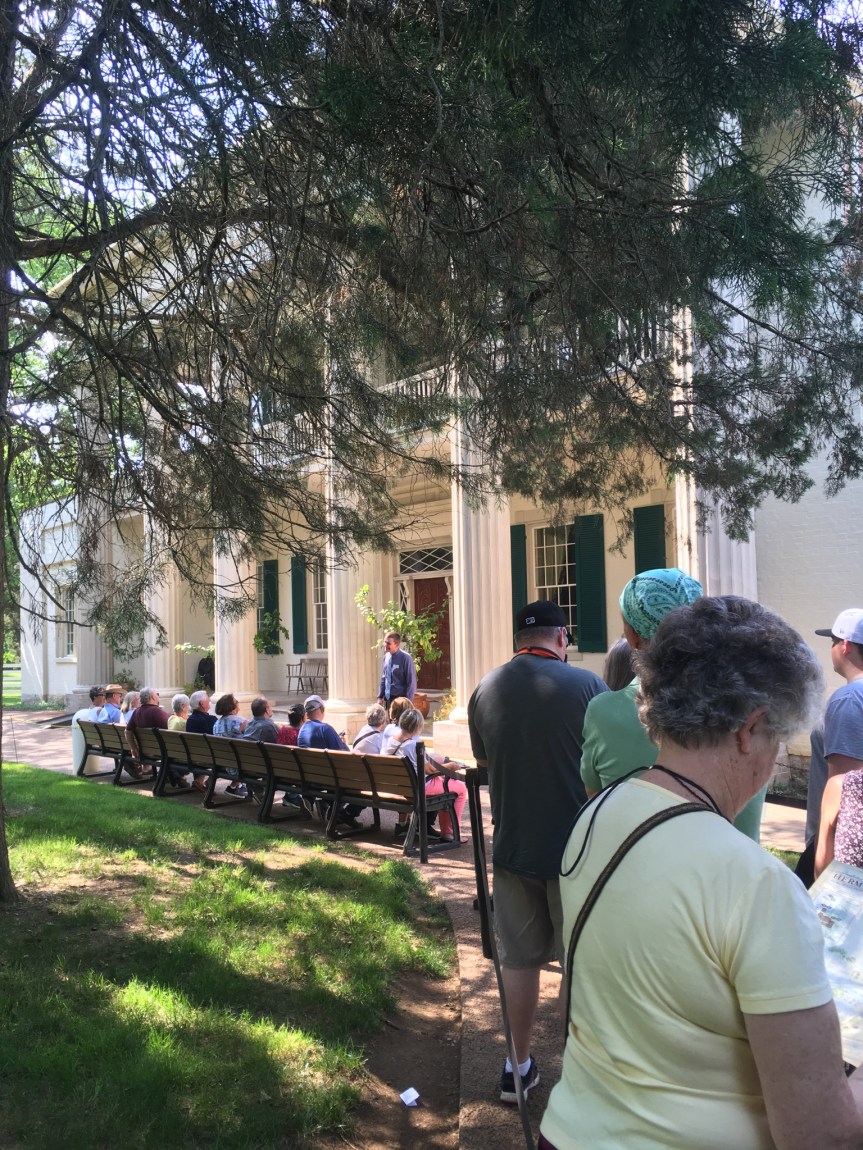
Then, you stand in a cordoned off line, and wait for your turn to enter the building. For this they’ve come up with really smart way of breaking the tourists into easily manageable groups. There is a set of benches, and only as many people as can comfortably sit on the benches at once are allowed in at a time, and each group once seated is given a short speech about what they’re about to see, with a question period after it, all of this intended to space the groups out.

IMG_1231

One difference I DID notice between this time and my previous visit in 2010 was back then ALL the various tour guides were dressed in period costumes, while this time they all were wearing modern clothes. (I think this change is a loss)

IMG_0100
Note the difference in cloths of this guy (in the black outfit) in this picture taken in 2010 with the young guy in the picture taken yesterday

Additionally, and this I’m less sure of, last time I’m pretty sure that the same docent stayed with our group along the whole tour, while this time we visitors were moved from one location to the next but the tour guides stayed put.

Both times, while in the house, we were not allowed to take pictures. However, I think this was for two reasons, firstly, picture takers can slow down the efficient movement of people from one location to the next, and secondly, picture takes tend to break the rules in favor of a good shot… crossing boundaries and using flash (which could have a cumulatively destructive effect on the antiques in the house).

But once you’re outside of the shuffled through tour part, there’s not only no one telling you NOT to take pictures, but there also plastic walls in place separating you from any chance to do anything destructive… via the servants section of the house where you can see into the main house … so… here are some.

IMG_1251

This was the informal part of Jackson Parlor. In the Front rooms, which are not directly visible from the servants area is where he met official visitors, this back room was where family would spend their time

IMG_1326

This is the dining room. The flooring which looks like linoleum is actually a waxed cloth (like wall paper for floors) that was popular at the time and even existed in the White House. The stove was a modern Franklin stove which was much more efficient than a fireplace.

The home would house any and all visitors who came that day (as at that time it was a couple of hours ride away from Nashville), offering them a place for the night. Bed rooms were filled on a first come first serve basis, separated by gender, with late comers given bedding on the floor, as was the common courtesy of the day. (There’s actually an amusing story of one time Thomas Jefferson while running for President went to visit the then widowed Martha Washington in Mount Vernon, and she hated him so much while she could not refuse to see him, she did not, as was considered common courtesy, offer him a place for the night… and he was forced to ride all the way back to Alexandria. A MAJOR diss… we know this is true because apparently he ran up quite the liquor bill that night at the inn he ended up in)

After dinner, the dinner table was designed to be easily taken apart, and the dinning room was then available for dancing and other entertainments. Right behind the dining room is of course the servants area, such as the kitchen and store rooms

IMG_1327

Another change I noticed was, while last time I was here, people would press the various buttons (like the one here in front of the kitchen) to listen to the recording describing the area, which was blared over a loud-speaker to the whole group at once, this time NO ONE (other than me) pressed these buttons. In fact I spotted one woman bitching to a guard that I had disturbed her by doing it… to which I’m pretty sure he responded, “Madam, that’s what they’re there for.”

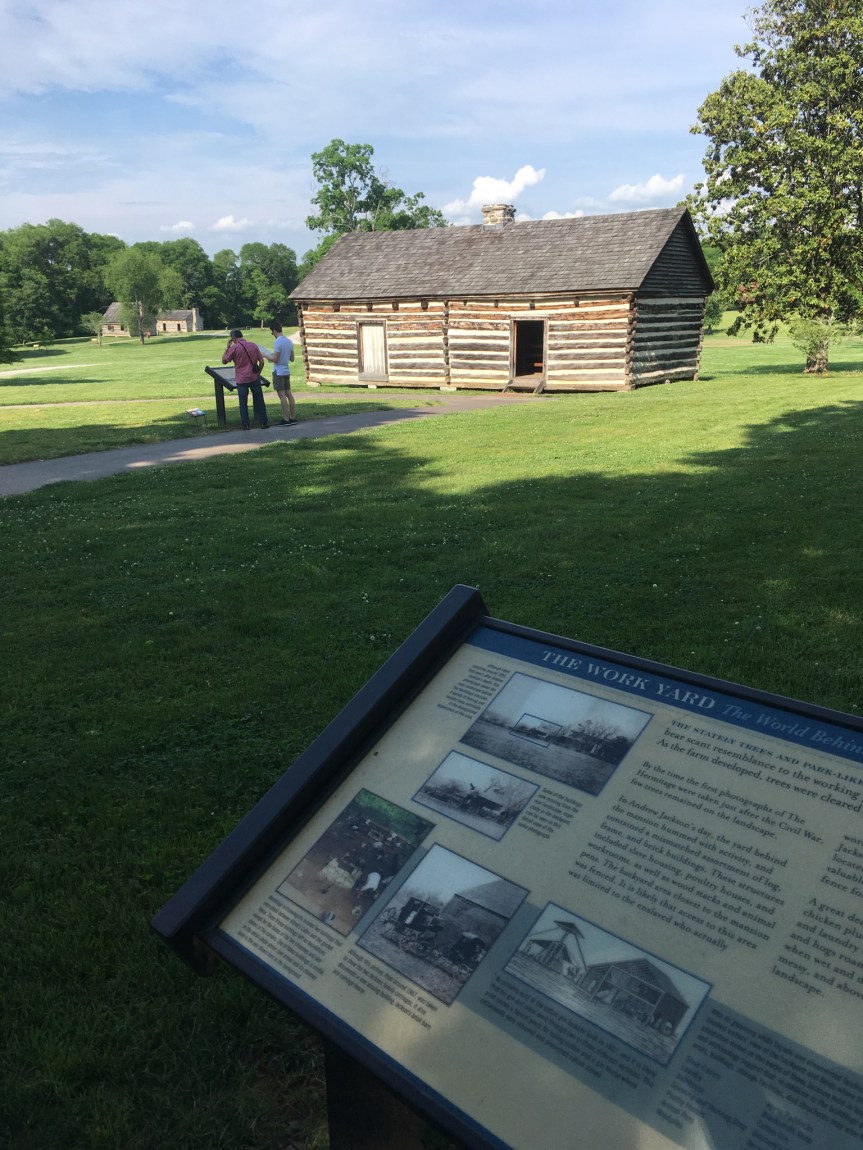
After the house you walk to the fields, work houses and slave quarters that are located in the backyard area

IMG_1259

IMG_1264
A view of the house from the back, less fancy than from the front

IMG_1266

IMG_1267

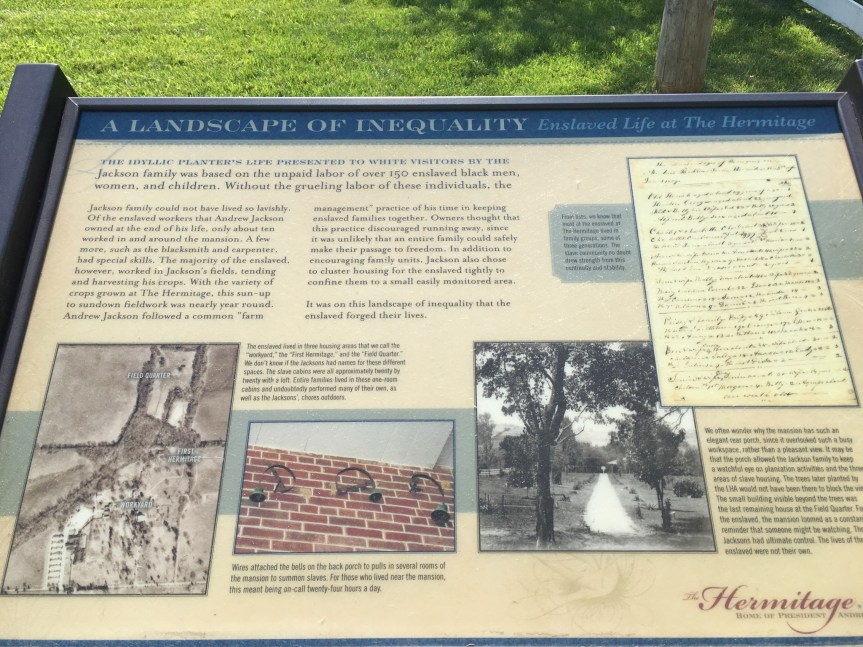
One of the interesting things that I learned was that while one of the horrors of slavery you always hear about is families being separated, it was NOT Andrew Jackson’s practice to do this. Whenever possible he kept slave families together even to the point of it not being economically practical (holding on to the very young and the very old), to the extent of he once purchased a seamstress for his time at the white house, and then upon her request her whole family… she had informed him that they were all trained house slaves owned by a man going bankrupt and therefore at risk of being seperated (it was in one of the audio files, from her voice I think she was the same African-American historian who spoke in the movie, who specialized in the slave experience). However, according to the above sign, Jefferson did this less out of the goodness of his heart than as a modern slave management technique, designed to make slaves less likely to want to run away as the larger their families, the less likely they would be able to do it together.

IMG_1271

IMG_1281

IMG_1273

That said, back when I was studying the institution of slavery at Northwestern University with a professor who specialized in it, one of the things she taught us was one of the best measures of was, and I preface this by saying slavery is a HORRIBLE thing and should never exist, and there are therefore no “good” slave owners… that said, the way to distinguish the relatively ‘good’ owners from the really bad ones was once emancipation came, how many freed slaves chose to stay put and continue working for their former owners, versus opted to grab their freedom and pursue better options. The reality, as politically incorrect as this might sound, was that many former slaves stayed put (or came back after doing a walk about to see what else was out there)… but those owned by BAD owners, the ones who were most notorious for their evil behaviors… those saw their “families” of former slaves abandon them with a will…

That said, while Andrew Jackson had passed away about 20 years before the Civil war, and it was his son who was the owner of all of his former ‘properties’ once emancipation came to the Hermitage, according to the sign above … most of Jackson’s “black family still at the Hermitage chose an uncertain future and fled behind Union lines”

In fact, I wasn’t able to find the sign this time, but I remember that last time I was there I read one that said in fact almost ALL the former slaves but a small handful (I think the number was like three?) had run away from them, telling you pretty much everything you needed to know, at least about how Jackson’s son had treated them.

New Echota Historic Site & Museum; Calhoun, GA, (2 years later)

This was my second visit to the New Echota historical site. A memorial to, and attempted recreation of, the former capitol of the Cherokee nation — a city that was modern for it’s time ….  until it’s people were uprooted and moved west during the trail of tears — one of the more disturbing events in US history — even after they had fought their case all the way to the Supreme court (at the time headed by John Marshall) and WON their case, to which President Andrew Jackson replied:

IMG_1032.jpg

My first visit was by myself in 2016, this time I was touring around my childhood best friend (who has joined me previously in my travels, but only ever for a few days at a time, in: Victoria, Washington D.C. and DisneyWorld; usually we’ll go to do a High-Tea together when she visits, but this time I wasn’t able to find a good one nearby). She had asked if she could visit me wherever I was going to be in March…  at which time I was planning on staying not at an Airbnb, but at the home of another old friend who lives in Dalton (I said, “you can, but you’re going to have to find someplace else to stay”).

IMG_1029.JPG

As such, since this is a second visit… I’m not going to repeat what I wrote then, but rather focus on any updates and or changes I find interesting or relevant.

As I commented last time I was here, “while I’m glad they built/are building this place, and I doubt it’s much of a money-maker… I question the motives that created it as much as I appreciate the results.” So, … it’s been two years… what’s new you ask? Not much. There was evidence of some construction/repairs going on at the front entrance/ roadway, but even though the last time I was there they said they were going to add to the “reconstructed” homes of the town, I didn’t see ANY evidence of said additional homes being built.

IMG_7612
Picture from last my 2016 visit, the area was JUST as empty in 2018….. except for more grass

That said, there seems to have been cuts to their budget, as evidenced by not only the lack of developing the property, but also they are now selectively mowing the lawns, rather than doing it regularly and completely (like in the picture above from 2016)

IMG_1065.jpg
Rather than mowing all the lawn, they’re just clearing paths

… and in the age of a high risk of catching Lime disease (which has serious derailed a few of my friends lives, one of whom used to be a researcher for NASA and now can’t hold down a job) from something as simple as a SINGLE tick bite, that’s a MAJOR issue

Please note the OLD picture on the left, the lawn was mown all the way out to the far trees, while in the most recent photo (on the right) they are only mowing the most high traffic areas and cutting some narrow paths for people to walk on. This is a problem because, to quote this website: “Ticks are attracted to areas with tall grass, moisture, and shade, so keep your grass cut short, your shrubs trimmed and your leaves raked up.” The first things I asked the park staff member when we were paying our entrance fee was how bad the ticks were in the park were… she responded that just yesterday she had pulled three of them off her body, and she didn’t remember going into the deeply wooded areas that day, i.e., she probably got it just by walking through the unmown lawns.

Last time I talked about how one of the coolest elements was they had created a narrated walking tour that you could call up with your phone, or by scanning the QR code with an application in your smart phone. What I hadn’t mentioned at the time was that you of course had to do it with your phone, and the free WiFi that is in the building (and insanely slow) does not extend outside of the that build’s four walls. As such, you’re reliant on your phone’s data signal to be able access it… and on while it had worked relatively well the first time I was there, this time… not so much. That said, the grounds are small enough, that it would be relatively easy and inexpensive to create free WiFi that covered that grounds… again, hasn’t happened (as I noted in my update on Ruby Falls, which is located about a half hour drive away, they HAVE wired all the caves for free WiFi).

IMG_1705.JPG

The first time I was here I commented about how “What I would have liked to see but didn’t (which does not mean it isn’t happening, just that it wasn’t front and center in the museum) evidence that tribal elders are somehow involved in this site, etc.” Again, I really didn’t see much of that. However, one thing I noticed (it wasn’t new, but last time I didn’t really notice it) was this one hand cranked device that included descriptions voiced by individuals with distinctly Native American accents… that said, it would be SO easy to attach a solar panel to this…. cranking it was kind of a pain (we ultimately figured out you can crank it slowly).

As I said last time: “Counter to the Hollywood stereotype, The Cherokee lived in western type wood homes, grew crops, had their own written language using a unique alphabet (actually a syllabary) developed by Sequoyah;

IMG_1076

That said, a few weeks after visiting New Echota the first time (back in 2016) and learning about Sequoyah and his invention of the Cherokee syllabaryI was able to visit his birthplace.

So, not only did the Cherokee have their own democratic government systems, but they also had their own newspaper called the Cherokee Phoenix (written half in English and half in the Cherokee language) edited initially by Elias Boudinot  (the paper is still active) which had a world-wide distribution (according to the docent), and literacy level among their people that was actually was higher than among the surrounding white communities (but at the time that wasn’t all that hard to achieve).”

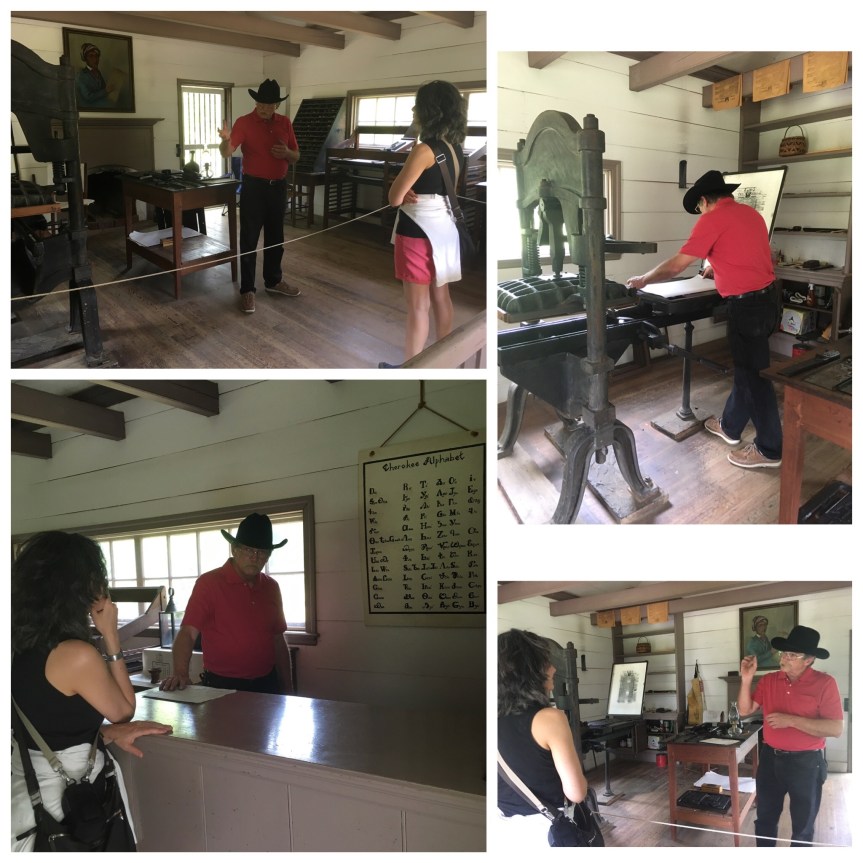
Another difference I noticed between the two visits was when visiting the Print shop, which in my mind is probably the highlight of the who park; last time, visitors were allowed full access to the print shop to the extent that children and parents were even allowed try their hand at using the printing machine (under supervision)

This time, we were kept firmly behind various barriers (one being a rope extended across the work space), even thought there were only two of us, both adults. And when the guy printed something he did not ask us if we wanted to try our hand.

IMG_1706.JPG

That said, I did learn a bunch of interesting printing related fact from him, a collection of everyday phrases that were inspired by printing,


Invasion day/ Australia day: A Rally in support of the Aboriginal population


26168255_585319435144528_5797177957101119331_n
The black above, red beneath with a yellow sun in the middle is the flag of the Aborigianl

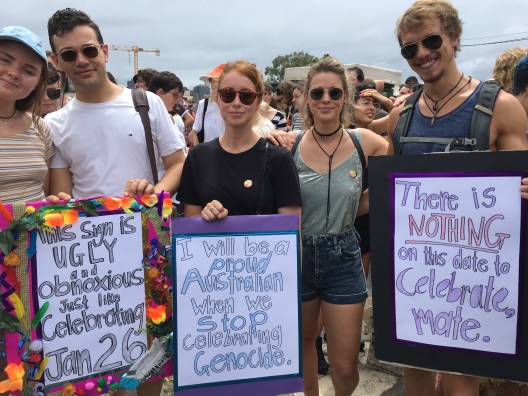
While the PLAN had been to spend the whole day attending a series of events that were scattered around the city through to the massive fireworks display at night, the only thing we managed to attend was a rally in support of the Australian Aboriginals (because I fell down and went boom). However, while at the march I learned that, their presence on the land, for a myriad of reasons, is STILL not legally recognized, either NOW or historically, because of a legal declaration made by the British 200 years ago that the Australian continent was terra nullius (i.e., empty of humans). The mind boggles, really it does.

On top of that, a major issue that apparently hadn’t really BEEN until just this year, was the fact that Australia day, which celebrates the landing of the first boatload of western settlers is also, from the Aboriginal point of view the day that marks the west’s invasion of their historical lands (kind of like Columbus day and the 4th of July rolled into one).

IMG_6839

Anyway, my friend that I’m traveling with is fairly solidly left wing in his politics, and told me that while I didn’t have to come with if I didn’t want to, this is the event he would be attending first thing in the morning (as in we had wake up way earlier than I’m used to in order to be there on time, which may have been part of why I tripped), but since I didn’t know much about Aboriginals, in spite of my background in Native Americans, I decided I should go with him. AFTER we were going to go do all the more sort of normal celebrate the day things.

The following is the details about the rally from their facebook page:

“Invasion Day 2018 rally:
The war on Aboriginal people continues… Sovereignty and Justice Now! This rally will mark 230 years since British military forces invaded Gadigal land and declared British rule over this continent, along with Aotearoa and other Pacific Islands. While colonial regime continues to hold a day of celebration, we resist the ongoing war against Aboriginal people. From the brutalisation of black youth in detention, the murder of men and women in custody, the theft of children from families, the destruction of Aboriginal lands to feed corporate profits, the apartheid NT Intervention, the forced removal of communities,First Nations on this continent are under heavy assault from a new wave of dispossession. But the fightback is also growing and urgently needs your support. This rally has been initiated by Fighting In Resistance Equally (FIRE), a coalition that organised last years impactful and successful “Invasion Day 2017 rally – no pride in genocide!”
Also the last two successful marches on human rights day, December 10 last year and this year.

FIRE believes that standing against the colonial system and the racist mindset that was brought here in 1788 is crucial to all struggles against oppression and exploitation.”

IMG_6837


So yesterday, before I hit the floor and went boom, at the march/protest in support of Aboriginals … I had questions.

Firstly I must admit that my eyebrows went up when we first arrived to see what was clearly socialist types coopting what was supposed to be a pro aboriginal thing with their own stuff… HATE when that happens in the US when whites try to co-opt Native American protests… Or the way I learned that moveon.org, after I signed their initial petition about how the Feds should “move on” from being obsessed with Clinton’s sex life, felt that as I had signed ONE thing they believed in that give them the right to put my electronic signature on EVERY petition they were coming up with … so that now I just won’t sign any of those things anymore and at one point sent MoveOn an angry cease and desist email.

IMG_6841

And then I was SERIOUSLY put off by the fact that they put up a Palestinian guy to speak who was making false comparisons (if you support the Aboriginals you must support the Palestinians) and blaming the Israelis for atrocities that WERE done to the Palestinians, no doubt … ONLY it was by their Jordanians and Syrians “brothers” rather than the Israelis who had done them, but rewriting that history to put it all on Israel’s back… and he even had the audacity to claim we’d done child abductions, when the PLO had ACTUALLY been abducting Christian Lebanese children and turning them into child warriors before the Lebanese war …. I think he thinks that when Israel offers free health care and university degrees and such, we’re abducting their kids… and watching all the young hipsters nodding their heads with how right he was… set me off no end…

Basically (and modern genetic testing techniques back me up on this) we were arguably there before the Palestinians — although more than a few Palestinians would be shocked to learn, and the genetic testing also backs this up, their ancestors had been Jews and were forcibly converted to Islam generations ago at the point of a sword — and we were driven off our land by waves of invaders, and from my perspective Palestinians are a bit like… well some time in an alternative reality future, white people — many of whom are actually have Aboriginal ancestry they have forgotten about — being pissed off because Aboriginals who had escaped the genocide in Australia, got rich, came home and bought up all of Sydney and then declared an Aboriginal state, saying the white people could continue to live there but they would have to adhere to aboriginal law. It in fact would make a pretty good alternative reality book…

Add to that the fact that I was tired, and it was really hot, and I was NOT in a happy mode towards the start of that day…

So I immediately had some doubts about pretty much anything I heard after that… There was a chant, “always was, always will be aboriginal land” which I couldn’t quite make sense of. If it were true, does that mean all the young middle class hipsters who were chanting it were willing to contact some suffering Aboriginal families and put their money where their mouth was? “Hey, I’ve been chanting this, I own a couple of properties around Sydney I inherited from my family…. I’ve decided my family stole it from you guys so HERE, take my property I’m sailing back to the UK?” Don’t think so… so WHAT in fact did the chant mean?

My friend who I travel with was trying to explain it to me, but then a complete stranger who was walking near us, was this nice guy called Luke who offered some very coherent explanations, and for the rest of the march he became my teacher, explaining in a lot of detail stuff I had not known.

With regards to the chant, NO, Luke agreed I was right, none of these guys were likely to hand over their homes, but it was more of a constitutional issue. Until quite recently there hadn’t even been any discussion that the Australian constitution should even recognize Aboriginals as having been there first (which in this day and age is kind of head scratcher, and completely inconsistent with how the rest of the world views Australians), and the constitution here still doesn’t although discussions have commenced. (I did note later to my friend that the ONLY reason the US constitution is any different, in case you didn’t know we have always legally recognized the tribes as “dependent sovereigns” even if we didn’t stand by our words, is because at the time of the founding we were at war with the French and NEEDED the tribes on our side in that war.) But there’s apparently push back from the sort of Australians who would have voted for Trump (the sorts who were wearing Australians flags yesterday, instead of showing up at pro aboriginal protests), who like in the US don’t tend to be the folks living in cities — although some of them do (and it’s pretty easy to spot them on Australia day). To paraphrase his friend Sonja, who we met up with at the event, there are 3 sorts of Australians… the all white and claim their ancestory to early settlers “we’re Australians! This is OUR land” crowd… then there’s the urban yes we’re Australians but we feel really bad about what was done to the Aboriginals crowd, and thirdly the more recent recent immigrants and or refugees or first generations folks who are of the “we’re just happy to be here” crowd…. but then we agreed there’s a 4th group, the “who gives a fuck about politics this is just a day off work” crowd. And I learned there’s a Northern territory that isn’t actually under the same laws as the rest of the country (from a legal viewpoint a bit like Louisiana which has a completely different legal system from the rest of the USA, or Canadian territories which aren’t actually states) and in these Northern territories some pretty gruesome stuff is still happening, kids still being separated from parents without due process, etc — which I had not ever heard about before.

So I learned a lot. It was good… and after that we attended a thing in a park where aboriginal dance groups and singers performed, and various aboriginal artists exhibited their works

IMG_6850

After, I found these articles about the march in Sydney and some others around the country… was kind of hoping I’d spot me of my friend in the march, but so far no luck.

https://www.theguardian.com/australia-news/2018/jan/25/invasion-day-rally-where-protests-will-be-held-across-australia

http://www.news.com.au/national/nsw-act/hundreds-gather-for-invasion-day-protest-march-in-sydney/news-story/fb0f514ff0088107a2b6b0b307d6bb1a

http://www.news.com.au/national/hope-australia-burns-to-the-ground-tens-of-thousands-protest-across-the-country/news-story/558c5aabea78c258cdf9c155259497c4

http://www.smh.com.au/nsw/invasion-day-rally-in-sydney-draws-thousands-of-protesters-20180126-h0orw4.html

IMG_6852

High Tea & Tour at the National Cathedral; Washington D.C.

Yesterday a childhood friend and I had High tea at the National Cathedral in Washington D.C.; it was a very interesting tour with a tasty snack at the end. Unlike most high teas, the portions are just enough to satiate your hunger while leaving you more than enough room for dinner.

IMG_4006

As is our ‘tradition’ whenever my friend Gina comes to town, we go to high tea. Last time I was in D.C., Cheryl, another childhood friend who lives in the general area, suggested that our BEST choice was this one at the National Cathedral — but seating is highly limited so that by the time Gina had finalized her travel dates they were already fully booked and we ended up at Lady Camellia’s in Georgetown instead. However, SINCE I was going to be coming back to D.C. again this week, I suggested to Cheryl that this time she and I should do it together.

IMG_4161

When at first you arrive at the Cathedral, the first thing you’ll notice is the update on the post 2011 earthquake repairs to the only recently completed Cathedral (1990), and a plea for funds so that they can complete the job. Personally, while construction had begun in 1907, I have to wonder why as it progressed modifications had not been instituted to keep it up to modern earthquake standards.

IMG_4171

When you enter the Cathedral at the check in counter you tell them you’re there for the high tea, and they don’t even bother to check a ticket or compare your name to a list. (That said, one way to get in and avoid admission on a weekday is to time your visit to when folks would be arriving for the tea, and just say that’s why your there.) Once you are inside the church proper, you are immediately impressed by it’s grandness, which is on par with some of the greatest medieval built Cathedrals of Europe, but with a lot of very modern touches (earthquake proofing construction not being one of them).

Notably, the stain-glass windows are on the whole far more modern than what I would have expected. One of them, which I could not get a good shot of, is devoted to the exploration of space, and includes a moon rock provided by NASA. And many of the windows have a sort of ‘cartoonish’ aspect to them, rather than the sort of classic stained glass you normally see in churches.

IMG_0409

My favorite window however was fairly traditional… and pretty clearly devoted to Jews and the old testament:

IMG_4029

About 30+ people had shown up that day for the tour and tea, and first they spoke to us about the Cathedral

IMG_4035

and then of course showed us some of it’s high points.

IMG_0410

IMG_4077
if you look very carefully you’ll see mine and Cheryl’s reflection in the mirror, I’m wearing red

HOWEVER, as Cheryl had already done the generic cathedral tour twice before, I had signed us up for their “Nobel Prize” tour, which highlights aspects of the church devoted to that; this is a tour only offered a few times a year, and these are some but by no means all of the details they pointed out to us…

fullsizeoutput_3515
This corner includes an image of Mother Teresa who won the Nobel Peace Prize in 1979
IMG_4163
While Elenor Roosevelt never won the Nobel Peace Prize, she was nominated for it three times
IMG_4164
Winston Churchill won the Nobel Prize in Literature in 1953, this area of the church is devoted to him and includes a sculpture of the prize itself
fullsizeoutput_3514
A window devoted to the United Nations whose combined agencies and funds, etc., have won the Nobel Peace Prize eleven times
IMG_4061
The actual crypt of President Woodrow Wilson who won the Nobel Peace Prize of 1919 for his work in trying to form the League of Nations (the precursor to the United Nations) and his wife
IMG_4081
And this is of course is in honor of Martin Luther King Jr., who won the Nobel Peace Prize in 1964. While at it Cheryl and I talked about how he had come to the village green of our home town of Winnetka in 1965 to speak about how segregated the great Chicagoland area was. When my parents tried to buy a home in the area realtors would not show us any because we were Jewish, and when my parents on their own found a home for sale by owner and bought it, petitions went out the next day in protest that Jews were moving into the neighborhood. The first blacks to move in was a bi-racial couple where the wife and mixed race daughter stayed hidden from the realtors till after the sale had been completed.

IMG_4165

Kneeling cushions devoted to Nobel Prize winners, and and other notables. While Ben Franklin obviously could not have won the Nobel as it was not created till well after his death, he did win the Copley Medal for his work with electricity, which is given out the UK’s Royal Society, and was an early equivalent.

After the tour they took us all upstairs to have our tea. Cheryl and I were lucky in that we had a window seat:

IMG_4167

IMG_4166

While very tasty, as you can see the sandwiches and desserts are for the most part “finger food” or appetizer sized portions, so our hunger was soothed, but the meal wasn’t filling enough so that we had no appetite for dinner.

IMG_4085
This was the view directly out of the window we were seated next to

After our tea was over, we explored the top floor and the windows other groups were sat next too, taking in the various views offered

IMG_4169
Note the capitol building and the Washington monument

IMG_4106.jpg

IMG_4094
In this image you can also see the Vice President’s mansion and the Jefferson memorial

IMG_4109

After the Tea we went down into the basement of the Cathedral, which the tour had not gone to and explored it…

IMG_4114
the basement gift shop
IMG_4170
Things for sale in the basement gift shop
IMG_4162
Apparently one of the Gargoyles on the building is the head of Darth Vader, and as a way to make money to fund the repairs, you can buy a duplicate of it

In addition to the massive gift shop the basement holds more crypts, chapels, and is something of medieval architectural delight

IMG_0412IMG_0411