President McKinley National Memorial & Library

IMG_8077

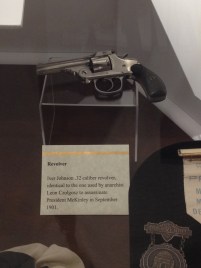
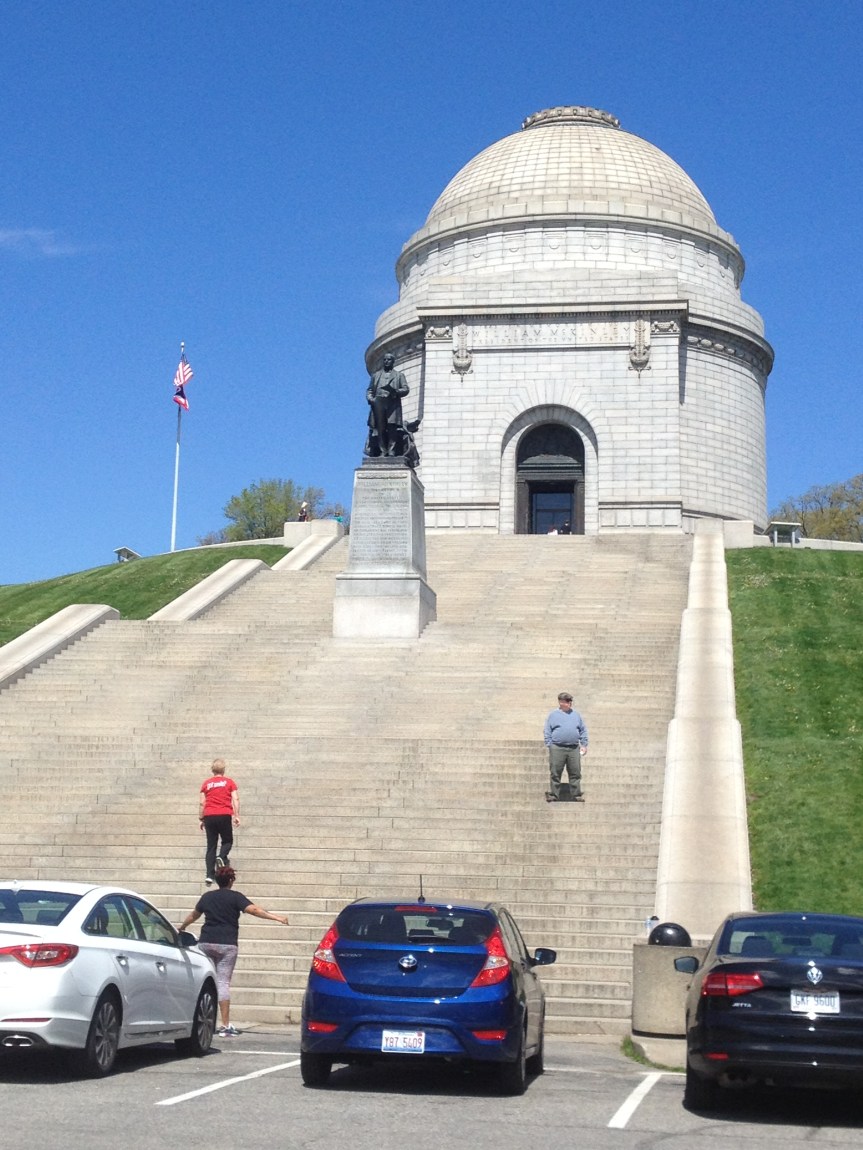
For those who are weak on their presidential history, McKinley was the 25th President, and was shot six months into his second term, in 1901, by Leon Czolgosz, an anarchist (he didn’t think we should have any sort of government); McKinley is probably best remembered for, by the simple act of dying, making way for Teddy Roosevelt — which might not be fair to McKinley who was actually a fairly effective president (depending on how you feel about US expansionism/colonialism), but is none the less an accurate statement.
IMG_8074

As mausoleums  go, this is a pretty impressive one, and doubles as a popular place to work out, a phenomena that I seriously doubt the folks who designed and built it had in mind. While there I saw any number of ‘dressed to work out’ women and some men doing the steps. I even saw one class of orange clad 2nd graders assigned by their teacher to run up the stairs as a way of calming them down after a long bus ride, before entering the presidential library/museum portion of the memorial.


IMG_8084

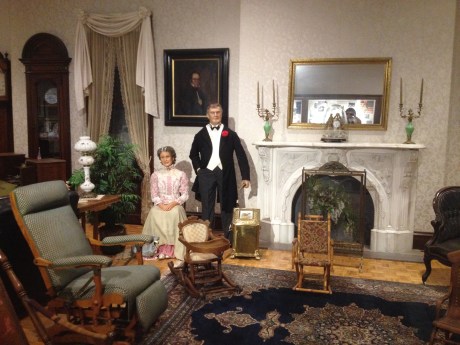
Next door to the mausoleum is a really impressive little museum (completed in 1964) that is most definitely worth a visit. It kind of reminds me of a miniature version of Chicago’s Museum of Science and Industry. There’a small planetarium (because of all the school kids I was lucky enough to see a light show on a week day), a gallery devoted to the McKinley’s that shows furniture and various items that belonged to the and includes an animatronic President so good that I’m thinking they may have gone to Disney for his production.
IMG_8105 IMG_8098

There is also a whole wing dedicated to recreating a small town of McKinley’s era, with various shops, a post office, a doctor’s office, a dentist, etc., which is in and of itself worth the price of admission, etc., and that’s just on the top floor. I consider this to be part of the living museum trend, even though none of the ‘buildings’ are saved historic ones.


The basement is devoted to dinosaurs, but I barely got to see it. There is in fact way more thing to do that I made time for because I wanted to make sure I was able to fit in a visit to the first ladies museum on the other side of town before it closed. If I go to Canton again, which I intend to, I will devote a whole afternoon to this museum.
 

Pro Football Hall of Fame

IMG_8071

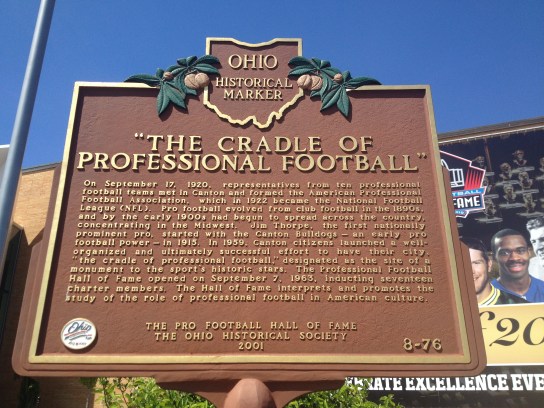
Hadn’t come to Canton intending to visit the Pro football Hall of fame; to be honest didn’t even know it was there (not a football fan); however, driving around in this town it’s kind of hard to miss it.

So I came here, and I was interested, but not $24 + $10 for parking interested….

IMG_8070

Once I saw the prices, I opted to just check out the gift shop, which the guys working their front-desk did not want to let me do (and they even said I should have paid the $10 for the pleasure of parking my car before shopping) but I just ignored their comments, and no one stopped me.

The gift shop is basically any sports wear shop you’ve ever seen that specializes in any particular NFL team, only this one has stuff for every team, and not much more than that. They don’t even have much specifically aimed at that museum itself… I compare this to goods for sale at Hong Kong Disney which are just generic ‘disney’ stuff, with almost nothing that is specific or special to the park. In other words, there’s no reason to not just buy a generic disney character shirt at a discount store rather than pay the elevated park prices. Suffice it to say, I was out of there in about three minutes. 

I heard afterwards from the front desk clerk at my hotel that it’s possible to get a combined ticket for both the NFL and the Rock and Roll (which I didn’t realize was also in Canton)hall of fame ticket for $30, and according to my male friends — when they heard I could have gone in but didn’t — both are MUST see museums  ….. So, I will try the combo ticket next time I’m in Canton. 


The American Saddlebred Museum

This is one of my favorite sorts of museums, folks who are entirely geeking out about something they love…. in this case, a specific breed of horse called the American Saddlebred horse, which used to be called “Kentucky Saddler.”

IMG_8022

I found this museum on a list of ‘unusual’ things to visit in Lexington, KY. I had just driven up from the Pigeon Forge, TN (Dollywood) and was hoping to arrive in time to see Mary Todd’s Home, but that had closed at 3pm and I arrived at around 3:30pm. So, I decided to spend the night and to do it the next day. It is located on the grounds of the Kentucky State Horse Farm Park and apparently is usually a combined ticket to the race track, meet and greet with the horses, pony rides, etc., but I wasn’t here for those things…I was here for the geek museum.

IMG_7986

The area is broken into two rooms — the first is a massive collection of personal momentous from trainers including paintings and sculptures they had commissioned of themselves and their favorite horses,

… as well as personal mementoes, like awards they’d won, or favorite saddles, riding gear, etc.

The 2nd is a museum dedicated to history of the breed, the uses of the horses, and some history of the people who worked with them. Walking around the space it is clear from walking around here that serious money had been spent.

IMG_8010

There are two full documentaries (which I have a feeling they had specially made), one about the horses the museum honors and another about the forgotten history of black trainers who didn’t receive any recognition before the 1970’s. According to the film the color barrier didn’t just apply to people; one of the stories the film told was about a horse that wasn’t winning awards because of her odd color (silver), so her trainer — who was a person of color himself, dyed her brown instead of silver and changed her name to painted lady, and she began winning.

The movie that was just about the horses, their history, and why these people love them, includes an interview with the actor William Shatner (of Star Trek fame, again, GEEK) …

 
4083 Iron Works Pkwy, Lexington, KY 40511, United States
+1 859-259-2746

Hiwassee River Heritage Center

To be blunt, this is a “not yet ready for prime time” educational center about the Cherokee nation and the ‘Trail of Tears,’ which passed along the old ‘highway’ (aka, historic paved road) the center sits next to.  According to the woman who ran the place, they’re still getting funding and were just recently able to buy this building (which looks like it might have been some sort of office). The plan is to tear down the current structure, in the very near future — just a matter of months, and replace it with a much larger facility on the same location.

Currently, all they really have to show are some placards on the wall that tell the story of what happened, which are (I’m pretty sure) duplicates of ones I already saw on the walls of other more developed locations like New Echota (I’m guessing they were gifts from a state historical society or some such). She said that once they expand there will also be artifacts from local digs and research facilities, with a full library, etc. Among the placards was a description of archeological digs done in the area before the Tennessee Valley Authority had put in a damn that flooded many historic Indian sites back in the 1930’s as part of the depression area development of the region, and I assume many of the artifacts will be from those digs.

I look forward to coming back to this place at some later date to see how it progresses.

When I first drove here, I thought that maybe my GPS had failed me, because there were no signs leading to here, but happily, there are nice clear signs out front. Then I saw the sign on the door… firstly, the author forgot to include the local area code and not being a from there I had no idea what to dial, and secondly, my T-mobile phone had no signal, as in none. I went next door to the gas station and asked a nice young guy if he had a working cell phone and would he please call the number for me. The woman who runs the place was apparently 15 minutes away running errands, but said to wait for her.

While doing that, I went next door to a nice looking antiques place (other people’s junk), which actually had a few things worth buying, as a well a huge collection of abandoned family photographs that go back to the 1800’s (we don’t recognize any of these relatives so what will you pay us for them). It was kind of sad actually. The woman who ran the place gave me a free copy of a book about the history of the area written by a local man.

Howard Finster’s Paradise Garden

The former back yard of an artist: Remember the iconic talking heads album cover? Well this is the home of the Howard Finster, the Baptist ‘tent revival’ preacher who created those images.

IMG_7751

One of the most acclaimed (by the mass media — but not so much the art world) folk art artists of his day, he even did Jonnie Carson, Finster was the darling of the rock and roll world since REM filmed one of their early music videos in his back garden.

Howard Finster had been a tent revival preacher who felt a calling from God to pass ‘his’ word via art rather than in preaching… Creating art then became a compunction for Finster. He was initially ‘discovered’ by art professors at the university of Georgia, Athens.. And then by one of the most influential gallery owners in NYC (soho), and then by the likes of REM and the talking heads. According to the intro movie Keith Haring did a pilgrimage to here before he died and as you walk around you can see clear evidence of his handiwork.


When I got here originally I drove up and there was this smiling guy sitting on a grass cutter the kind you can drive around and according to go to the guy at the front door I was the first person to show up today. I had the place to myself, at least or a while. As soon as I got to the front door a big orange tabby walked up and demanded entrance and the guy working the front door dutifully let him in.

IMG_7750

When you first enter the museum you directed towards watch a half hour movie about the artist; it explains his life and motivation for his work (serving G-d). The moment I sat down to watch it the orange tabby came right over, jumped on my lap and proceeded to demand to be petted, so I scratched him about the ears for about 10 minutes, till he decided to get even more affectionate. Now I love cats, used to have three of them, but I have since been diagnosed as seriously allergic to them (which is why I no longer have any), so I had to nudge him to the floor. He gave me a pissed-off glance and walked away. Clearly from the cats perspective the job of any visitor is to pet him. As soon as the movie was over I ran to the bathroom, to wash my hands & arms which were now covered with cat, and splashed water on my eyes which had gone all itchy (I respect and obey cats to my own detriment). I later learned that there were in fact three orange tabbies who see it as your job as a visitor to pet them. 

IMG_7735

Otherwise, you are left alone to wander his mazelike gardens. Towards the back he constructed a house of mirrors that I suppose was intended to create the infinity of spirit ….
By the way, this is what I saw in the sky on the way driving to here

…. so that by the time I arrived to his Paradise Garden I was already predisposed to see ‘the spirit’ (if you will) in Finster’s art.  

All in all, this place was pretty amazing. Also, I had apparently unplugged the cork because after me a few car loads of artsy types just pulled in 

Booth Western Art Museum; Cartersville, GA

A Smithsonian Affiliate museum: while a lot of the art work here is ‘so-so,’ there are quite a few impressive pieces (often borrowed), especially among some of the modern art works.

IMG_7421

I’ve spent a fairly decent amount of time in the Southwest, in large part living on the Navajo Reservation, so I’m pretty familiar with this sort of work, and have seen better collections out there; that said, considering this is in the southeast I’m guessing its probably the best publicly viewable collection of Southwestern narrative art in this part of the country. It’s also a Smithsonian Affiliate which means they get to borrow things from that collection that the Smithsonian would otherwise keep in storage, like this incredibly racist piece which seems to have come from the Buffalo Bill Historical Center.

What I particularly enjoyed, were some of the modern art works.

IMG_7386

And this is a process I do not believe I have ever seen before, cast paper

The museums also contains some examples of paintings produced to be used for things such as book covers for western-genre literature, film posters, and magazine covers, etc. I found this particularly interesting as the wife of an old high-school friend of mine is an artist who specializes in the western genre and has had her work used for magazine covers, etc… so I checked to see if they had any of her work, but they did not.

What initially brought me the museum however was an Ansel Adams exhibition  (I was a photography major as an undergrad). It was an OK exhibition, it had a few of his photos and a collection of works by other who either influenced him, or were influenced by him. Of the latter, the most surprising ones were these:

And then this was one of the ones I might like in my own home

IMG_7395 

Charles H. Coolidge Medal of Honor Heritage Center; Chattanooga, TN

Museum dedicated to a medal. Currently located in a mall, but expected to move back to central Chattanooga soon.

IMG_7358

This is a tiny but very interesting museum that should not be confused with the larger Museum that is being built in Mt. Pleasant, South Carolina. I had a published pamphlet advertising it, and had called previously to confirm that was open and that it was really located in the mall… all of which turned out to be a very good thing, because if I had needed to rely solely on folks who worked in the mall to direct me, I’d have left feeling lost and annoyed; as it was, once I was at the mall I quite literally had to ask seven different staff members for directions before I found one who even know it was there and could direct me (and none of her fellow workers had any idea about it and laughed when they learned it was there and had been there for a while; One even realized she’d walked by it daily, and never saw it).

Like I said previously, the first medal of Honor was given for the civil war campaign called “The Great Locomotive Chase” (which, not surprisingly, Disney made a 1956 movie about) that occurred during the Civil war and ended in a tunnel near Dalton Georgia, where some union soldiers tried to steal a confederate train, take it back up north to Chattanooga, and do as much damage to the strategic rail line as possible along the way, hence the existence of this museum in the Chattanooga area. This museum used to be downtown and according to the docent, intends to move back there soon. The guy running it was a young war-geek guy, maybe 27 years old (where most docents are retired elderly people) who seemed to know a heck of a lot about every aspect of the museum. From what I could tell this was sort of a dream job for him, where he gets paid to sit around all day reading every book he could get his hand on about medal of honor winners, and shares that knowledge with visitors.

It’s a small place, but it’s packed to the gills with information about the medal itself, it’s history, and placards describing some of the more outstanding individuals who had won the medals. Among the ones that peaked my interest was the only medal of honor ever given to a woman, Dr. Mary E. Walker, which — according to the docent, was then taken away from her because women weren’t in the military (only she refused to stop wearing it), but the right was later returned to her posthumously. She had been a volunteer Union army surgeon who had been taken captive when she cross enemy lines in order to help wounded civilians, and declared a spy (probably because they couldn’t believe she was a doctor)

Among their fairly large selection of original medals and historic artifacts, was special cash brought back by WWII soldiers that had been created by the nazis for Jews to use within the concentration camp of Theresienstadt, which I’m not sure I ever saw before. For those who don’t know, Theresienstadt was a mediveil walled city which the Nazi’s had converted into a Ghetto for Jews, and as something of a waypoint to the extermination camps. Mostly however, they also used it for propaganda purposes, making movies about it claiming it to the world that it was an example of many Jewish resettlement areas, and an area they allowed the red cross to visit to prove the lie.

IMG_7366

And of course, we can’t forget everyone’s favorite Medal of Honor Winner, Audie L. Murphy who initially tried to enlist at 17, then won the medal of honor for valor he showed in battle when only 19, and then became the most decorated hero of WWII (33 different awards) when he finally left the military at age 21; and if that weren’t enough, he then went on to be a fairly successful hollywood star who even performed in a few movies that went on to become classics, including as himself in “To hell and back” his own life story.

IMG_7367

Roland Hayes Museum; Calhoun, GA

Local boy does good “museum” dedicated to a now mostly forgotten African American vocalist. Honestly, you’ll learn more about the man via Google than from this place. NOT worth the trip.

This place to be blunt about it pissed me off. I had seen pamphlets for it around town which looked professional and inviting, so even though I had initially gone to Calhoun with the intent of seeing New Echota only to find it closed (they’re only open Wed-Sat), I tried this place instead because of the misleading brochures. I found it to be a pathetically weak excuse for a museum.

Firstly, there is NO signage in front of the building telling you the Roland Hayes museum is in there (or if there is I couldn’t find it), rather you see a prominent sign for the Harris Arts Center in front of an historic looking hotel, located on the towns main street next door to the county government building, that seems to be recently, and (more importantly) expensively renovated. In retrospect, this fact betrayed what I believe to be the museums true purpose … which was NOT to honor Roland Hayes. After much confusion, and second guessing myself as to was I in the right place,  I went in.

Essentially, I found a mid sized room set off to the side of the front door, inside of which was mostly just some randomly placed pictures and documents on the walls of the room. The place was so haphazardly ‘hung’ that it took me a full 20 minutes to even figure out who the guy was (as a former art major and history major I was getting really pissed off, a five year old could have done a better job of organizing the place so that it told a story). Considering he was a recording artist whose work was now in the public domaine you would think they would at least have someplace where you could listen to his music —  you can on their web site — but NO. And when I say the ‘documentation’ was hung haphazardly, I mean it… they ACTUALLY buried the lead, to use a journalism term; at the far end of the room, and around a corner into a hallway that leads off to some meeting rooms (which don’t feel like they’re part of the museum, so that you get the sense you should not go there) I found a framed newspaper article about the man saying he was the top selling African American vocalist of his day — THAT should have been front and center, as it answers the all important question of, “as a total stranger whose never heard of the guy, why should I care?”

Afterwards, while searching the internet I found recordings of his in the public domain, were they available to hear at the museum? NO… I found a documentary shot in 1990, had they made a deal with the filmmaker to show it at the museum, of course not. I did however spot these things available for purchase on a display in the far corner of the museum store behind the other goods they were working hard to sell, which was mostly what I think may have been art made by locals… or it could have been from China, I didn’t look too closely.

To be perfectly honest, the more I looked at this excuse of a “museum” and compared it to the rest of the very large space in which it was placed — that was being actively used by a bunch of local (dressed to the hilt and bouffant haired) society women’ (not one of which was a person of color) on that Tuesday afternoon, I developed a theory as to why it was there at all. I think the town leaders wanted to convert an old hotel in the center of town into a ladies art center and, looking around for external grants, realized their town had a famous POC and they could get government and other funding for the building’s renovation if they simply devoted one room of that building to him —  I’m sure their grant proposal said something to the effect that the rest was intended to honor him by promoting the arts (and I’m sure they throw in just enough yearly events ‘in his memory’ to ensure that funding is not revoked). Did I mention there isn’t even an easily visible sign on the exterior of the building saying the museum is in there?  I honestly think more money was spent advertising the space via pamphlets than on actually creating something for people to see once they got there… because, and of course this is all my personal opinion, their real purpose was to renovate the building for the elites of the town and to draw in some tourism dollars to the city — hoping that the ‘hooked fish’ who have driven all this way, after having spent 10 minutes (maximum) walking around the room and finding little to see, will then explore the town a little and hopefully spend some money in the local economy.


Nacoochee Mound & Sautee Nacoochee, GA

While the Indian mound is essentially a mildly offensive tourist trap, the tiny village of Sautee — just down the street — is in my opinion well worth the visit:

fullsizeoutput_332b

Located in Georgia, just outside of Helena, there is this Indian mound that really impressed me, at least until I learned from online sources (such as Atlas Obscura) that it had already been excavated, and then replaced (and is therefore a replica rather than the original) — a fact that none of the signs at the location tell you … nor one shared with me by locals.

The area in which it sits could best be described as countrified yuppie. It’s all gift shops and locally made artesian soaps cheeses and art etc., none of whom I suppose have any motivation to tell the truth about historical mound their shops are adjacent to. Not only did the locals not share the actual facts with me, I was, I would argue, actively misled by them. I can’t remember if it was the saleswoman at the racist antiques store across the street (which sold Sambo dolls and ‘Song of the South‘ DVD’s) or one of the other locals business people who initially assured me that the mound was an Indian burial mound that had been kept in “almost pristine condition” in large part because of the gazebo that a local farmer had opted to place on the top, that kept him and future farmers from leveling it.

In fact, if you look closely and read the sign, and then go to this site, you’ll discover that the sign is mostly a pack of lies!!!! There is no evidence that DeSoto visited, and archeologists are fairly certain that the mound predates any Cherokee habitation of the area.

Consider for instance “legend” that is associated to the mound:

“The legend of the Nacoochee Indian Mound states that Indian lovers from opposing tribes are buried within the mound.  Sautee, a brave of the Chicksaw Tribe, and Nacoochee, the daughter of a Cherokee Chief fell immediately and hopelessly in love when a Chicksaw band stopped in Cherokee territory at a designated resting place.  The two lovers met in the night and ran away to nearby Yonah Mountain to spend a few idyllic days together.  When they later confronted Nacoochee’s father with the idea of creating peace between the two nations, Chief Wahoo ordered Sautee thrown from the high cliffs of Yonah Mountain while Nacoochee was forced to watch.  Almost immediately, Nacoochee broke away from her father’s restraining hands and leaped from the cliff to join her lover.  At the foot of the cliff, the lovers dragged their broken bodies together and locked in a final embrace and died there.  The Chief, overcome with remorse realized the greatness of love and buried the lovers, still locked in death, near the banks of the Chattahoochee River as a burial mound.”
source: Southernhighroads.org

Seems a bit TOO Romeo and Juliet for my tastes… that and the fact that the mound is listed on the National registry of historical places may, in actuality, have more to do with it’s having been located on the estate of L.C. Hardman, a former Georgia Governor, than anything else. … none of which I learned till I started researching the location for this blog post.

I have to say that in retrospect, as someone who has deep personal connections to the Native American community, I felt a bit ‘ripped off’ by my experience at this location. On the upside, it’s not someplace I went out of my way to see, it just happened to be along the drive… but that said, some honesty would be appreciated! I suppose I shouldn’t have been surprised, considering this is located just outside of Helen, GA, (notable only for German architecture and restaurants — only one of which is any good — it is essentially a tourist trap aimed at anyone in search of a little touch of a Bavaria in the midst of the Appalachian foothills).

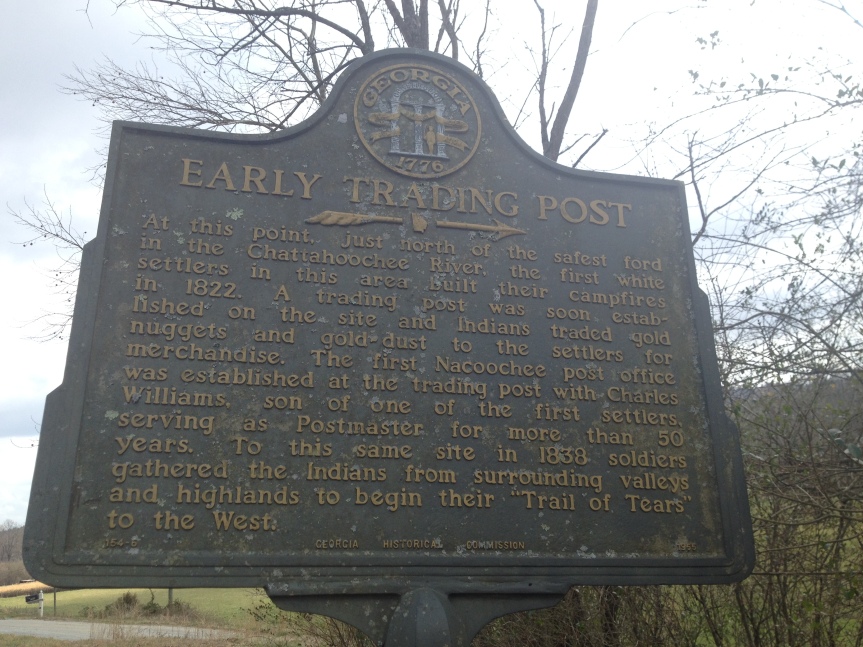
That said, directly adjacent is one of the actual gathering points (of which there were many) for the Trail of Tears… a forced relocation (that for those Native Americans not affluent enough to purchase transit devolved into an ultimately genocidal/ethnic cleansing) of the south eastern United states, during the administration of Andrew Jackson.

IMG_7191

 fullsizeoutput_332c

That said, I did find one major “FIND” a bit further down Unicoi turnpike… first you’ll find a very cute “village/crossroads” (not more than few stores) of Sautee Nacoochee which includes the ridiculously picturesque Old Sautee’s Store and market,

IMG_0002

walking distance from which you’ll find the Folk Pottery Museum of Northeast Georgia, a museum for the Traditional pottery of the area, built as an annex to a converted historic school, which now serves as the Sautee Nacoochee Center, a gallery and visual arts center for local artists (and a lot of what they have for sale — and at affordable prices considering it’s original art…  are, at least in my opinion, really good)

IMG_0001

Georgia Museum of Agriculture and Historic Village; Tifton, GA

Worth a full day stop in Tifton, Georgia (whose only other advantage is affordable hotels), when driving via Interstate 75 to or from Florida. I dedicated four hours to it, and didn’t come close to seeing it all.

I found a very good 15min film on Youtube about the how the museum is integrated with the Georgia University of agriculture, and supported by the state. It also includes interviews with the various docents and the crafts that they teach at the site.

While there is an indoor museum of agriculture at the back, the real draw here, which should enthrall kids and parents alike, is the historic village; it is probably the most complete example of what I like to call living museums that I’ve seen so far, complete with docents giving demonstrations.

When I first arrived at the attraction I was a little confused. There are essentially two entrances, the Georgia Museum of Agriculture, which is visible from Interstate 75, and the country store. When driving there, you first pass the country store (which seems to just be a store with a normal sized parking lot) and then there’s a driveway that seems to be beckoning you towards the Georgia Museum where there is a massive parking lot. So I drove to the Museum, parked, walked in, and was told by two historically garbed elderly women sitting at the entrance table there (knitting, no really, knitting), that in fact I was supposed to go to the country store first.

The Georgia Museum of Agriculture and Historic Village is actually a very good example of this “living museums” trend: they have brought in different buildings, historic ones from around the area and created a town of 1800s technology. To enter the town you ride a real steam locomotive train (the day I went the “conductor” looked to be about 8 years old),

and then are let off at the train depot (fully recreated) and left there to explore the surrounding homes, farms (with animals and fields), and often elderly docents in historic costumes/garb, who will walk you through the homes and explain whose home it was, where it was moved from, aspects of the histories of the families that owned the home, and how they ‘functioned’ with the 1800’s technology.

The old school (the original 1895 building)


There is also a working wood-mill, and a working gristmill, etc., where again docents will talk about the history of the building, and do demonstrations of the function the building fulfilled, usually allowing young kids to be involved in the safest jobs.

In the Mill, the docent also pointed out to us a board in the building where locals had sketched outlines of their most recent catches, comparing sizes, listing dates, etc.

IMG_6969

Then there was also a downtown area of the village where there were stables, complete with the local masonic lodge (with all its secrets revealed, and explained)

and a doctor’s office, with all the doctor’s tools of the day:

They even had the historic home of the riches man in town, complete with a lot of the family antiques — this home is locked up, and wait outside on the porch for the docent to bring you in for a tour.

I was there during an off day, but still about 1/5 of the buildings had docents in them. Apparently if you come during their scheduled activity days, weekends, etc., all the building will have docents who are either explaining, or giving trade and cooking demonstrations of lost skills.