The personal authentic travels of a world-wide drifter, you'll always see pics of me at the locations being described (if the other blogs you're reading don't do that, odds are they were NEVER there, just saying…)
If you’re ever in the historic town of Acre, Israel (it’s one of the oldest continuously inhabited ones on the planet) and looking for a place to spend the night that is nothing fancy, but clean and HIGHLY affordable, look no farther than Nazar Khoury’s Guest House. I stayed here for almost a full month, and LOVED IT. If you want to book with him you can either call him directly (see number below), or use Booking.com, Agoda, or Airbnb (like I did — you may need to be signed into your Airbnb account in order to see that link, I’m not sure). That said, while he has four different rooms available, his place is so much more affordable than the other places in town, that he tends to be full almost continuously (or at least was while I was there).
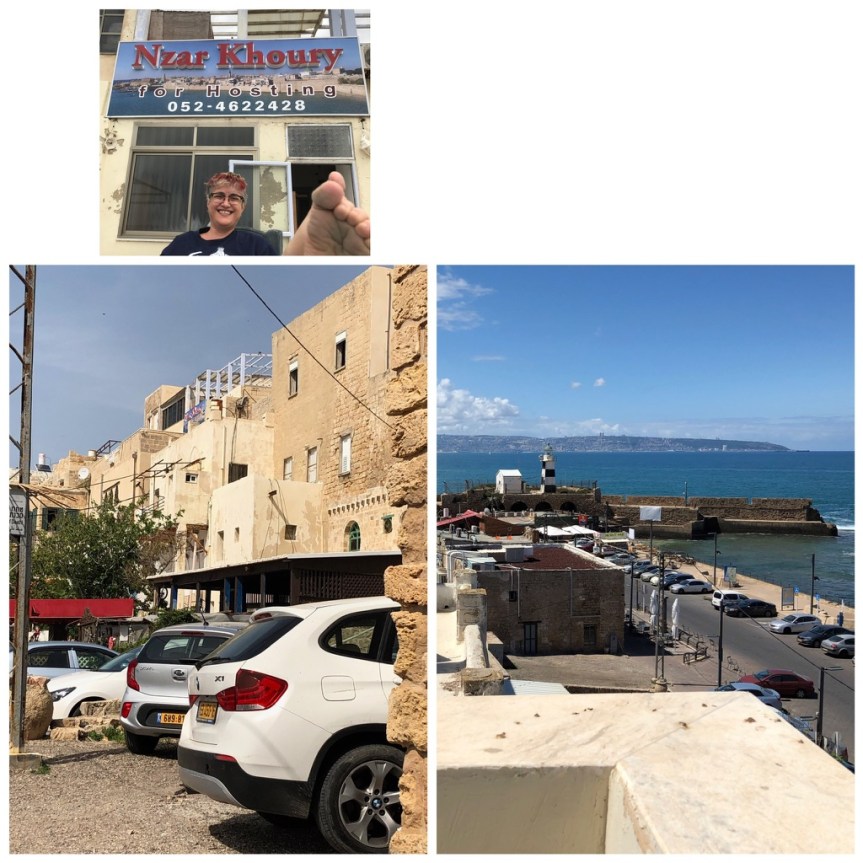
Be warned, this is NOT a fancy hotel, with elevators and bell boys, but rather his family home that he grew up in, which he has converted himself in order to accommodate guests. He runs it himself (the guy in image above) and for the most part does a pretty good job of it … If you stay here you’ll be getting an authentic experience of how the locals live.
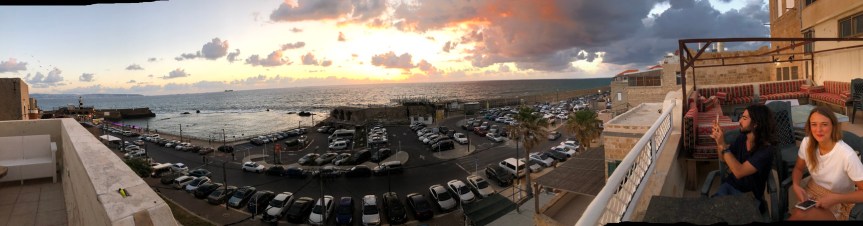
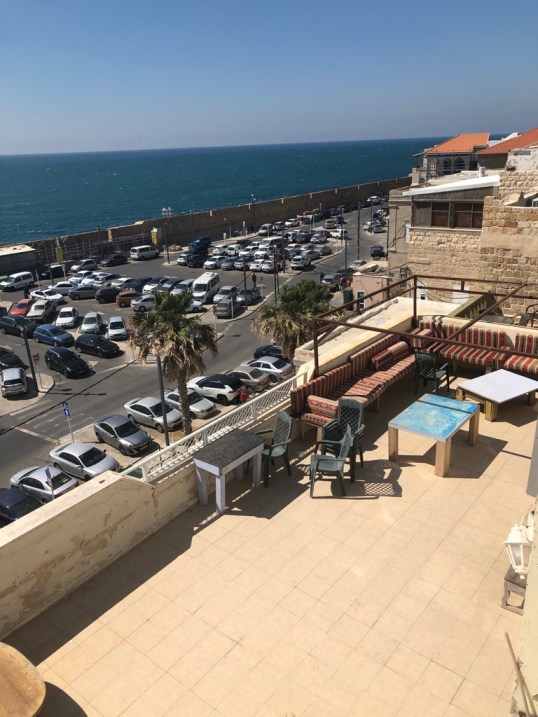
His home, which is located about four floors up, has a patio that overlooks the mediterranean ocean and the old Ottoman built seawall/ ramparts of this historic, and once militarily strategic town.
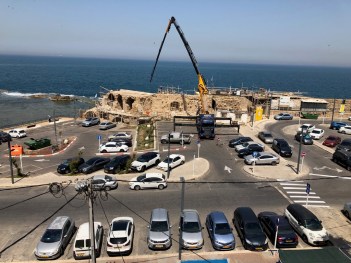
The wall is currently being renovated; I was hoping they’d leave this long enough for me to get a shot of the sun setting in the middle of it, but no luck, it was only there for a few hours.
It is an almost idyllic place to sit and enjoy the ocean. While there you can also get to know some of his other guests (I met more than few people that way) as you all watch the setting sun while nibbling on the free munchies he provides.
This picture (above) was taken at around sunset — as you can tell by the golden color of the stones, and if you look up towards the Nzar Khoury sign, you’ll spot some guests, particularly the guy in the black shirt, talking to each other while enjoying said it from the patio — next to him was in fact his wife (who was distracting him from the view).
The moon, just moments after the sunset
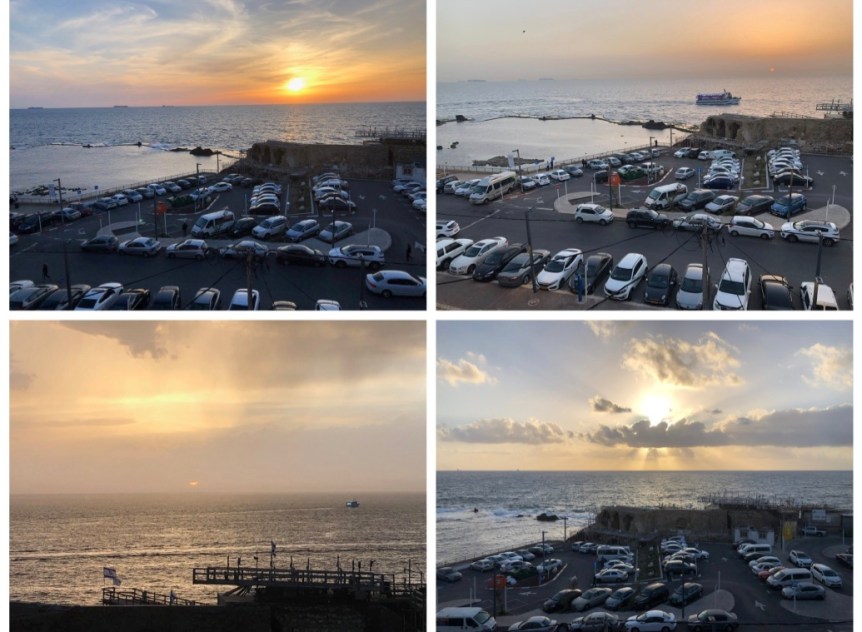
The great part about having stayed at the Guest House for almost a month was how many different sunsets I was able to watch… no two ever exactly the same
From his home you can easily see Acre’s famous lighthouse, and Haifa across the bay.
On VERY clear days you can just make out the second holiest Bahá’ítemple in the world, known as the Shrine of the Báb, it’ll look like a vertical strip from the top of the of the mountain to the bottom, with one very large building in the middle of it. I know all about the Bahá’í because one of their temples isn’t far from the home where I grew up, north of Chicago. But like I said, you can only see it on VERY clear days… otherwise the fog and or smog (depending on the color — fog is white, not brown) will block you from seeing it.
Just to the right of the lighthouse is the remains of a submerged crusader castle. On days when the wind is low and the water is still, you can just make out the walls of the various rooms of the building…
on other days you’ll see fishermen (who aren’t actually supposed to be there, but the police don’t stop them) fishing either off the exterior wall of that castle, or netting up fish caught in the pools they create.
Getting to his place is however NOT the easiest thing for people with mobility issues (it is NOT wheelchair accessible). The image above is the first set of stairs you’ll need to climb. These were built by the ottoman controlled Acre and were built more to be comfortable for horses pulling carts, then they were for humans. That said, the built-in ramps would have been a lot more helpful if they were filled in (so to speak). If you try pulling a suitcase up them, or a cart, the wheels will constantly slip off to one side or the other. (I’ve not seen anyone even TRY to negotiate them with a wheel chair.)
The Stairway and Church’s doorway, decorated for the wedding
Nzar’s home — which is built upon the remains of a Crusader Church — is just next door to the St. Andrew’s Church (Greek Catholic), which is accessed from the parking lot by that same stairway. So, if you’re lucky, as I was, from his balcony you’ll be able to watch an Arab wedding party ceremoniously lead the bride to the altar.
At the top of the stairs you make a hard left (if you go right you see the church’s front door which is usually locked) and you’ll see the big metal door that marks his entrance
The guest house’s doorway and staircase
Push it open (it’s never locked)… be careful not to pull the handle (sometimes it’ll come off)… and you’ll see a very uninviting steep staircase that’s about 2 stories high with a banister that is just a rusty pipe bolted to the wall… that wiggles a bit if you lean on it (so don’t if you don’t absolutely need to). That said, while I was there a 90-year-old gray-haired grandmother with a seriously bent back put me to shame on those stairs.
Once inside you’ll see an apartment with VERY high ceilings. These are traditional to the region, and act as a sort of natural air conditioning system, as the heat rises above your head, and the cold drops to floor level. That said, no two spaces are on the same level. All the bedrooms are a step up to a place where you can leave your shoes, and then another step up to the bedroom area… the en suite bathrooms are yet another step up.
The skylight viewed from above
My bedroom, where I stayed, has a skylight (image of it from the building’s roof)… but it’s currently the only one like that does. Unfortunately there were no way to block that light… so I ended up having to go to sleep earlier than normal in preparation for an 8am wake up (after a 6 am one, at which point I covered my head with a pillow)
The setting sun as viewed through the doorway to the patio
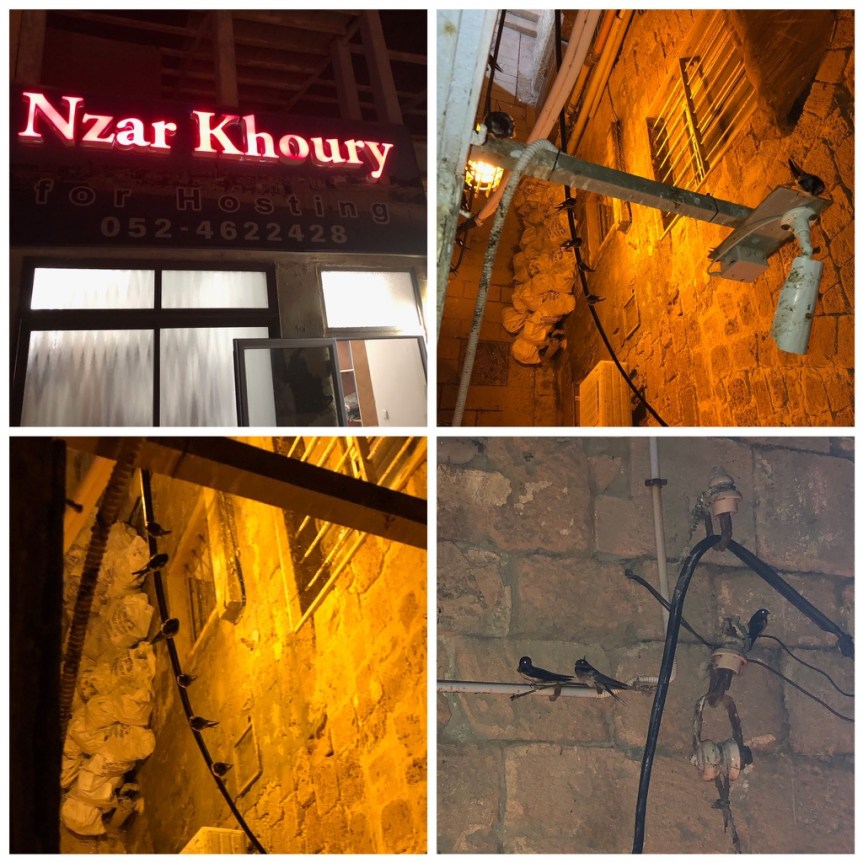
At night, Nzar lights up his sign, so you can still easily see it from the parking lot below. IF you’re in one of the rooms that lines the back alley, as I was, and pop your head out the window, you’ll an large number of swallows (who you can watch at around sunset feasting on the mosquitos, G-d bless them), hanging out on the electrical and telephone wires that line the way.
That said, I WARN YOU… they wake up really easily from things like the flash on your camera; and if awoken, they will fly around like crazy idiots for the next hour or so, chirping noisily. DO NOT WAKE UP THE SWALLOWS. That said, if you’re there during Ramadan, as I was, the wake up call before sunrise to allow muslims a chance to have breakfast, is ALSO going to wake the birds… you’ve been warned (ear plugs are your friend, as is a pillow over your head).
Me, blogging while sitting on the patio on an overcast day
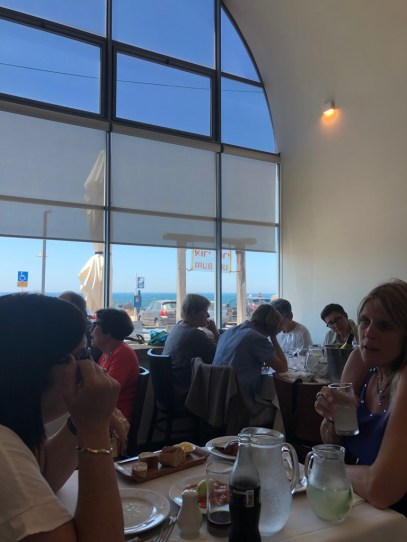
Located at the edge of the Mediterranean, in a completely renovated 400 year old Ottoman building in Acre, is what many consider to be the best fish restaurant in all of Israel, Uri Buri. According to Forbes Magazine, it is one of the three restaurants in Israel any traveler to the country must try…. and considering the place was literally a 4 minute walk from my Airbnb for a month… how could I not. That said, if you go to seafood restaurants hoping to be able to get a healthy low-fat meal… this is NOT the place for you. The place offers up what can best be described as Israeli/French/Asian fusion food, that’s heavy on the cream and oils.
The sign faces the ocean and the road… and is translucent (so I was looking through from the back)… I reversed the image making the writing no longer backwards
I knew Uri Buri was there and that a couple had spent the night at my Airbnb just so that they could have dinner there, and it was supposed to be THAT good… but as it was also really expensive. While in my 50 odd years, and they’ve been odd… I’ve had occasion to eat at some of the world’s top restaurants, I really do tend to prefer expensive meals when someone else is paying for them. If I’m going to pay three times the price for my meal I want it to taste three times as good as the cheaper alternatives… and that rarely happen. ONCE in my life, while in Kyoto, Japan, I got taken to french restaurant that only at like 14 people at a time, and was so expensive that the menu didn’t include prices (as in if you care about price, you probably shouldn’t eat there anyway) and that meal was SO good it was better than sex…. but like I said, I wasn’t paying that night. So, while I knew Uri Buri was just next door… I hadn’t really considered going in.
That said a friend of the family, when he came to pick me up to bring me to his parent’s for dinner, when he saw I was literally a stone’s throw from the place — well not with my pitching arm but a GOOD thrower could do it from the patio of my airbnb, see the image above — he said that I HAD to eat there at least once while I was staying in Acre. See the red and blue sign on top of the building on the left side image, that’s the patio of the airbnb I stayed at for 29 days; the stone building on the right edge of that image is Uri Buri… as is the low flat squarish building visible from the patio, looking down. THAT is how close I was to the place…
So of course I HAD to go there…. how often in life are you THAT close to world-famous restaurant? The first time I went was a weekday at three in the afternoon — without a reservation. In spite of it being mid-week and middle of the day, they told me they had no spare seating inside; but they could, however, seat me outside… if I was willing. It was one of those odd days when it is too hot to sit in the sun while too chilly to be sitting in the shade, and insanely windy…. but, never the less… I said yes.
For this first visit, I approached Uri Buri as I do MOST restaurants… I explained about my fatty liver diagnoses, what that meant in terms of my dietary needs, and asked them what they could serve me that would not piss off my doctors. They promised to bring me a very low-fat grilled piece of fish that was healthy… on a bed of purred squash with balsamic… sounded good… and looked very good
Sadly, on closer inspection the fillet had been pan-fried, and was dripping with oil. My first thought was that maybe the concept of my having a serious medical condition that demanded I eat very low-fat meals had fallen on deaf ears… Later I considered that maybe the food here was normally SO ridiculously oily, that from the chefs perspective this in fact was their idea of low fat by comparison … as in maybe the dish is normally served swimming in rosemary butter. That said, it was clear to me that really, no one could eat come here with the expectation of a really healthy meal.
A picture of my host, Nzar
Afterwards my Airbnb host, who had converted his childhood home into a guest house… suggested that I really should try Uri Buri’s tasting menu at least once before leaving. [For this they charge you for every item you eat, but the portions are smaller than if you ordered each dish alone.] This Airbnb, while GREAT, has a host who loves his guests and demonstrates that love by laying out a daily Smörgåsbord of food… and my impulse control is NULL… as a result my diet has been LOUSY during my stay anyway, and I’ve gained a good bit of weight… so in my mind, I might as well try this famous tasting menu as I’ve decidedly screwed my diet anyway …. and then try hard to get back on the bandwagon afterwards.
When he got to that table, I heard him speaking in German to the customers, NOT Israelis
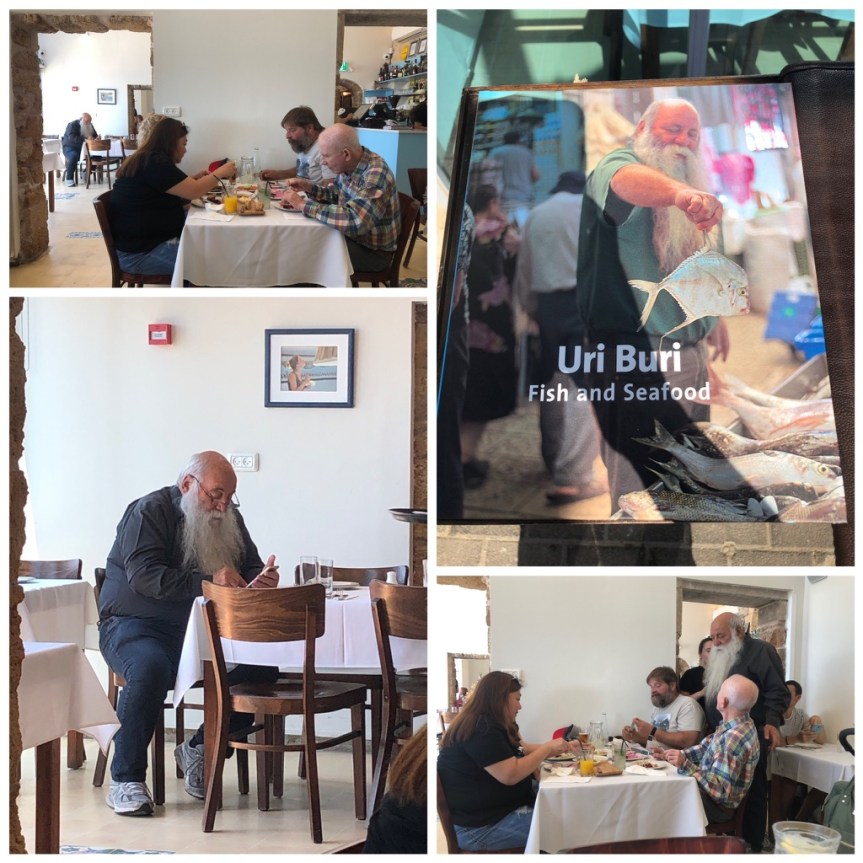
So I went back about two weeks later in order to try their tasting menu, and discovered why that is: see the guy who looks like Father Christmas? He’s the famous chef who owns the restaurant. Looking at him as an American, yah he’s a bit on the heavy side… but looking at him as an Israeli… I can not overstate this… he’s morbidly obese. Walking around Israel, IF you see anyone that’s anywhere near as heavy as he is.. than either they’re tourists visiting from abroad, or moved here recently, after having spent most of the lives in countries that have obesity issues. Israeli’s are almost never fat by US standards (at worst they develop a bit of a belly in old age). This is because they eat a diet that’s very low in processed foods, and because meat is very expensive here, if there’s protein on their plates at all, it’s usually chicken, fish, lamb or mutton — and for many its only eaten one meal a day, with the rest being vegetarian (or an egg). Most meals consist of a small amount of meat protein, and high amounts of vegetable ones… like hummus. And all meals arrive with multiple vegetable salad options on the side. As such, the average Israeli can afford to eat his cooking to no ill effect, because it’s not a daily thing. He on the other hand DOES eat his own cooking daily … and well… nuff said.
All of the folks in this photo were Israeli (I heard them all speaking Hebrew), note the sizes
This time I also arrived mid-week, and without a reservation at about 2:00 in the afternoon, but this time it was during the Islamic fasting month of Ramadan (and I had noticed a significant drop in tourists to the guest house since the festival began). As such I was guessing I could probably get a table, and yes, this time they were able to seat me inside the building … and I ordered the tasting menu.
17 ₪ and 14 ₪, so $4.76 & $3.92 USD
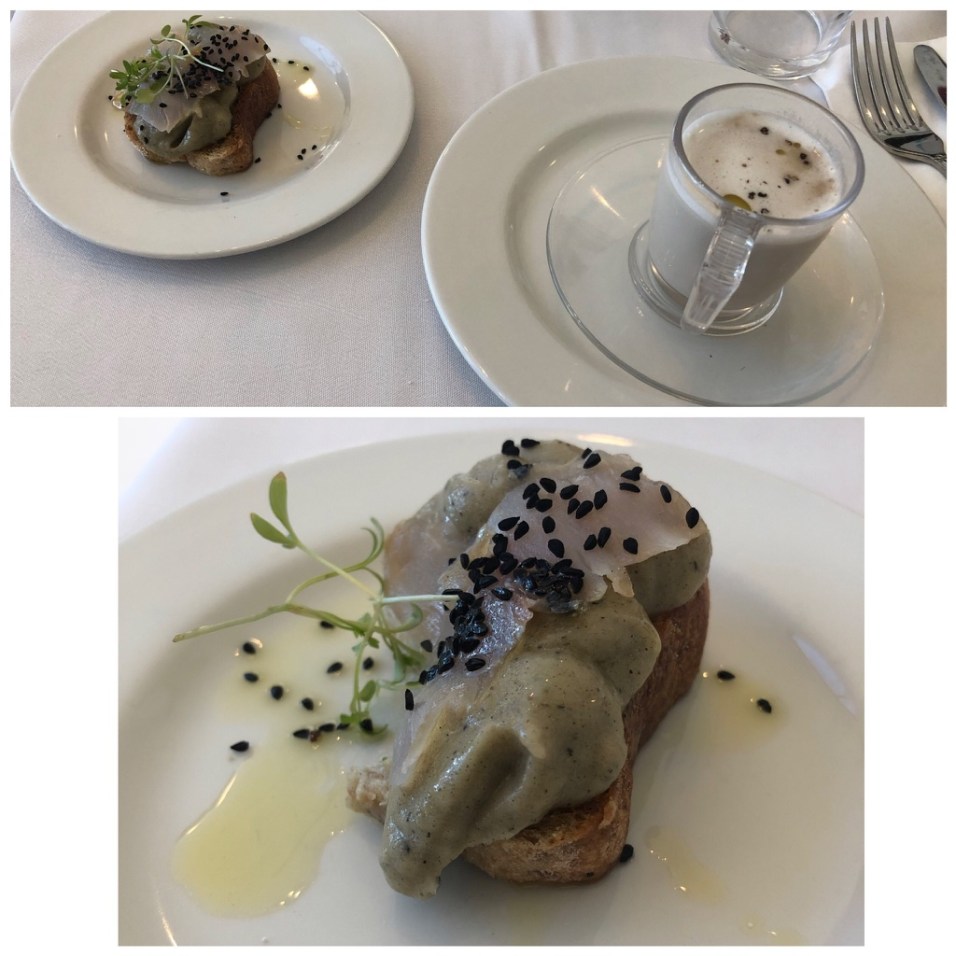
The first course was a seafood bruschetta, with some sort of white fish sitting on a puréed eggplant with what I thought were poppy seeds and drizzled with olive oil. It came with an espresso cup full of mushroom soup. topped with truffle oil, according to the waitress. Immediately I was like, “huh?” as this is an ingredient while trendy is usually considered verboten by top ranked chefs, who consider it an abomination. But this guy prides himself on being “self-taught” so … whatever. The soup was consistent with how Israelis like their mushroom soup (there’s a particular taste to it, not how I like it but… this is Israel and it’s how they expect it)… but already between the cream in the soup and the truffle oil, PLUS the oil drizzled on the bruschetta … my body mouth and stomach were going, SERIOUSLY??!! But at this point my body isn’t really used to a lot of oil at one time… most people are. So… fine, whatever…
18 ₪ = $5.04 USD
The next course was a Scallop sitting on a purée of artichoke with spirulina syrup. First I had a hard time understanding what the waitress was saying — she had a very strong Israeli accent — and then once I did I was kind of surprised. In the states this is usually the word used for the dietary supplement, not the food… which basically is just a high protein blue-green algae (the sort of thing that was supposed to solve the world’s food shortages once upon a time, think Soylent Green). I suppose spirulina sounds better than algae to the average Israeli… most of whom are a bit pedantic when it comes to food. That said, The scallop was a few seconds under cooked (you can see that in the picture… it should be clean white ALL the way through, not just at the edges… while not being rubbery (which is over cooked). This one is solid white at the edges and then shifts towards a sort of translucent white … which means not fully cooked. But that said… I regularly eat scallop sashimi and/or sushi, but still, this was supposed to be cooked, not seared. And, if that weren’t bad enough… it tasted slightly fishy (so not particularly fresh). Also, you couldn’t really taste the artichoke at all while the after taste of olive oil was strong. When the waitress asked me how I like it, she get defensive and said that was how the scallops are supposed to be when cooked… ah no, sorry.
The next items were “Caramelized Tilapia on a bed of Beets” along with their signature dish … “Salmon Sashimi with Wasabi ice cream/sorbet” — which the waitress I had the first time I came here had been trying to push at me as something “really special!”
27 ₪ = $7.56 USD
Firstly, lets start with the tilapia… a fish I HATE by the way. Sometimes referred to as the aqua-chicken, because it’s the easiest sort of fish to farm in pools and hence super cheap… it’s not any one sort of fish, actually, but rather a random assortment of small white fish that have been selectively bred in order to assure they grow quickly and survive in captivity. Basically the same way we’ve screwed with chickens and cows … which is how it got its other nickname, “frankenfish.” There’s a lot of debate about this fish and how healthy it may or may not be at this point. But, that said, it’s almost always a very very mild fish, and as such is great to serve to people who don’t like fish…. because it barely tastes of anything. If you then go and give it a teriyaki glaze, which is what they did… calling it caramelized was a bit of a misnomer, then you’re not really going to taste ANYTHING because teriyaki is a pretty strong flavor. If you then place it on top of pickled beets… YUP, not fresh beets which would have been great… these were pickled… sort of Jewish food 101… well then between the pickled beets and the teriyaki you’re REALLY not going to taste the fish. The fish was completely overpowered by the other items on the plate. This time the waitress said I didn’t have to eat it if I didn’t like it… but beets are good for you, and pickles are probiotic… so I finished it like a good girl…
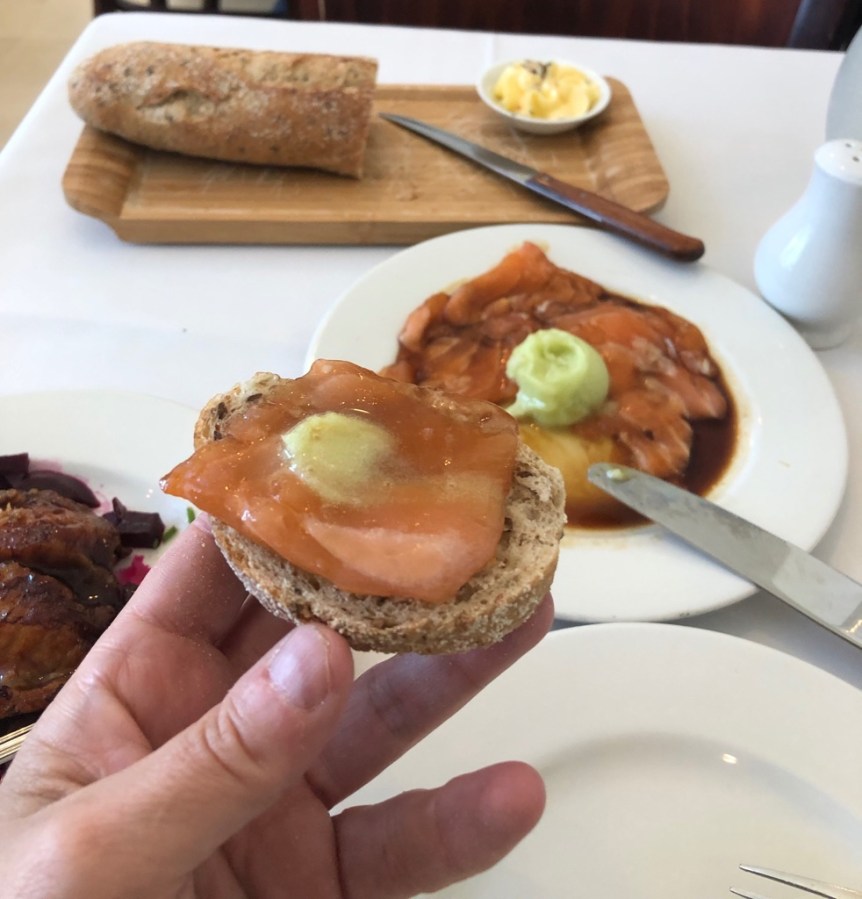
Then there was salmon sashimi with wasabi ice cream, their signature dish… which I was told to eat on the provided bread (good bread, tasted like multi grain)… I skipped the butter cause… butter
Enter a caption
The salmon was ok, except for once again having been drowned in a sweet teriyaki sauce rather than just soy (there was something really glutenous about it). I think again it is because Israelis who eat sashimi do so because they want to be seen as cool, not because they actually enjoy raw fish. So add sweet soy and they’ll like it more. As to the Wasabi ice cream… firstly it didn’t taste anything isn’t wasabi, not even the American sort which ISN’T (no really it’s not) … the American stuff is usually made of the mildest horseradish they can find, with color added (actual wasabi has to be ground fresh and eaten within about 15 minutes of grinding… and has a mild floral sort of thing going on that opens your sinuses gently, rather than painfully) …. This stuff however was a very STRONG horseradish, as in it didn’t even TRY to approximate wasabi.
52 ₪ = $14.56 USD
It was like the horse-radish Jews eat at passover … straight.. so we can experience the suffering of slavery. Only this was that… with a lot of sweet added to it. When the waitress asked me my opinion of this dish, she was like: “well you’ve never had wasabi ice cream before!” And I was like, actually I have, many many times. The waitress was shocked as she had believed the chef had invented the stuff…
17 ₪ = $4.76 USD
The next dish was finally one that made me happy. It was seafood soup, what looked like squid and shrimp cut up small, with coconut milk and a touch of curry. The heat began as barely perceptible, although the taste of curry was there, and then grew as I ate it but never past the level of a soothing warmth. Total winner! One thing to know is that in Israel seafood does not mean a mixture of fish and shellfish, as it does in the rest of the world; rather, it means shellfish. Fish is fish, but seafood is shellfish; this is a way of distinguishing between kosher and not… fish in Israel is always KOSHER fishes (fins and scales that are easy to see and remove), and seafood is not… so it might include catfish, shark, dolphin, etc., but I’ve never seen it.
69 ₪ = $19.33 USD
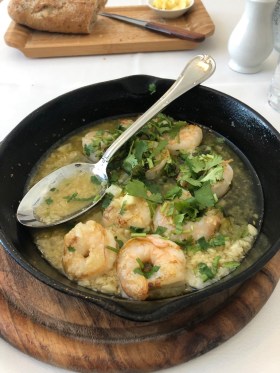
The next dish was Shrimp in a Mediterranean sauce—- LOTS of garlic, oil, what I thought was fresh parsley but the menu said was coriander …and enough lemon that the garlic tasted almost pickled … along with a few bits of sliced up jalapeños.. this dish had a nice fresh flavor and wasn’t TOO oily (once I allowed the sauce to drip away from the shrimps)
free apparently
She then asked me how full was I, as there are still two main dishes to go, and did I have room for both? I thought about it, and said, no I really could only do one more, so she gave me a choice from those two options. Then she brought out a sorbet to clean my palette of all the garlic… first taste was still full of garlic so I thought it was mango but she said it was mandarin orange… when I said it wasn’t sweet enough and had a bit too much bite… she said that’s how they are in Israel… ok fine… it did what it was supposed to do, clean the palette.
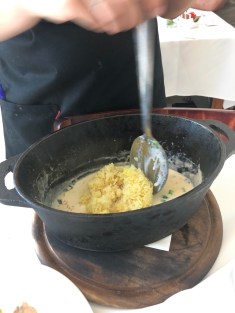
The final main dish was Trout in a cream sauce with green onions, and a side of risotto. It arrived with … lots of fan-fair in a super hot cast iron pot. The the fish was allowed to finish cooking in the bubbling cream sauce, and was then moved to the plate and a dish of yellow rice was then dumped in the cream and stirred “to make risotto” according to her. My brain went straight to… “risotto isn’t just rice with sauce added to it” … but I kept my mouth shut (it’s a starchy variety of rice cooked a specific way).
67 ₪ = $18.77
The resultant side dish was heavy on the cream but tasty … and the fish is good
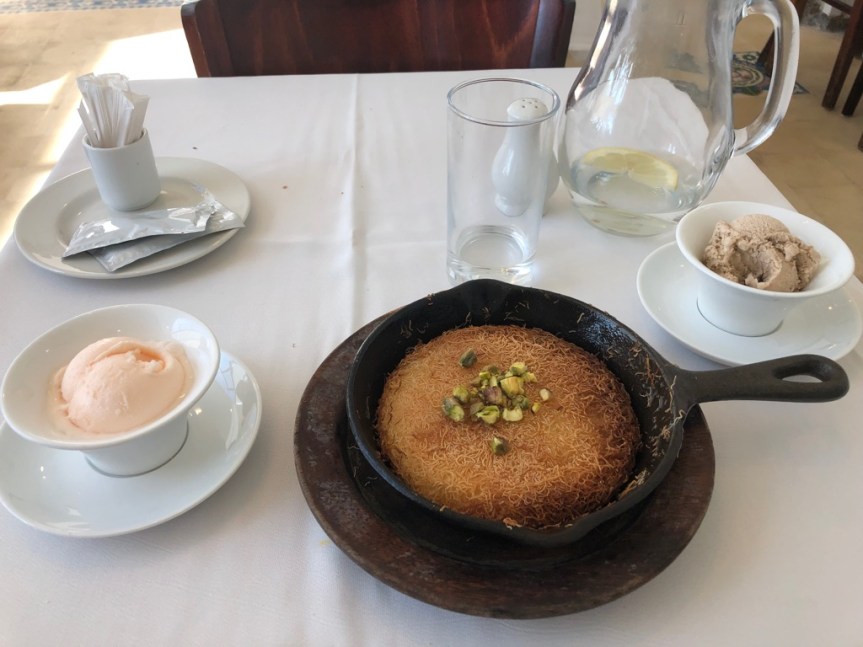
For dessert I decided to getting the Palestinian dessert knafeh which she promised me would be the very best example of this dish I’ve ever had. In Acre they make it differently than how its done in Tel Aviv — where to my taste it is WAY too sweet… in Acre its subtly sweet, and to my mind, much tastier. She promised me that this one would be way better than even what’s sold by the local bakeries in town. After my having “already had wasabi ice cream” issue, she wanted to know if they had a flavor I’d never had… She assumed it would be Cardamon, but I’ve had that and rose…. so she’s said she’d bring it with date ice cream … but brought the requisite rose-water ice cream as well
42 ₪ = $11.76 USD, and she threw in the 2nd ice cream free
the Rose Ice cream was actually Meh… inferior to what I’ve had before, but the date ice cream was really nice… the knafeh was … eeeh… again not WAY better than the other places in town.
Toward the end of my meal a young German couple arrived who were VERY excited to eating here (like seeing a movie star excited) … according to the girl there’s a German travel food show that this restaurant was presented on as a MUST experience once in your life kind of place….
That said, my very FILLING lunch (my stomach was distended) took two hours to eat and came to 323 ₪/shekels… ~$90 USD…. before the %15 tip… and in spite of it feeling like I’d eaten a lot of food (mostly because of how much cream and oil my stomach was having to deal with… it was almost gurgling because of all the gas… I was a farting machine for the rest of the day) with the possible exception of that one soup… nothing struck me as being worth the price. By US prices (and keeping in mind it was small portions of every item) it doesn’t seem to bad… but any other restaurant in town would give you a triple portion of that shrimp dish for $14 USD and with it would be huge portions of at least six different salads (humus, tahini, Jerusalem salad, beet salad, cabbage, tabouleh, etc.) which are ALL YOU CAN EAT, like at a Korean place…. plus all the pita bread you need to go with it.
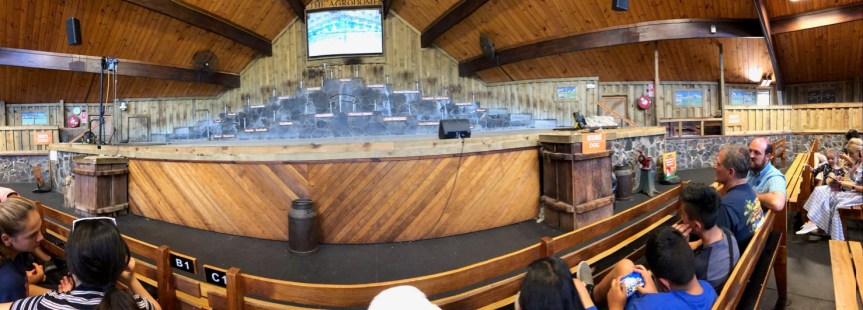
If you’re in Rotorua, New Zealand, and looking for a low exertion activity (with air-conditioning) that’s entertaining for the whole family — and a bit educational, I STRONGLY suggest a visit to the Agrodome. This 40-year-old “award-winning” Farm Show takes place on a 350 acre farm, that you can also pay to take a guided tour of (mostly a riding tour rather than a walking one, so also good for people with mobility issues). The attraction is really geared towards families, and their family priced ticket is a bit of a deal, as it costs the same as two adults and a child, while allowing three children. And if you check their website, they sometimes offer on-line ticket discounts. The show lasts an hour, and only happens three times a day, so make sure to time your arrival accordingly. It’s a highly entertaining show, that’s in my opinion, and worth the $36.50 (NZD) [$24.03 USD] — even though the price seemed a bit steep to me at first.
We arrived at the Agrodome pretty much first thing on our arrival into Rotorua, which I now know is one of the major tourism meccas for both for folks who are road-tripping through New Zealand and locals. As in, pretty much anyone who does the trip is going to be spending a day or two here taking in the sites, which include geysers, and other geothermal activities — mud pools, i.e., mud so hot it bubbles and is utilized for things like high-end full day spa treatments, etc.,. In addition, other attractions of interest to tourists have developed in the area, including multiple Māori cultural daytime and dinner shows, etc., rides of various types, and attractions like the Agrodome.
To put it in perspective for Americans, Rotorua is a bit like the Wisconsin Dells area north of Chicago, the Gatlinburg area in the great smoky mountains, or the Canadian side of Niagara Falls (which is all casino’s, etc.). All of these locations began as places that people came to in order to appreciate the natural wonders of mother nature… but tend to have devolved over time into decidedly working and middle-class tourist traps, as the majority of their day-to-day customers tend to be nearby locals who can’t afford travel further afield. In ANY town like this, all the attractions tend to be a bit overpriced, I suppose this is done partly in order to make the customers feel like they’re buying something of value. (‘It’s expensive so it must be good’, being a pervasive misconception by the average customer that marketers utilize when positioning a product.)
Again my favorite quote from American Gods by Neil Gaiman comes to mind
“So what is this place?” asked Shadow, as they walked through the parking lot toward a low, unimpressive wooden building.
“This is a roadside attraction,” said Wednesday. “One of the finest. Which means it is a place of power.”
“Come again?”
“It’s perfectly simple,” said Wednesday. “In other countries, over the years, people recognized the places of power. Sometimes it would be a natural formation, sometimes it would be a place that was, somehow, special. They knew that something important was happening there, that there was some focusing point, some channel, some window to the Immanent. And so they would build temples or cathedrals, or erect stone circles, or…well, you get the idea.”
“There are churches all across the States, though,” said Shadow.
“In every town. Sometimes on every block. And about as significant, in this context, as dentists’ offices. No, in the USA people still get the call, or some of them, and they feel themselves being called to from the transcendent void, and they respond to it by building a model out of beer bottles of somewhere they’ve never visited, or by erecting a giant bat house in some part of the country that bats have traditionally declined to visit. Roadside attractions: people feel themselves being pulled to places where, in other parts of the world, they would recognize that part of themselves that is truly transcendent, and buy a hot dog and walk around, feeling satisfied on a level they cannot truly describe, and profoundly dissatisfied on a level beneath that.”
― Neil Gaiman, American Gods
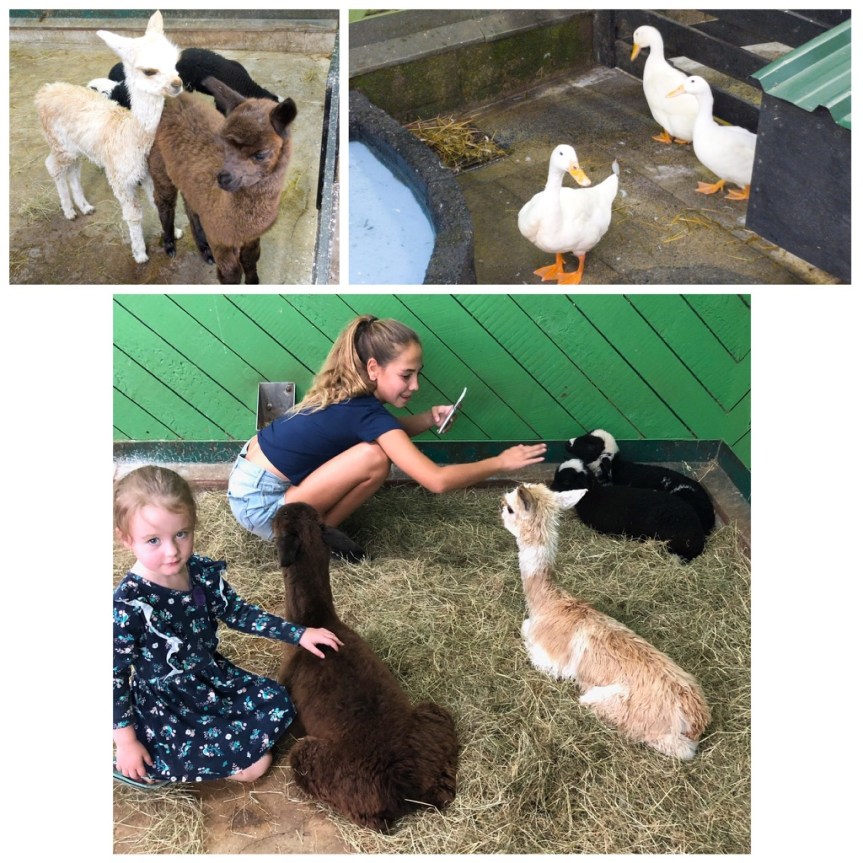
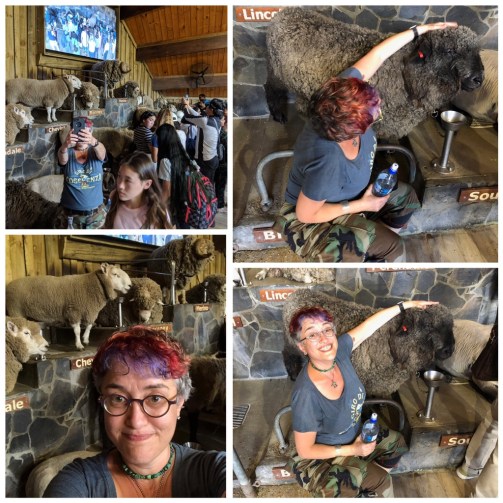
That said, IF you get there early (before the final show — which is the one we attended, off to the left side (as you’re facing the stage) of the theater there’s a petting zoo type area with baby animals and ducks
…they will be taking part in the show later… However, if you wait till after the final show… they might not be there, as its sort of a holding area (I’m guessing they go back to see their mom’s afterwards).
The show begins with a sort of “fashion show of sheep” beginning with the local star, the Marino. In case you’re unfamiliar, this breed produces the finest and softest wool of all the varieties. While expensive it is AMAZING, and any item made of it is utterly worth the investment. MOST my socks, with the exception of my compression stockings (edema runs in my family) are merino wool — and have been since I experienced my first pair. First time I saw them was in shop catering to outdoorsy types, and I was like “$20 for a pair of SOCKS?!! Are you MAD?” but the staff members assured me that they were entirely worth it. They challenged me to buy one pair, wear them for a full week without washing, and then sniff them. Seriously… not only do these wick moisture from you feet, but they also naturally kill foot oder issues… AND they are incredibly sturdy and last way way way longer than any other socks I’ve ever owned (and never stretch out over the course of a day).
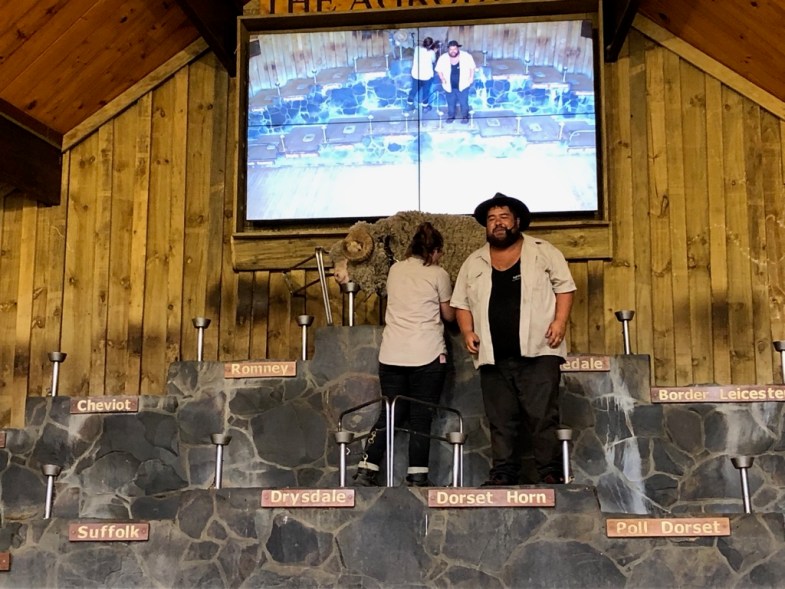
Each is led in individually, introduced to the crowd, and its particular attributes described… so for instance the breeds like Merino, that produce wool that’s great for clothing, while others are desirable more for their meat than their wool.
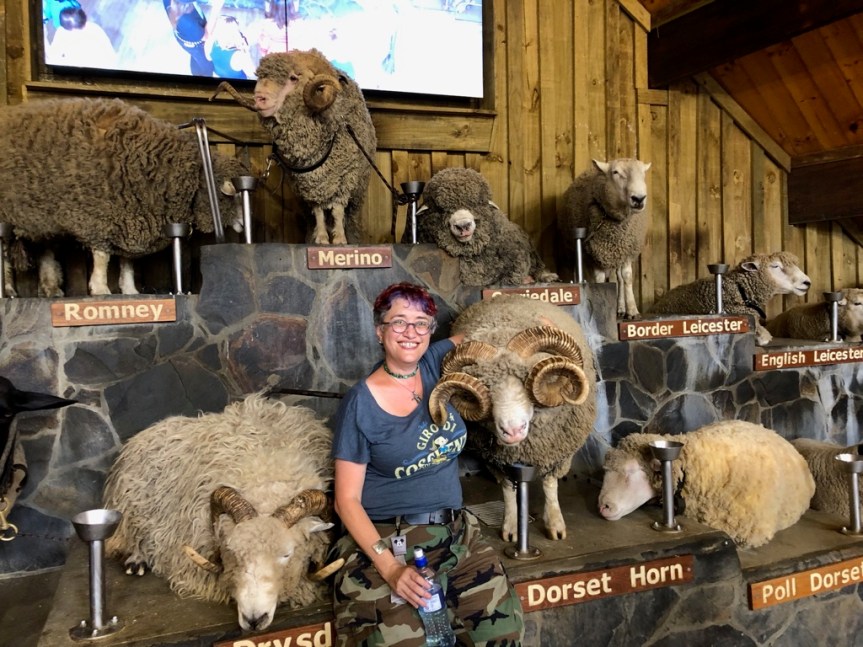
In the above image he’s introducing the Drysdale breed; this New Zealand created breed is raised primarily for its wool. It was developed in the 1930’s by crossbreeding a genetically freakish Romney ram with unusually coarse wool another Romney and a Cheviots resulting in a new breed of genetically modified sheep. One of the freak attributes is that both genders have horns, and its wool grows so quickly that it has to be shorn twice a year…. and the wool it produces is coarse and sturdy, so it is great for things like rugs…
The full selection of “beauty sheep” on display
Once all the sheep have been led in and introduced, that is when you’ll get to see, the thing I was most hoping to see…. a sheep being sheered
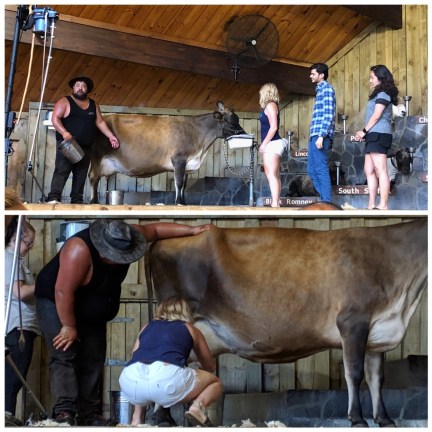
You, or more likely your older kids, might be chosen from the crowd to come up on stage and experience the joys of milking a cow
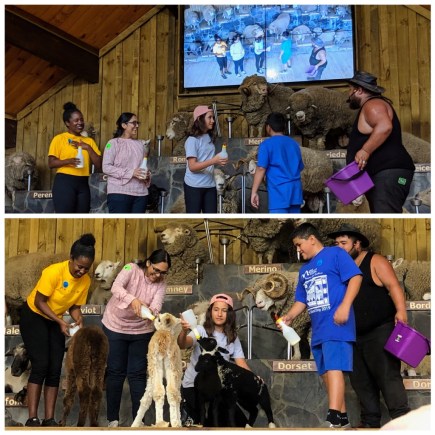
or the excitement of feeding baby lambs and alpacas (who are ridiculously cute)
and then you’ll be able to watch demonstrations of sheep dogs showing off just how smart and capable they are.
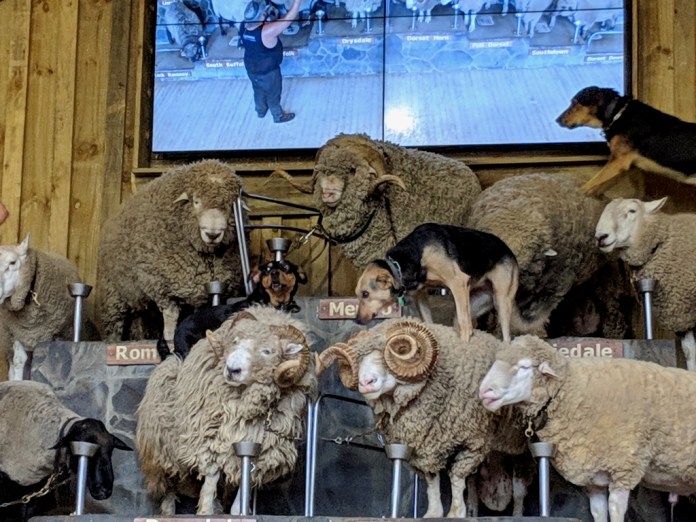
Initially, a single dog is asked to herd around the stage a small bunch of ducks, the ones from the petting farm area, proably because there simply wasn’t room to do it with sheep. But then a different dog is asked to displayed something far more impressive, the ability to jump on top of the sheep’s backs, running across them like stones in a stream …
something the dogs need to be able to do in order to get a better vantage point from which to view of the entire flock, and be able to protect them from possible threats…
such as wolves, AND then they do it as a pack, multiple dogs run on stage and they do it together… even running past each other without falling off. I was impressed, having not known they could do it.
After this highpoint of the show, the audience was invited to come up on stage, pet the dogs and take their pictures with the sheep…. and folks didn’t need to be invited twice…
people raced up there really quickly and competed with each other for the best photos and to pet the animals
we took our time and I waited for the crowds to clear off….
After that, I of course insisted that I have a chance to check out the gift shop. For the most part it was pretty much the same stuff you see in almost every other gift shop in Australia, so not really that big of a deal. That said…
I had spotted this toy, which was a stuffed animal with actual sheep’s wool as the coat and thinking I might want to buy it looked at the tag to do my normal “look but don’t buy” then…. go home and find it on-line for probably less money than at an impulse driven shop (like this one). While doing so I definitely noticed that it doesn’t actually SAY made in NZ anywhere on the tag … but in way that sure as hell would lead the less trained observer to assume it had been… and I was like, “HEH, their gift shop is selling NZ stuff not made in NZ!” (and knowing what that told me about the politics of the owners) …. and then when I got home and googled it, sure enough! There was actually a legal suit brought against this souvenir company for misleading tourist into thinking they were buying NZ goods.
If you’re passing through Paeroa, while road tripping New Zealand (NZ) — let’s face it you’re most likely on the way to some place else — you WILL be seeing these two “Big Things”, i.e., huge bottles with the letters L&P on them located at either end of town. They represent one of NZ’s national soft drinks, which is made in here, using the local water.
It is a super sweet lemony concoctin called L&P, short for Lemon — because it’s supposed to be a lemon tasting drink & Paeroa, the name given to the magnesium bicarbonate rich water of the springs located here. That said, the brand is no longer made here… it got bought out by Coke years back and is bottled up in Auckland …. although I’m not sure how many Kiwi’s know this.
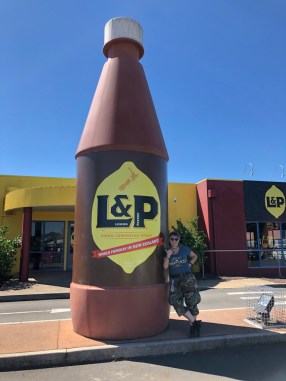
bottle in front of cafe
The bottle above, located in front of the L&P cafe, is one of two such bottles in town. In the photo I’m pointing at the advertising slogan on a red banner across it’s front… which reads “World famous in New Zealand.” I thought that was pretty witty, but learned afterwards that, according to Wikipedia, it was so successful that it has become a popular saying in New Zealand.
bottle in park
At first I assumed the one in front of the cafe was the promosed “big bottle” but when we got there we were told that it was in fact the smaller one. The BIG one, is at the other end of town in a small park along the main road/highway… Although, that said, if you compare the one above with the one below, to me they looked to be about the same size, only the one in the park is standing on a pedestal
In case you’re completely unfamiliar with the product, L&P is a local to NZ brand of a lemony flavored soft drink… that in my personal opinion wasn’t very lemony, and actually tasted kind of fake … like some lab’s idea of lemon… And then of course I read the ingredients and…. its basically water, sugar, a lot of acid, and Citric acid (330).
As I discussed at length in the article about my visit to Hobbiton, (the movie set where the Hobbit Shire for the Lord of the Rings Movies where shot) is that while New Zealand’s economy is ranked first in the entire world for its socially progressive policies, and has a reputation for being one of the cleanest and greenest among the First World/western block, high income, Organisation for Economic Co-operation and Development (OECD) countries…. the reality is that it is, ironically, also the most DEregulated government within that institution.
This is the result of the economic policies of Roger Douglas, who was NZ’s Minister of Finance back in 1984, as part of the country’s Fourth Labour Government (1984-1990). Known as Rogernomics, a hat-tilt to Ronald Reagan‘s Reaganomics, he had instituted a set of neoliberaleconomic policies, the most important of which from the perspective of this piece, was an almost complete deregulation of NZ’s industries.
A retrospective of how L&P containers used to look, located in the entryway of the cafe
In day-to-day life, part of how this shows up for the average consumer is that in New Zealand, food labeling is DEVIOUS… so if you look at the close up of the bottle’s ingredients it says “food acid (330)” rather than “citric acid” … and ALL chemicals put into foods are like this… You know how in the states the general rule is if your reading the ingredients list and you can’t pronounce the ingredient you probably shouldn’t consume the product? Well in New Zealand ALL food additives are some easy to read words and a number code.
First my friend and I went to the L&P cafe location (which is the first one you’ll hit if driving south from Auckland to Wellington, and pit stopped long enough to try a bottle of the stuff and use the facilities.
While the menu looked ok, I was actually holding out, if you can believe it, for a pit stop at the McDonald’s down the road. No, seriously! This was because along with happy meals in New Zealand’s McDs were giving out children’s books by Ronald Dahl (he of Charlie and the Chocolate Factory, which was renamed as Willy Wonka and the Chocolate Factory for the movie version) with the happy meals instead of toysThe book being given out was his story Matilda (which in the movie version is called Matilda), only given out one chapter at a time — so that the title of the chapter was the title of the book — but with no reference on the cover to the fact that it was part of the larger book called Matilda. But for the fact that I’m very familiar with the story (not just the movie) I would never have known… and I was hoping beyond hope that at least they were giving out a chapter a week, because ever McD’s I stopped at was handing out the same “Marvelous Miss Honey” mini book.
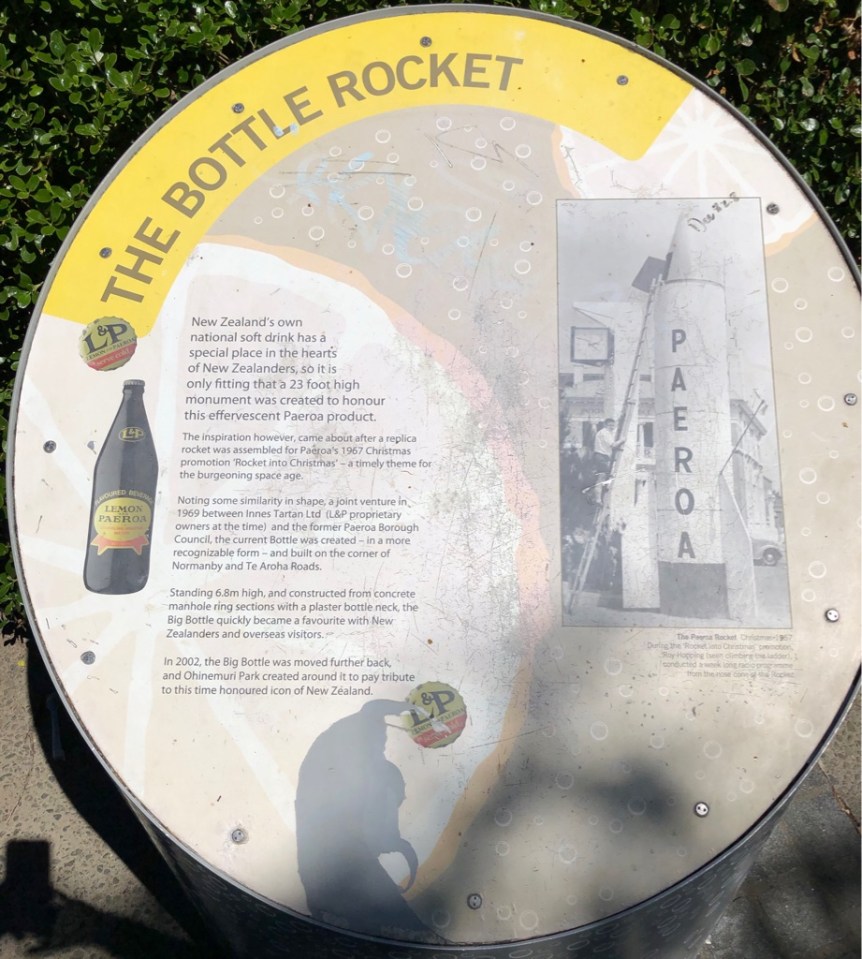
After this we stopped at the park at the other end of town where the “bigger” bottle was located. This one had little spots on the ground leading to it, which I’m guessing were supposed to be bubbles… which was kind of cute…. and a collection of signs talking about the history of the town
As well as the history of the product
According to the sign above, the reason the drink was made in this town, and I guess was made part of the drink’s name, was because the water in the town is naturally effervescent…. hence the bubbles on the floor.
That said, we weren’t the only ones stopping to take a picture with the bottles… only these guy had the good sense to bring bottles of the stuff with them for when they posed in front of it.
If you’re staying in Auckland, New Zealand (NZ), have a car, and are looking for a nice location for a nice day trip location, I strongly suggest Piha Beach; it is a one to two-hour drive away (depending on the traffic) and gorgeous, with lava-rock formations and black sand beaches. It is the most popular day trip destination for Aucklanders (hence the variable travel times), as along with sun, sand, sea and surf, it offers some nice bush walks, including one vertical/aerobic one up Lion Rock.
The day we went here, we’d just picked up our rental car the day before, and had been intending to road trip up north … but I was still trying to shake off a pretty bad cold I’d picked up the first day we arrived, so rest was a priority.
Views of Auckland as we drove north over the bridge
My friend had initially suggested we go see the Tāne Mahuta, the largest kauri tree known to exist today (in keeping with my love of BIG THINGS), which is located in the Waipoua Forest, towards the north end of the north Island…
Kiwi Valley Farm Park, a spot along the route to the beach
but that was 3.5 hours each way … without stopping for anything … so it would have been too much of a strain for me in my condition (things to do next time I go to NZ). Instead, I did some digging on-line and I found this beach that was at most 2 hours away with traffic (because it was a Saturday), but might be a lot less… so we did that…
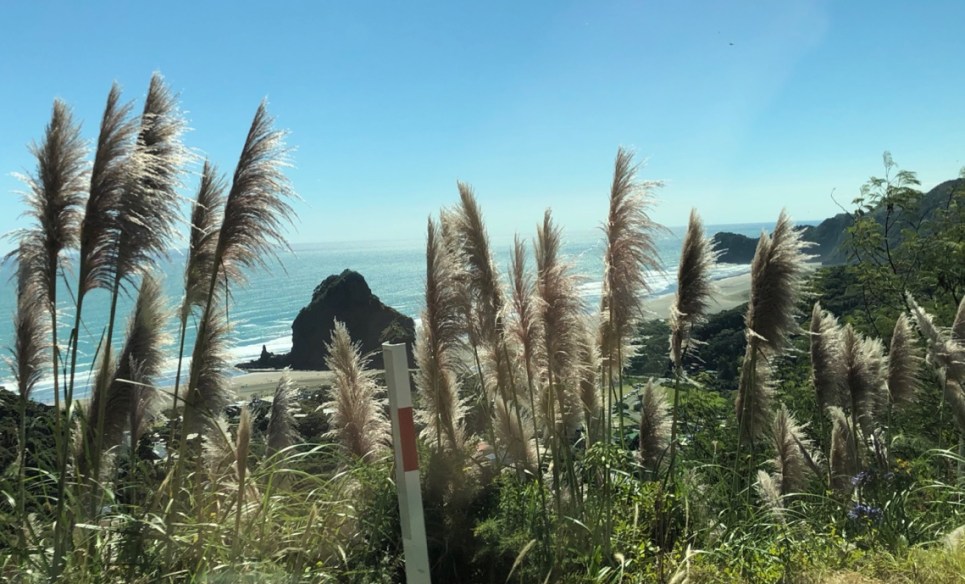
View of the beach from Piha Beach Lookout, Piha Road
We were actually kind of lucky, and because the weather was kind of cool that day, (I liked it, he through it was a bit chilly), traffic to the beach was minimal. That said, it is 39 km (24.25 miles) west of Auckland, on the Tasman Sea coast, has two surfing beaches ….. and is quite pretty and restful.
The population of Piha is so small (600 people) that technically it doesn’t even meet the requirements for a town, and is instead considered a settlement.
Along with the two beaches is one sheltered lagoon, although as the signs said, that is NOT safe for swimming, fishing, etc. When we first arrived, I was tired and really wanted my morning coffee, which I had forgotten to drink, and a snack… so I headed to the coffee-house just a bit up the road from the beach… keep in mind I was struggling with a cold (while there I also picked up a few T-shirts from an adjoining gift shop).
View from the cafe’s patio
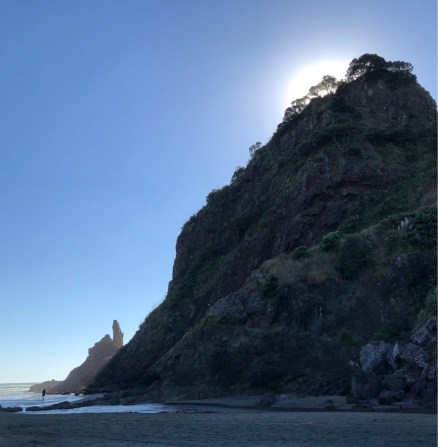
My travel buddy at the same time proclaimed a desire to climb Lion rock, which divides the two surfing beaches from each other,
Note the TINY figure on the beach (bottom left) to get a sense of the scale of the thing
and like all mountain tops in NZ, holds religious, historic, and cultural significance to the Maori people… and as such must be approached with respect….
This image was taken by Mik, my travel buddy, with HIS camera
[Note the people in the image below, beginning the climb up the rock formation]
I learned later while researching about the beach for this blog, that Lion Rock is an eroded 16-million-year-old volcanic plug rock formation. [The following images, OBVIOUSLY, are not in fact mine but were taken by my travel buddy with his camera, and borrowed with his permission… he even said I could post them. I couldn’t have taken them because I was sick with a cold, not to mention the fact that a climb like that would be unsafe for me due to my physical constraints.]
In the image below [again, his] if you look at the road going up along the river near the center of the image, and just to the left of it as it starts to turn right, that is where I was having my coffee and doing some shopping.
a panorama shot from near the top
After his climb he met up with me at the coffee shop, and commented that the climb … which had included stairs and a handrail (so under other circumstances I might have been able to do it), wasn’t AS strenuous as he had hoped as it only allowed you to go part of the way, rather than all the way, up to the top. This was because of constraints on the climb placed there in respect of the feelings of the Maori people.
That ‘end’ location was CLEARLY marked with a Maori statue and the sign on the ground, about respecting the history of the place, that I posted earlier. He ALSO was highly critical about the fact that a lot of other folks [NOT him, because he is VERY into respectful of the concerns of Native Peoples] were ignoring that very clearly marked limit, and were continuing the climb PAST the designated point… [Note the image of him NOT smiling for the camera, because of what was going on behind him]
(bottom left, I set up the shot and used my friend like a living tripod)
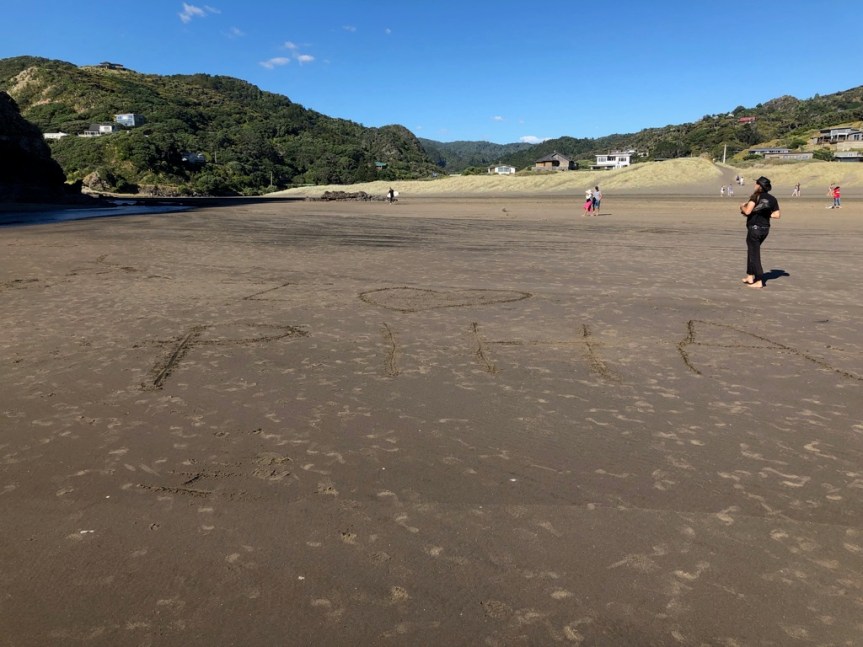
Afterward the two of us went down to the beach together… I loved the color of the sand, it’s not so much black as a sort of iridescent dark tan color, that reminded me of the color of my Subaru back in the states.
Images from the beach North of Lion Rock
[For the bottom left one image, I told him where to stand, and to keep shooting till I told him to stop, then picked the best one]
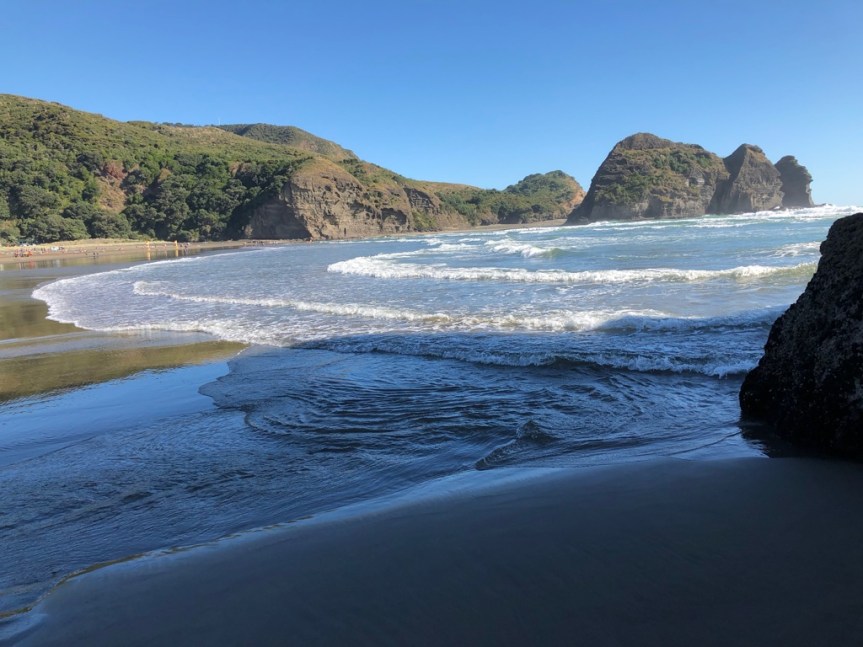
Then we crossed the river emptying into the ocean, and checked out the beach south of Lion Rock… Where I became transfixed with the patterns the wind created on the water
Afterwards we both agreed that it was a wonderful place to spend an afternoon
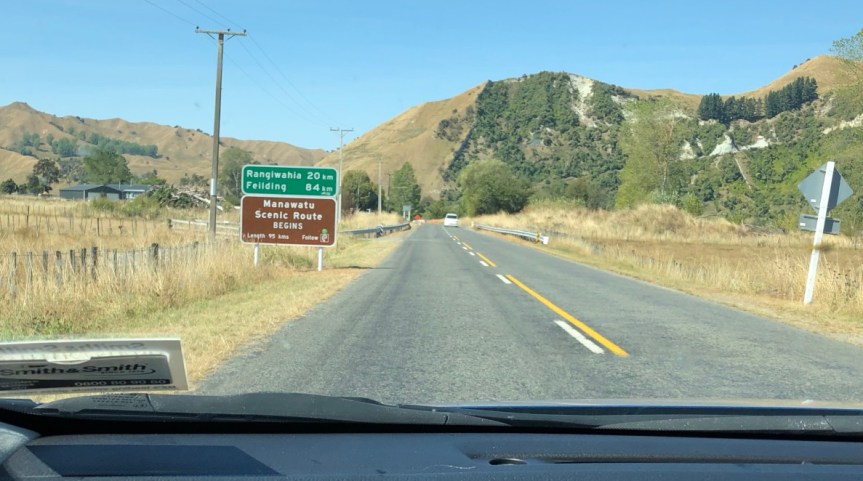
While my friend and I were road tripping south from Auckland to Wellington, we found ourselves with some (planned by me) spare time, and my friend … he who was doing the driving… pretty much spontaneously decided he wanted to use said time to take a scenic route option his phone had notified him of, rather than stay on the most direct one. So, we turned off of New Zealand’s highway 1 and onto the Manawatu Scenic Route.
Pretty much as SOON as we left route 1 we were happy we’d done so…
The pictures really don’t do it justice
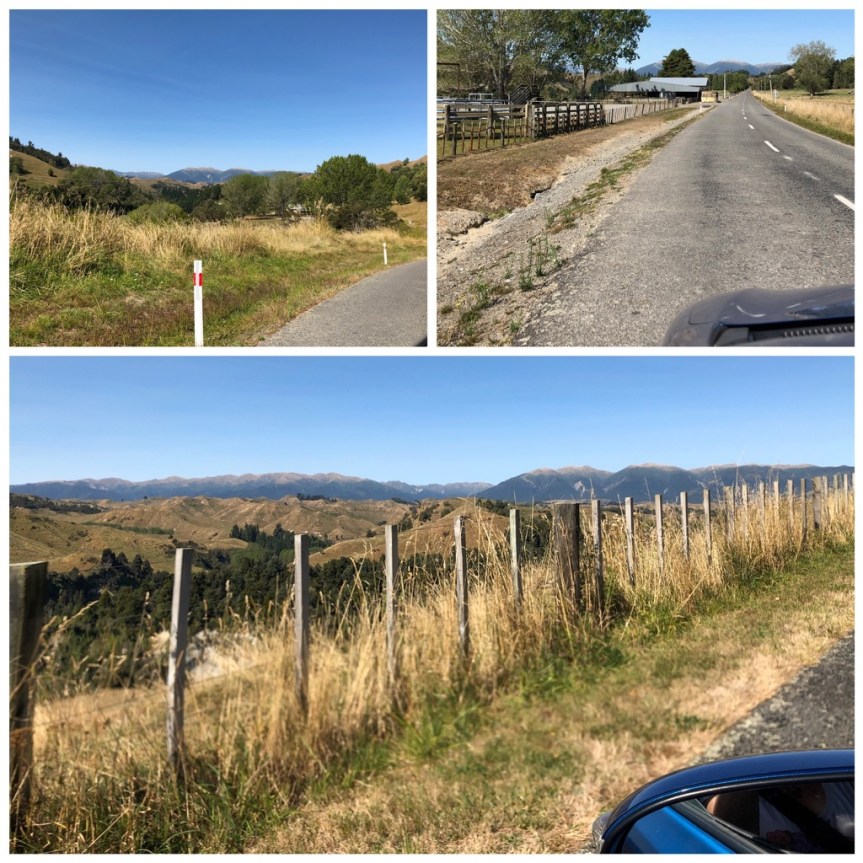
We found ourselves driving through a very windy and narrow river canyon type road (which was much more fun for him from a driving perspective than the mostly straight highway 1), with sides that were almost chalky white but shot through with green
and a road that took us higher and higher up the side of the gorge, after which we entered a flatter area (at the top apparently)with some farms, and a GORGEOUS mountain range in the distance
And then to MY delight (he was driving so past he didn’t even see it as we whizzed past) I noticed a stopping area with a sign and picnic area, and demanded that he stop and return us to it. [One of the many reasons we’re not traveling together anymore is he likes driving through places and considers them seen, while I like stopping each and every time I spot a good potential photo, so that I can take good pictures. Ironically, after I ended it with him, he wanted me to share with him said pictures.]
Panorama shot
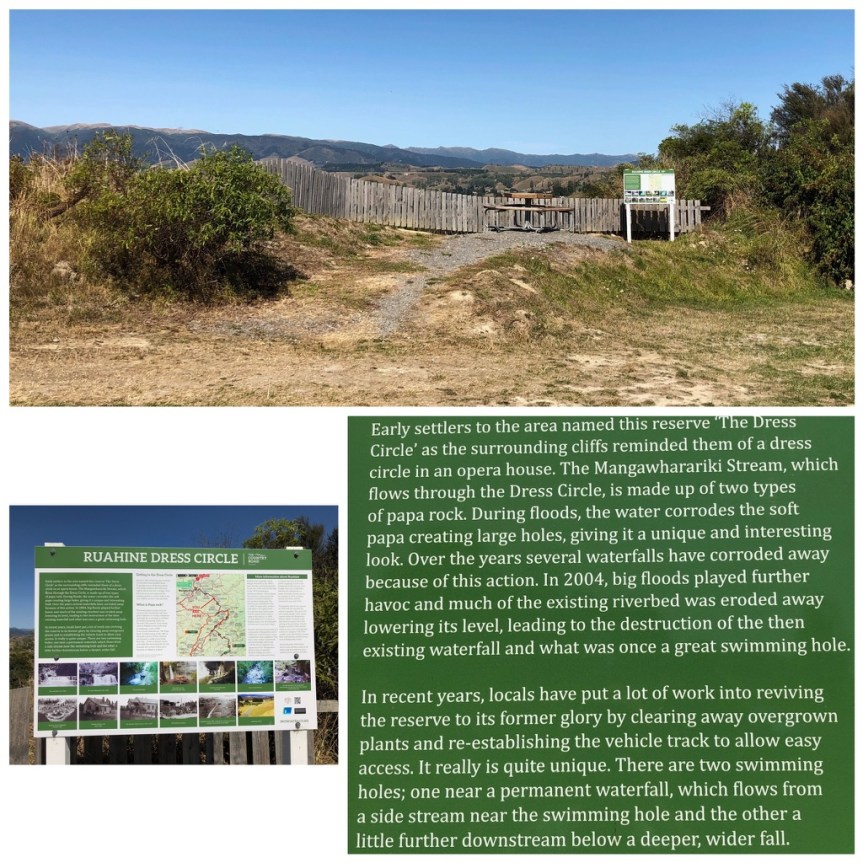
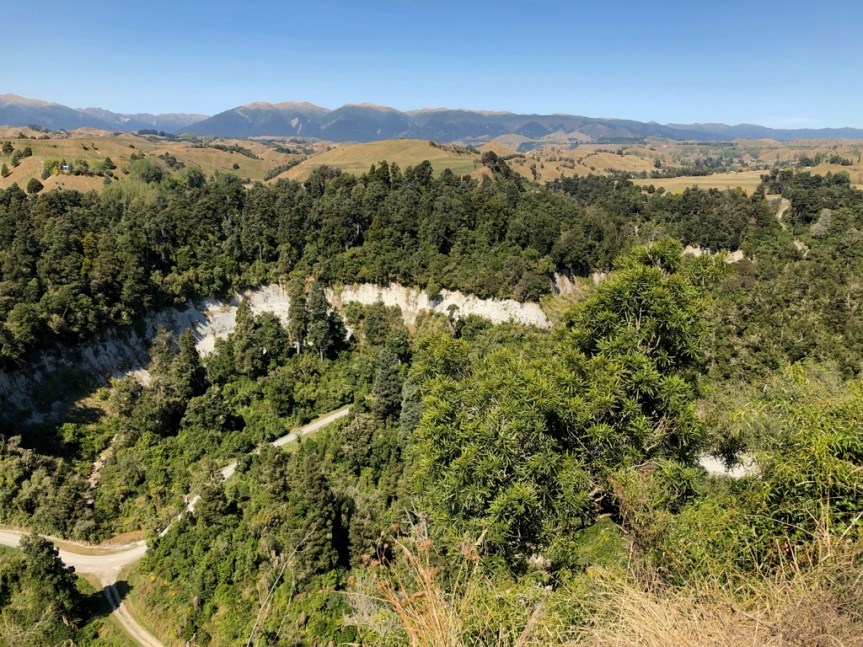
looking down into the gorge I could see what the original settler meant, in terms of it looking like the dress circle seating in an Opera house (read the image above)…
It wasn’t until afterwards when I researched the ‘Ruahine dress-circle’ that I learned that there was a side road we could have used to go down into it where there is a very popular swimming hole down there which we missed.
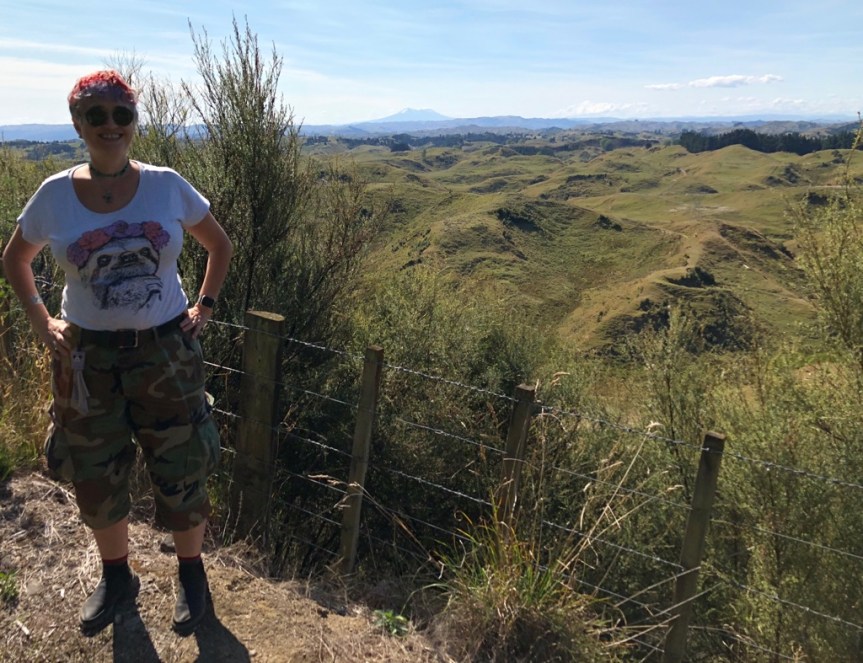
my friend, who is about 6’+ tall, took this for me while standing on the picnic table (at my insistence)
Unfortunately, since he’s not one to carefully plan things in advance, my travel buddy was driving through the area sort of haphazardly (if I’D been the one to PLAN it, I’d have known in advance about the stopping location and the possibility of the swimming hole) and his GPS on his phone instead of taking us through the length of the whole scenic drive redirected us OFF of it once we got past the end of Ruahine Road, and (as he’s not a planner) he didn’t realize we actually had sufficient time and would have had MUCH better views had we stayed on it… because from what I’m reading about it now, as I write this, we really only got a bit of taste of it…
This month is the first time in my life I’ve spent Ramadan in an Arab town. I’m SO naive about these things that I didn’t even THINK about that when planning this trip.
First thing to remember is that while Arabs are of two predominant religious groups, Muslim AND Christian. The first keeps Ramadan, the second does NOT…
… and not all sects of those two major groups are alike. While Bahá’í and Druze are both, historically, offshoots of Islam, the Bahá’ís DO keep Ramadan but the Durūz/Druzim [transliterated Arabic & Hebrew spellings for the plural] do NOT …
Christian owned restaurants tend to hire mostly Christian workers (friends and family), and are in retrospect easy to spot because they’re the ones that offer beer and wine options on the menu.
Muslim owned places do NOT have beer or wine on the menu.
*Noting this distinction in advance will tell you which of your favorite eateries are likely to be open or not
And of course, Acco being in Israel, there are a handful of Kosher places in town… that hire Jewish workers and as such will be open: This includes the VERY expensive Uri Buri (which will demand reservations), which has won all sorts of culinary awards, is considered to be one of the best resturants in Israel, and while it has shellfish on the menu is also set up to cook Kosher food. (Warning: its “French” style, so after a full meal here, you’re going to want to go out to eat)
That said, NO restaurant can afford to be closed for one month every year!!!
According to my Airbnb host (a Xtian who has lived here his whole life) the first THREE days of Ramadan is when it’s an issue. Employers give their muslim workers that much time to acclimate into the pattern of NOT eating during the day, and then will open back up for business because there’s a tourist market that has to be served.or of course you can load up the fridge in advance and feed yourself… something I neglected to do…
If you’re in the area and you’re looking for a REALLY good place to eat at affordable prices, I STRONGLY suggest the Rustic Eating House in Waiouru, New Zealand. Granted, the last thing you’d expect in a town so small that you’ll miss it if you blink (population 950) is a chef driven restaurant that serves up haute cuisine, but prepare to be surprised!
It’s located in a strip mall right near where highway #49 meets up with highway #1. I had also taken some interior shots, but I googled the place as I was about to write about it, and I’m seeing that they JUST did a massive redecoration of the interior and it now looks radically different on the inside (as in much more like a fine dining experience and less like a diner).
From the new photos someone posted I’m seeing brand new chairs padded with brown leather, green plants, and decorative piles of chopped wood. That and they’ve covered the white pillars with wood paneling …. So, that said the image below is what it looked like in early March 2019 when I visited the place, but it doesn’t look like this anymore.
So, when I first got there, I was having a hard time believing the reviews on Trip advisor, as they looked like every other a mom and pop cafe with coffees and teas, and all the take-away offerings one comes to expect at places like in Australia or New Zealand,
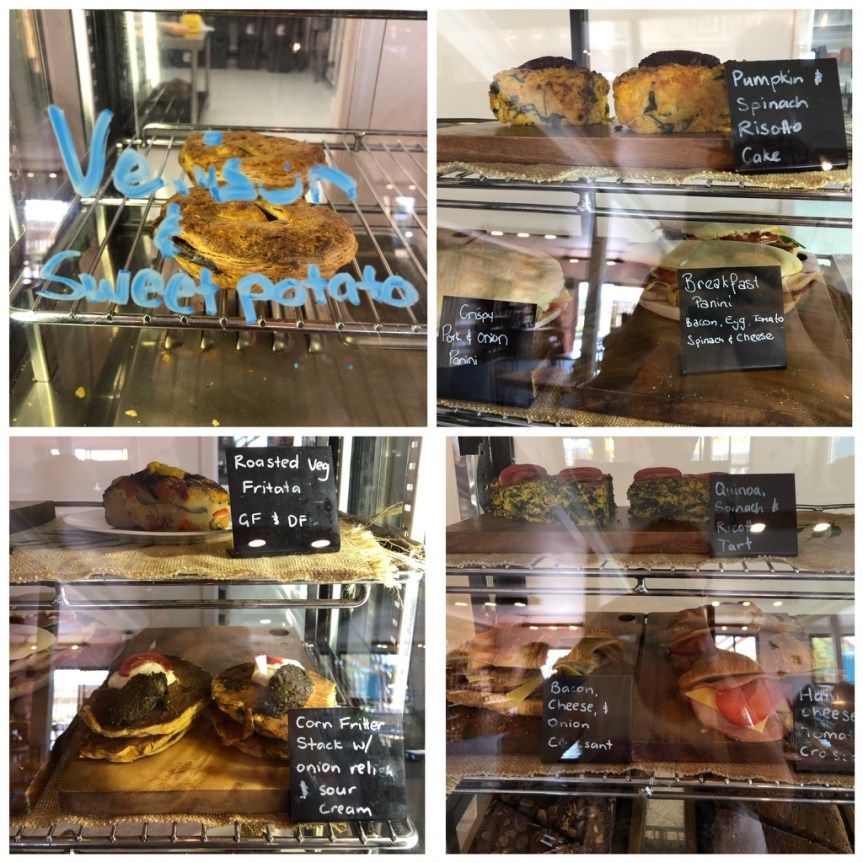
but that said, on 2nd glance I could see they were clearly a cut above, as in they had all the obligatory meat pies and such, but with much more interesting ingredients…
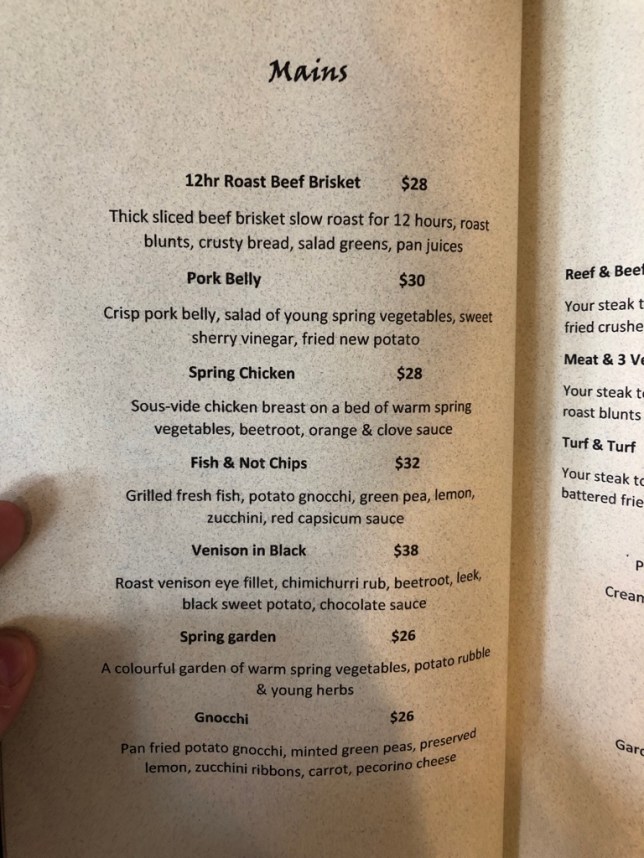
In addition to what was on offer in the cases, they also had a menu which looked VERY interesting….
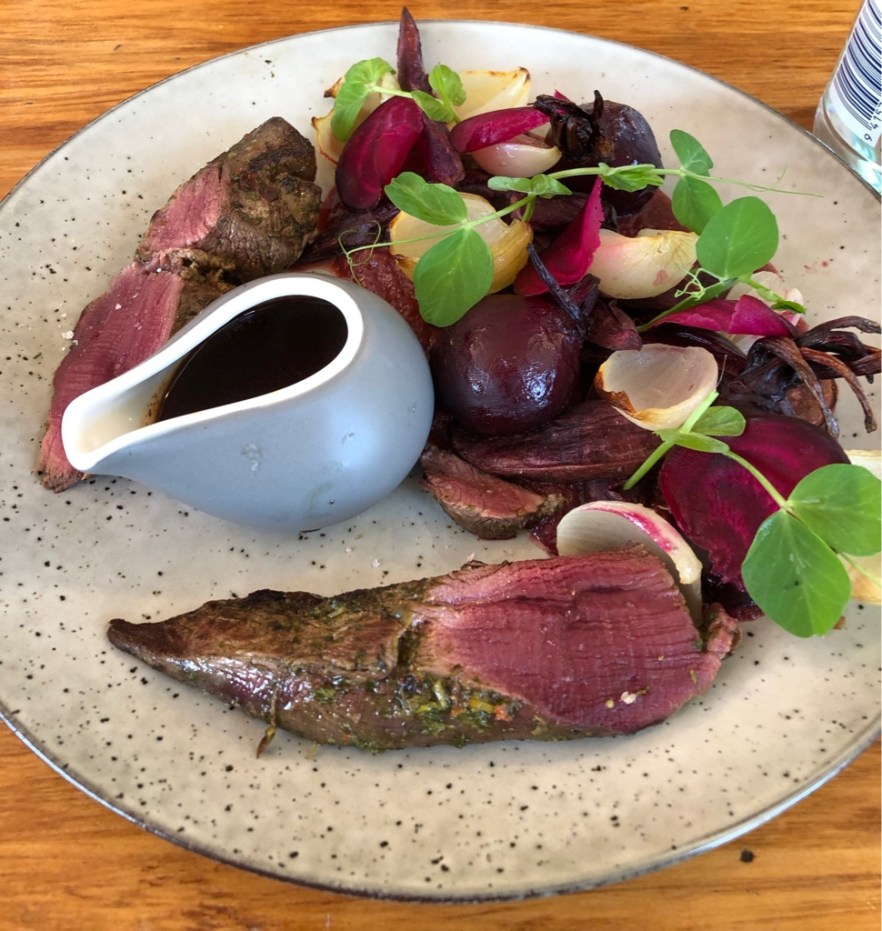
I ordered the “Venison in Black” — roast venison eye fillet, with a chimichurri rub, beetroot, leek, black sweet potato and chocolate sauce.
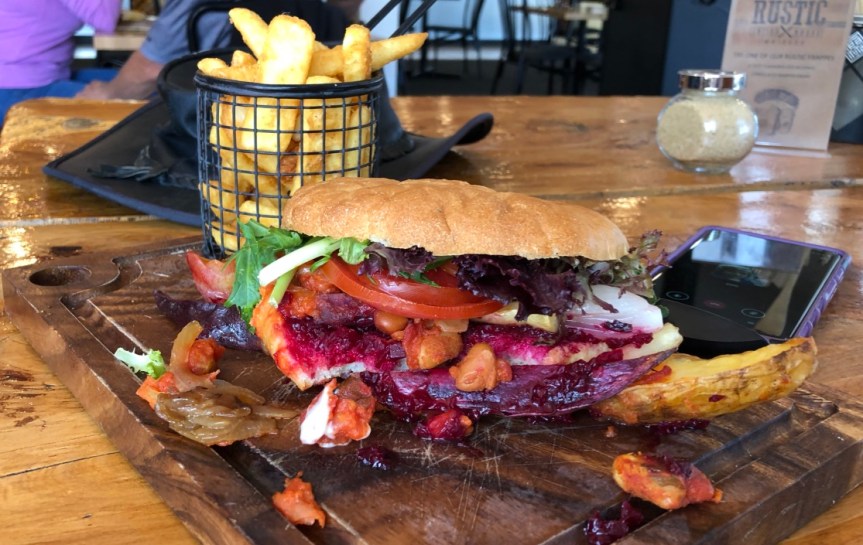
My friend the vegetarian asked for a veggie burger, and while they didn’t really have one, they put this together for him on the fly and he was VERY happy with it:
that said, If it ain’t one thing it’s another we were sitting outside and there were shade umbrellas big ones weighted down by water. I was at one table in the shade, my travel buddy was at a different one in the sun (having an on-line work conference meeting).
I was sitting in the shade below the umbrellas she was setting up in above photo, when it happened
A massive wind picked up and started to knock them over, so I stood up to try to keep them from falling on me and then one of the ones that I was holding went completely airborne taking me with it. Rebecca went boom again. Did not hit my head. But I was little bit shaky afterwards… basically post fall shock. I did scrape up my hand pretty good, and my neck was not particularly happy with me afterwards. That and I was a bit less than pleased with how little the staff seemed to care about what had happened to me, past asking me did I want to call for an ambulance (because, and this is what they told me…. that would take about a half hour to show up anyway and cost me a load of money). In fact the only “help” was the owner got me a band-aid for my hand and moved my plate for me, indoors. So NOT the best customer service on the planet. That said my food was REALLY tasty and the chef had no issues with modifying it slightly to meet my dietary needs.
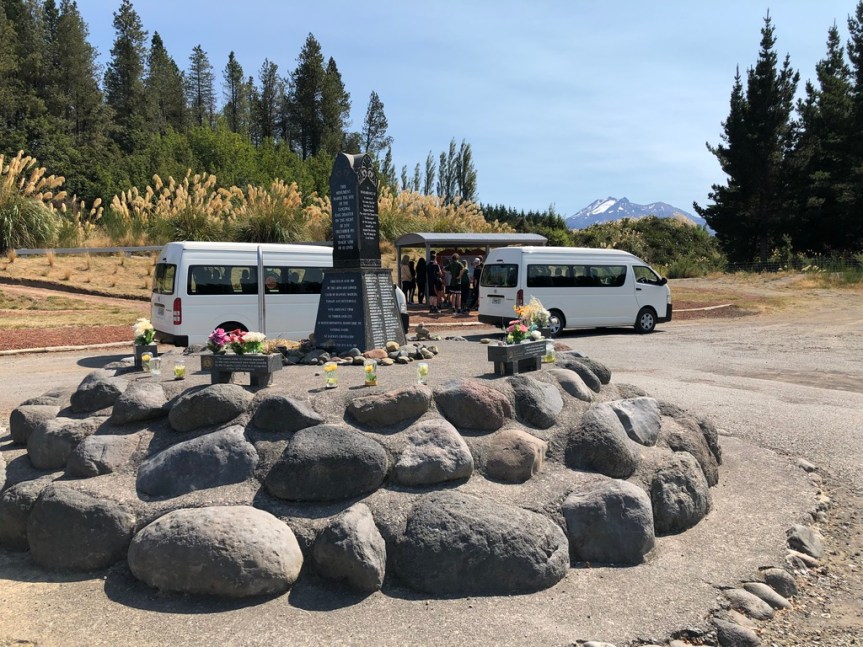
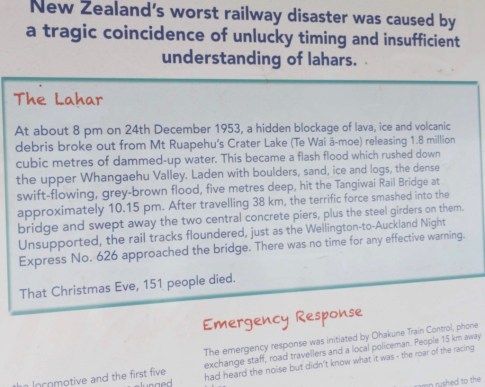
In Tangiwai, a rural Māori community in New Zealand, about half way between the rural towns of Rangataua and Waiouru, just off the side of highway 49, is a memorial to the worst train accident in the country’s history. The catastrophe occurred on Xmas eve in 1953, when the rail-bridge over the Whangaehu River collapsed beneath an express passenger train traveling from Wellington to Auckland, resulting in the death of 151 souls.
A local school group was brought here to learn about the disaster
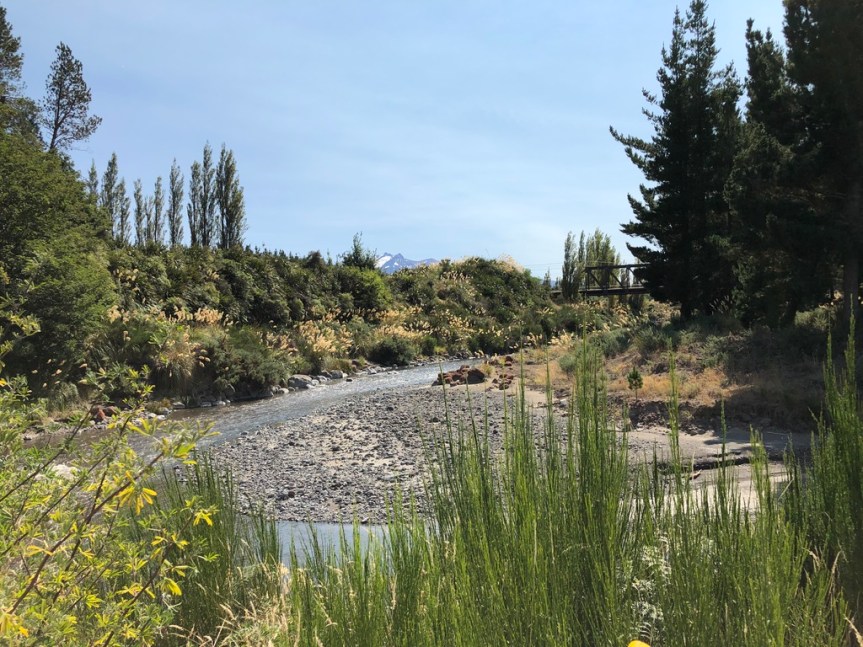
The disaster happened because the Islanders at that time suffered from a lack of understanding of the full risks associated with being directly downstream from an active Volcano, in this case, Mount Ruapehu (see images above and below).
Note the Volcano and the reconstructed bridge in the above photo
Volcano’s are beautiful, and their eruptions result in rich black fertile earth at their bases that is wonderful for farming, and this is why so many farming communities are located directly at their bases all around world — in spite of their being some of the most violent forces on earth.
For example: think about the cities of Pompeii and Herculaneum located at the base of Mount Vesuvius (a volcano) in Italy, or the town of Kagoshima in Japan which sits directly adjacent to Mount Sakurajima, which is so active that residents have to walk around with plastic umbrellas to keep the volcano’s ash out of their hair.
The cause of the Tangiwai disaster was in part seriously bad luck. Almost 10 years earlier in 1945, Mount Ruapehu, the volcano whose nearby presence is the source of the area’s sustenance, had erupted creating a thick layer of ash at the top of the mountain.
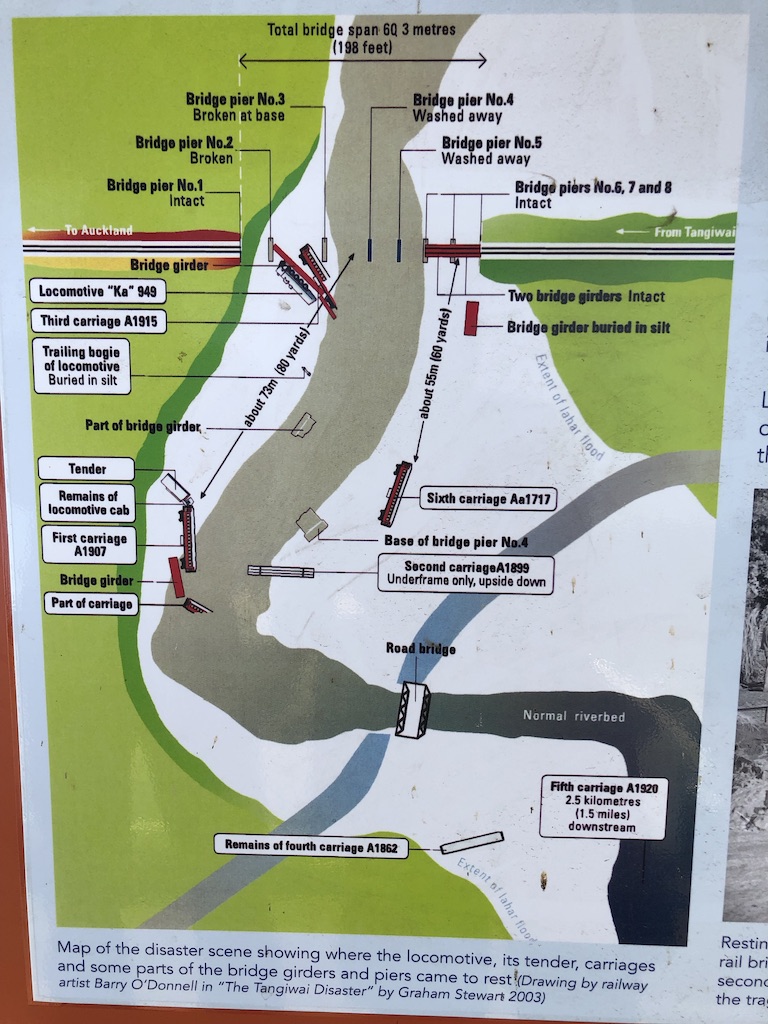
Over the next 8 years, water collected in the cone of the volcano, forming a lake, held in place in part by that same layer of ash. Earlier that evening, at around 8pm, the water (heavy with lava, ice and ash) had broken through and rushed downhill via the Whangaehu River (whose headwaters are the yearly melts off the glacier that sits atop the volcano — see the pictures above taken in during NZ’s summer), and at approximately 10:15pm, the force of flood had taken out many of the railroad’s bridge’s supports…. but unfortunately, not the bridge (which the driver might have seen).
The disaster happened only about 5 minutes later, at 10:21pm, and as I said resulted in the death of 151 souls; the recovery was horrific and continued for days as bodies were found hanging in near by trees, washed downstream by the river, or buried in banks of sand and mud; 21 of these bodies of the victims were never identified, and the bodies of another 20 souls, who were believed to have been on the train, were never found.
Here are two videos about the disaster from youtube. The first is very short, 1.5 minutes video posted by the Auckland War Memorial Museum:
This second video is a full 20 minute TV show about bad days in history that focuses on the disaster:
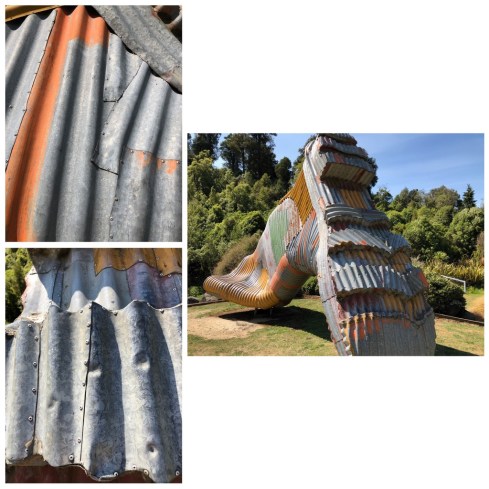
In a similar way to the tiny rural town of Riverside, Iowa (Population 993), having its monument in honor of the future birth of Star Trek‘s James T. Kirk, the slightly larger rural town of Taihape, New Zealand (NZ), population 1,730, has a giant “Gumboot” (Kiwi for a rubber boot) in honor of its fictional hometown TV character, a farmer by the name of Fred Dagg.
Created by a NZ satirist by the name of John Clarke, in the 1970’s, the Dagg character — known for wearing his Gumboot’s 24 hours a day (even in bed and in the shower) was designed to represent and make fun of the stereotypical NZ farmers, who lived in NZ’s stereotypically isolated farming towns.
Once he unveiled Dagg on national TV in 1975 the character made Clarke a national star. And as he had chosen Taihape as that hometown for his character, and the town owned that claim to fame with a will. Not only have they declared themselves the Gumboot Capital of the World, but they also have a yearly Gumboot Day, where contestants compete to see who can throw a gumboot the farthest, and who can wear them and look the dashing while doing it.
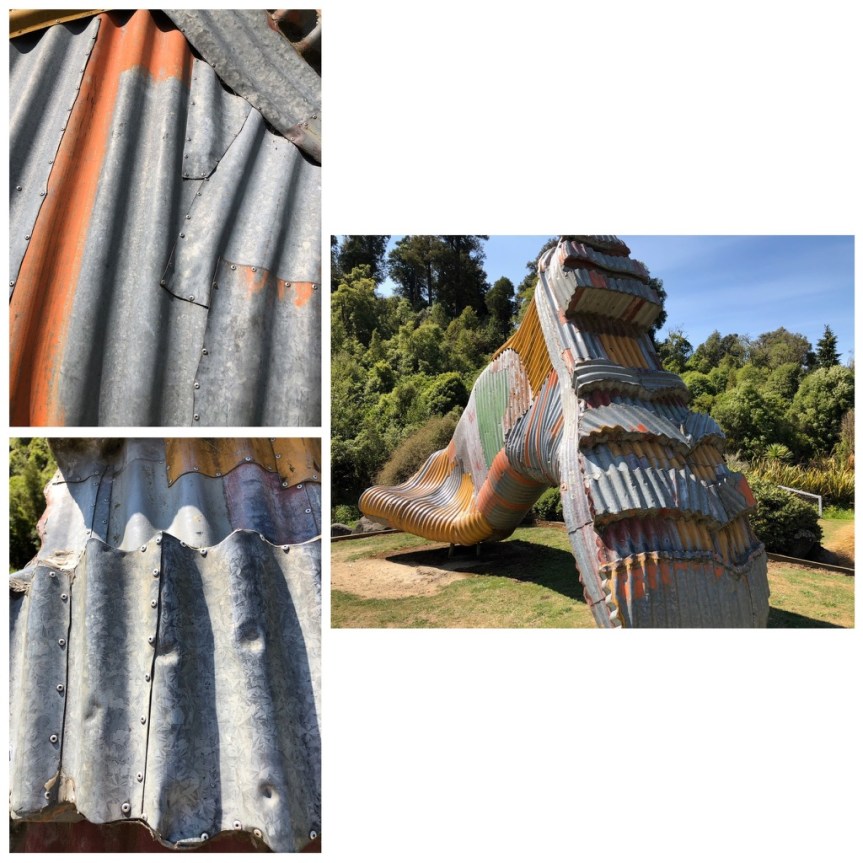
As in nearby Tiarau, NZ, where corrugated galvanised iron was used to construct the Big Sheepdog, Ewe & Ram buildings, the Gumboot is also crafted from the same material, which New Zealanders seem to have a sort of love affair with.
And just for kicks, some of Fred Dagg’s Greatest hit songs:







 on other days you’ll see fishermen (who aren’t actually supposed to be there, but the police don’t stop them) fishing either off the exterior wall of that castle, or netting up fish caught in the pools they create.


 Once inside you’ll see an apartment with VERY high ceilings. These are traditional to the region, and act as a sort of natural air conditioning system, as the heat rises above your head, and the cold drops to floor level. That said, no two spaces are on the same level. All the bedrooms are a step up to a place where you can leave your shoes, and then another step up to the bedroom area… the en suite bathrooms are yet another step up.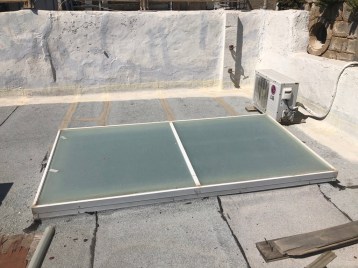






















 As I discussed at length in the article about my visit to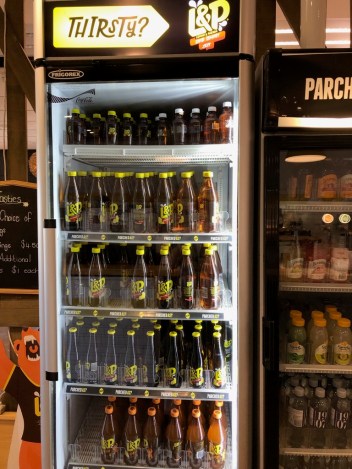
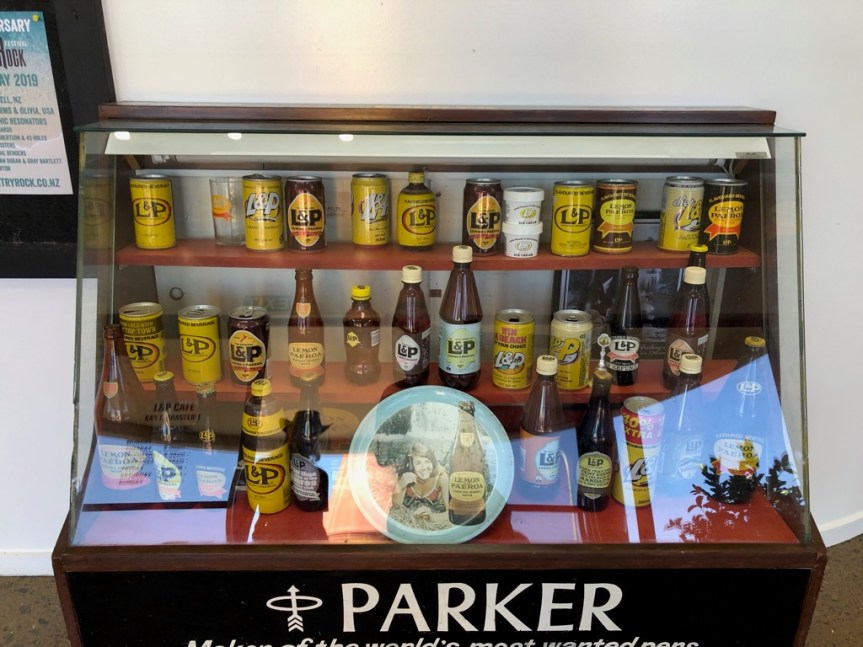
 First my friend and I went to the L&P cafe location (which is the first one you’ll hit if driving south from Auckland to Wellington, and pit stopped long enough to try a bottle of the stuff and use the facilities.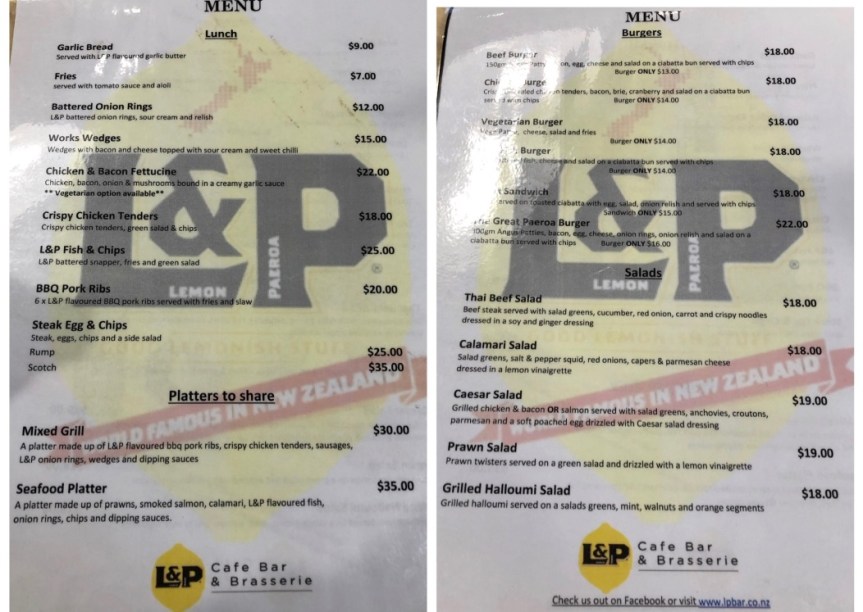
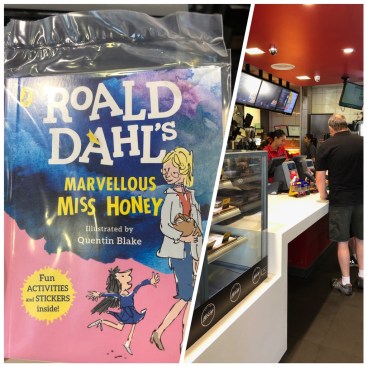 The book being given out was his story
 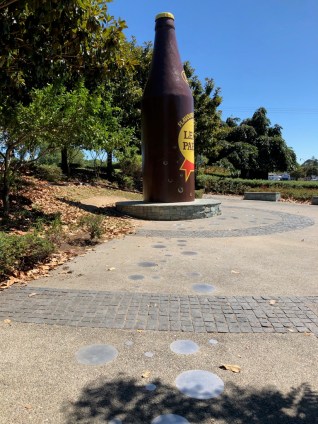 After this we stopped at the park at the other end of town where the “bigger” bottle was located. This one had little spots on the ground leading to it, which I’m guessing were supposed to be bubbles… which was kind of cute…. and a collection of signs talking about the history of the town


















 From the new photos someone posted I’m seeing brand new chairs padded with brown leather, green plants, and decorative piles of chopped wood. That and they’ve covered the white pillars with wood paneling …. So, that said the image below is what it looked like in early March 2019 when I visited the place, but it doesn’t look like this anymore.






 Rebecca Radnor's Personal Blog: Consider yourselves warned!