The personal authentic travels of a world-wide drifter, you'll always see pics of me at the locations being described (if the other blogs you're reading don't do that, odds are they were NEVER there, just saying…)
Category: Tourist Attractions
These are permanent things that exist both for the local population (museums, amusement parks, areas that protect and explain local history, etc), but also in a determined effort to attract in tourism to the city… and sometimes these efforts offer little to no value to the locals OTHER than to bring in tourist dollars …
You won’t see this if you fly; I have horrible motion sickness issues and I was just fine.
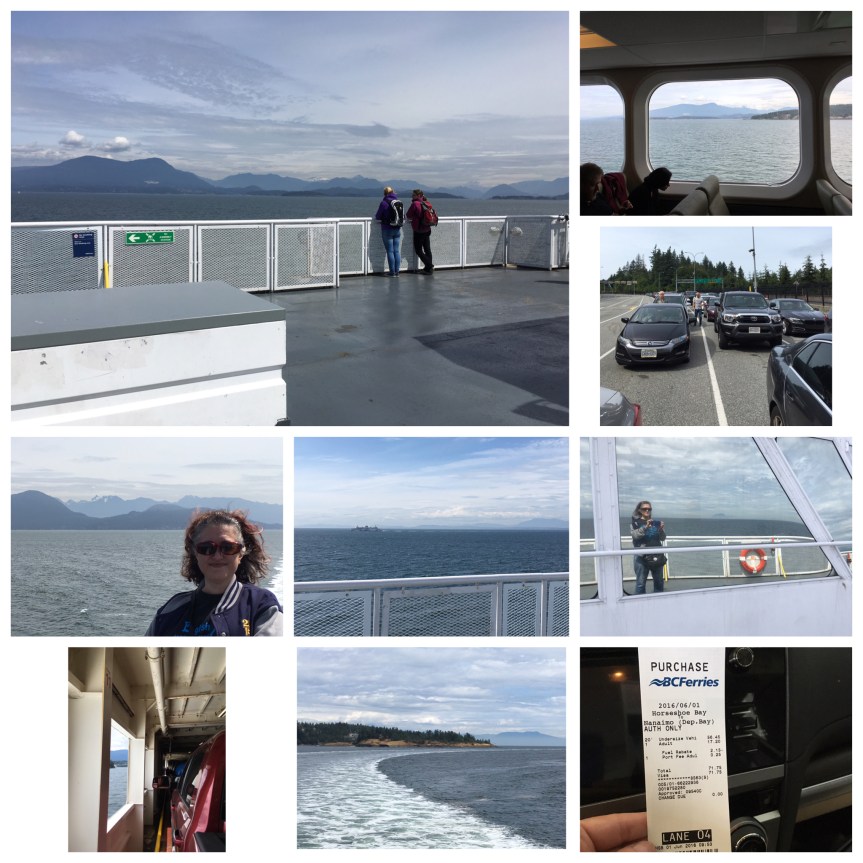
Towards the end of the TransCanadian Highway (route 1) there’s a ferry you can take across to Vancouver Island, and the rest of route 1. The ride took about an hour and a half, and was highly restful and pretty… although granted we had fine weather.
First you go through a tollbooth kind of thing where they give you a ticket and you pay $71.75CD for your transit ($17.20 CD for you $56.45CD for your car — not sure what the exchange rate is, but the other day I bought some stamps at the post office costing $1.75CD, gave them $10US and got back $10CD and change), and then you go stand in a very long line of cars. I think there are like three different ferries that take off from this location. According to the people in the car next to me they won’t start actually loading the ferry for another 20 minutes and then it‘s not going to leave for another 20 minutes after that. Apparently there’s a schedule for these things and I was supposed to have checked but I just randomly showed up. But it seems like it’s a good thing because there’s already a boatload of cars behind me and I think I mean this literally… . I kind of thought that I would just drive onto the ferry and it would take off I wasn’t expecting the wait. Everybody else in the line seems to be far more prepared for it then I am, with coffee, reading materials… and things
After a while you hear loud and clear (remarkably clearly — amazing sound system) announcements about various ferries, and warnings if it’s time to get back to your car. Then the line starts to move and your directed by a host of staff quickly and efficiently into loading, with instructions you can’t miss all along the way (these folks really know their jobs). You can then stay in your car, if you choose, go to the full service cafeteria, hang out in the seating area, or up on deck.
The cafeteria was kind of huge; you could buy a full freshly made and tasty breakfast (which I thought was a tad overpriced), or burgers, sandwiches, sweet potato fries (which seem popular in Canada), raspberry rhubarb pie, or of course, poutine — which seems to be the Canadian national dish.
According to trip advisor’s web site, probably the major attraction in the city of Vancouver, to be distinguished from the Island of the same name — so confusing… is this park. It’s sort of like Central park, only it’s not really ‘man made’ the way that one is, and is pretty densely forested.
Firstly, there is no free parking… even curb parking is monitored, so I parked my car at the first major lot I came to (figuring out how to pay for the parking took about 15 minutes, and then I had to spend another five minutes trying to explain it to the elderly American behind me — you need to punch in your license plate number, which is harder than it sounds, and then guess at how much time you’ll need), and then paid for the horse and carriage guided tour — the last one of the day.
There are also other things to do at the park, but I had limited time
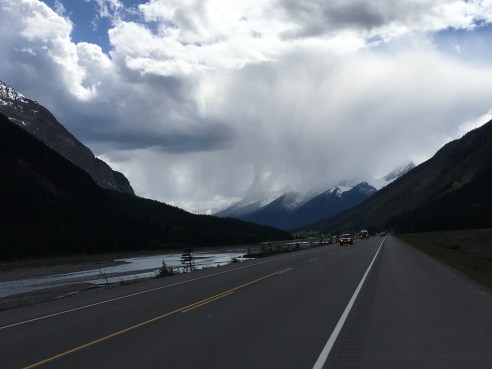
Something funky is going on with the sky right now, there’s reds and blues and whites like sunset colors only it’s not.
I’m not sure what’s causing this — I posted the image to Facebook, and a friend suggested that it’s a fairly common phenomena in the mountains.
There are little white stripes even, it’s most visible when looking through my tinted sunglasses, which are also looking through the tinted front shield of the car — but you can still sort of see it in the photo. It’s at moments like this that I wish I had tinted lenses for my iPhone — TransCanadian Highway (Route 1), near Herrling Island.
I spent most of today traveling the Trans-Canada Highway from Banff National park to Kamloops, where I had booked a highly affordable night’s stay via Airbnb (and which took me a good 6 hours to drive) I passed though two national parks… Yoho National Park and Canadian end of Glacier National Park. Suffice it to say it’s a gorgeous drive.
One of the things I loved seeing along the way were the high fences along the high ways along with regular animal overpasses (bridge on the right) — we really need to start building these in the states.
There are also rest and picnic stops all along the route at scenic spots (with toilets!)
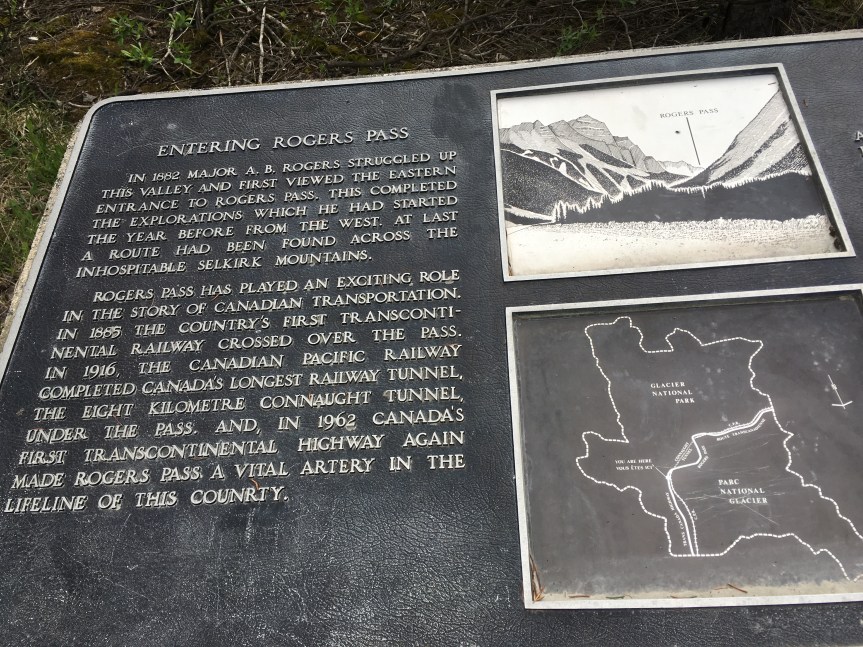
And then I passed through Roger’s Pass… which is in the heart of Canada’s half of the Glacier National Park
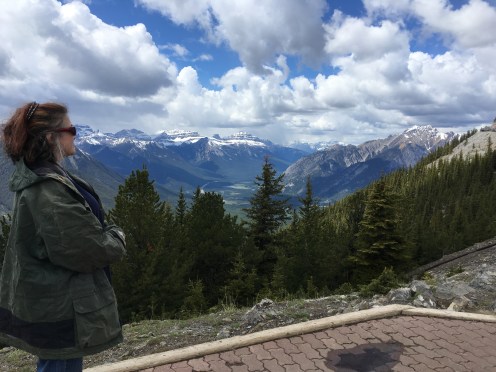
Even if you only have time for a quick drive through on your way to somewhere else via Canada’s Highway 1 (like I did), it is TOTALLY worth it to pitstop at Banff National Park’s Gondola for a ride up the mountain ($42 for adults, $21 for kids);
Every time I told anyone what my plans were for this summer, the one thing I heard almost everyone say was, “well of course you HAVE to stop in Banff” and now I know why. Banff is a cute, very touristy little town located in the middle of a national park, of the same name and just to the side of Canada’s Highway 1. It is, in a word, gorgeous. I was there in the last week of May, in a winter so warm and dry that Canada was having wild fires, and the mountains were still snow peaked.
From the town to where the Gondola is, is about a stunning 10 minute, very well marked drive (even without my GPS I would have found it. Once there, If you want to get to the top of the mountain you can of course, always hike up it, like these folks are doing….
Or you can pay what initially seems like a hefty $42/adult to take the Gondola, a choice I did not regret once I was in it — they allowed me to ride alone.
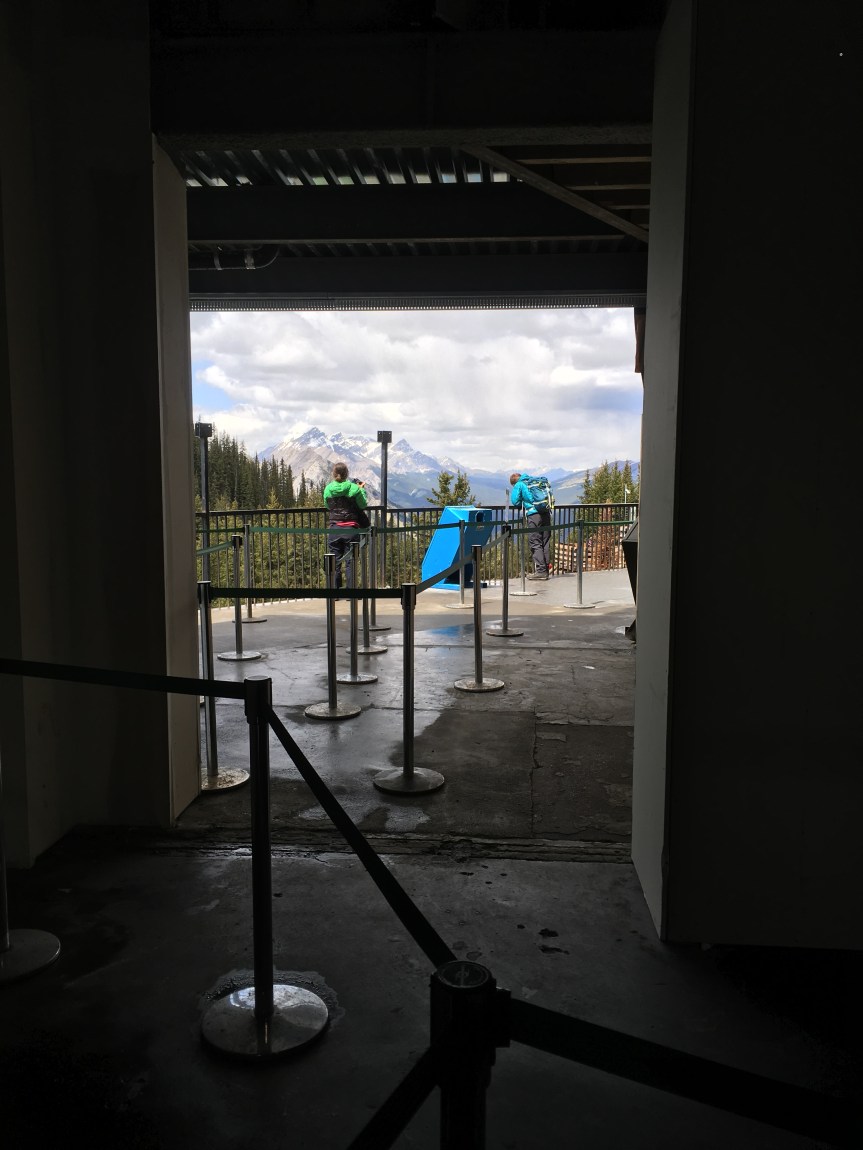
When you get to the top (which is not really handicapped accessible) there is a wooden walkway with strong railings that extends all the way to next peak (with a lot of up and down staircases along the way), which I did not take; in part because I’m a wuss, but also because I knew I had a good six hours of driving ahead of me and it would not be safe to exhaust myself (no really, it isn’t just an excuse). If you do choose to do it, you need not worry about doing it alone, I would argue that MOST of the folks opted to do the full hike.
I however choose to just hang out near the arrival building. When I was there it was under construction, but usually it contains a restaurant, bathrooms, a gift shop, etc. While we didn’t see much wildlife up there, there was some:
There was this one very ballsy chipmunk, he came right up to one woman who was sitting on a bench and sat next to her, then she saw him and freaked — then he kept approaching folks hoping for food — And then there were mountain goats who seemed to prefer to hang out under the walkway, which I assume provided them some protection from predators who didn’t like the sound and smells of all the humans.
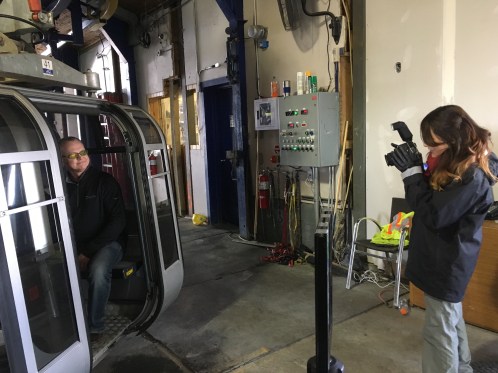
Then, when you’re ready to go down they take a picture of you as you renter the gondola, which they then try to sell you a print of (they aren’t able sell the digital image) photoshopped really badly into a cheesy looking background.
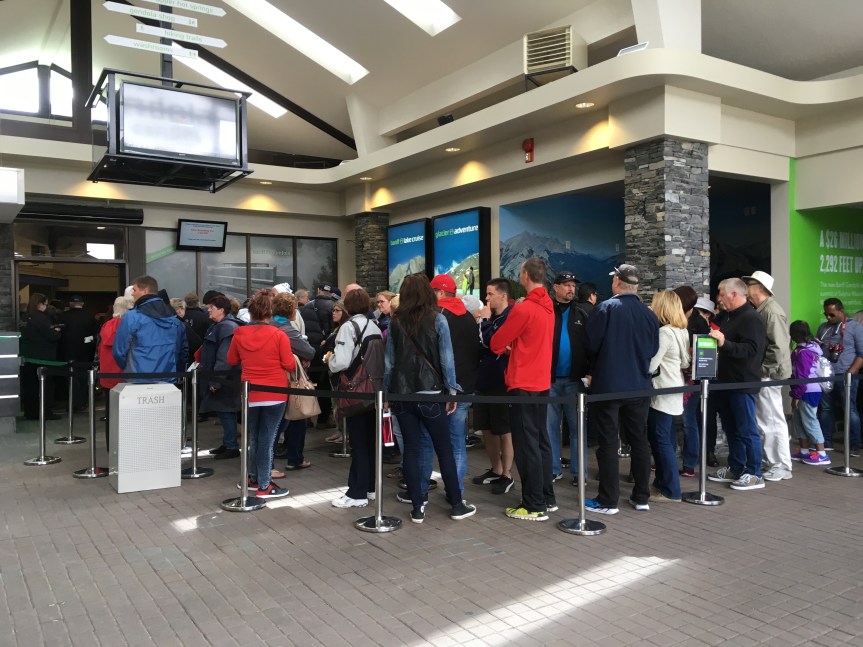
I will say this, apparently I came at the right time, because there was no line at all, either when I bought my ticket, or decided to finally take the ride up (after a bathroom break and checking out the gift store, etc.); however, when I got to the bottom, this is what I saw:
and it kept going all the way down the hallway.
That said, I think it’s important to try to time around bus tours. When I first got there I saw three large tour busses loading up and heading away, and then I think all of these guys were dropped off while I was coming down. Don’t wait in a line like this, have a cup of coffee, troll the gift shop, and wait for it to shrink.
On the road to it I passed what at first I thought was just a bunch of cattle, but then when I got closer I realized they’re not cattle, but rather were buffalo –
– later I wondered if they were the same herd that provided the meat I was eating at the site’s cafeteria — bannock is apparently the name here for the chunk of Indian fry-bread like stuff that came with the Buffalo Stew
There seem to be two major variety of tourists to this place, firstly, the hikers, who tend to take the interpretive trail to the bottom of the drop, which is about a mile round trip
And secondly, folks like me who are not so much for the hiking or the running into mountain lions. For us there’s a van that does continuous round trips from the parking lot at the bottom of the hill to the visitor center at the top (really NOT that hard of a walk, but I’m no fan of hills). Then you walk into the visitor center and take two elevators up to the top, where you walk up a gentle slope to the top of a fenced in area on top of the hill for looking down.
This area is paved, fenced in, maybe a 3 minute walk, wheel chair accessible, and ends in a small plaza with benches and telescopes, and a fabulous view of the plaines below — way more my speed.
At the end is the buffalo jump, a ragged cliff that the animals were stampeded over as a hunting technique. According to the information provided, there’s scientific evidence that the cliff was used for that purpose as early as 5,500 year ago. Hunters who were young and good runners would dress up as wolves, pursuing the buffalo, while other members of the tribe would have prepped the ground with rocks and branches, so that the buffalo, who apparently have lousy peripheral vision, would think they were walled in, and run where the hunters wanted them to go — over the edge.
According to the signs, back then, the sandstone cliff was even higher up, and has actually been worn away both by the weather, and the repeated stampedes (sandstone being very soft).
Also, the name derives not from the buffalo, but from a native American story about how one time a native boy, not willing to listen to his elders, had hid at the base of the cliff hoping to see the animals fall, and they had fallen right on his head. When his parents found his, his head had been smashed in.
While I did not see any large wild animals while I was there, I did notice this little guy — a sort of yellow ground hog — who was hanging out on the far edge of the rock (which he sort of blends with — camouflage) just hanging out and enjoying the view along with the humans, but as far from us as he could get (there’s a fence that kept me from getting any closer).
Back inside the building is a visitors center (designed so that you see this AFTER viewing the outdoor cliff view), that explains the history of the location with a multimedia display, museum exhibits of items excavated from the area, a fifteen minute movie where local indians (actors) re-enact the hunting techniques of their ancestors, the aforementioned cafeteria and of course a gift shop.
One of the things I found interesting, if a tad disturbing, was the how they specifically tried to hunt in early spring, even though that is when they thinnest — less meaty — in order to be able to kill the buffalo when there were likely to be new born calfs (veal if you will) and the pregnant mothers with unborn babies whose skin (calfskin) was used for things like babies blankets, etc.
According to the museum exhibit, there used to be a lot more of these sites scattered around the plaines, with massive piles of buffalo bones, but between WWI and WWII they were decimated by industrial firms who wanted them for their phosphorus content which was used in explosives and fertilizer. One of the only reasons this particular site survived that process was because it was so far from any rail lines and/or farms, that it was not cost efficient to plunder.
The Remington Carriage Museum has the largest collection of horse drawn carriages, wagons, etc. in all of North America (270 of them); it is located in this small border town near one of the US/Canadian border crossings. They have trained young docents who give free hourly guided tours.
This really is NOT something you would expect to find in this location. It was a private collection by Don Remington (a local horse carriage geek) who donated his “babies” to the government on three conditions: firstly, that it must stay in his home town town, and secondly, that the pieces be kept together, and thirdly, that he have access to it whenever he wanted it. The government accepted his terms and spent $12.5 million building this facility to house the collection.
It is absolutely massive, and holds 270 carriages and wagons, etc., of the sort drawn by horses and rarely used anymore, like totally massive. Its so enormous that locals get year passes just so that they can use it as an indoor walking area during incremental weather.
Of the carriages, 49 belonged to Remington who began the collections, and another 175 are on loan from other organizations that don’t have the space to display them, or were donated. The museum facilities also do restorations of carriages that people bring in, but those are not the ones that go into the collection on display, because those are considered historical artifacts so they try to avoid restoring them as that would negatively affect their value. Got everything from carriages for hauling wood to carriages for hauling the rich. There is also like a 20 minute documentary on the history and evolution of the carriage industry in America
I was there on a weekday, and NOT during tourist season, so some of what’s “available” wasn’t while I was there: There is also a barn that holds a collection of Clydesdales and other horses, that provide carriage rides; there’s a working ironsmith, etc. There is also a restaurant, but it too was closed.
Glacier National Park is HUGE, as in you can’t really see and enjoy the whole place in one day, not even if you’re going to do the whole thing by car. It is just too big. This was my second day, when I explored the western half… and then wished I’d allowed myself a full week at the place.
Warning: If you arrive at the park early in the season (I was there at the very end of May) the “Going to the Sun” drive which connects the east and west segments and travels through the middle of the park will most likely STILL be blocked with snow. If it is you’ll be forced — as I was– to leave the park and circle around via lower altitude roads.
I learned later that the full road isn’t actually opened until LATE June or even mid July, depending on weather conditions — there is even a web page dedicated to updating tourists about how much of it the plows have opened for traffic. Apparently about Oct. 16th is when the road closes down again because of expected snow accumulation… one of these days I will go there again in September after the kids are back in school so I can drive through the highest elevation parts…
I stayed two nights at Brownies Youth Hostel and Restaurant, which is near the eastern side of the park. I had found it via Airbnb, but had then contacted them directly and made the booking by phone in order to ensure that I got the specific room I wanted (a private and across the hall from the ladies bathroom). It was the ONLY Airbnb near where I wanted to be, as close to the park as possible but not far off the highway I was going to take up to Calgary, and every hotel I found in that same area (note: I was not yet truly skilled in the ways of finding high quality mom and pop motels yet, so this price was compared to the larger hotels, etc) were asking WAY more than I wanted to pay. Here at the hostel, a bunk-bed in a shared dorm room is $22/night, and a private room with a double bed is $65 — utterly reasonable prices. I really enjoyed my stay there and met a bunch of really nice college kids who were roughing it, as well as a really nice married Indian couple who were both young professors (one taught business, the other psychology).
My bedroom at Brownies
I will say the only unexpected (it is a hostel and not a hotel) downsides of Brownies were 1) the WiFi in my bedroom sucked to the point of useless; the modem was down the hall where the shared spaces were — kitchen and living room and was good and fast there, but the signal just didn’t really reach to my room. And, 2) while the rustic log cabin walls were cute and provided visual privacy, they resulted in small gaps between the interior and exterior walls with the result that they did not block noises from the other rooms pretty much at all. This would not really have been a problem were it not for the fact that the college dude sleeping in the bed on the other side of it had a snore like a freight train (thank the lord I ALWAYS travel with an ample supply of top of the line ear plugs). He was in a group of guys who were bicycling their way across America (raising money along the way), and we all kidded him about he’d have to do something about that snore if he ever wanted to get and stay married.
After breakfast I headed around south and then west along route 2 through the Marias Pass to the other end of the “Going to the Sun” road, which I had not been able to reach the yesterday due to snow and ice still blocking the roads at the higher elevations.
So, on the way there I passed through the Louise & Clark National forest, which is yet ANOTHER stop of the Louise & Clark trail… and get this, it’s May 28th, and it is SNOWING! (no wonder the higher elevations are still blocked with snow). Off to the side of the road there was an area with two big memorials, and one tiny one:
The obelisk is a memorial to Teddy Roosevelt, constructed in 1931Note the Cargo Train running behind the statue
This statue is in memory of John F. Stevens (25 April 1853 – 2 June 1943), an American civil engineer who helped to build both the great Northern Railroad and the Panama Canal, [the following is according to the highly faded and barely legible sign that was standing in front of him, sad] “was charged finding a suitable rail route across the Continental Divide. In December of 1889, Stevens located and recorded the pass which had been used by area Native Americans for many centuries” i.e., what came to be known as Marias Pass.
There was also a third, very small memorial … just a big chunk of pink rock with a plaque embedded into it which I actually found kind of touching:
There’s a story (found it on the cite I linked to Morrison’s name, see below)), about how “John F. Stevens, credited by the Great Northern Railroad with the discovery of Marias Pass, spoke at the dedication of the Stevens statue at Summit. In the course of his speech, Stevens told of hardships in searching out the pass over the Continental Divide. He explained that it was December, and he had nearly perished in a blizzard at the pass. At this point, Morrison spoke up from the crowd: “Why didn’t you come over to my house? I was living right over there,” he said, pointing to his cabin.” — makes me smile
Again, there was a very faded sign in front of the memorial (that was even LESS legible than the last one) with more information:
“William H. “Slippery Bill” Morrison was a mountain man who had “squatters rights” on 160 acres at the Marias Pass summit. He donated a portion of his land for the site of the Theodore Roosevelt Memorial monument.
Morrison was a frontier philosopher who would often expound on his favorite theories to anyone who would listen. Morrison spent most of his life as a trapper and prospector.
Slippery Bill diet in 1932 at the age of 84. According to his wishes the balance of his land was transferred to the federal government after his death.”
All of which was followed by a very faded sketch of the old guy:
As I approached the park, firstly I realized that there were way more people here than had been at the other end of the park, and second — after driving over an hour to get here — I realized I had better fill up before entering the West Glacier Park entrance, because those places almost never have gas stations inside the park boundaries. Also, it was SO FRIGGING COLD (may 28th and it was SNOWING) that I decided to try to unload my trunk and dig out the down coat, winter hat and gloves that I had buried in the compartment designed for the spare wheel.
Granted, this made them kind of inaccessible, but they were there for emergencies just like this one. My overall goal with these trips is to structure my movements so as to never need see full winter, but, that said I had had the forethought to bring them just in case. Let’s face it, even southern Florida occasionally gets a cold snap. I also lug around a big thick down blanket in the backseat of my car, for the same reason, and have had a few days when I needed it. My car actually is loaded with food (nuts, olives, etc), loads of water, and a heavy down blanket just in case the car should happen to break down in the middle of no where on a cold night. Yes, I’m a planner.
Anyway, since my massive suitcases were still in there, and I needed help in order to remove them, I spotted a guy standing off to the side with a handful of papers and called him over asking him to help me. Turned out his name was John Marshall and he was from the University of Montana and was doing a research questionnaire about tourism at the park, and in exchange for my scratching his back (answering the very long questionnaire) he helped me unload and then reload my car, and we got to talking…
As we were talking the question of the local Blackfeet population came up (I forget why), and I told him about the heavily graffiti-ed obelisk I had passed on the way to my hostel, just the day before; so, he was the one actually gave me the heads up about the confrontational history between the local tribes and Louis & Clark; and he was also the one who told me to look up Elouise Cobell, and how she had brought a case titled, Cobell v. Babbittagainst the United states Department of Interior based on her own investigation of their practices (that she said “revealed mismanagement, ineptness, dishonesty, and delay of federal officials”of Indian trust assets … money owned by the government but held in trust for Native Americans… to the tune of $176 billion).
Apparently he had not long before attended her funeral, so she was active in his mind — and I got so distracted in talking to him that when I finally got into the park I realized that in all that moving, packing and talking that I had completely forgotten to actually pump any gas. So I had to leave the park after having just entered (yay for my National parks pass) to go get gas (again). At which point I realized it was already lunch time, and that I was hungry …. so I stopped at the West Glacier Restaurant and got myself an elk sausage (seriously, elk!), tomato Florentine soup and cup of a huckleberry tea (am saving room for more huckleberry pie for tonight) — it was supposed to be served in a kaiser roll type thing but I asked them to hold the carbs, and the french fries, and give me more veggies instead
And then FINALLY I got into the park!
Leading off of the lake and up into the mountains is this river, which is full of a lot of picturesque twists and turns, and rapids, etc… which the “Road to the Sun” follows alongside of, heading up into the mountains… or at least at this time of year up until the road conditions become unsafe….
and multiple times along the river you come to narrow bridges you can often drive across, but at the other side you usually find some limited parking and hiking trails (of course with my painful hips, knees, and plantar fasciitis — feet — this was not something I was going to do, that and I didn’t have proper hiking boots, just a pair of Crocs, because of the plantar fasciitis).
As I traveled around the park I kept running into this film crew who said they worked for a German TV station, they had this big red van and sometimes sometimes would prop the cameraman and his rig up over the top of at… the last time I saw them was when I was about to leave, and a park cop and pulled them over, lights and all, which made me think that maybe they didn’t have the proper permits… either that or he wasn’t pleased to see the cameraman perched on their hood
At one point I came to this place, where there were all sorts of cars parked to one side, only there was no parking for me, so I parked as far off the road as I could on the side where there was no designated parking (hoping it wouldn’t earn me a ticket. When I initially parked here I was the only car not on the side with designated parking spot, but instead on the wrong side of the road pulled off to the side as much as possible… I came back five minutes later seven cars (two not visible) had already followed my lead
I kept driving up as far as I could, but about 45 minutes in, as the elevation started to rise, snow and sleet started to come down, I had started to approach, but hadn’t gotten anywhere near the area called
At this point the weather was definitively nasty (I actually ran into one of my fellow youth Hostel guests up there), and there was a massive road block… so there was no choice but to return the way I had come… only this time I took one of the many side roads that led back around the lake to the other side
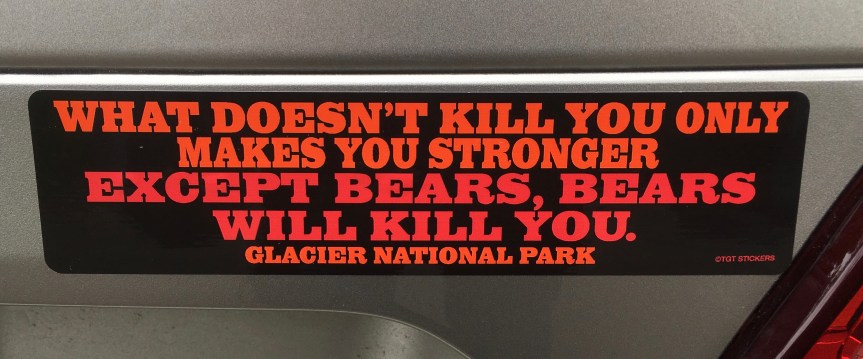
After driving around a while I came to a section of the park that was all shops and restaurants, and a hotel complex within the park for visitors. In one of the shops I found this, and … well…. my new car is in dire need of some new bumper stickers:
I am the proud owner of a new bumper sticker!
Finally, I headed home and after stopping off for dinner, where I got myself that piece of Huckleberry pie, I headed back to the Hostel, at which point I realized that it was 10 pm and it is still light out… WTF?! How far North am I?
Glacier National Park, US or Canada should be on everyone’s bucket list, it’s AWE inspiring. That said, consider your dates of arrival carefully because if you come too early (and that means June) the roads at the higher elevations will still be snowed in.
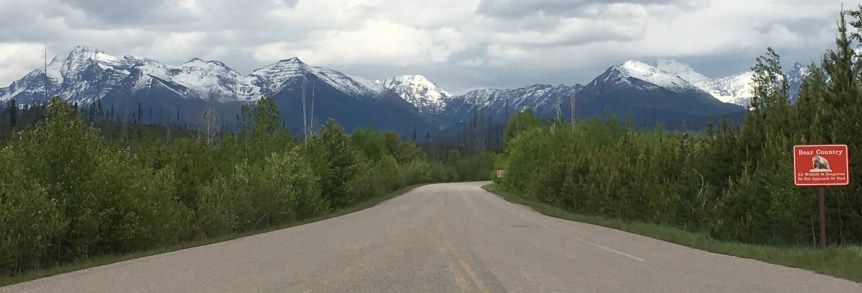
After a very long day of driving from Grand rapids, I found myself driving towards the gradure of the Rocky Mountains, and arrived at my Youth Hostel which is right next door to the parks, but not in them. I had found the place a few days before via Airbnb, who said they had room, and I was able to find their phone number via Google — because Airbnb won’t give you that info before you’ve booked via them (they don’t want you going around their system). The woman who answered said there was a private room right next to the bathroom, but she couldn’t figure out how to log into the system to see availability, so they called me back the next day while I was already on road towards them to verify.
I had found it on Airbnb but called them to make sure I got the sort of room I wanted (private and across the hall from a bathroom), Brownies, and checked in. The ground floor has a restaurant coffee shop that serves up pizza, sandwiches, soup etc and the whole place looks very Berkeley amenable. Nothing on their menu really worked for me so…
Next I grabbed a meal next door at Luna’s cafe, a bison Brat — was tasty, and got to taste for the first time the joys of a Huckleberry Pie — (I was assured the Luna’s makes a very good one). In my attempt at maintaining my diet I ate the filling, but skipped the crust… it was more tart than sweet, but very good.
After that I headed north to see the park, since I was assured it would stay open till sunset which was not for a few more hours.
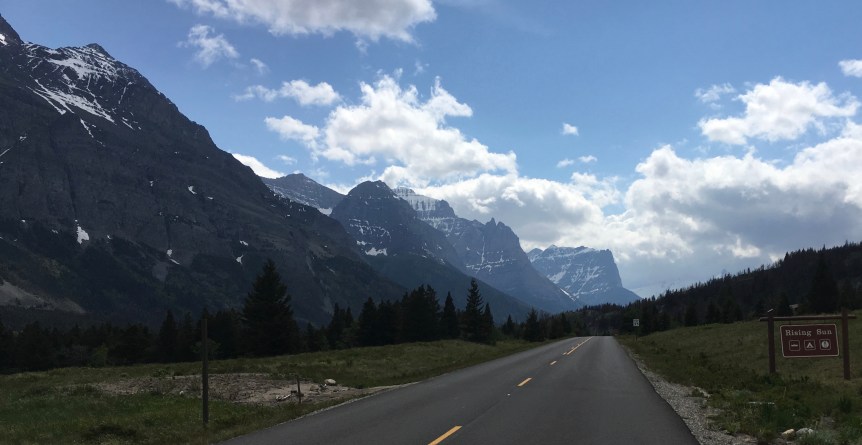
When I finally entered the park… no really, the pics above were all take on the way TO it… There is no WiFi in the park, for obvious reasons, but some notes. Firstly I saved $30 on my park entrance because I had the National Parks pass, and all told I think in about two months I’ve already earned back the price of its purchase (like $85?) for this year.
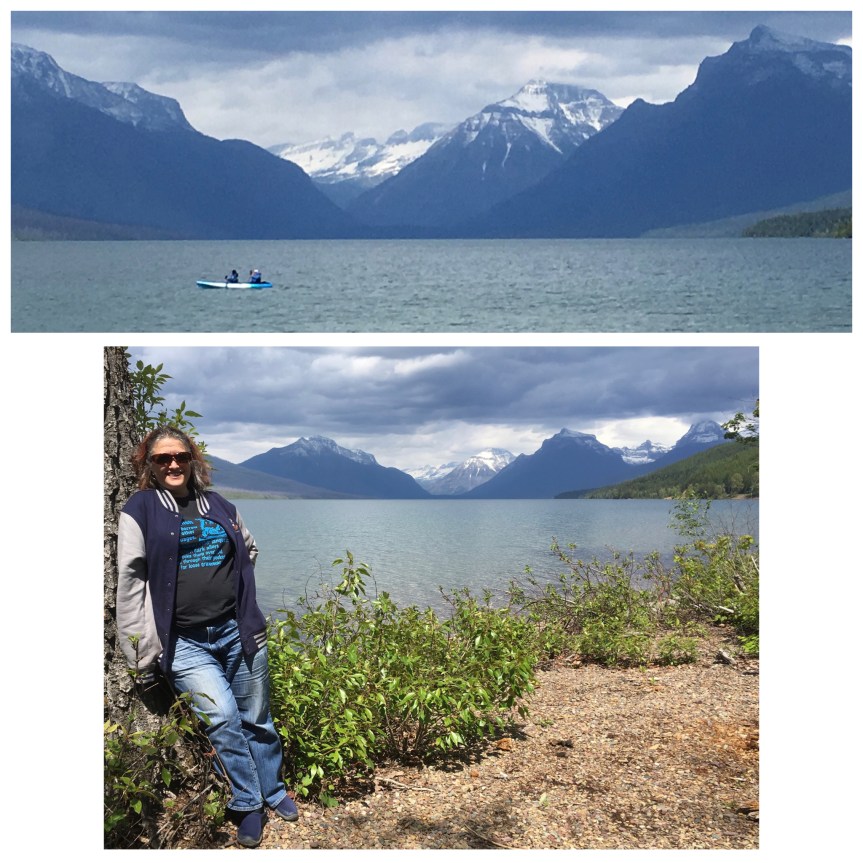
Me, in my fashion poseNotes to self: 1) when road-tripping for a week, dirty hair on a windy day can make me look a bit like medusa; and 2) Huckleberry Pie while VERY tasty, turns your whole mouth blue for a few hours after eating, so brushing is advised.
It’s been raining on and off the last couple of days, and even though Montana is usually dry by now that isn’t the case this year.
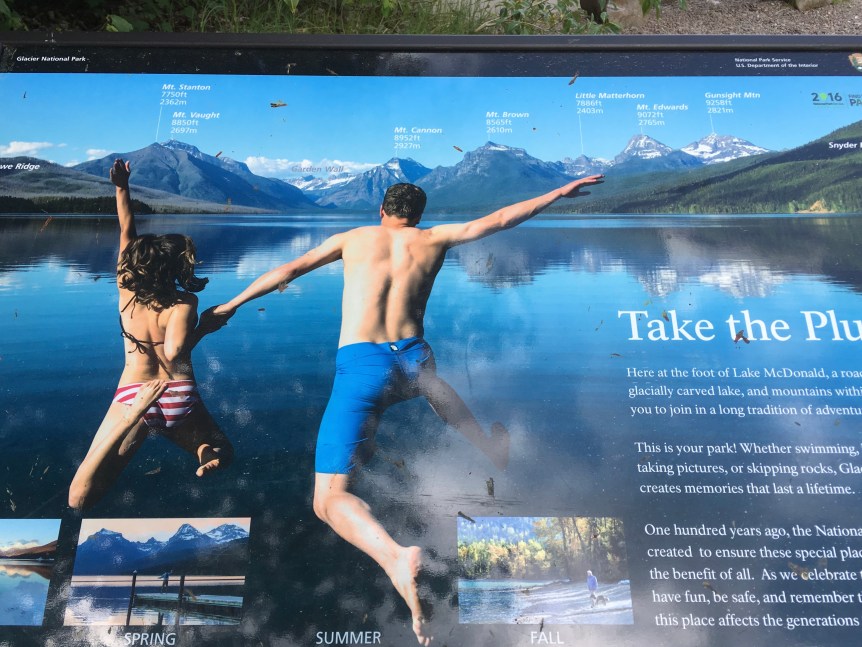
At the Far end of this view are some Glaciers, they are the solid white high in the mountains
As a result of all the recent rains (or snow in the higher elevations) the “going to the Sun” Road which is supposed to be absolutely amazing was blocked most of the way through the center of the park (when you’re in the Rockies) so I could only enter a park-entrance go as far as I could till the roads were blocked, and then back out– go to different park entrance, rinse repeat, etc… so unless I was willing to hike (which I wasn’t) I wasn’t able to get up close and personal with the glaciers and had to just enjoy them from a distance.
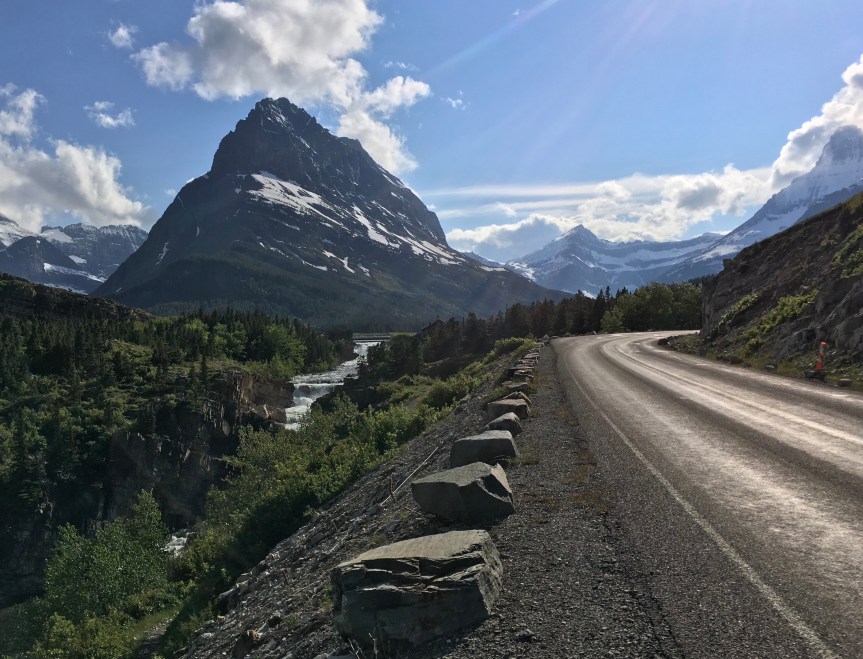
I am particularly proud of this picture, note the waterfall off to the left; so nice I posted it twice (so that it would grace the header)… but this is where I took itThis is a very expensive hotel inside the park
It’s begun sleeting really badly, which is not particularly pleasant. I’ve reached Jackson glacier viewpoint, but the road is closed past here and the mist and fog and sleet are so thick that I wasn’t able to get any decent photos… I will have to come back some other year.
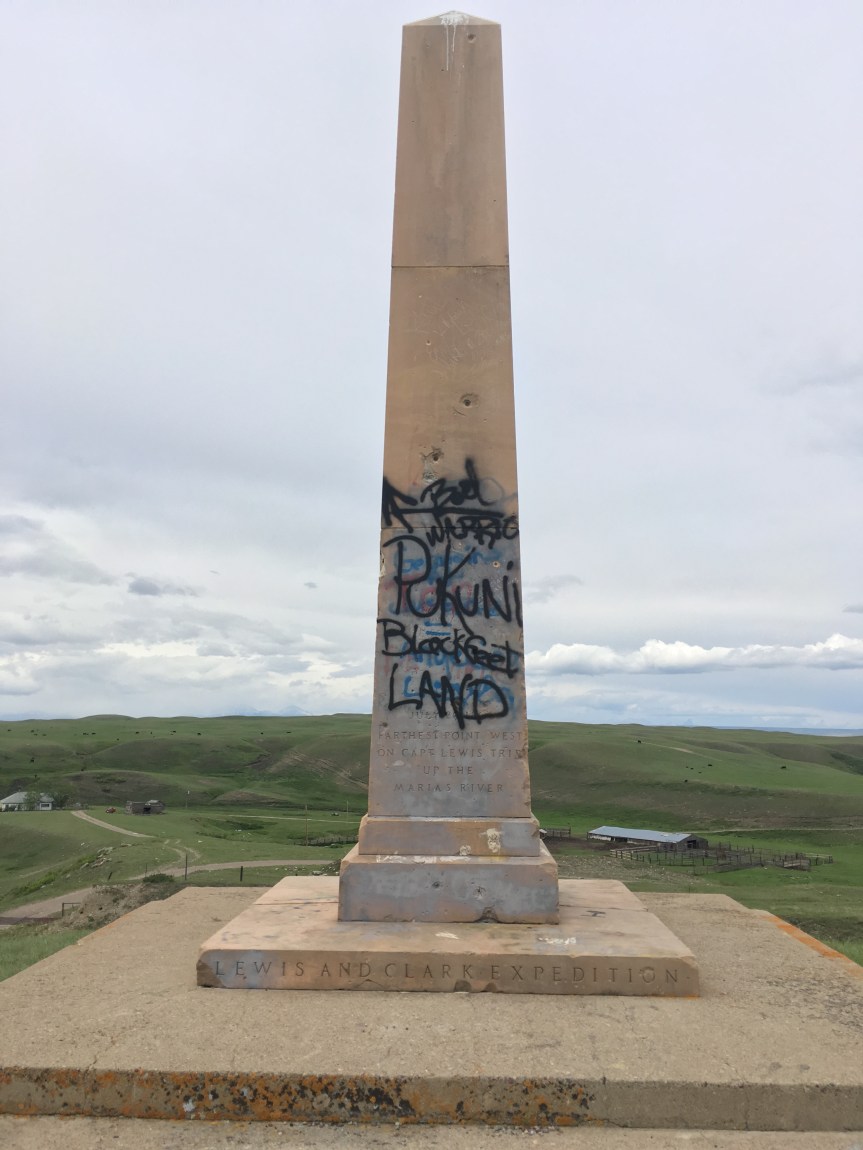
Situated along the return route of the Lewis and Clark National Historic Trail, this site is very near another, more historically significant, site that marks the northernmost point on their trip on the same Marias river known as Camp Disappointment (reason explained at this other blog I wrote)…. an event that happened there explains why this monument is so heavily graffitied.
I passed this ‘monument on a hill’ as I was driving at 80mph (the speed limit) towards Glacier National Park. I stopped, backed up the car (happily there wasn’t much traffic on that road), and took the barely marked, pot holed, uncared for gravel path up to it — worrying about possibly needing to get my tires re-aligned after, or worse getting a flat. Once I got up there, and not yet knowing the context behind its defacement, let’s just say I wasn’t happy about what I saw. But here’s what the whole thing is about.
Back at the National Park’s Lewis and Clark Center, in Great Falls, MT., I had learned how, on their way back to see President Jefferson, after trying to find a tributary of the Missouri river that would travel across the 50th parrallel Captain Lewis’s portion of the expedition met up with a group of eight young Pikuni“Blackfeet” warriors on July 26 on his way back from Camp Disappointment to meet up with Clark’s half of the group. After Lewis’s group met this group of Blackfeet, they had sat down to a friendly dinner, that apparently had a included a foot race and some friendly gambling. This is where the agreement among whites and Blackfeet diverges with regards to what happened next.
The next morning the “braves” (whom Native Americans argue were just young boys), are said to have tried to steal the expedition group’s rifles (at least according to Lewis’s men). A fight broke out and two of the Pikuni were killed in the only violent encounter with any native Americans during the whole expedition, part of whose goal was to open up trade and good relations with any tribes they might meet. This incident, however, had the opposite result, with the Blackfeet closing off their territory to whites for the next 80 years — till it was opened again by force. And then, to add insult to injury, from their perspective, Blackfeet became one of the ‘go-to’ tribes (along with others, like the Pawnee) for “bad/violent tribes” in American myth and movies.
As such, what happened to the monument was not just wanton destruction (although it is) but rather is evidence of the repercussions of an historic event (albeit one not described on the monument) that to most of the Anglo population of America is just a footnote in history, but to the Blackfeet is a source of constant grievance regarding how they are displayed in the historical narrative of America.
I think it is highly relevant that I learned all of this NOT at the visitors center, but rather later, after mentioning to a professor I met near Glacier National Park about what had been done to this monument. He was the one that told me that the Blackfeet tribal members are STILL seriously pissed off about this incident and blame it completely on the “invaders”.
That said, I will note that on the American side there is a single interpretation of what happened, while on the Blackfeet side there are multiple and conflicting ones, with one story saying that during it was there had been gambling and racing and that the warriors were in fact boys who were as young as 13, who had been led to believe they had ‘won’ the rifles, and were just taking what they’d believed was theirs… While another story says that Lewis’ men had said they would be distributing rifles (as trade goods) to other tribes that unbeknownst to the Anglos were in fact enemies of the Blackfeet (and the braves in this story are not described as young, as they are in the other account), and that the braves decided they needed to keep that from happening, by stealing said weapons., etc.
That said, when you consider an ‘ancient history’ like this, with more recent events, graffiti like this becomes a bit more understandable, if no more acceptable.
However, the issues come close to home than that. While most Americans know nothing of this, in the not too distant past, the late 1990’s, a now deceased Blackfeet tribal member by the name of Elouise Cobell brought a case titled, Cobell v. Babbittagainst the United states Department of Interior based on her own investigation of their practices that she said “revealed mismanagement, ineptness, dishonesty, and delay of federal officials”of indian trust assets (money owned by the government but held in trust for Native Americans… to the tune of $176 billion — with a B. Not that long ago, 2010 a government approved settlement was finally reached of $3.4 billion, making this the largest class action settlement against the government to date; of course some of this money will go to compensate individuals, such as the lawyers who worked on the case, as well as tribal members who paid out of pocket to bring it forward, however, the rest will be used to buy back tribal lands Native Americans have been forced to sell away to pay off debts (placed on them because of the remunerations they were not receiving), and to set up a $60 million scholarship fund.














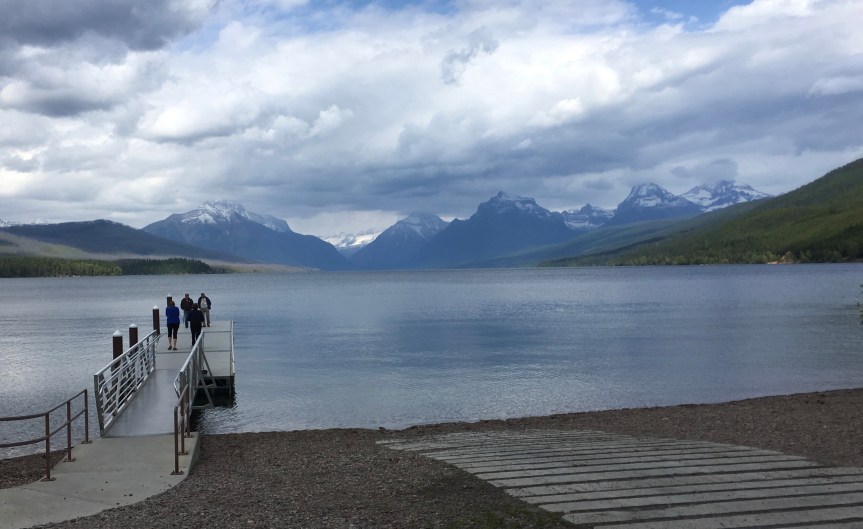
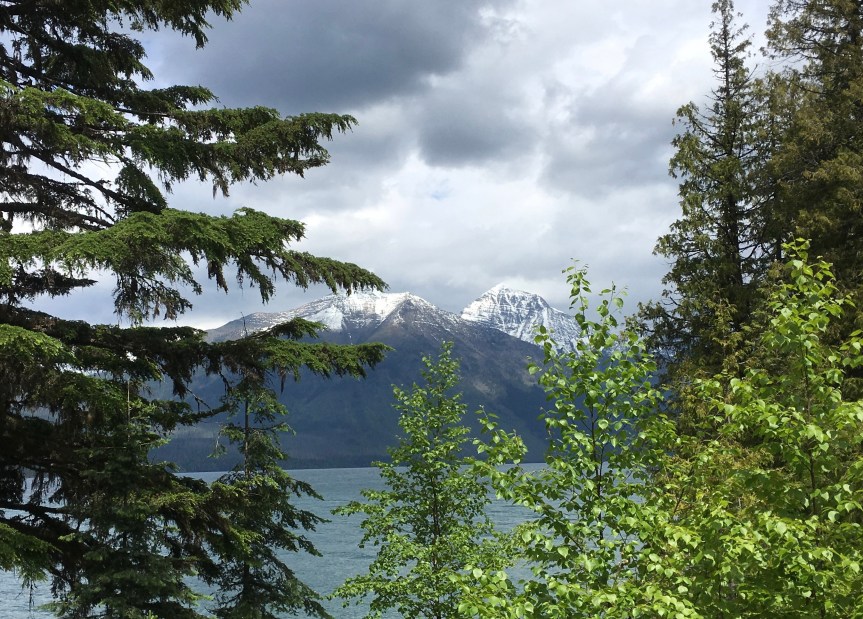


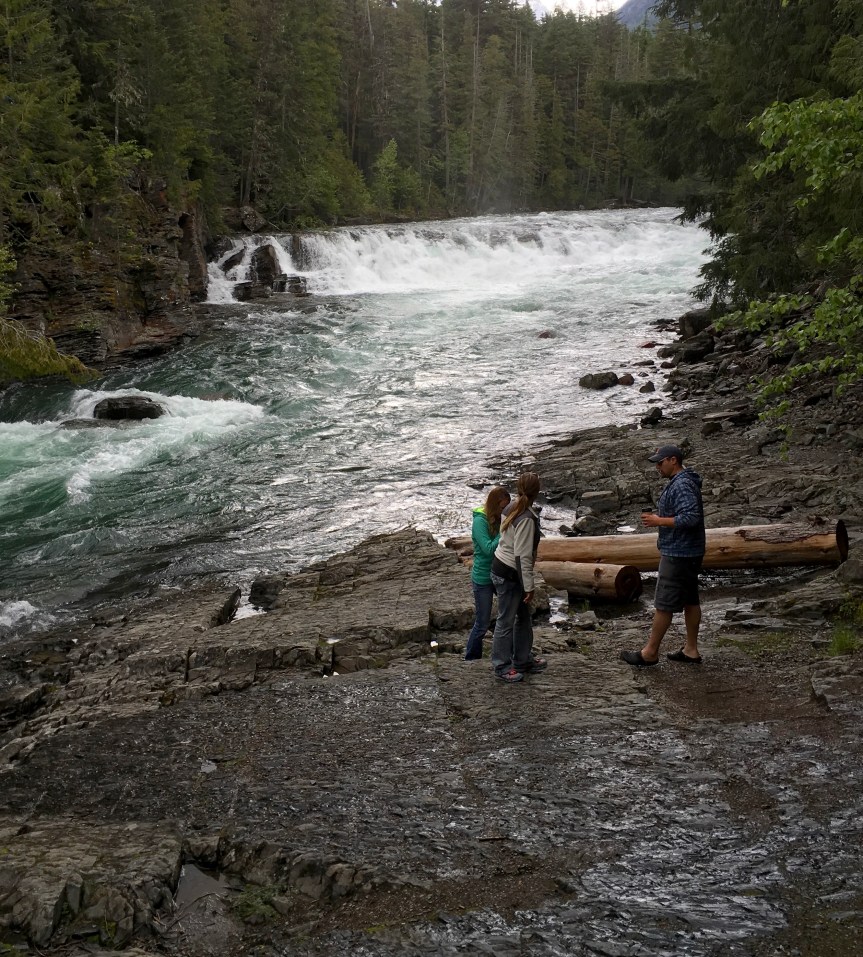
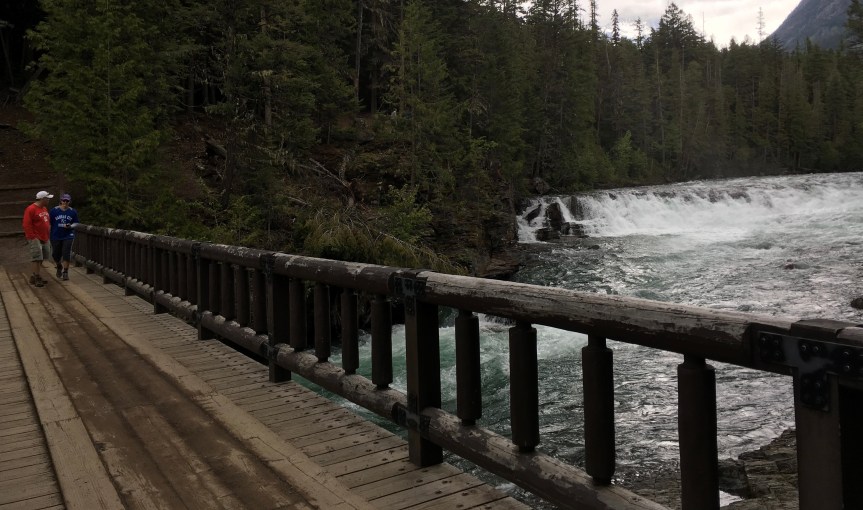

 When I initially parked here I was the only car not on the side with designated parking spot, but instead on the wrong side of the road pulled off to the side as much as possible… I came back five minutes later seven cars (two not visible) had already followed my lead


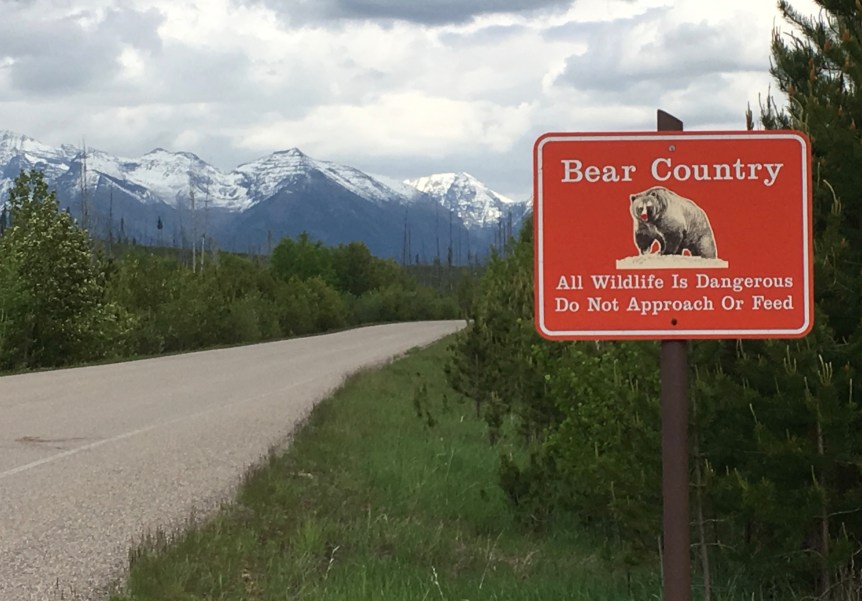





 Rebecca Radnor's Personal Blog: Consider yourselves warned!