The personal authentic travels of a world-wide drifter, you'll always see pics of me at the locations being described (if the other blogs you're reading don't do that, odds are they were NEVER there, just saying…)
This motel is a classic Route 66 experience … but that said, DEAR LORD!!! What a dump!! That said I am SO glad that my first experience with WigWam Motels (all three of which are registered on the National Register of Historic Places) was in San Bernardino, CA and not this one in Holbrook. That one made me very happy, this one pissed me off so badly by comparison that after I inspected the room and checked the wifi, I asked for a refund and a found a MUCH nicer room for $10 less someplace else in town.
I’m willing to bet this owner spends on classic cars to park on his property what the other owner in California spends on repair and upkeep of the rooms.
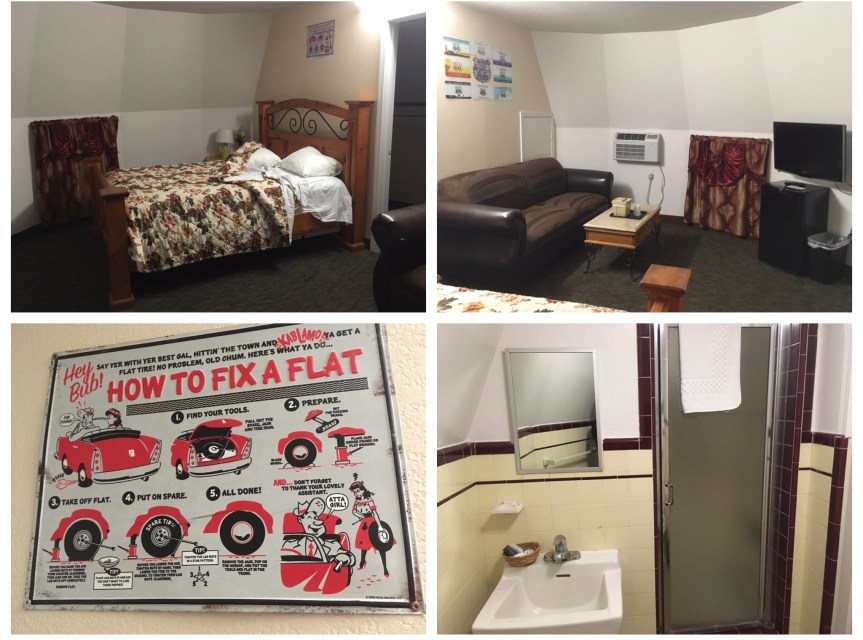
In a way I got lucky. Normally I would check in, unpack my stuff, get into the bed, fire up my computer and THEN check into the wifi. This time, just as I was checking in a nice Chinese guy (I ran into him again at a restaurant) who was booked into one of the other TeePee’s came into the office complaining that he couldn’t connect to the wifi. He said it worked fine in the office — the woman had told him to connect there first, THEN go back to the room… but counter to what she’d told him… not in the room. So I logged in, walked outside and towards my room… and sure enough the wifi died. She said “well you need to go INTO the teepee cause those are concrete and we have extenders in each room.” Ok fine… I go into my room and see there is in fact a wifi modem there… try to log in and get “wrong password” — even checked the bottom of the thing to see if listed a different one… but no… that and I looked around the room and it clearly had NOT been kept up with the same loving care I’d seen in San Bernardino.
While it has a nice coverlet, there’s no art on the walls
While I didn’t take any photos in the bathroom, the tile was cracked, the shower had a dinky curtain (the CA one had installed a class door) and compared to the one in CA looked worn (exact same layout as you can see) AND, of course, the WiFi if it did work was inaccessible and WORST of all, the woman working the desk didn’t seem to care.
Note all the classic cars parked out front, THATS where this owner puts his money, not the rooms
I met my neighbors and they too were all complaining about the WiFi. You could connect in the office but when you tried to connect in the rooms either it said wrong password OR, from the one woman who HAD been able to log in, it was insanely slow.
Like I said the woman running the joint didn’t care so since I’d not unpacked or even sat on the bed, I asked for a refund and booked at the local Travel Lodge which had unusually high reviews for $10 a night less… got there to find it was clean, no bed bugs and 34 Mbps downloads and 20 Mbps uploads… (a bit small and cramped, but like I said, well-kept up, blazing fast wifi, and nice caring people working the front desk).
I did however come back the next day for more pictures because the BEST part of this hotel is the experience you have OUTSIDE of the rooms… which is free. And just like the other Wigwam, this one was reflexive of the Disney/Pixar Movie “Cars” — a cartoon you SHOULD know if only because it was nominated for two Academy Awards including Best Animated Feature and won the Golden Globe Award for Best Animated Feature Film. Anyone who’s seen it KNOWS that it’s animators were clearly influenced by many of the iconic Route 66 locations in the Southwest, which include either this motel, or the one other Teepee motel located in Holbrook, Arizona (where I’m also going to be sleeping in about a week) in the creation of the Cozy Cone Motel in the movie
From what I read, because the Radiator Springs in the movie is supposedly limited to Route 66 locations from Kansas to Arizona, THIS WigWam lays claim to being the inspiration for the Cozy Cone Motel in the movie and at Disneyland.
Again, I was at Disney during Halloween, so ignore the spooky extras, they’re temporary
P.S…..
Normally I don’t do post scripts but this was too funny. When I was in Santa Fe visiting with an old friend from grade school who lives there, I was talking about my trip and mentioned my two WigWam bookings… how much I loved the one in San Bernardino and then as I mentioned this one in Holbrook my friend’s girlfriend jumped in with, “That place is a DUMP!” to which I agreed whole heartedly. She’s never stayed in the CA one, but went on at length about how much she’d hated her stay here.
This historic gas station has an identity problem. If you drive on route 66 from Kingman to Oatman, Arizona you simply can’t miss it… really you can’t… but pretty much ever on-line sites that I’ve found it on things its located in a different area… Some say Oatman, some say Golden valley, some say Kingman, and some just say it’s in Cool Springs… and hence the name.
A wonderful sort of camaraderie tends to form among those of us traveling the route. The pictures of me were taken by a german guy… he had a big fancy camera set up and initially took this photo of me, see below, which was the exact same shot he’d been taking of him and his girlfriend. Then I looked around for good shots, and asked him to please take the photo of me (above)… he at first tried to get close (making me larger in the shot but I shood him back to the spot I’d chosen.)
he ultimately (when we looked at the shots in the camera) saw that I had clearly found a MUCH better shot and we were now bonded by desire to see 66 and our love of photography. (From then on I watched as he was trying to find other shots that included the 66 on the highway.)
What was kind of interesting was everyone who passed felt a sort of obligation to buy something. A sort of general awareness that this place (which is miles from anything) could only stay open and access-able to the next person if they did.
Interestingly… they better be a bit careful as I found the store selling this… and my ‘bullshit’ monitor went off big time…
First opened in 1949, this motel is a classic Route 66 experience that is listed on the National Register of Historic Places. It’s the sort of thing they used to build in the late 40’s that they just don’t anymore. Of the seven initially built, only three are still in operation, and this is the only one in California. The price is highly affordable (although there are cheaper places to stay in town) and in my opinion well worth doing — at least once in your life, just so that you can say you did.
Just checked into this historic Wigwam Motel in San Bernardino/Rialto — the address says Rialto but my car’s GPS said San Bernardino and it couldn’t find the street address in Rialto… so be warned. (A mind blower is that GOOGLE has it listed twice, once in Rialto and once in San Bernardino).
That and this is a family owned business and they don’t stay open overnight, so if you’re NOT able to be there by 8pm you MUST call them and give them an ETA, and if it’s NOT at a reasonable hour — OR you don’t call, they might give your room away to someone else.
That said,WOW! The rooms are cute! Granted they’re a lot cuter on the outside than on their insides, but I understand why the association gave them an award, they really have tried to keep the units up to date as much as possible without destroying their charm, and in good repair.
And when I first tested the wifi at around 9pm, it’s was 76.58 Mbps download and 25.57 upload .. that’s BLAZING fast. I don’t know of ANY hotels that offer speeds like that. I tested it a 2nd time at around 11pm and 166.74 download (TWICE as fast) with essentially no change in the upload. That said, the place was built in the 40’s, so there’s no electricity in the bathrooms — this was normal then, water and electricity not being a great mix.
One of the things I found kind of cute (and a bit smart) was how reflexive the place is to the Disney/Pixar Movie “Cars” — a cartoon you SHOULD know if only because it was nominated for two Academy Awards including Best Animated Feature and won the Golden Globe Award for Best Animated Feature Film. Anyone who’s seen it KNOWS that it’s animators were clearly influenced by many of the iconic Route 66 locations in the Southwest, which include either this motel, or the one other Teepee motel located in Holbrook, Arizona (where I’m also going to be sleeping in about a week) in the creation of the Cozy Cone Motel in the movie
To ‘promote’ the point, if you will… they’ve parked a bunch of old un-drivable classic cars around the property.
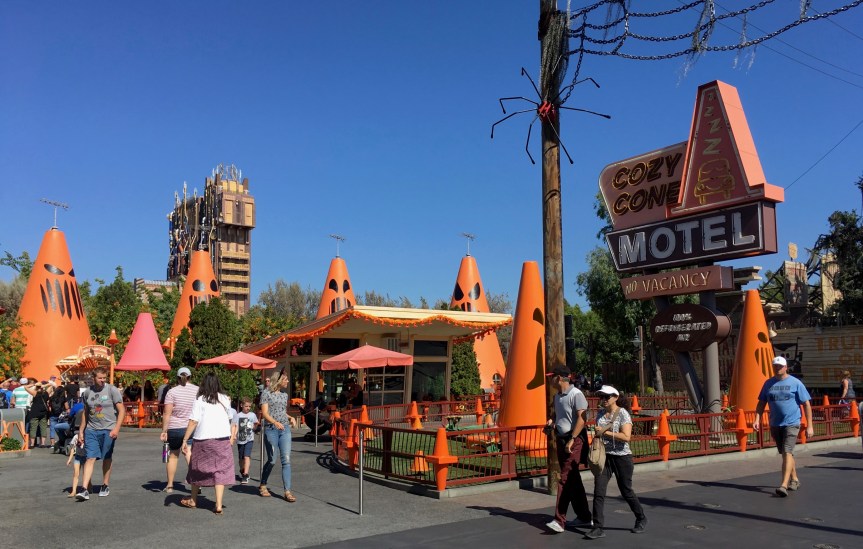
The Cozy Cone can also be found be found in the Pixar “Radiator Springs” section in Disneyland’s California Adventure Park, as I discovered when I was there.
Ignore the jack’o’lantern touches… I was there during the park’s Halloween period, and the black eyes and mouths are all temporary/removable appliqués added for the holiday (along with the black widow spider dropping down from the electric pole.
I found this cool little video about the place back from 2013 that includes an interview with a guy who I assume was the owner at the time.
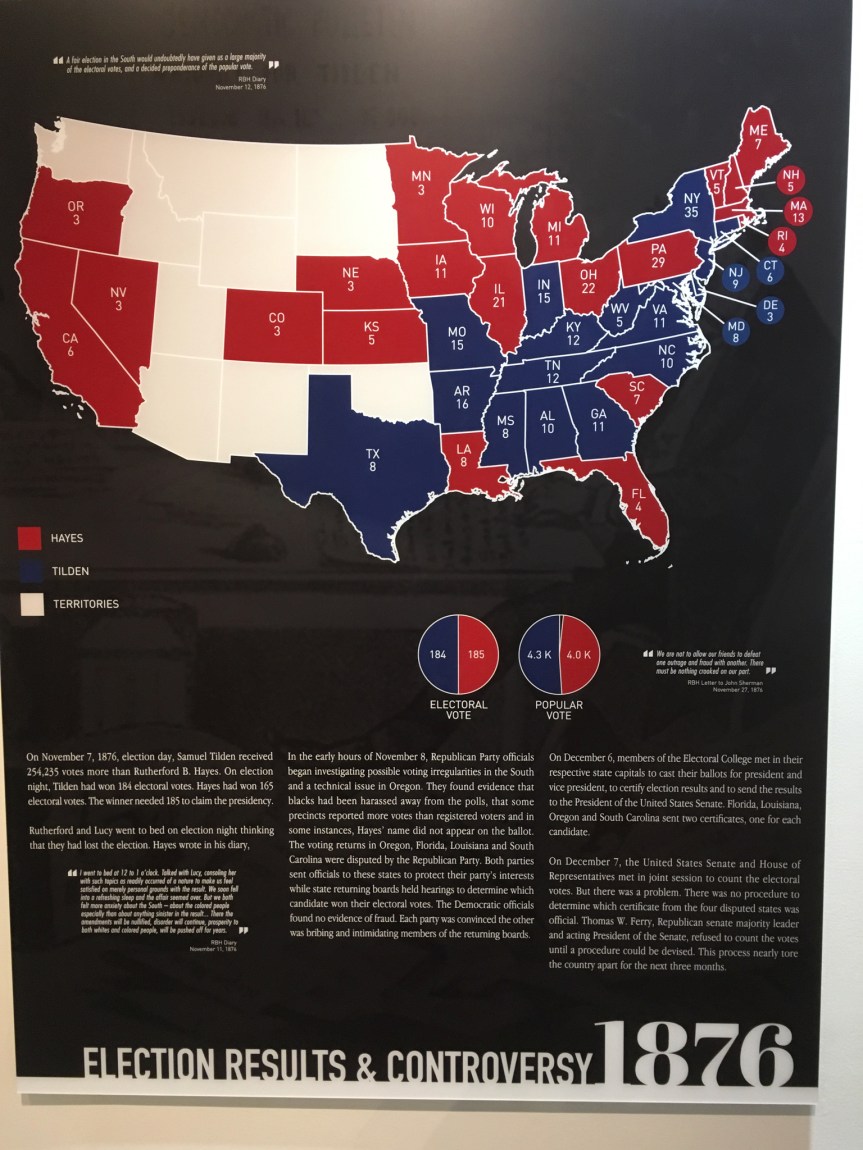
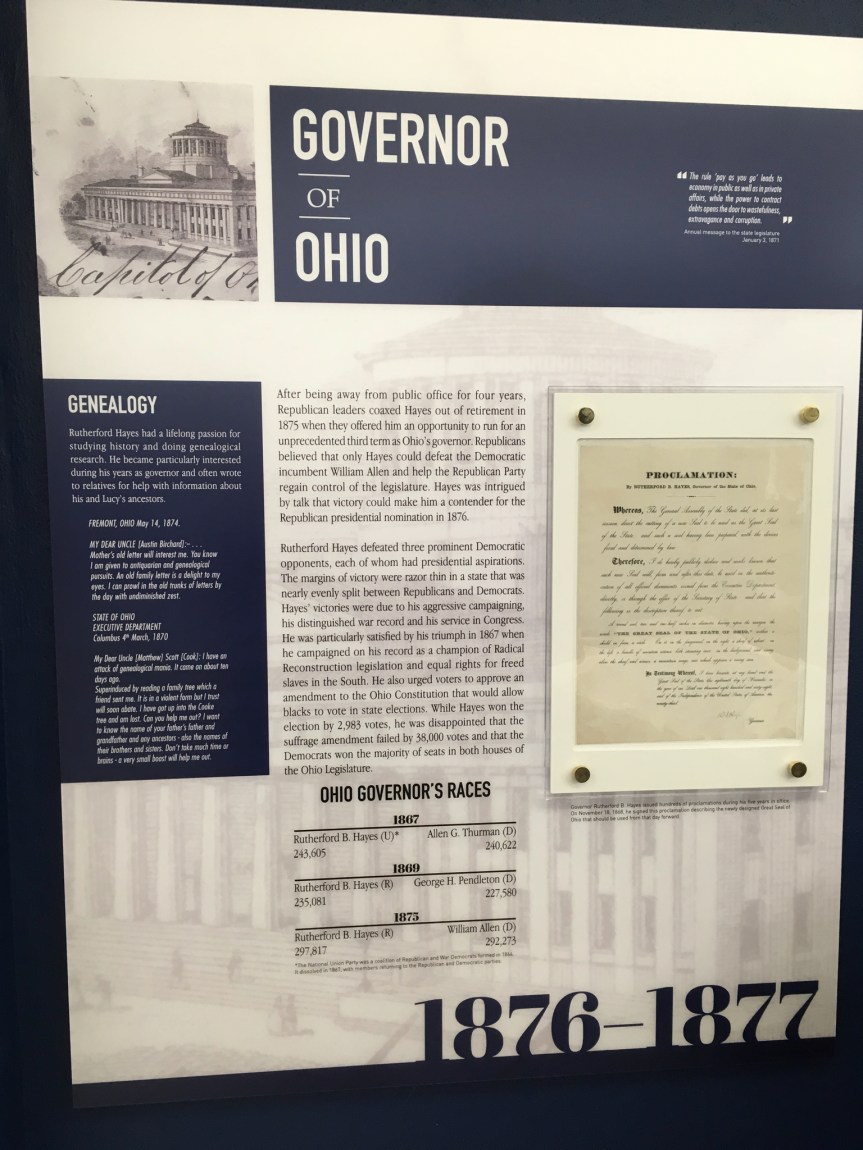
Located in the incredibly pretty town of Fremont, Ohio (formerly known as lower Sandusky) is the Rutherford B. Hayes Presidential Library & Museum (19th president of the United States, 1877-1881). The election of Hayes is actually one of the low points of US history; it was arrived at via the Compromise of 1877, a completely UNDER THE TABLE deal where the southern states agreed to recognize Rutherford B. Hayes as President in exchange for an end to Reconstruction in the formerly confederate states rather than address what had happened in a pretty fucked up election (the outcome of which was statistically impossible). In other words, the Republican party to stay in power, rather than confront election tampering head-on, agreed to put an end to all attempts to use the force of law to give former slaves their civil rights as free men, a chicken shit move that took 100 years to rectify. That said, once in power Hayes did a reasonably good job while president (he tends to be ranked about well as Nixon, Ford or Carter), and as such this is a place worth visiting.
When I arrived in Fremont it turned out to be yet another one of those Ohio towns that in the 1800’s were the place to be, but that are now one of those unexpectedly pretty but economically struggling towns that make for great movie sets. The homes here were impressively gorgeous and/or huge and I had a feeling that it was one of those town where you could buy an amazing home dirt cheap. I saw more than a few ‘for sale’ signs all describing the property as a classic that just needed to be lovingly upgraded.
The library and Museum are located sort of near the center of town, on a fairly large piece of green land known as Spiegel Grove.
The Grove is a state park that houses not only the property the Hayes family, but was also (according to the gates) the entrance to the old Sandusky Scioto Trail (which went from Lake Erie to the Ohio River (connecting the St. Lawrence river and the Great Lakes with the Ohio and Mississippi Rivers) — which was used during the Harrison Trail War in 1812 as part of the battle of Tippecanoe (whose memorial in Indiana I also visited)
The park itself is very pretty, and full of some very old growth trees, some of which were planted by important people, etc.
On the grounds are two buildings of interest… The home (which you need to buy a ticket and join a set tour in order to see) and the Museum/Library — entrance to which is included in the ticket.
firstly the Library. Personally I found its front stairs to be fascinating. They had recently been redone to convert them from traditional museum steps to handicapped accessible ones, using a design I’d not seen before… (on the left or right edges they’re fairly normal steps) AND according to the staff member I spoke to they heat up in winter so that no snow or ice form on them.
which contains the gift storeI was actually very impressed with the store because in addition to some of the more obligatory things (t-shirts, mugs, bumper stickers, etc) and the same fake ‘historical type’ stuff which you see for sold at almost all US historic sites, they had gone the extra mile to try to make sure they promoted locally made products.
The Museum, like ALL of the presidential museums is WELL worth a visit. It’s expertly curated (wouldn’t be surprised if they borrowed someone from the Smithsonian to do it) and discusses not only his administration, but also the family. It starts with the obligatory introductory video:
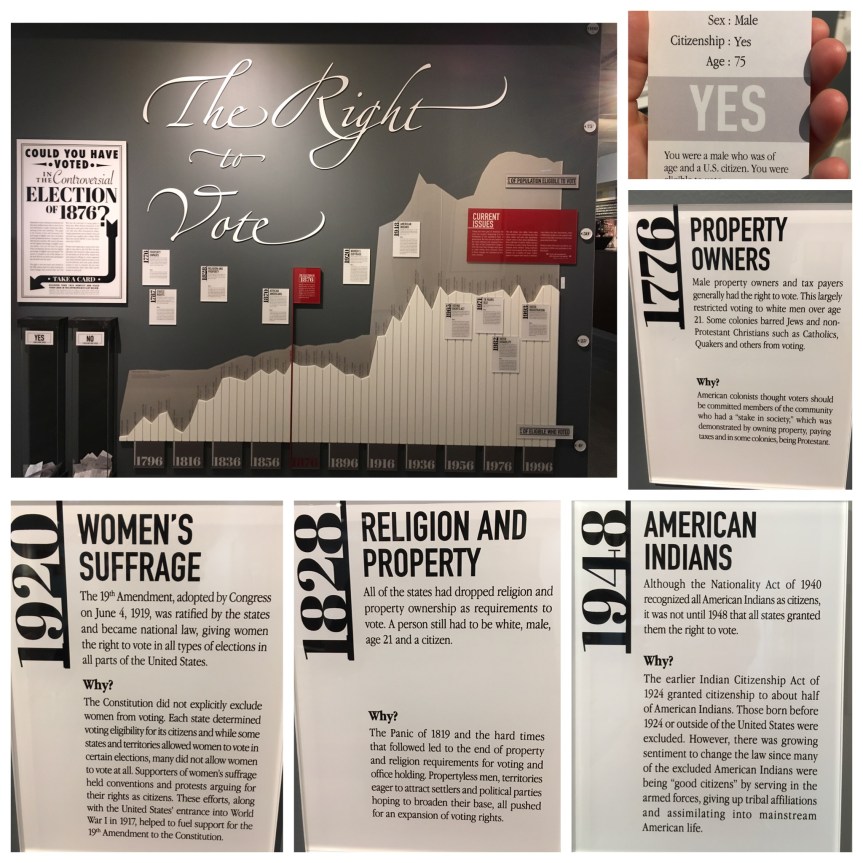
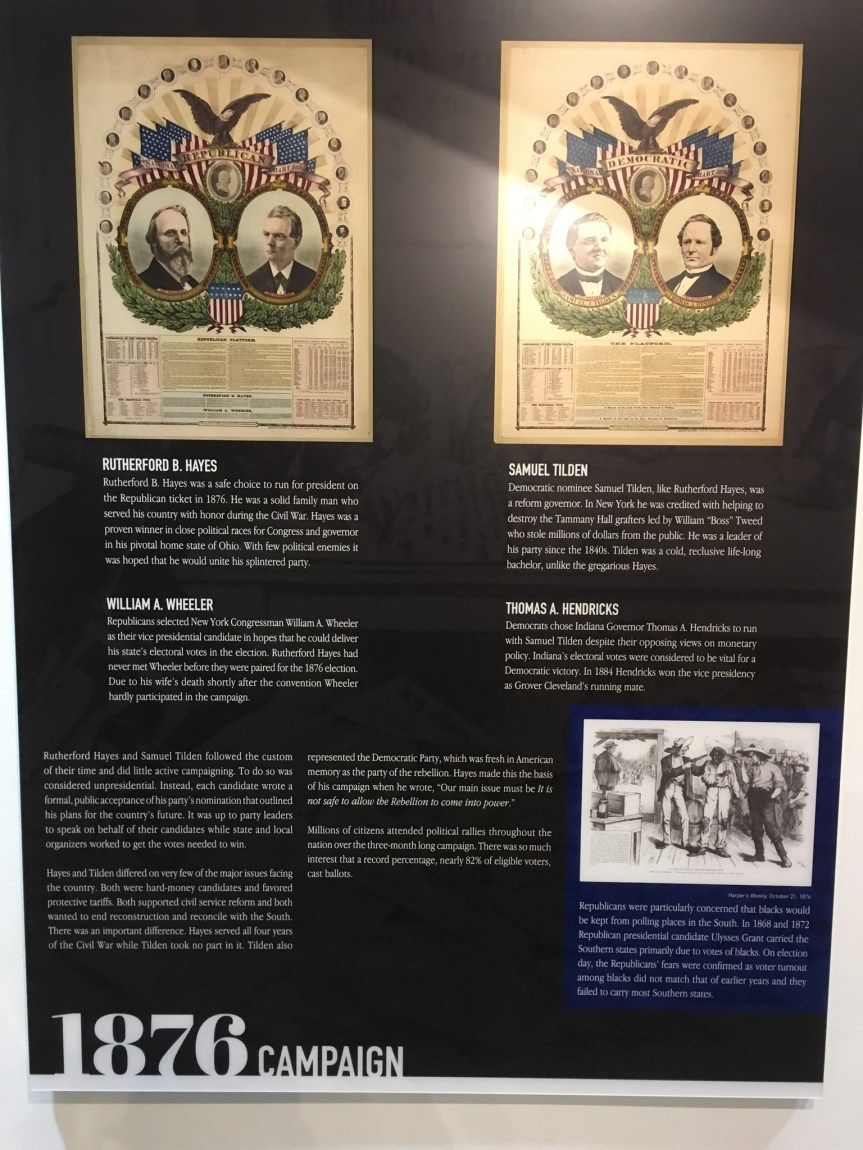
The displays on the main floor were about the presidency and started with a discussion of the controversial election, it began by focusing on how issues of suffrage (who did or did not have the right to vote and when) might have impacted the outcome of the election
And then went into the specifics of what happened, how the south basically did everything it could to sway the outcome (more people voted then there were residents in towns and blacks were actively intimidated and threatened to keep them from voting, etc), all of which led to the final compromise, rather than running a second election.
And then the presentation turned away from the election to what he was able to accomplish during his tenure.
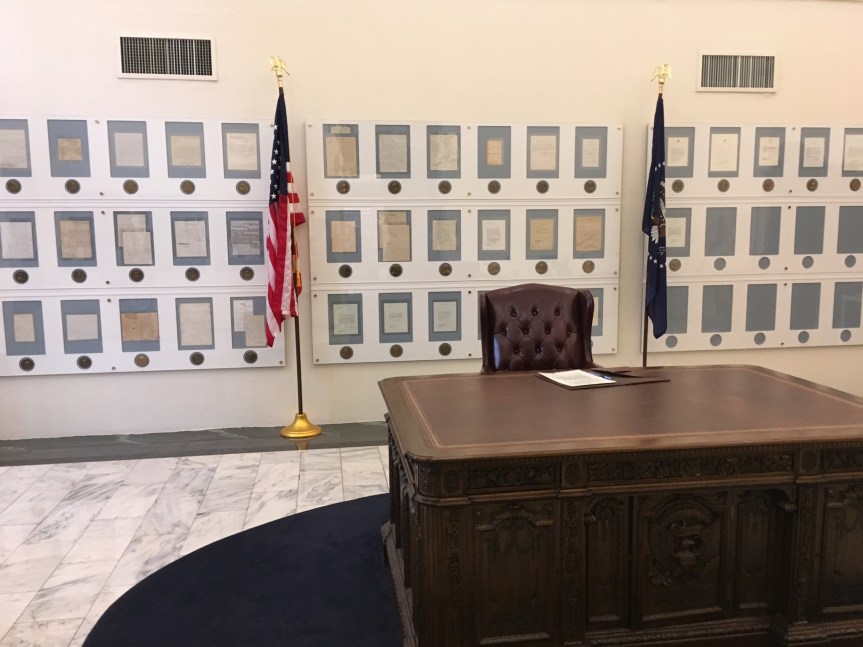
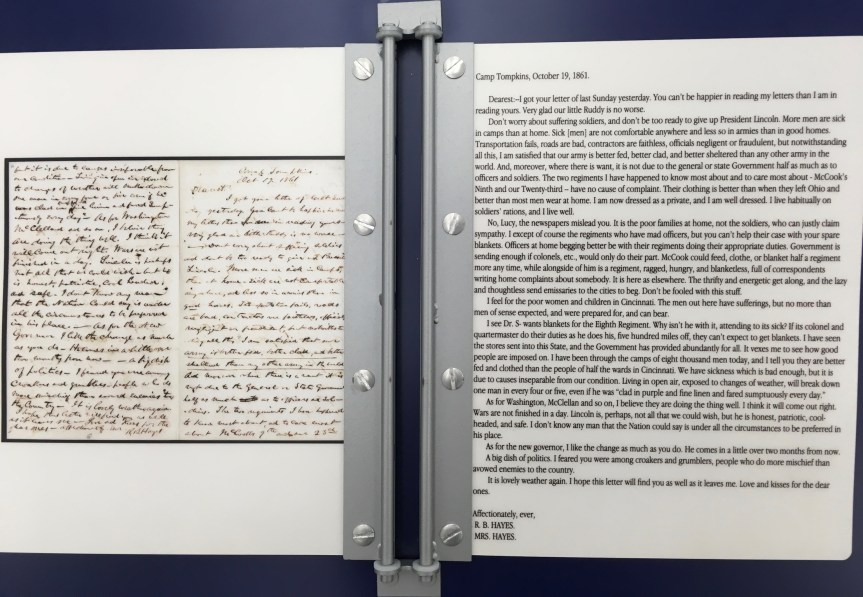
And then in addition to all of the “text-book” like displays, there were personal items given to or belonging to the family, scattered around the rooms. After this was a large atrium sort of room (I have a feeling it may have been the original entrance), called The President’s Gallery, that was REALLY beautiful
On either side of the gallery were large rooms; one was dedicated to desks used by the president’s administration
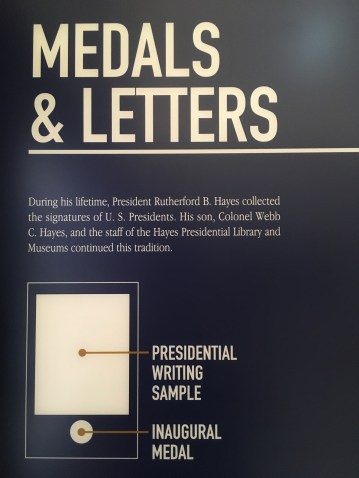
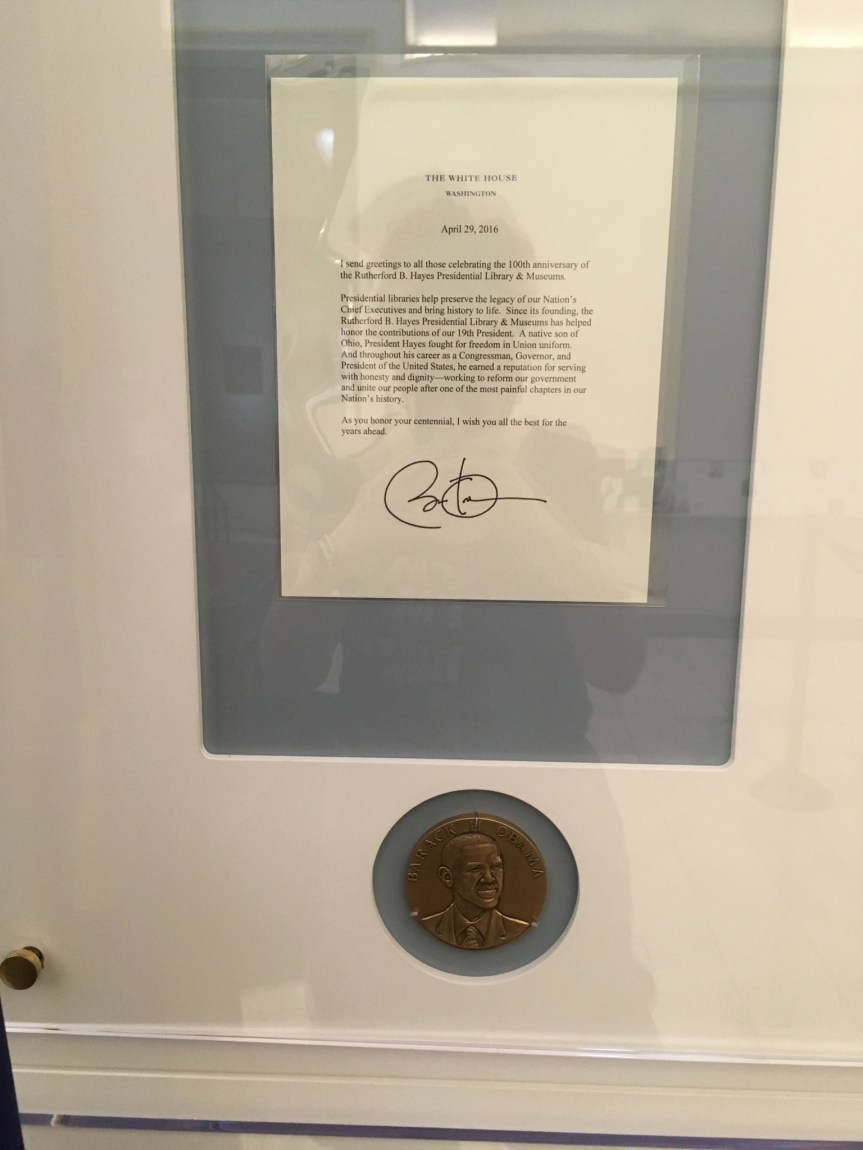
The collection of signatures is impressive, it begins with our first president, George Washington… travels through the various presidents beginning with purchased/collected letters … and in the modern period moves to presidents specifically writing to the president’s son, or the library itself… and ends with Obama
In the room on the other side of the atrium are items belonging to Hayes’ wife, children, grandchildren and GREAT.
This is a heck of a doll house I want this doll house
And then lining the walls were other personal items of the family members
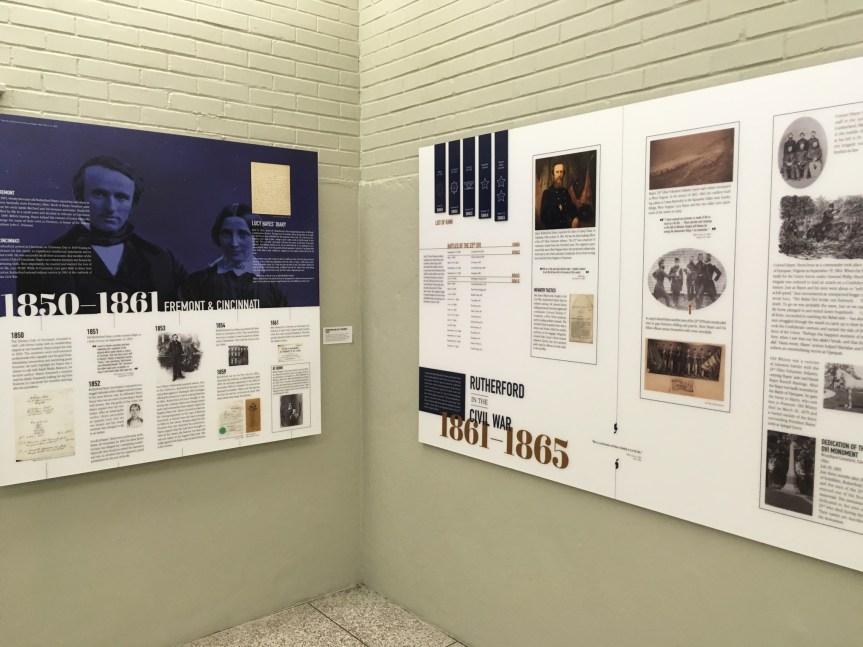
If you head downstairs, you find more stuff….
When I leaned in to take the close up photo of the description of the desk I heard a warning message “You are to close to the exhibit please step back!” in an authoritative male voice…
This is kind of a cool experiential exhibit, clearly designed for little kids; they’re allowed to stand on platform (it’s one of those weight machines) and experice what a 46 lb load (which is what ever civil war soldier carried) feels like on their back
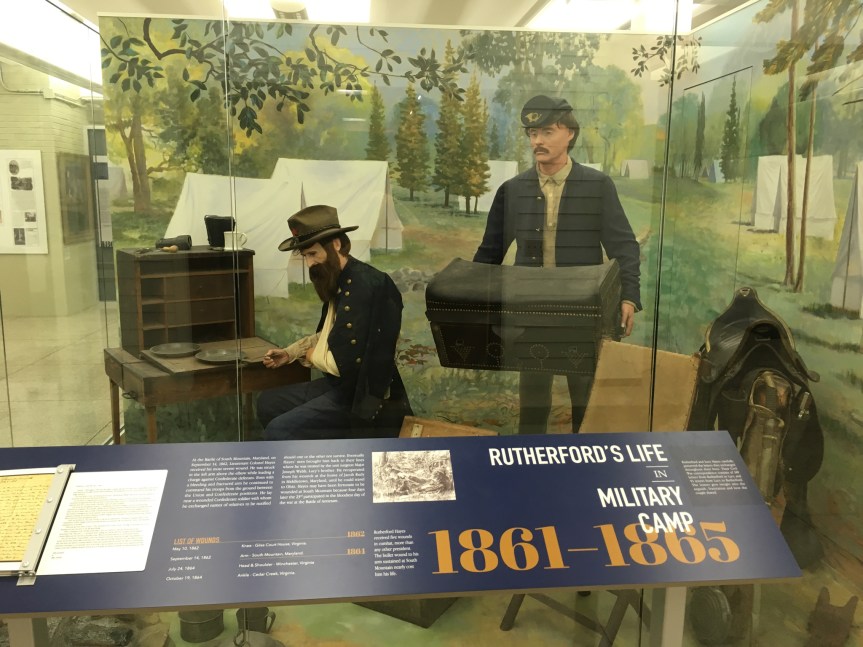
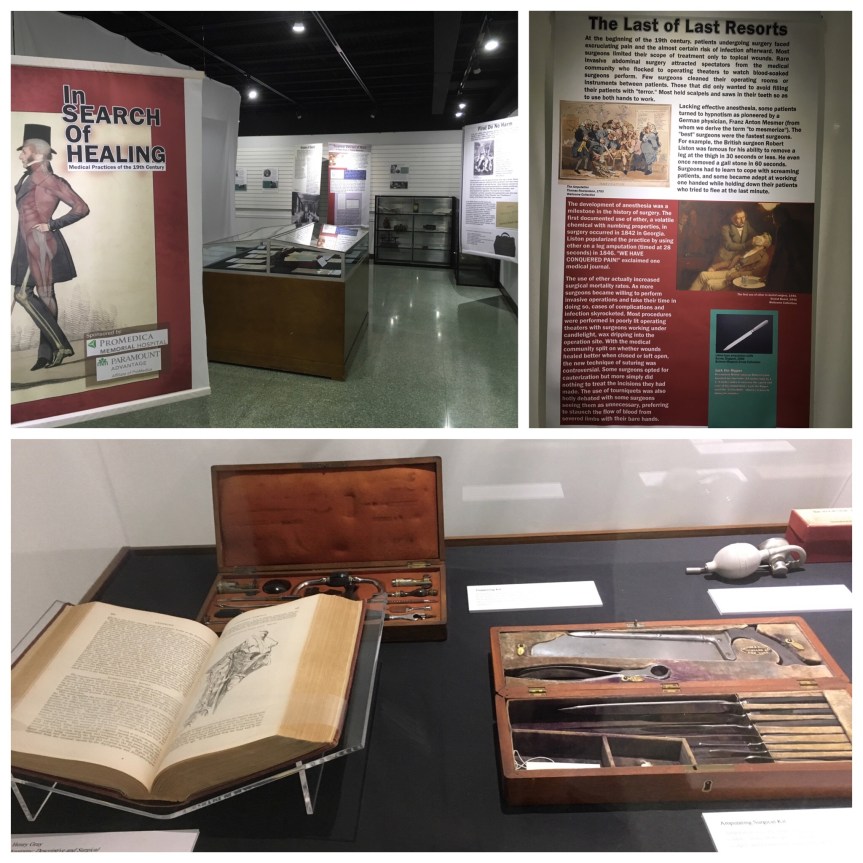
They had a temporary exhibit about medicine in that period (later I learned that the business of Fremont had been foundries, which did all sorts of cutlery and things like the surgical knives… hence the exhibit, well at least partially)
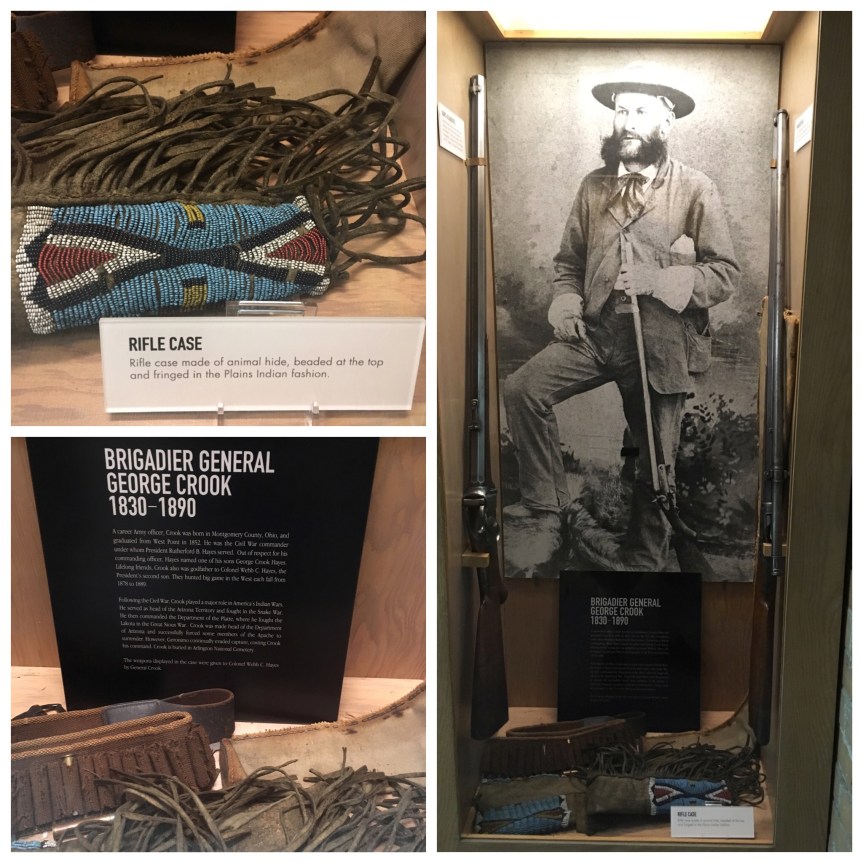
That said… Apparently military service AND weapons collecting were both a big things in the Hayes family going forward based on these collections. One room is devoted to the weapons collected not just by the President, but also by his grandchildren
If you never studied the war of 1812, it was sort of The American Revolutionary war part 2, begun in large part because the British weren’t respecting American sovereignty
A few of the grandsons went on the be an admirals or some such and were involved in the wars in the Philippines, The Boxer Rebellion in China, and in World War …
In addition to showing the familie’s arms collection they had an area devoted to their tours of service and what they did
This included how the female members (like President Hayse’s wife) served by supporting the troups
One cool thing they did was to try and replicate things like the trenches of WWI, and the Submarines, to try to give you a sense of being in one. After viewing the exhibit I said to them… that was so cool!!! But you need to dirty up the metal!!
And then after completing the museume I visited the Hayes home. The tours of the family home happen every hour (rather than every half hour as described by the RoadTrippers web page).
As I waited to go in I talked to some local women, one of whom was actually (through Rutherford B Hayes’s daughter) related to the family. She told me that the industries here were foundries, which did all sorts of cutlery and things like the surgical knives that were shown in the display in the museum (see above). The town of Fremont, being connected to Lake Erie through the Sandusky river was therefore at the time conveniently located for the transportation of goods, and were also on the railway lines when those came through. Rutherford B. Hayes, had apparently helped build this town — even before becoming President; and that it was really a major nothing when he came to settle here. He built the first church… for his wife (even though he didn’t attend), and he also built a prison because until then all of the prisoners were held in underground pits.
You can tell by looking at the back of the house (see above) that it was one of those homes built in stages — hence the unwieldy angles of the thing. In fact according to the docent it was built in three stages…
The lady wearing blue told us REPEATEDLY that she was related to the family through Rutherford’s Daughter. The woman in white, also had a personal connection… her grandfather had been a caretaker of the property and had actually died there.
The initial home (the door and to the left of the docent) was owned by Hayes’ uncle who was a “professional bachelor” (a term we now pretty much always know meant he was most likely gay) who was affluent, but had no wife or children. Hayes own father had died before he was born, so his mom went to live with her brother. Since Hayes would therefore inherit the house, the Uncle had asked him what ‘changes’ he’d like made to it, and he had said what he wanted most was a “porch with a house attached to it”, hence this great big gorgeous porch… which had at one time encircled the whole home. Later when Hayes went to D.C., while he was gone he added to it knowing that now it would need to host (and probably house for the term of their visits) all visitors, official and otherwise who might want to see him, at which point he added two major extension, the bit to the right of the docent (see above), as well as an extension at the back of the house for a formal dining room and a kitchen capable of supporting it.
At that time, Rutherford B. Hayes, also ordered a new knocker for the home (with a presidential looking Bald Eagle on it) and sent it home to his wife and gave specific instructions of where it needed to be installed — exactly where and how high. The family, once Hayes became president got into the habit of saving EVERYTHING, so we know that it cost $1.95 in 1877 (about $46.83 in 2018 dollars).
No pics were allowed once in the house…. booooo!!!!! I was like, “oh no biggie, I’m sure I can find them on-line… but NO!!! When I started writing this and looked I found they’ve actually done a pretty good job of limiting access to the home. The only rooms shown in the videos were pretty much the ones they had made post cards of, that was it.
I did however find these videos that DO show the inside:
This one, produced by a local TV station talks at length about the renovation of the first floor of the house to its condition when the former president lived here. This was necessary because his descendants had lived in the house until 1965, and had updated various things to keep with modern styles.
This next, much longer video is from C-Span June 1995 (BEFORE the renovations took place, so the rooms now look different), is much longer and includes a lot of the narrative I heard while visiting.
Like I said the family from the time he was elected President were HYPER conscious of their historical importance from that point forward (to the extent of saving the receipt for the knocker). According to the docent, Rutherford’s cousin, who was a photo enthusiast, had visited the home in 1880 — while Hayes was still president — and took photographs of every single room in the house. These photos were then stored, along with everything else, and rediscovered among the boxes when the unpacking began in 2007, with the start of the restoration (which finished in 2012) so we know exactly how each room is looked.
Over the years, family members that inherited the property kept all of the original everything, and with great care. This family obsession with historical importance was such that THE ORIGINAL FABRIC that covered the sofas and chairs was left on the back of every item whenever they re-upholstered the fronts!!!! SERIOUSLY!!! As such, they were able to take that cloth and have brand new cloth made exactly to the same pattern and what we see today is that.
They altered a couple of things, as needed but they intentionally didn’t do any serious damage or made sure to keep examples of the old (like with the backs of the chairs). There’s a cover spread and pillows set that had been hand stitched by a cousin that was gifted to the Hayes’ that he and his wife had used on their bed, that had been folded up and carefully stored once Hayes had died, so that it is now still in perfect condition. When they changed a bathroom room into a different kind of room, they kept EVERYTHING… even if they weren’t using it because they understood it’s historic relevance… down to the square wooden pipes that diverted rain water into the bathtub. (According to the docent when they didn’t have enough rain water collected they would pump it from the kitchen and bring it in by hand).
The house — after the renovations — is four stories … the younger owners had put in wall-to-wall carpeting; and when they pulled it up they found this gorgeous inlaid wood floors. According to the docent in 1880 the cost of changing the house from one story to a four-story $880 (a sum of around $21,753.77 in 2018) …. at the time a daily wage for the workers was $.50-$.70 a day (we know this because the family even saved the receipts for what they payed their workers).
Photos were taken in 1880 and there were some bazaar items that they kept in the museum for forever, assuming “the president’s family couldn’t POSSIBLY have had this in the house… it was probably some odd gift someone had given them”… but when they finally found the photographs in the archives they brought them back into the house. This included one of those chairs made out of deer horns and leather. They have photos of what the house look like in the 1960s and then the photos of what it look like in 1880. There are a few items in the house that are not correctional he had, the two pianos in the house are not original because the second oldest son had taken the two of them and traded them to somebody for a large baby grand. He had over 8000 books and he read all of them
It was supposed to be a one hour tour we went in at 2 o’clock we came at 3:30. This entranceway was recently converted to handicap capable and in the winter time it heats up so they don’t get ice
Located in the heart of Silicon Valley, the Computer History Museum in Mountain View California, is a relatively new museum that’s still finding its legs. It is a work of love the houses donations not only from corporations, but from the individual movers and shakers of the bay area (the guys who actually invented the stuff you use today) who donated items from their garages and attics — as in some of them are friends of mine and I remember when this place first opened up.
One of my favorite people on the planet, I guy who I’ve known for over 20+ years (I knew him when was still an un-tenured professor in Chicago — we used to be dance partners at a country western bar in Chicago — he’s had four books on the New York Times best seller’s list since then), who I wanted to catch up with while I was in town (he’s become impossibly hard to contact since his success) suggested that we meet for lunch at a South American place called Voya located in Mountain View — we had ceviche which was ok, and a few other fish things… didn’t think it was anything to write home about and I was paying more attention to being with my friend than the food… so no review
(I got his Uber driver to take this photo of us before he took off — I think our last photo together was at his wedding) … ANYWAY… AS I got there a bit early … while waiting for him to arrive, I was walking around…
you know you’re in the Bay area when….
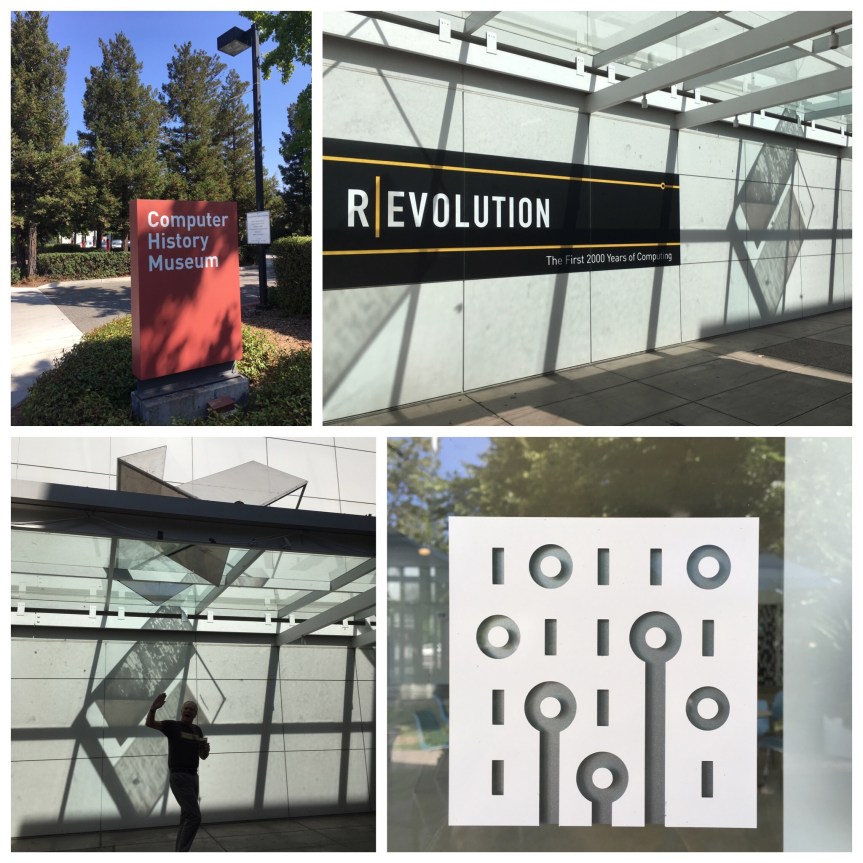
when I realized that the computer museum …. (one of the jewels of the bay area) was directly across the street …. A place I have not been to in about 16 years… So after he went back to work I went in for a visit.
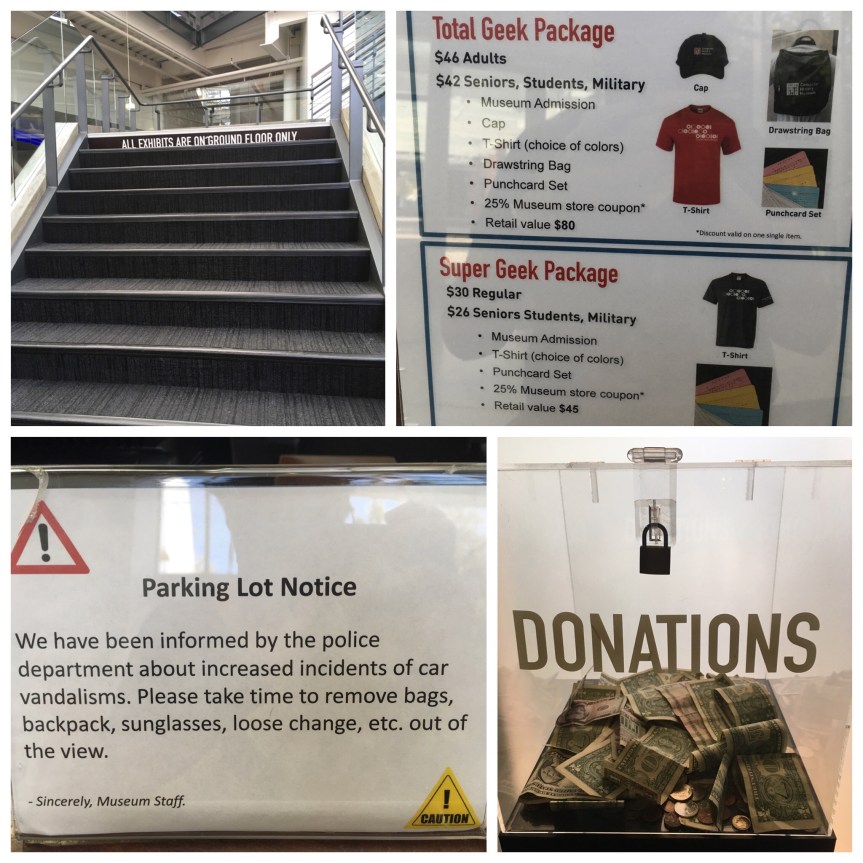
By the time I had shopped the gift store, gone to the bathroom, took my purchases back to the car (in part out of fear that my windows had been smashed — see below), yadda yadda, yadda….
It was already was already 3:30 in the afternoon and instead of having to pay $17.50 to get in (YEESH, that’s EXPENSIVE) I only had to pay $10. You’ll notice this is NOT advertised on their sign. In fact I was utterly clueless to it and just got lucky … the guy who was working the front desk… who had seen me earlier while I was scoping out the gift store
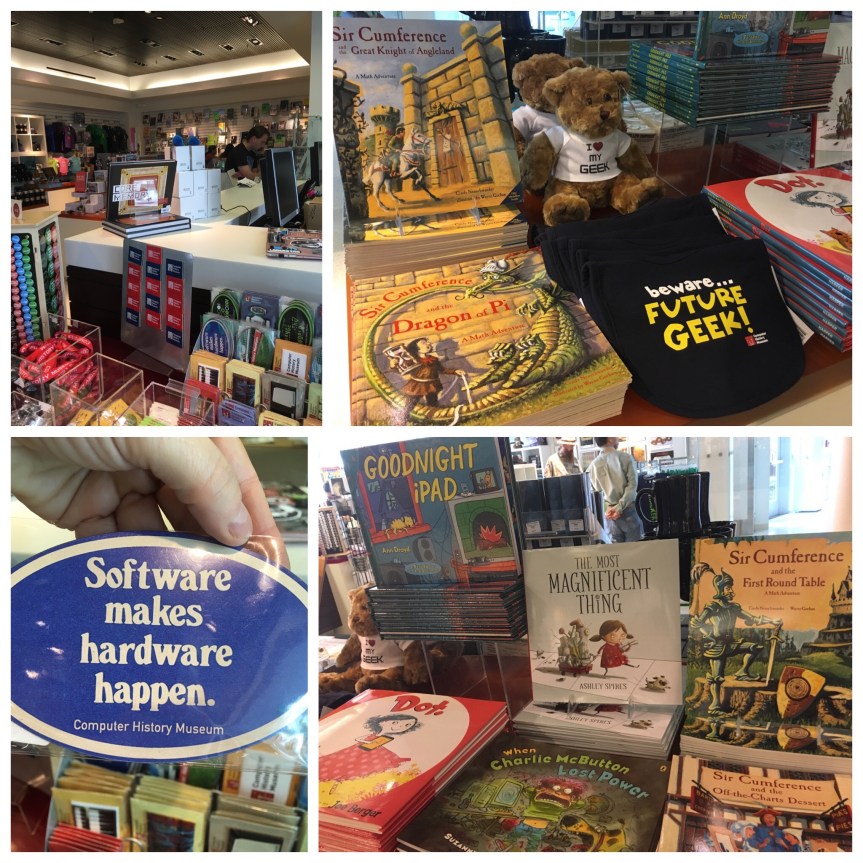
Whole sections of the store are devoted to women in the sciences stuff, or stuff geek girls might want… so I got very buy-happy/excitedWhy yes I did get the bumper sticker, why do you ask?And of course I got the geek girl jewelry (am now the proud owner of the hoop earrings with fuses hanging in them –these are the sort that are hidden in cars and appliances), and a few other pieces made from computer partsThat said, NOT ONE of the t-shirts for sale had a V-neck or scoop neck collar, so I didn’t get any of them (which made me very sad)
… HE assumed I had timed it intentionally, calling me a “smart woman” for doing it; but I swear, it was just dumb luck.
That said, there are two sections to the museum, the first one is to the left of the check in counter where you buy your tickets. The other is off to the right, between the counter and the gift shop. The first section, left of the counter, is mostly devoted to temporary exhibits (more than one) while the other is the permanent collection.
At the time I went one of the temporary ones was devoted to a brilliant woman who was not really awarded her just deserts in her lifetime due entirely to her gender… Ada Lovelace
Lovelace is considered by some to be the first person to fully recognize that the computing machine had applications beyond simply doing calculations, wrote a paper that included an algorithm on this topic, and is as such considered (by those who support her) as having been the first computer programmer (software engineer, versus hardware engineer… and “never the twain shall meet” (for those who don’t know, engineers tend to be one or the other, only VERY rarely are they both).
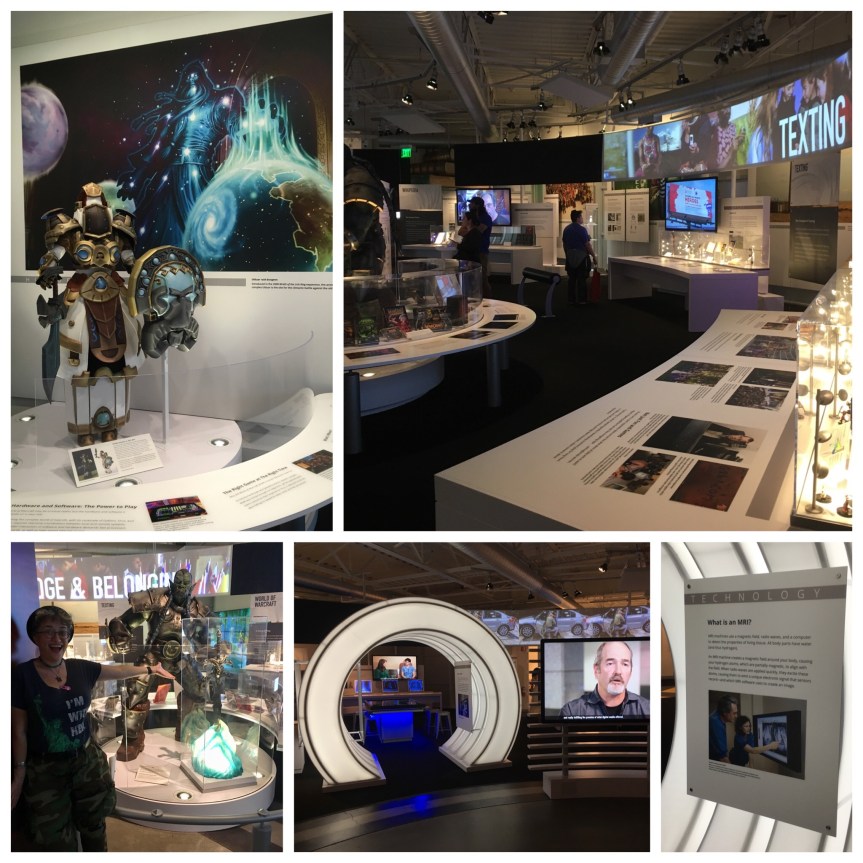
The other ‘temporary’ exhibit seemed to be more of a rotating one devoted to any and all of “newest” computer driven technology trends (well, the ones that are public anyway), everything from computer graphics, to texting, to medical technologies (like MRIs) to…
…the currently oh so sexy topic of fully automated cars. These would be the next step forward after my Subaru which has saved my life more than few times already by spotting potential accidents that I fully admit that I utterly would have missed (or not as the case might be) but for its warning me of them. My car, however, I still have to drive, in the future… a technology which is already visible (in its testing phases), at least on the streets of the Bay area…. is completely self driven cars.
Pics I took of the testing of “self driven cars” on Bay area streets
This exhibit talked about the not to distant future (hopefully) where they’ve managed to test all the bugs out and fully self driven cars are ready for prime time (a future that I for one look forward to, as I’ve never been one to drive for the fun of it).
This included side topics of how they are able to now utilize the computer graphics from the previous room create virtual car crashes. Virtual testing allows manufacturers a much cheaper way to test every conceivable sort of normally inconceivable crash, rather than actually smashing up a car. As some of you know, they used to only test two or three different sorts of common crashes; virtual testing allows them to reenact the uncommon ones, as well as test what might happen in those relatively unlikely cases with the newer cars, not yet on the roads.
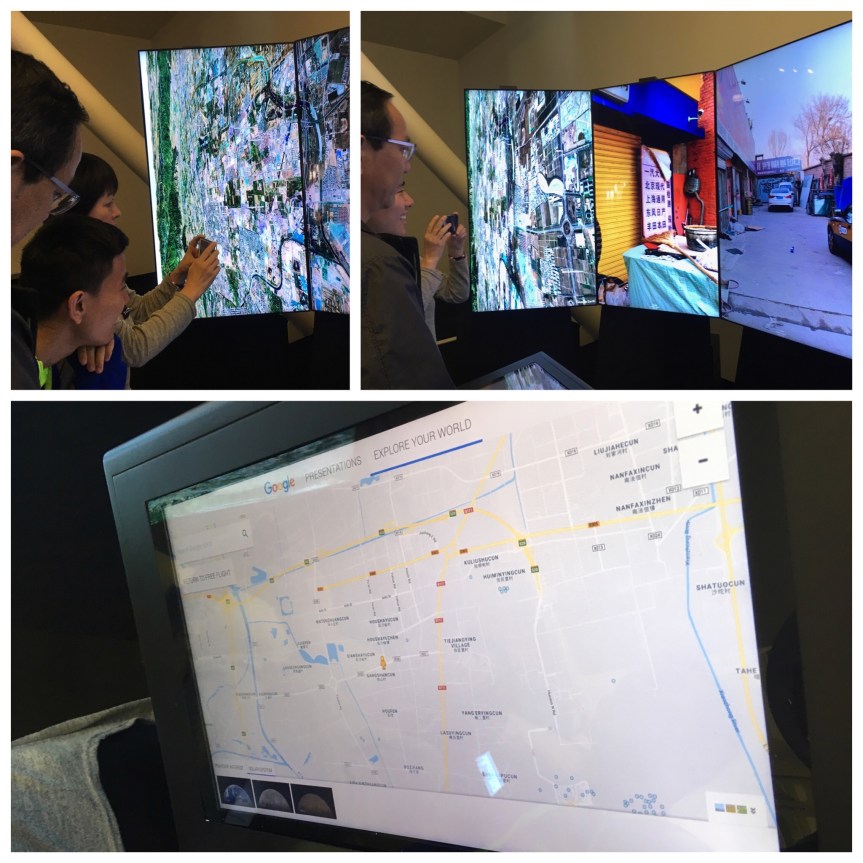
Additionally, as self driving cars rely a great deal on computerized maps, they also had a small exhibit showing just how advanced this has become… presented by Google Maps
And there was also segment devoted to Wikipedia (which anyone reading my blog knows I’m a big fan of)
Indirectly the Museum was exhibiting something it never talked about directly, but which I’ve NEVER seen before and hence was VERY aware of… i.e., a new technology for use in museum presentations
————————–
Now that said, One of the things that impressed me was an innovative sound management system that I’ve not seen anywhere else.
If you look carefully at the picture below you’ll see a woman watching a video in the middle of wide open space… this is pretty unusual although you might not realize it… normally movies are presented in cordoned off areas where the acoustics can be easily controlled. What’s even more unusual is from where she’s sitting the sound is completely clear and distinct, almost to the extent that it was like wearing headphones … or as though it were the only sound in the room, like in a movie theater. YET, from where I took the picture, you can only barely hear what she’s listening to at all.
How you ask? Well… look above her head and you’ll see there is small white square hanging from the ceiling… That’s where the sound came from… Now, logic dictates that it’s some sort of directed speaker that produces very directed sound waves. As in, she can hear it loudly and distinctly without it annoying someone a few feet away (where I was standing). From there, it merges into a sort of white noise created by the various soundtracks all running simultaneously but without the effect of cacophony of sound, like you get in other museums.
You can’t see it, but right behind me was a different video, with the same set up, with its own sound track, that in no way interfered with the experience the woman in the above picture was having. Now let’s face it, I go to a LOT of museums and I’ve never seen this technology in use before. I have no idea how much it costs but I hope to see it a lot more regularly from now on. It rocked…
——————————–
Returning to the museums itself: On this same side of the museum there they also have regular demonstrations of the OLD IBM mainframe computer systems that used to process things like company payrolls, first introduced back in 1959, which had been given the catchy name of the IBM CMH-1401
The demos are given every few hours by actual retired former IBM employees, whose jobs had been to keep the 1401 running in its heyday (read the signs below)
Interestingly, they do so to large throngs of very interested young programmers… keep in mind this was about 3:30 on a Wednesday, not one child or family unit in the room.
These all looked to be young programmers (most were between 23 and 35), new to the bay area (possibly)… and you could tell the older retired engineers were really happy to be so appreciated by the younger generation of engineersAt the end of the demonstration you could create a punch card with your name… which I did, and receive a custom printed … on a HISTORIC printer … that says you visited the place (as you can see I was there on September 5th, 2018).
—————–
After this I went to check out the permanent exhibit: This is in fact my 2nd time coming to this museum. The first time was about 16 YEARS ago in 2002 (the year I finally completed my dissertation) while I was still living in the bay area and was invited to the grand opening event for this ‘new’ building for the collection… by friends who had donated various contents from their garage to be shown in here … in fact I knew more than few people at that event who were all there for the same reason (donating objects to the collection). I have to say that at that time the museum was HIGHLY UN-impressive… Since then, major upgrades have occurred and it’s clear they have hired a fairly decent curator to organize the thing, and while it’s still imperfect, it is now quite IMPRESSIVE, although imperfect.
It starts out logically enough with “ancient” tools for making calculations (as in ones my dad was using 50 years ago), like slide rules, abacuses and maritime tools… and then moves on to things like
Calculating tools that helped during World War II, back when women who typed in the all the data were called calculators, to innovations of the 1950’s
there’s discussion of stops and starts and lateral moves as various technologies came up and then quickly died as someone else came up with a more elegant solution
And there’s discussion of the problems women had entering the male dominated field… to techs that I remember using when I was in grad school (20 years ago)
I particularly got a kick out of the video game section which talked about these on-line Unix based games like rogue and dungeon crawls where if you got far enough in the game you were allowed to contribute a dungeon section that you had coded yourself to the larger game… but it meant you had to learn the language C++ in order to do it… which drove a lot of players to learn to code.
… and there were also the more passive games, where you just a customer, like Pac-Man (which my brother excelled at) and pong.
————————–
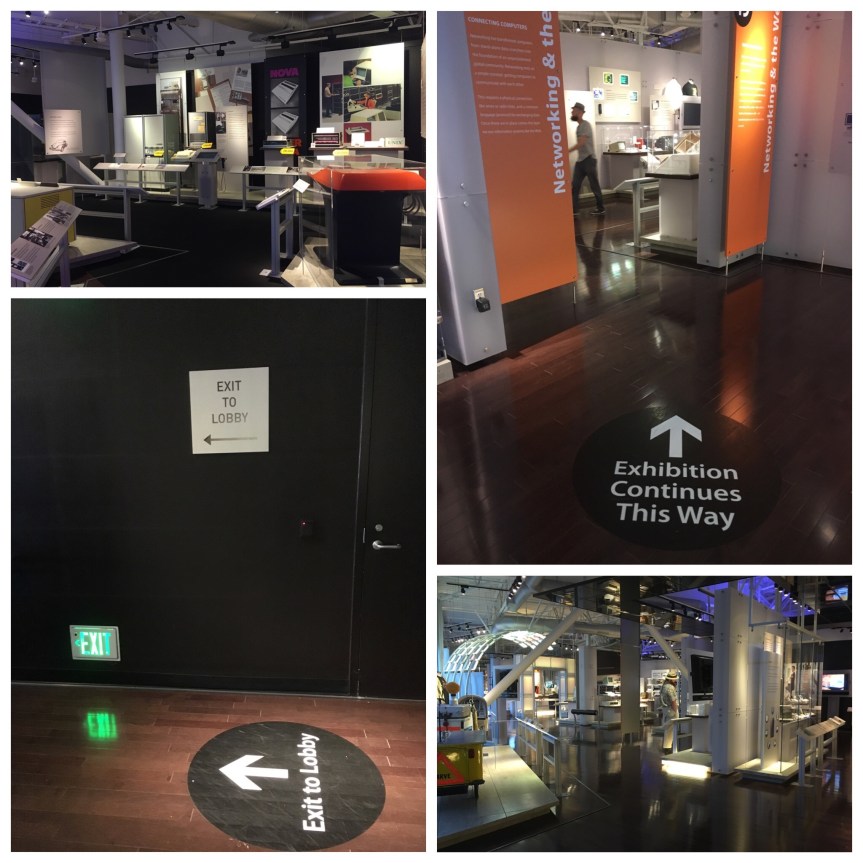
One of the things that I did NOT like was just how easy it is to get turned around and lost in the maze of exhibits.
Look at the map above, even there it’s like, “HUH” … unlike most museums there’s no clear path, it’s like a bit like a giant fun house maze
… to the extent that there they have had to place massive markers on the floor to direct you around … markers that if the museum were well laid out shouldn’t exist. That said, I can SORT of see a justification for messy layout, in that innovation and the connections between technologies isn’t a straight forward thing. Innovation goes backwards and side-ways and every which way… but a museum really shouldn’t do that.
I mean look at the above space, really look at them, and tell me if can figure where you’re supposed to go next in terms of the layout of the exhibit. There seems to be little rhyme or reason to it… and seriously, I got kind of lost in it. I almost never get lost.
Meeting up with an old friend I haven’t seen in years…. I will say this about the Bay Area… if you don’t like the weather drive 15 minuets, it’ll change. I was staying at the home of another old friend in the South Bay area, and drove north to Pacifica, which is right next to the ocean. We met at her home, had a long chat and then walked the TWO blocks (yes life is hard for some people) to the sea-side.
The temps in Sunnyvale (which is in the South bay) were 77 F when I left about an hour ago, here in Pacifica it’s 64 … this difference is because of the fog that coats the place almost none stop during the summer months
There was a group of whales out there— we kept seeing multiple poofs of water as they spouted….. and then I saw the whale’s back out in the distance, for just a second… and we kept watching and then saw jumping whales and their heads as they tried to scoop up the fish and then their tails when they dove back in—- but it was so far out in the ocean that I seriously doubted that my little iPhone camera picked up anything — and it didn’t
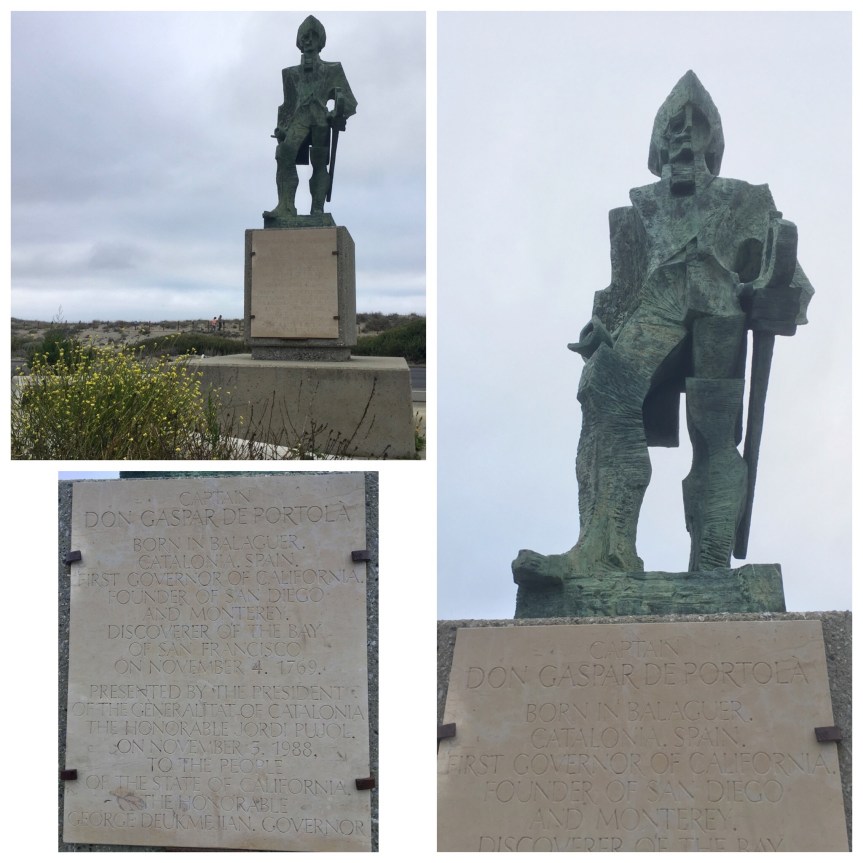
Just at the edge of the seashore was this statue:
Captain Don Gaspar De Portola
born in Balaguer, Catalonia, Spain
First Governor of California
Founder of San Diego and Monterey
Discoverer of the Bay of San Francisco on November 4, 1769
Presented by the President of the Generalitat of Catalonia
The Honorable Jordi Pujol on November 5, 1988
To the People of the State of California
The honorable George Deukmejian Governor
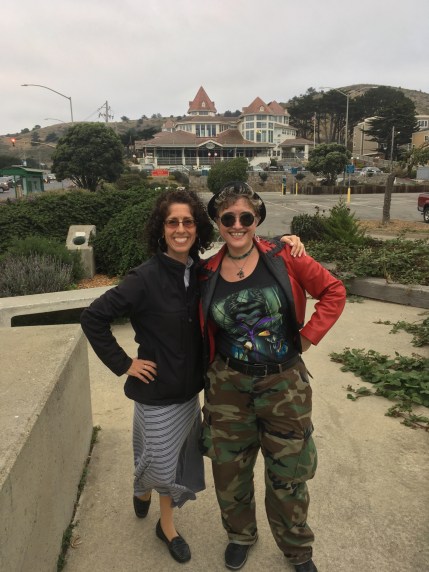
Me and my old friend, believe it or not we used to wear the same size clothes
That said, on the way back, my Subaru saved my life again today… was tired, driving home from Pacifica, didn’t notice cars in front of me on the highway suddenly slowing down, my car threw on the brakes and set off alarms, I threw the brakes on harder…. a tour bus was on the side of the road with the door to the luggage area completely open blocking a lane of traffic….
And then, when I got home to my friend’s house, where I’m staying… I found the family in bathing suits… “we’re going to go hot tub, care to join us?” My first soak in a hot tub in about a year — life in California is so hard
Located in Elko, Nevada, a gold mining & railroad town located off of Interstate-80, is the Western Folk-life Center is designed to promote the cowboy heritage and way of life through their songs, storytelling, poetry (for those who don’t know, Cowboy Poetry is THING) and artwork. It is also the location for the yearly (approaching its 35th anniversary) National Cowboy Poetry Gathering and competition…. six days of poetry, music, dancing, workshops, and exhibits all of which are based in tradition but focused on the modern/rural West.
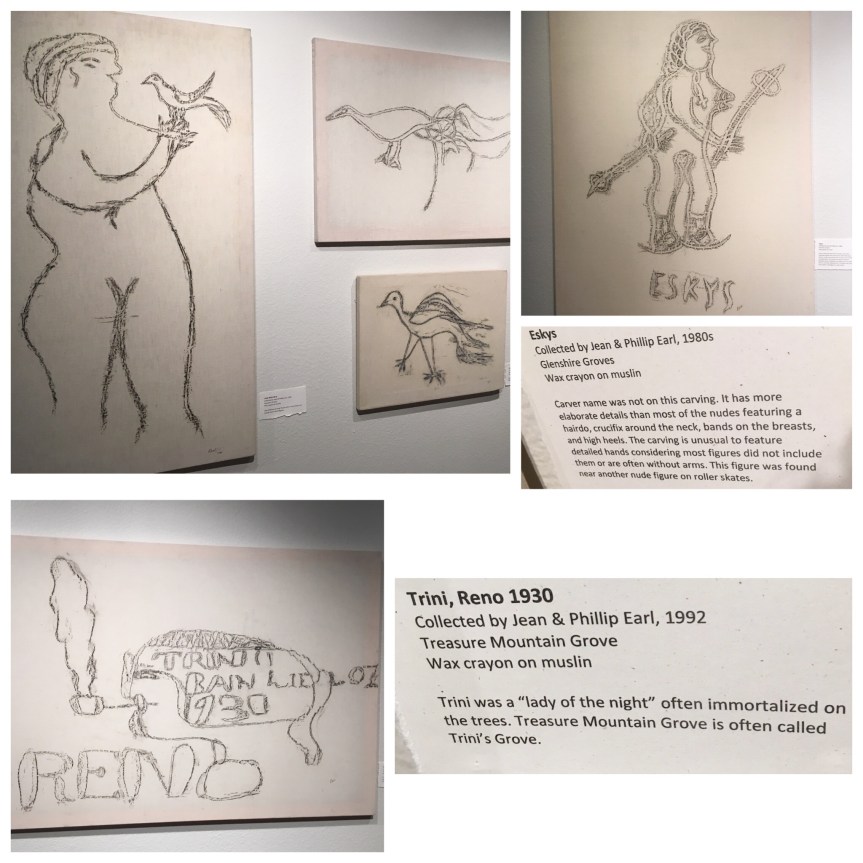
You first enter into the gift shop, which constitutes almost a quarter of the space, and actually has quite an impressive collection of items. Around the outer edges of the store you’ll find areas devoted to Cowboy poetry, music, and art, as you expect….Plus some handicrafts, including beauty products and other ranch produced handicrafts…. but the entire center of the shop???Jewelry! Lots and lots of jewelry — cause well… profit margins…. alongside the gift store is the art gallery. The guy in charge told me that they always have visiting exhibitions in this space… which switch out every few months. While I was here they had an exhibit about the art of Basque sheep herders (a different sort of cowboy) — and their art forms, including carvings, some of which date back to 1900, that are carved into local Aspen treesbecause these tree will ultimately die, a married couple had gone around collecting rubbings of all the ones they could find.
This was followed up by a small display about Basque improvised Poetry. Here they give them a topic and they have to come up with a poem on the subject … which was won by a woman for the first time last year
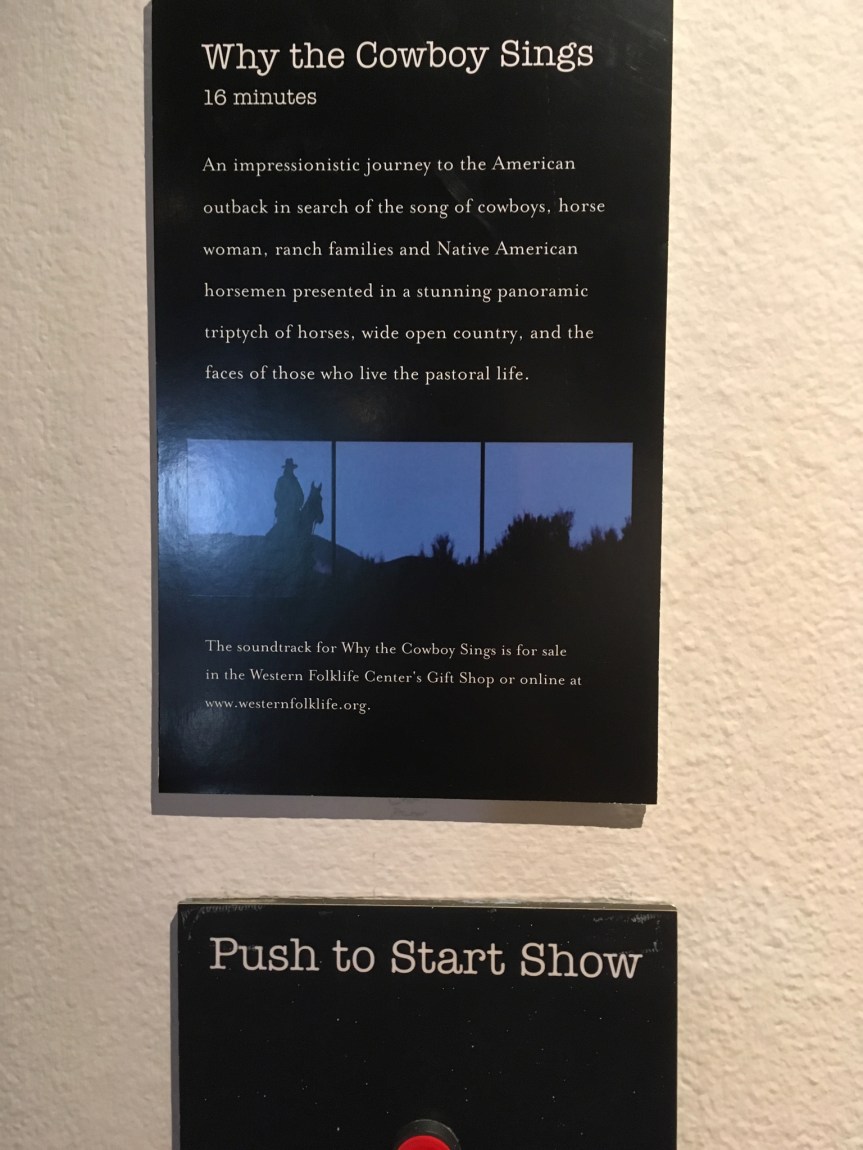
Then there was a permenent display, of the movie why the Cowboy sings…. only its the 16 minute version
Looking online I found the PREVIEW of “Why the Cowboy sings” (1.24 min)
As well as the Full 56 min movie — but no 16 minute version
After this the docent showed me their western bar… it was not specially made, they found it in a mining camp in a tent and brought it here
Some examples of Cowboy poetry:
This website shows last year’s “Best of the West” show, which is a yearly performance at the Poetry Gathering, which exhibits some of the best of modern Cowboy music. While this video on the event, gives you an idea of the full breath and depth of it:
Currently situated in the middle of the intersection at South 88th Street and Mills Civic Parkway in West Des Moines, Iowa (not far from I-80), lies the Huston Family Cemetery. It was named for James B. Huston, the patriarch of one of the first families to settle in Dallas County (in the 1840’s) and the LAST person buried at the plot (in 1889). The cemetery is unusual in that it now sits in the center of a roundabout in what was once a rural area, but that is no only about a mile away from a Costco, and as there’s already been one instance of a drunk driver driving through the site, it might end up being moved — although there is some talk of moving the roads instead.
The area which I’m fairly sure was completely rural a few years ago (like the other grave in a middle of the road I visited in Indiana) is to the graveyards detriment being developed REALLY quickly, according to the locals I spoke to … so much so that — like I already said– there’s a Costco about a mile directly down the road (with a gas station, which I filled up at).
The Huston Cemetery consists of 19 graves that date back to the late 1880’s, and are located near to The family’s original home — which is still standing nearby. The home is HIGHLY historical, as it was once a stage-coach station, a tavern, the local post office AND a stop on the Underground Railroad. The family patriarch, James B. Huston, was the first attorney in Dallas County (where the graves are situated)
According the city’s website, the first two former slave girls, both named Harper, who apparently had “died on their way to freedom” were the first individuals buried there — although this is conflicted by a report from another site, which claims the two girls were part of family that was on its way to Kansas to become part of John Brown’s raiders. They were followed by James Huston’s wife, Nancy Hill Huston, and six of their children, all of whom died young — so there’s a sad story to be told from these stones.
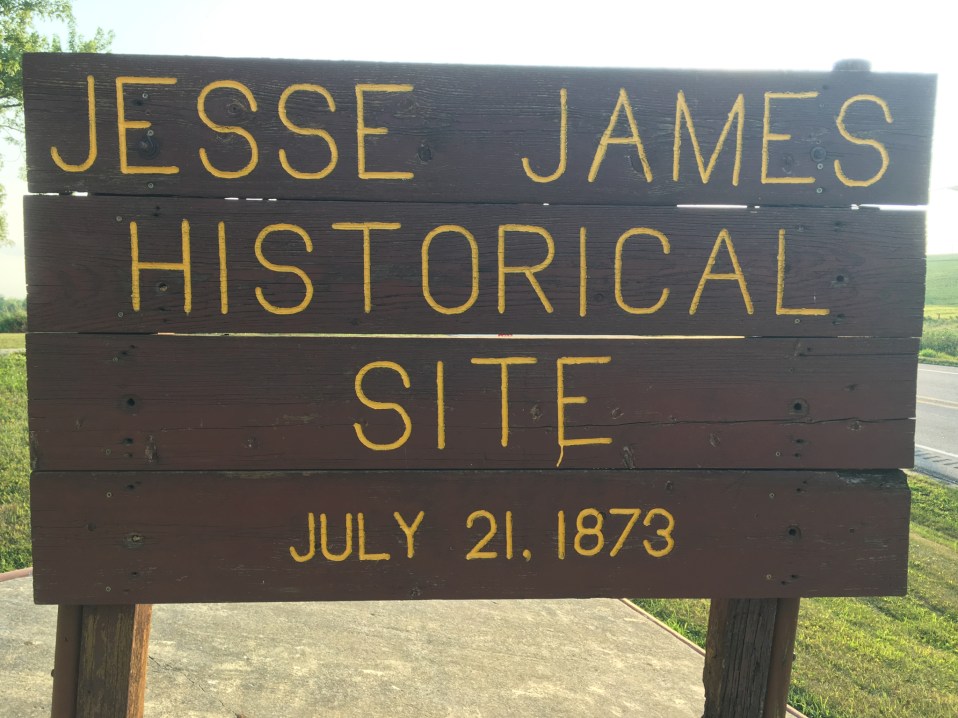
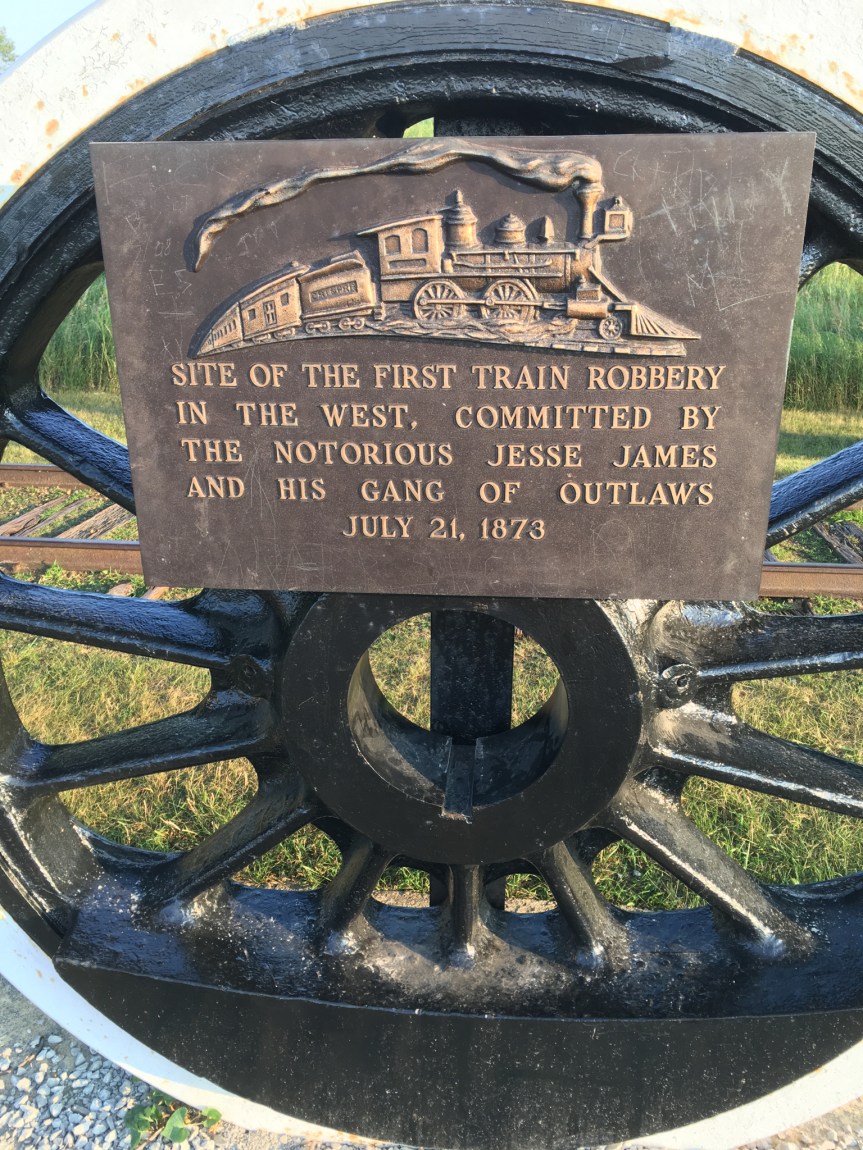
Located a short distance off of Interstate-80, in Adair, Iowa, is a monument dedicated to the very first documented heist of a moving train in the west; this occurred on July 21, 1873. The thieves in question were the notorious gang of outlaws led by Jesse James.
Road is to the far left, then the 2nd road is the off ramp, then the memorial
The memorial is located near the top of a low hill, along side an off ramp type road, so that tourists don’t block traffic or cause accidents.
Both sources make the point that this was sort of learning experience for the gang, in that their actions, jerking a rail out of place, resulted in a derailment of the train and the two needless deaths of Engineer and the fireman, plus injuries to various passangers… i.e., they ultimately decided this method just made it harder than it had to be.
Along with the explanation of the robbery are some posters talking about local wild plants and a bit about the town.








 When I arrived in Fremont it turned out to be yet another one of those Ohio towns that in the 1800’s were the place to be, but that are now one of those unexpectedly pretty but economically struggling towns that make for great movie sets. The homes here were impressively gorgeous and/or huge and I had a feeling that it was one of those town where you could buy an amazing home dirt cheap. I saw more than a few ‘for sale’ signs all describing the property as a classic that just needed to be lovingly upgraded.


 I was actually very impressed with the store because in addition to some of the more obligatory things (t-shirts, mugs, bumper stickers, etc) and the same fake ‘historical type’ stuff which you see for sold at almost all US historic sites, they had gone the extra mile to try to make sure they promoted locally made products.





 On either side of the gallery were large rooms; one was dedicated to desks used by the president’s administration



















 Additionally, as self driving cars rely a great deal on computerized maps, they also had a small exhibit showing just how advanced this has become… presented by Google Maps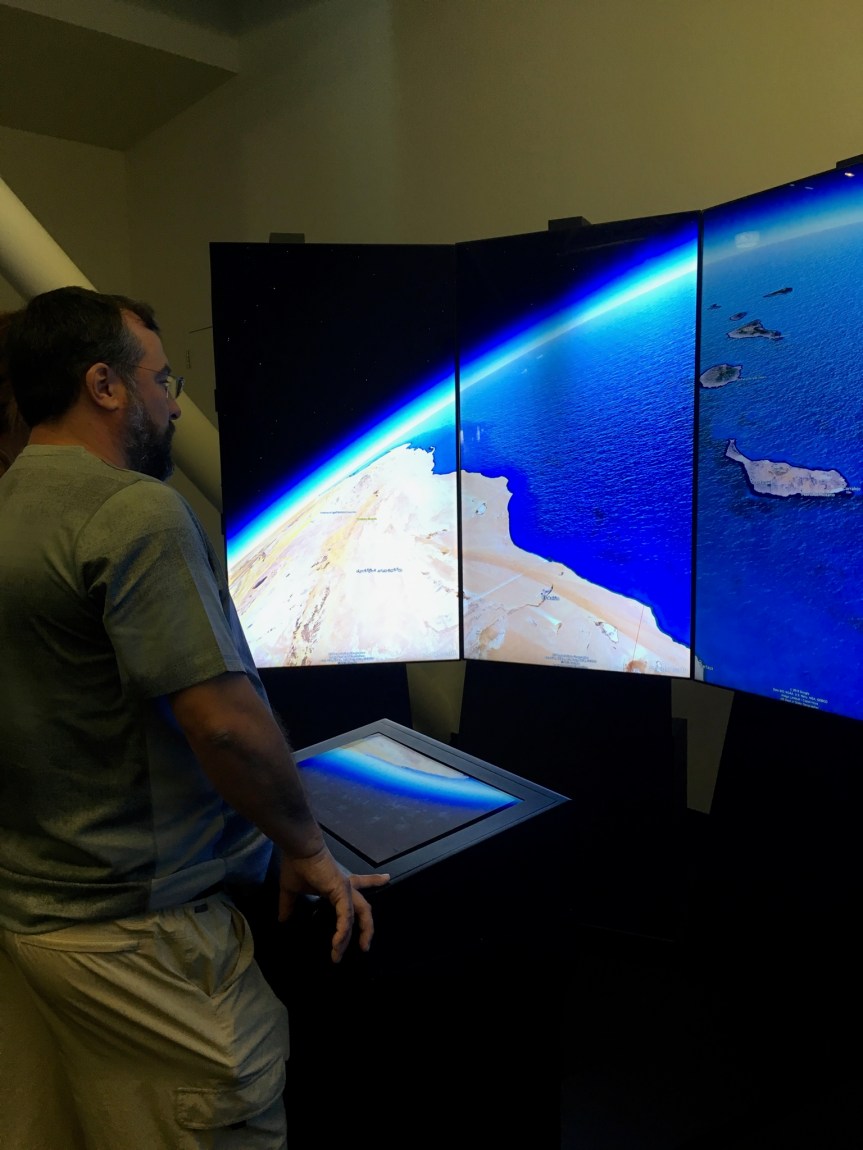


 The demos are given every few hours by actual retired former IBM employees, whose jobs had been to keep the 1401 running in its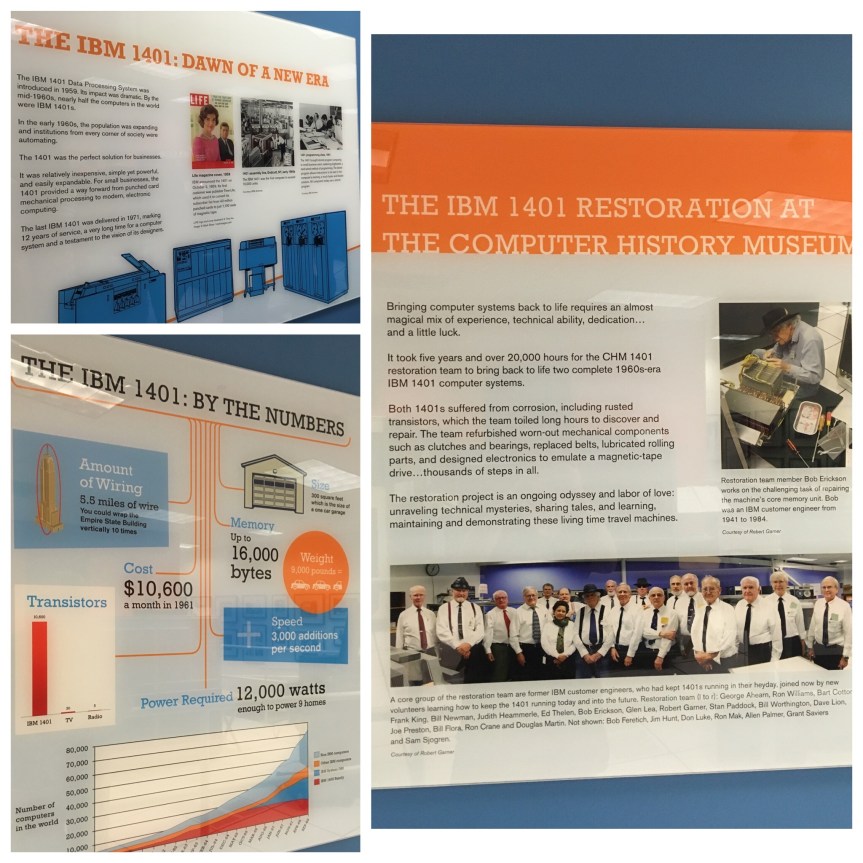
 These all looked to be young programmers (most were between 23 and 35), new to the bay area (possibly)… and you could tell the older retired engineers were really happy to be so appreciated by the younger generation of engineers
 At the end of the demonstration you could create a punch card with your name… which I did, and receive a custom printed … on a HISTORIC printer … that says you visited the place (as you can see I was there on September 5th, 2018).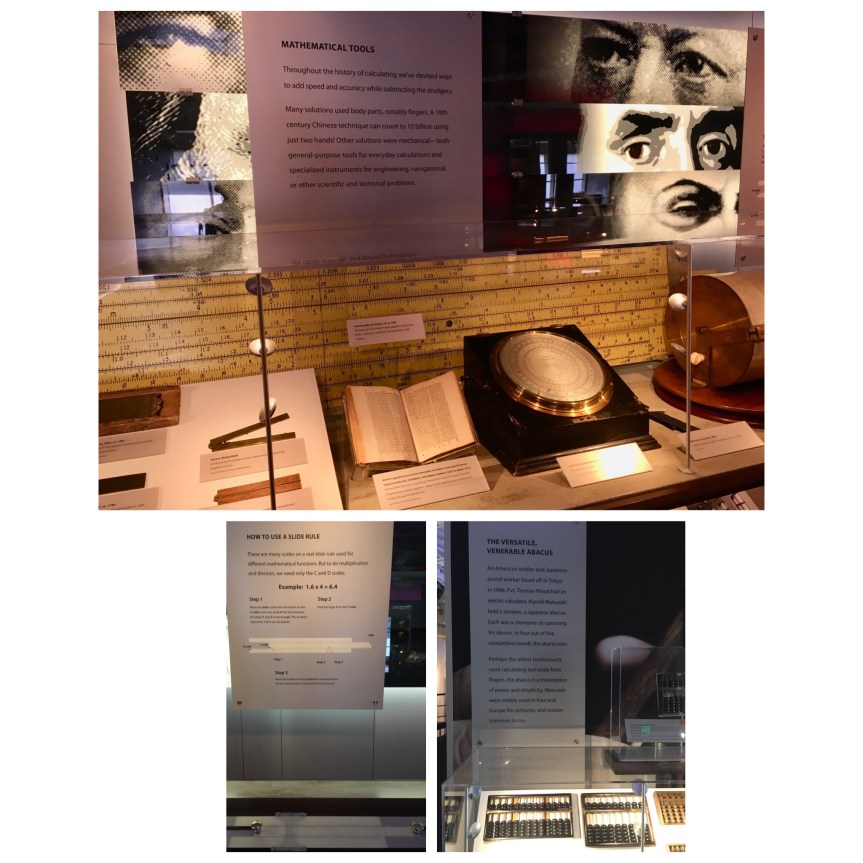





 You first enter into the gift shop, which constitutes almost a quarter of the space, and actually has quite an impressive collection of items.
  Around the outer edges of the store you’ll find areas devoted to Cowboy poetry, music, and art, as you expect….
 Plus some handicrafts, including beauty products and other ranch produced handicrafts…. but the entire center of the shop???
 Jewelry! Lots and lots of jewelry — cause well… profit margins…. alongside the gift store is the art gallery. The guy in charge told me that they always have visiting exhibitions in this space… which switch out every few months. While I was here they had an exhibit about the art of Basque sheep herders (a different sort of cowboy) — and their art forms, including carvings, some of which date back to 1900, that are carved into local Aspen trees
 because these tree will ultimately die, a married couple had gone around collecting rubbings of all the ones they could find.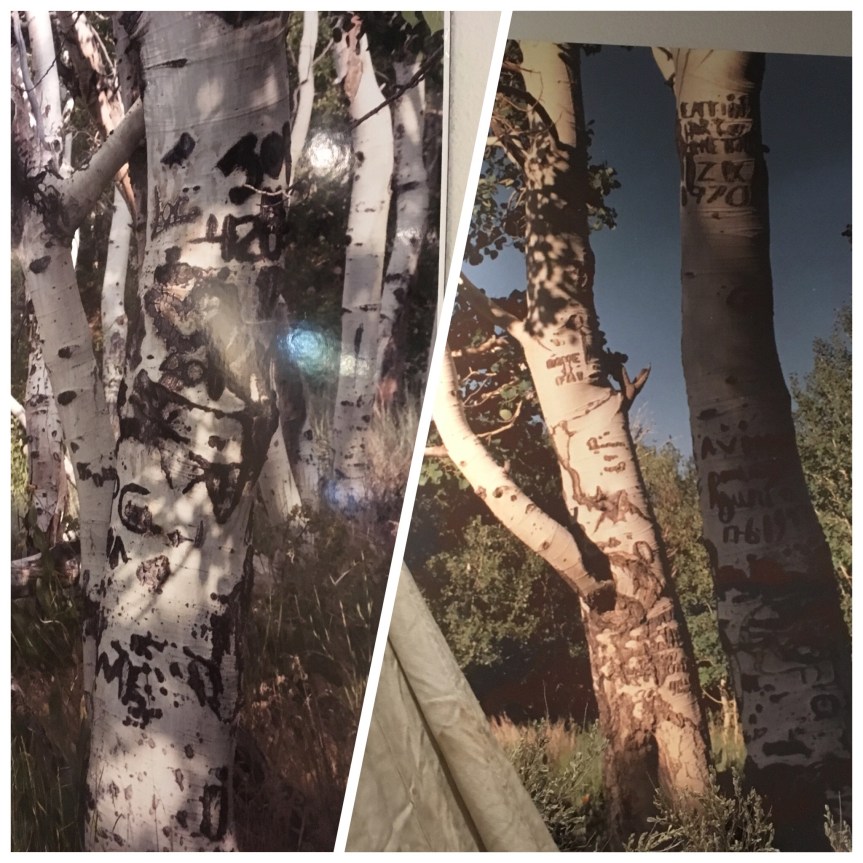







 Rebecca Radnor's Personal Blog: Consider yourselves warned!