I came to see it, but it’s closed for the entire month…
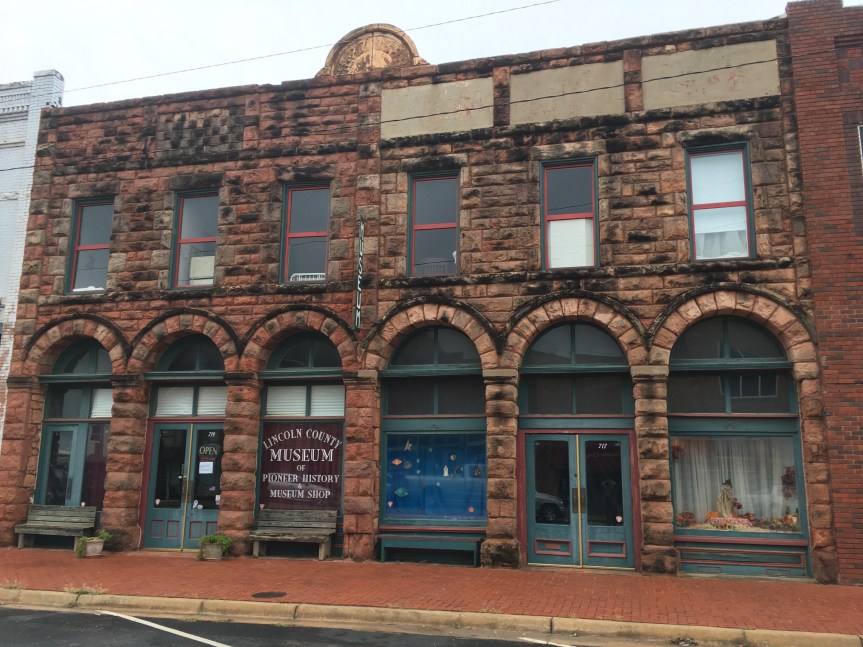
but apparently it’s running a sort of haunted house type thing… that said

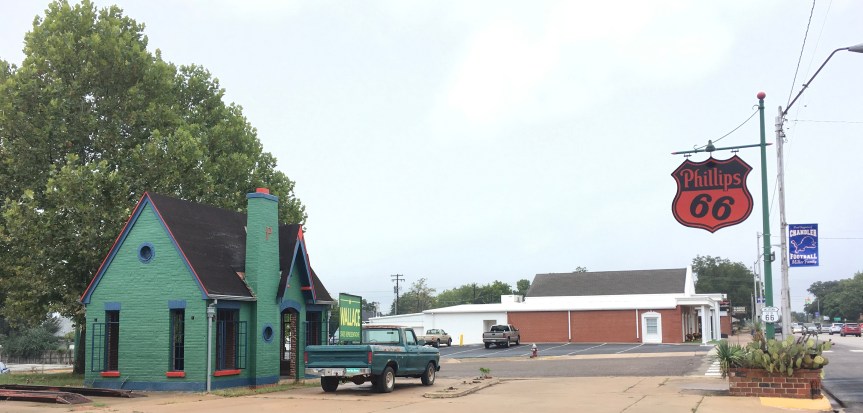
There a lot of buildings in this town that are on the historic register…

Rebecca Radnor's Personal Blog: Consider yourselves warned!
The personal authentic travels of a world-wide drifter, you'll always see pics of me at the locations being described (if the other blogs you're reading don't do that, odds are they were NEVER there, just saying…)
I came to see it, but it’s closed for the entire month…
but apparently it’s running a sort of haunted house type thing… that said
There a lot of buildings in this town that are on the historic register…
Located in Chandler Oklahoma on Route 66 in a beautiful building that once served as their national guard armory, is a museum dedicated to the Route 66 experience. Smartly, its designer looked at the other museums dedicated to 66 (the good and the not so good) and opted to compliment them rather than to repeat them … So, this exhibit is about the experience of some of the local high-points, rather than the road itself — for the low price of $5
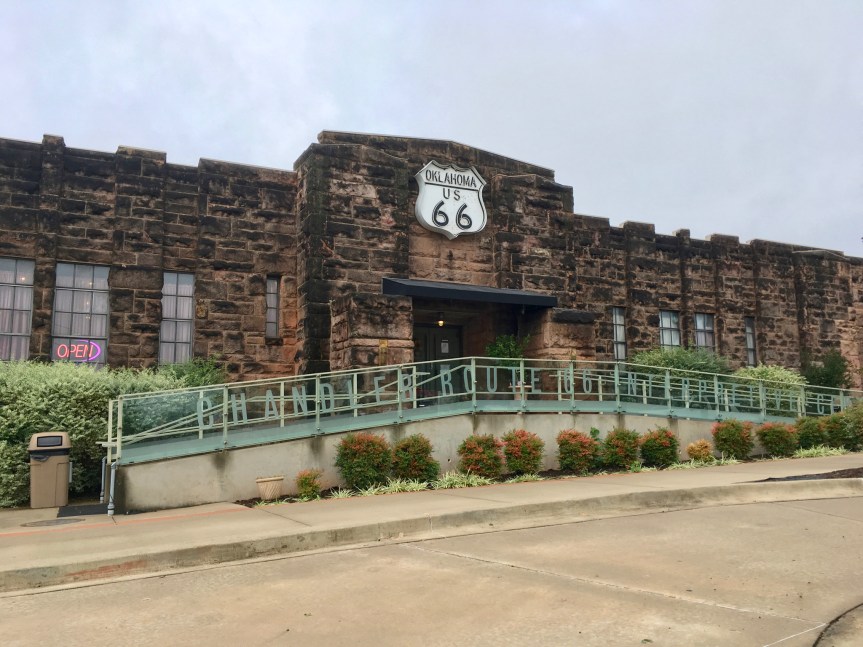
I have got to admit, this is one of the better local attempts at a museum I’ve seen.
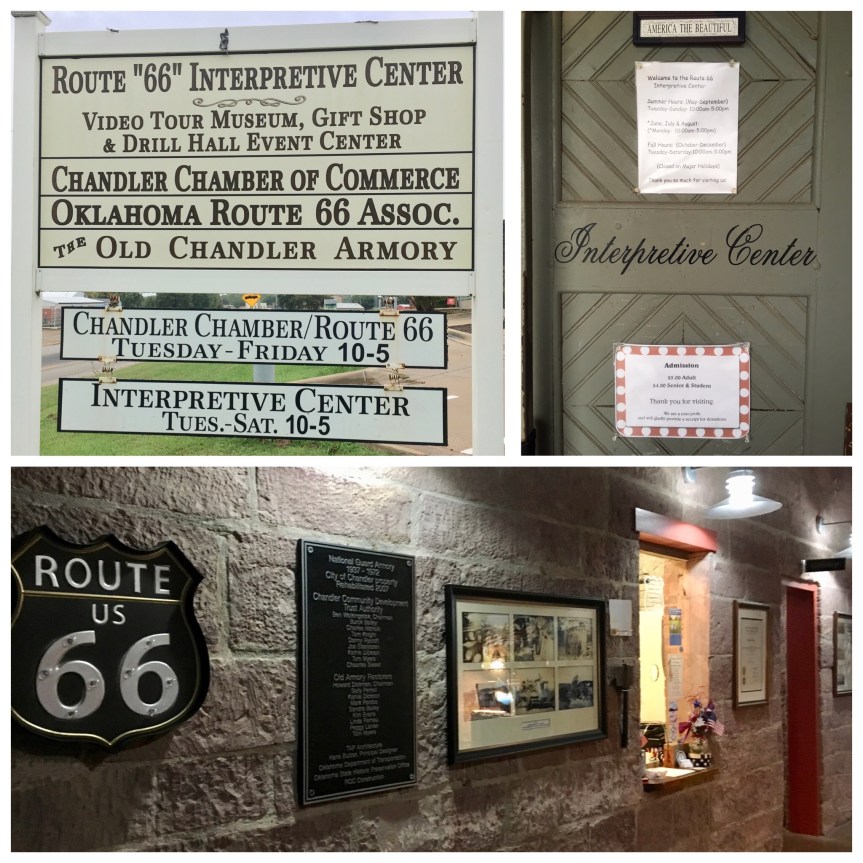
It has a docent, who, as soon as you walk in…. gives you a little tour of the place. First she talks a bit about the history of the building and it’s construction
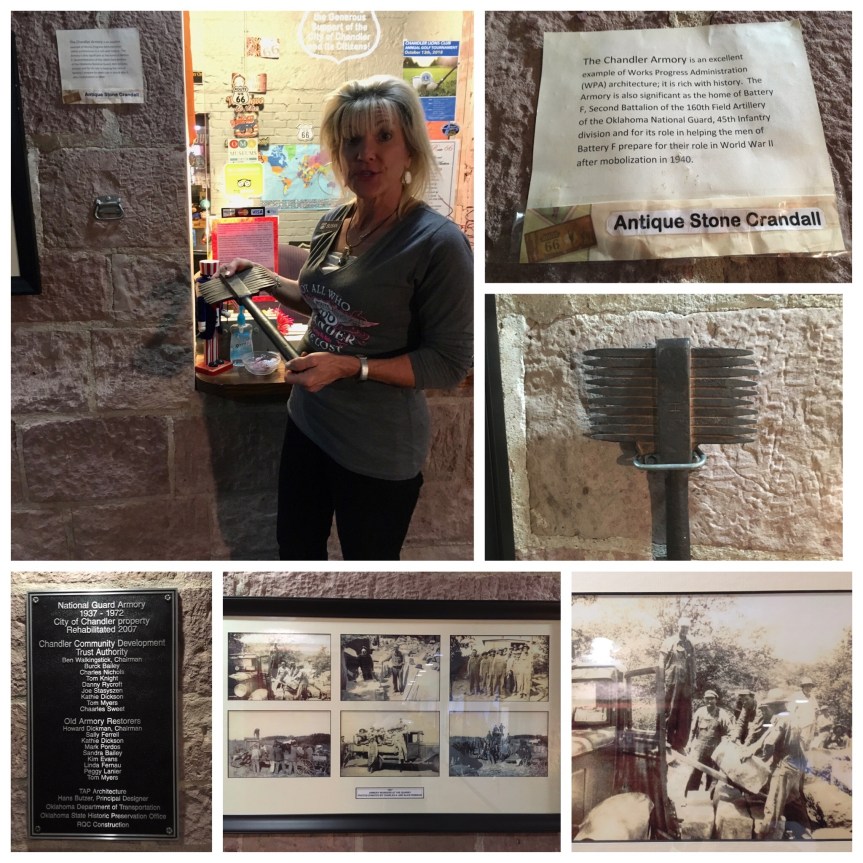
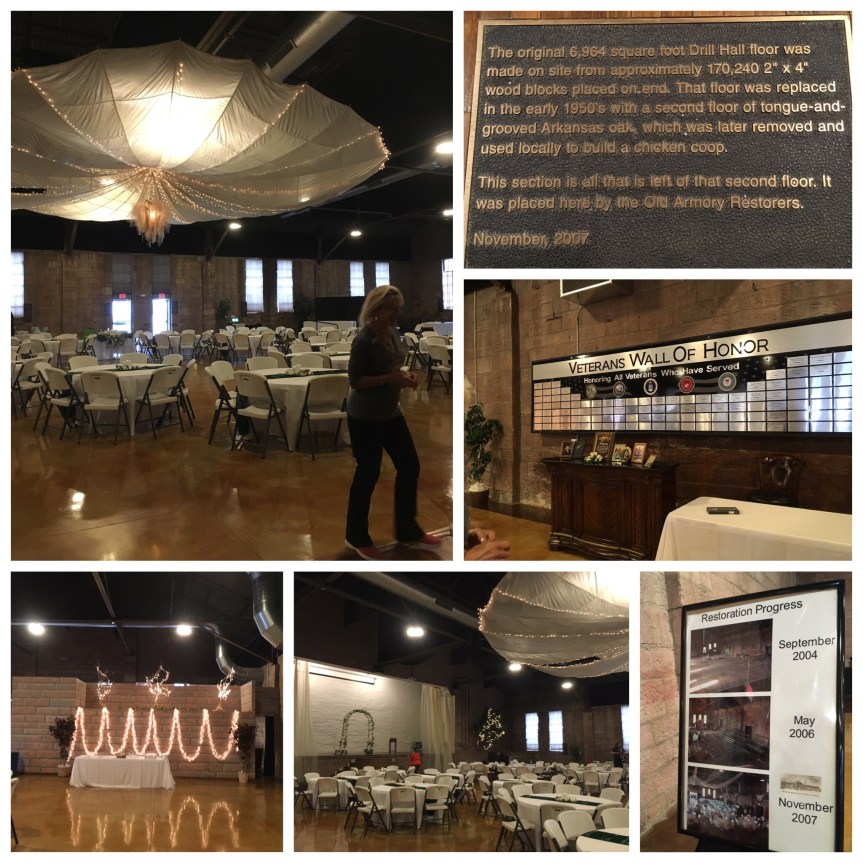
Then she showed us the drill hall which has now been repurposed by the community for things like a wedding venue
and finally she took us into the exhibit hall and explained how the interpretive center works. She told us (me, and two women I had run into previously at Pops), about how they had hired a curator to design the space, and I could have told her that just based on layout. (As you guys all know nothing pisses me off more than museums that don’t even TRY to curate themselves). Less is more people, less is more…

The suggested way to start the exhibit, is a 20 minute movie (assuming you have the time) about a man originally from IL who made about his first trip on 66 in his 20s (in 1939 going road-tripping with a buddy to their university in Arizona). On that trip he had written letters to parents at every top along the way, and had taken photographs. Years later, when it was time to move his mom into managed care, upon clearing out the family home he found his mother had kept all the letters and post cards… and this stimulated in him a desire to do the trip a 2nd time, in 2000, now that he was retired. He did so, making a point of trying to stop at all the same motels (or finding out what had happened to them) and focusing on the differences between the two trips. With the help of a friend, a documentary was created which is being shown only in this museum (I looked for it on-line and couldn’t find it, other than references saying it was showing at the museum.
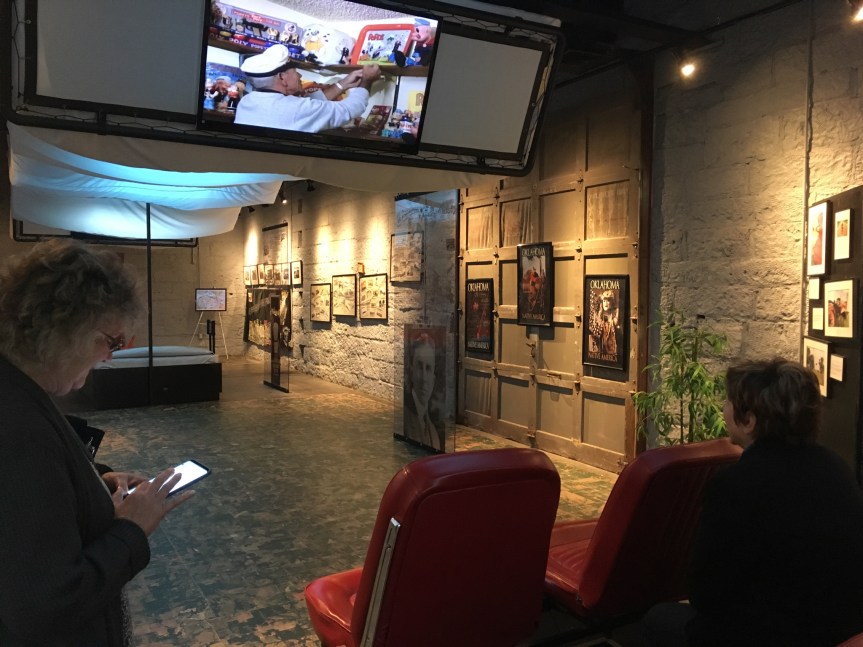
Then you move into a section where you can lie on beds (as though you were staying at one of the Route 66 motor homes), or sit in chairs (which were pulled from classic cars), And watch from a large selection of shorts (about 5 minutes or so each) on a variety of different topics
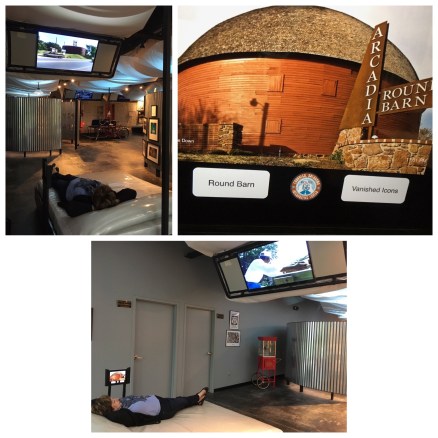
This one showed either a movie about renovating the Round Barn, that I had visited earlier that day, or a movie about the former icons that are no more — and the changing awareness of local communities and the government that these road side attractions actually need preserving as they are part of our history.
Located directly in front of the Heart of Route 66 Auto Museum, is a VERY big gas pump, but of the sorts that used to be used back when Route 66 was a thing.

The gas pump stands along side car museum. I found the juxtaposition of the very OLD fashioned gas pump with the Tesla charging stations amusing.

Unfortunately the places closes at 4pm and I got there at around 6pm… At first I thought it was open because so many cars were the parking lot and people were standing around, but it turned out to be a high-school reunion for the class of 1968 from the local high school
It’s the Grand Canyon, South Rim… it’s a classic! Rather than drive here, however, I took the train ride from Williams, AZ (on Route 66) where I was spending the night.

To be honest, the three hours the Train service allowed me was ENOUGH, in large part because my pinky toe on my right foot was seriously unhappy with me (I had sprained it and rather than let it rest and keeping it elevated, I had been driving cross-country and doing a load of walking.) As such, rather than walk I first took the shuttle bus for invalids (organized by the train company) from the train to

El Tovar.. in order to get some lunch, and to see it because … HARVEY HOUSE!!!


On the train I had asked the girl to suggest which of the restaurants had the best food, and she said the main restaurant at the El Tovar for sure… but I had done so much snacking on the way over that, while looking over their lunch menu, I found I wasn’t actually all that hungry, so I opted for the Onion Soup

It was VERY good (definitely a cut above the average), and every person I spoke to at the surrounding tables was also extremely happy with their food. Let’s face it, you don’t expect food at restaurants like this actually be good, especially when the food prices are relatively reasonable. (You’re paying for the location, ambiance and view).
That said, the room is also quite spectacular…. both its interior and decorations,
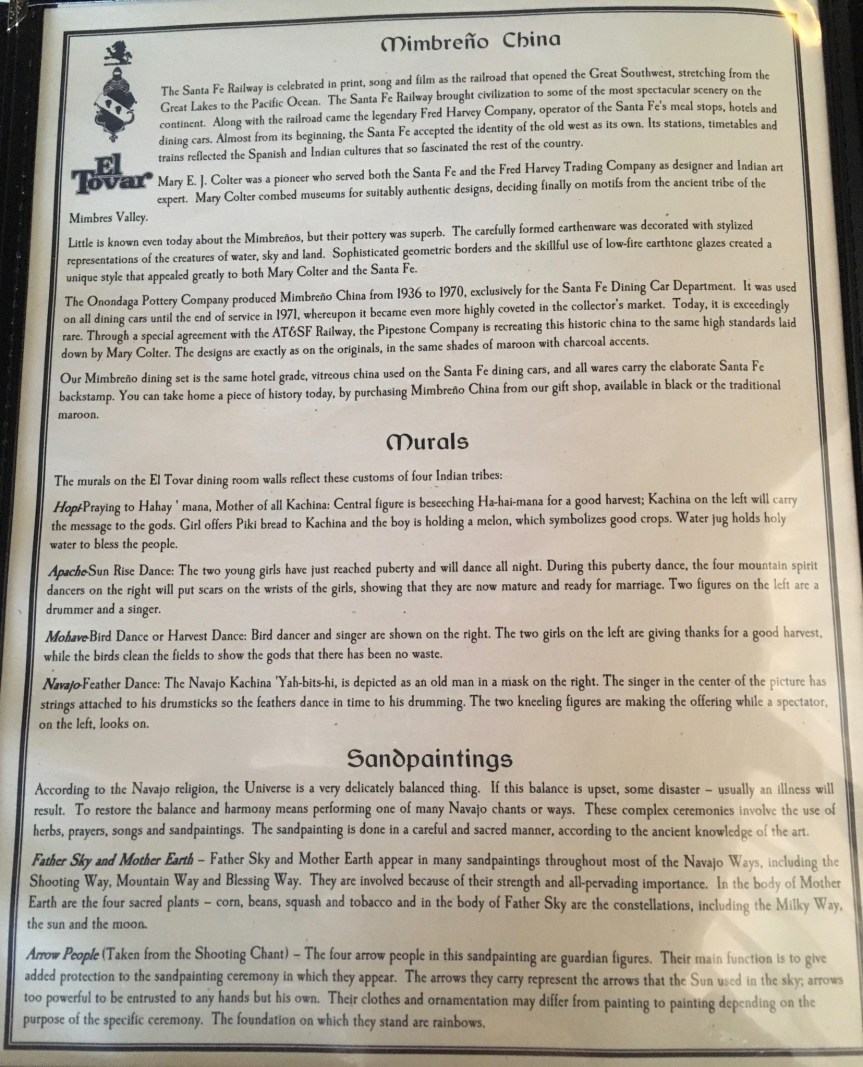
And of course if you’re very lucky (I wasn’t) you’ll be placed next to a widow with an amazing view.

The bottom right image was from my table… I was WAY in the back but that said, ….Heh, my table was RIGHT next to the electric plug and my iPhone’s battery was down to 20% after the train ride.

I wandered around the building a bit afterwards, cause it was gorgeous (and a Hardy House that had been kept authentic over time)… ‘
 Directly adjacent to the El Tovar is Hopi House, which is also a historic landmark, that is used as store for mostly high-end Native American goods. It was designed by Mary Colter, the same woman who designed almost all of the Harvey Houses.

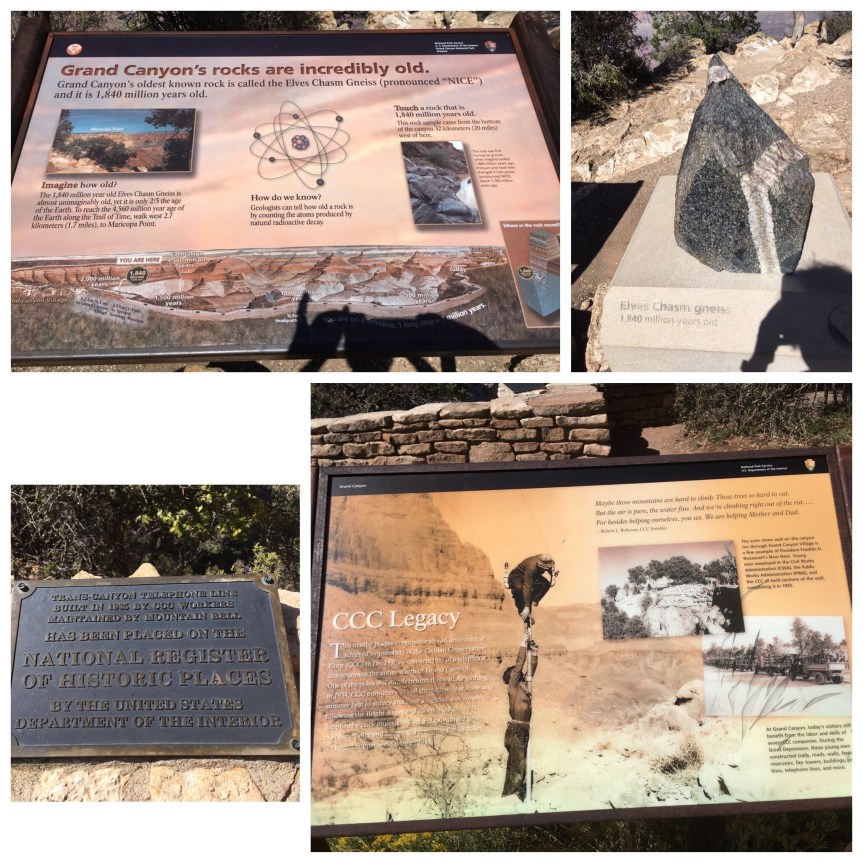
 After checking it out, I went to look at the rim…. pictures don’t do it justice, there’s something unreal about it.
 That said, I was in AWE of how clear the view was. I kept saying to people, “do you realize that a few years ago you wouldn’t have seen this? That there was a horrible haze mucking it up? That its only because of the Clean air act, and the recent closing of some near by coal-burning power stations that you can see this so clearly” Apparently nobody did… Not only that but some Trump supporters actually started yelling at me (I’m shitting you not.)

 My weather karma is continuing— like I said it was supposed to be raining today…


 At the other end of the part of the southern rim that I had walked along, is the Bright Angel Lodge which was also designed by Mary Colter, and this one has a very famous fireplace (that the one behind me in the images below)…. which again has amazing views at its restaurant… only the girl on the train told me the food isn’t quite as good.

Adjacent to it is an ice-cream place that also serves sandwiches, and pretzels and snacks (all the food you’d eat while standing outside)… although while I was there mostly all people were buying was the ice cream.
 As they warned us on the train, there’s a HUGE fine, like $500 if they catch you feeding a squirrel… and that they will try to steal your food if you don’t watch out… what they neglected to mention is the little buggers bite, and will infect you with the plague!!!!

After this I took an un-scenic shortcut back to the train station, because it was about time to go back to Williams, and if you miss the train you’re kind of screwed.
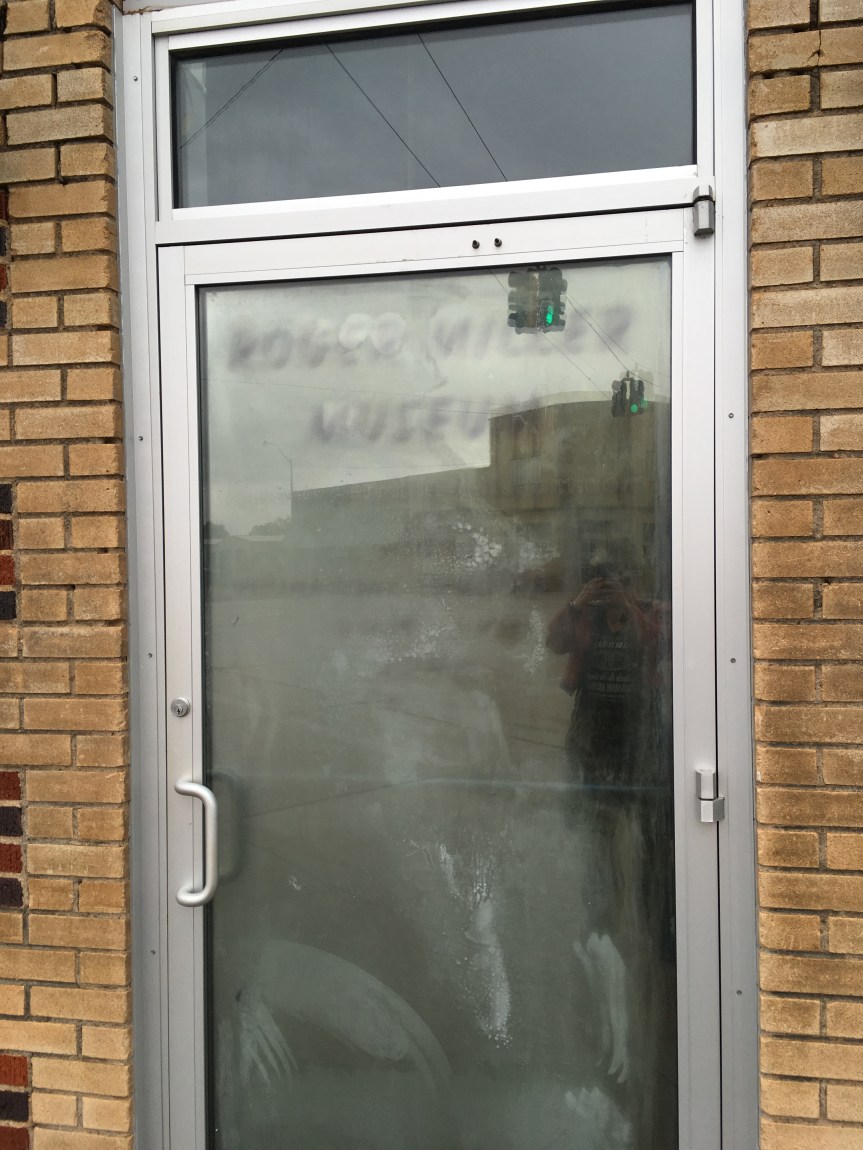
The king of the road Is no more….‘tis sad. NONE of the web sites that I looked at told me this, heck even GOOGLE… which knows all… didn’t tell me this (when I was charting the trip… between then and now someone informed them, so this closure must be pretty recent) … So when I got there I was pretty nonplussed to discover an empty building with blocked out windows, and when I peaked in all I saw was an empty room.
That said, I was going to seriously cheat on this one anyway. My mom used to bake, that was until she discovered the Sarah Lee factory that was about a 15 minute drive from our house that had an ACTUAL outlet store that sold items that had failed their “perfection” tests… so like the icing was lopsided or the crust was not perfectly flat, etc., which they then sold at a deep discount. From then on, she just bought their stuff and presented it as her own work. That said…
Think of it as a memory of things passed … (pun intended)
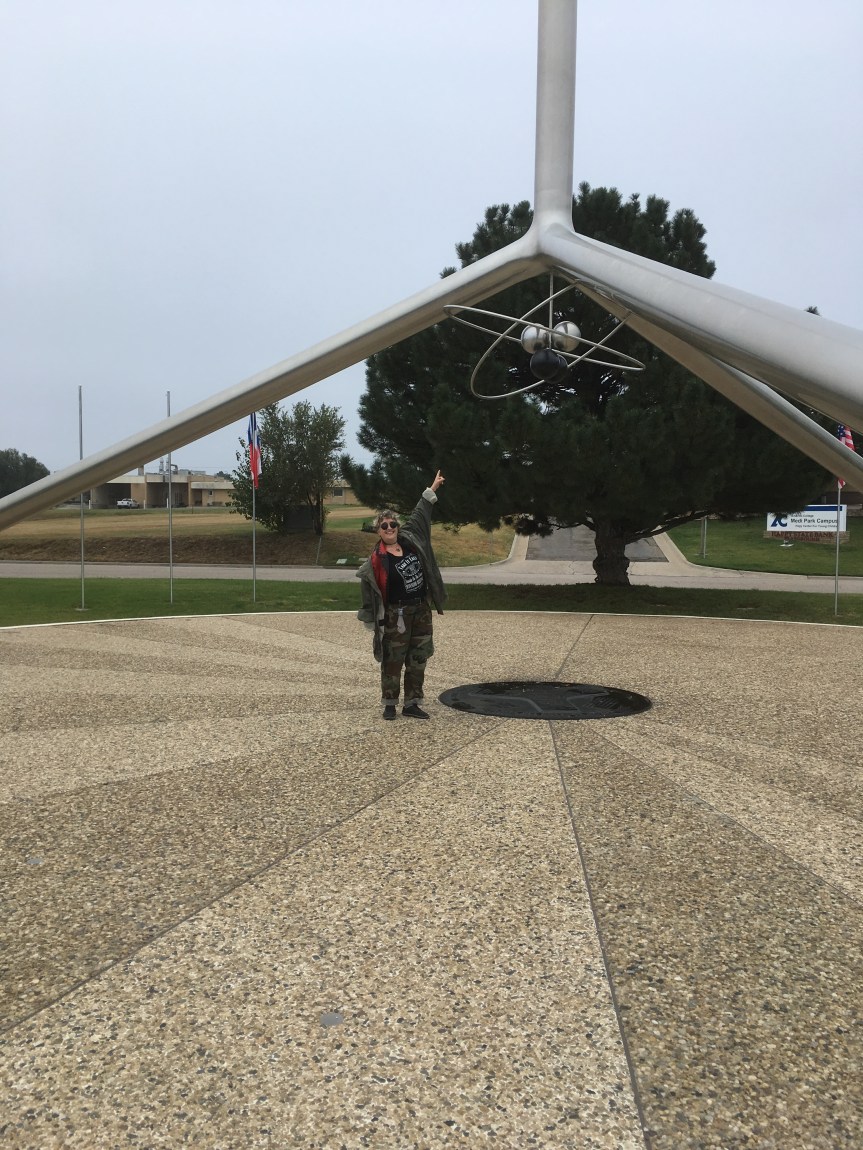
Why yes, I’m a geek. What’s your point? It’s a statue of the Helium molecule that’s located next to a Don Harrington discovery center that was closed by the time I got there. (It closes at 4:30, on a Saturday!!!?????? This is a Science museum in a major city… WTF?)


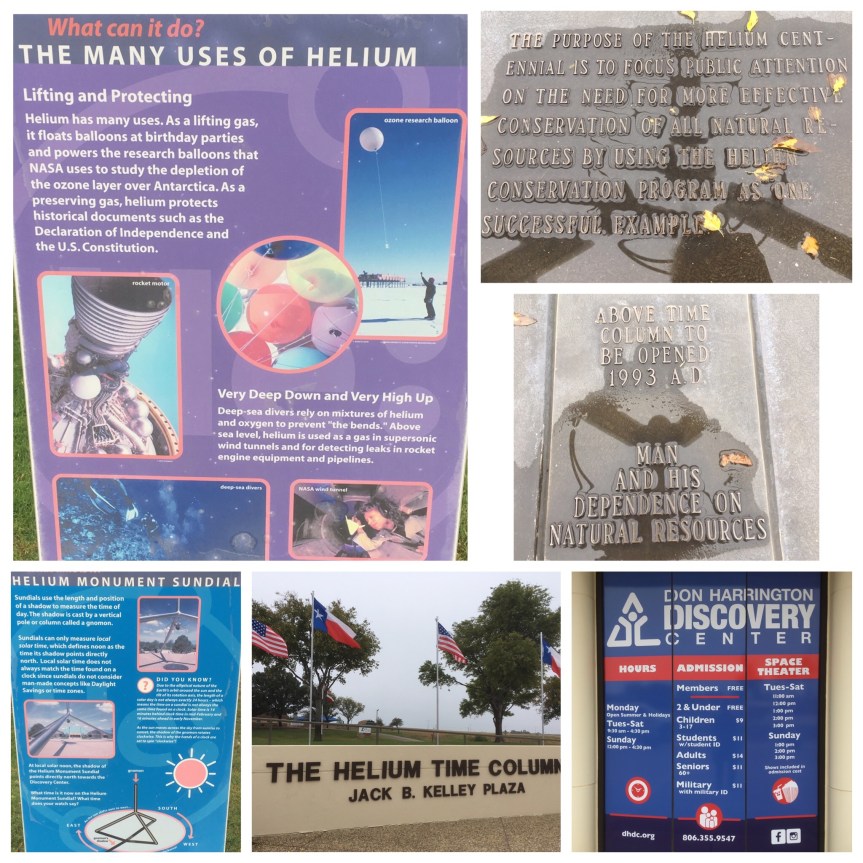
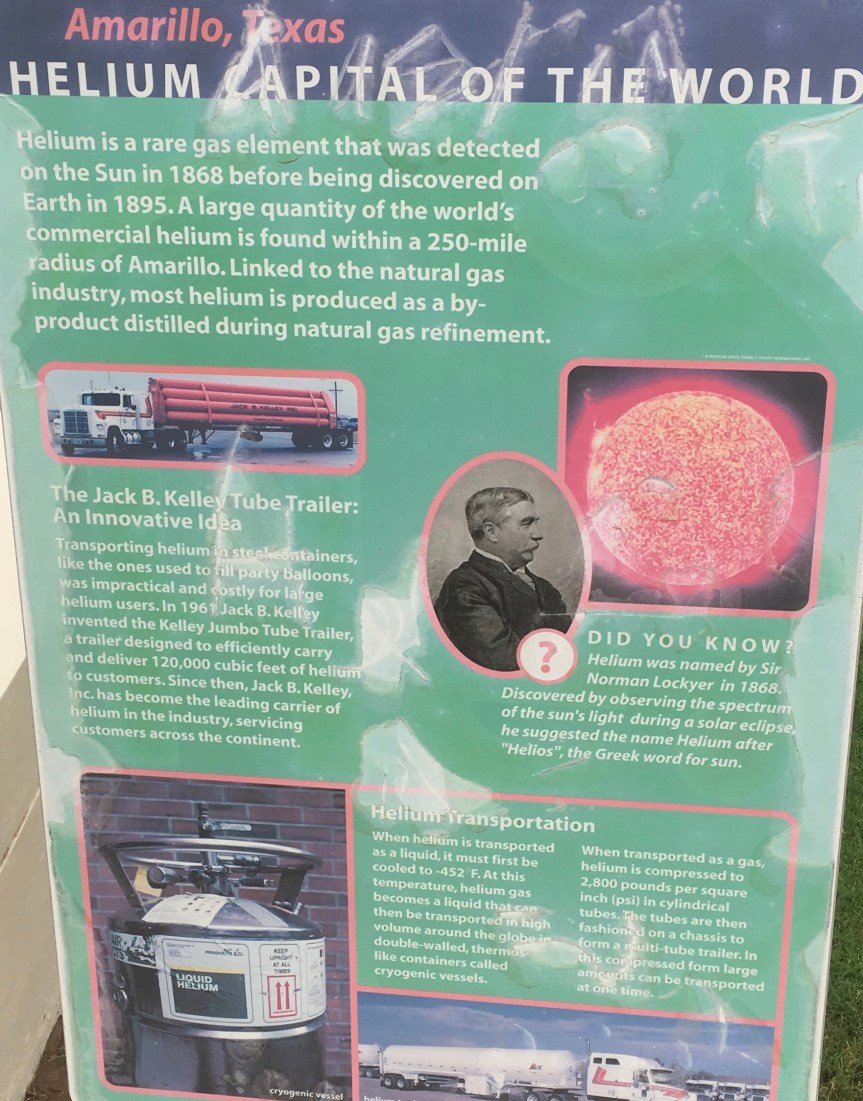
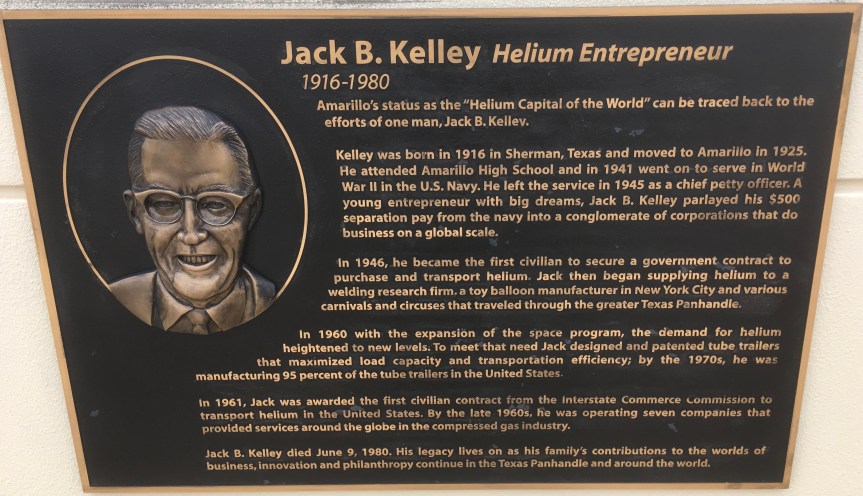
By visiting it I learned something I had not known, Amarillo is the Helium capital of the world… who knew?
This is a private Museum to all things McDonald’s located on the property that HAD been the location of the first McDonald’s. It is NOT owned or operated by McD’s corporate. The actual building had been destroyed in the late 70s — and this building doesn’t even look like that one did… but it is on the original property of the burger joint owned by Dick and Mac McDonald, who essentially invented the fast food model… that Ray Kroc took international — AND the sign out front includes elements of the original sign.

The museum was created by Albert Okura, who owns both a chicken processing empire and a string of chicken restaurants in the California, who bought the property and created this museum. Okura is a philanthropist who has invested a LOT of money into revitalizing sites along Route 66 — in addition to this one he OWNS the town of Amboy where Roy’s Motel is located and is responsible for its renovation and upkeep.
I came here as part of my Route 66 road trip. I have to admit I was kind of let down. The website I found this one did NOT make it clear that this was not the original building.


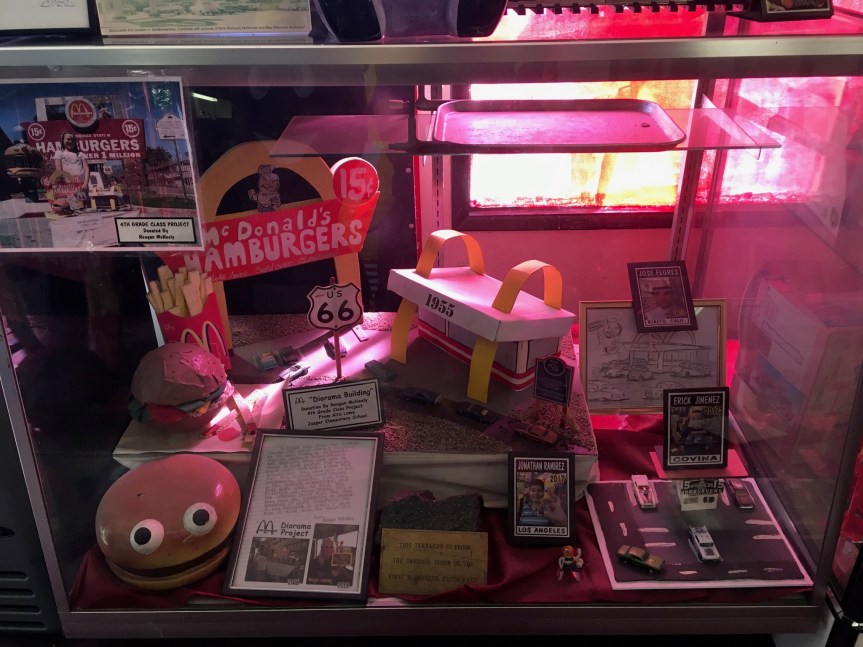


And then, I was kind of irritated to discover that the collection is completely un-curated. When you walk in what you see is a collection of display cabinets chock-a-block full of stuff… as though it were a store selling collectibles rather than a museum of them


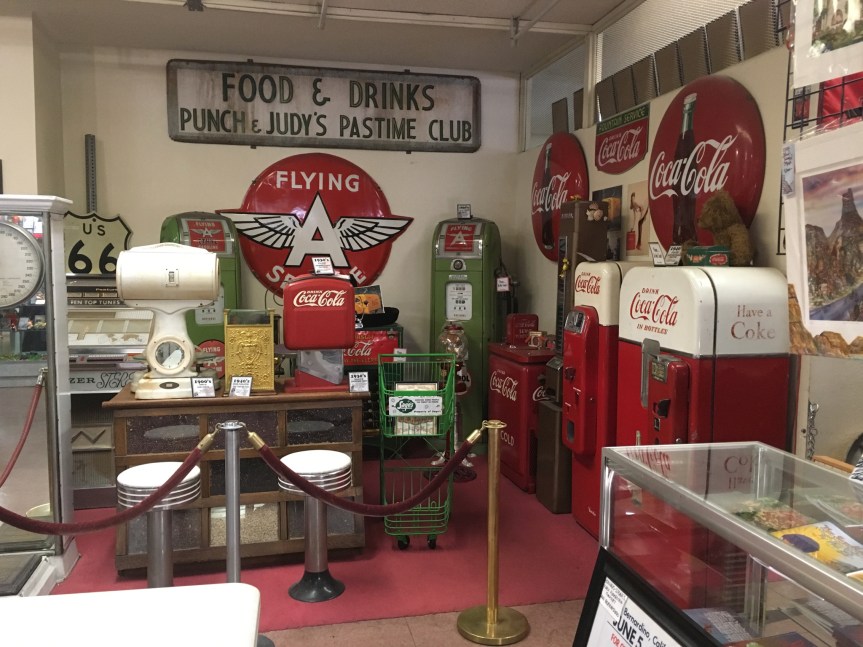
Essentially… They built the building they put some stuff in it and then over the years people have been bringing and/or sending them stuff to add to the collection… so that at this point they have McD’s related stuff from all around the world. Only they completely lack the space to display it in any sort of meaningful way.

THESE were my favorite items because we used to have them at our house. I have a feeling my brother ended up with them, which makes me sad… but that’s why G-d made eBay… apparently you can get the full set for like $20
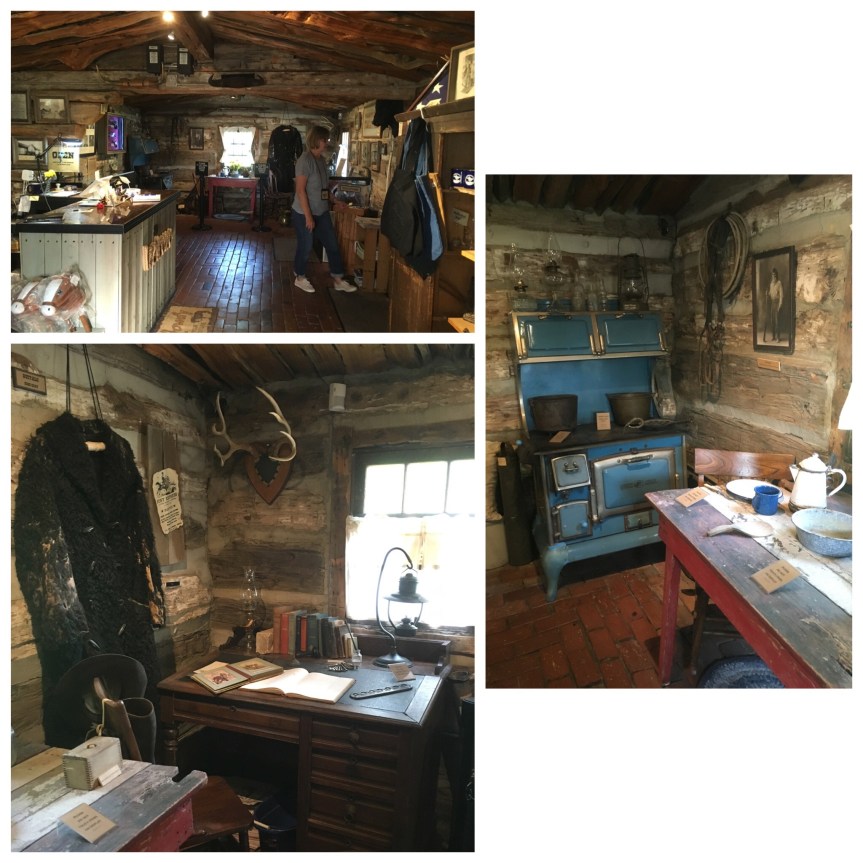
Located in Gothenburg Nebraska is a historic Pony Express Station (well, as it turned out… the walls are original, the roof is new) serving as a museum and gift store. Now granted, it’s not in its original location, historically, it was on the far side of town [they moved it to a park in the middle of town because that was better for business] …. and most of crucial importance, it has no bathroom… But, that said if what you’re looking for is a decent excuse to stretch your legs while road-tripping down I-80, this is it.
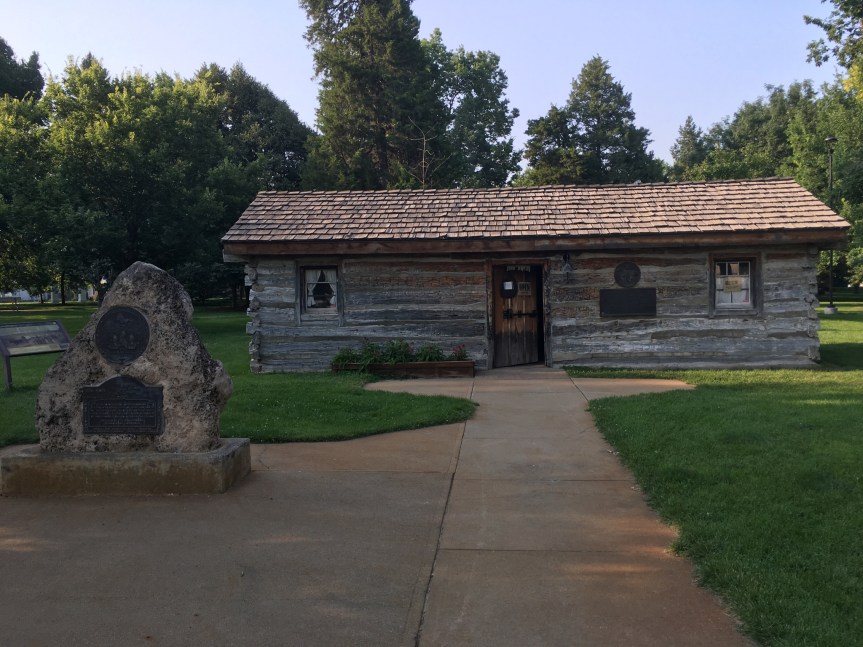

When I first arrived the exterior of the place met my expectations for a small museum dedicated to the historically important, if short-lived, Pony express


Most people don’t realize this but while it’s a favored features of Hollywood Westerns, the Pony express only was in service for about 18 months, partially because only the government or insanely rich people could really afford it…
“the cost to send a 1⁄2 ounce (14 g) letter was $5.00[32] at the beginning, (about $130.00 to today’s standards). By the end period of the Pony Express, the price had dropped to $1.00 per 1⁄2 ounce but even that was considered expensive (equivalent to $27 in 2017[33]) just to mail one letter.”
— from Wikipedia, but also told to me by the docent… and the informational signs they had attached to the walls…
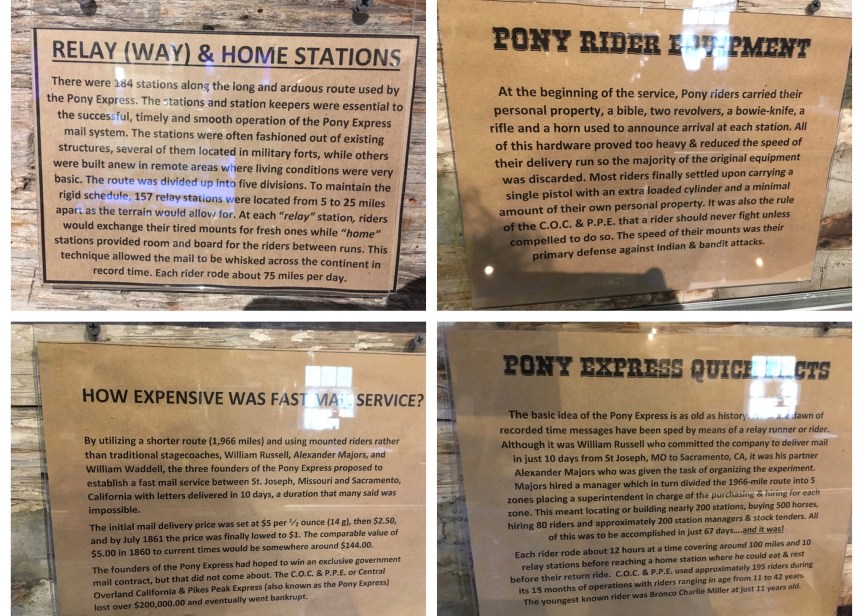
And as I already knew, about 18 month after it began working the first electrical telegraph wires had been set along the same distance, GREATLY reducing the transit time for a message from 10 days by pony express rider

Who had to ride the whole route on horse back…. albeit from station to station, each time switching to fresh horses


to the amount of time it took to send out all the dots and dashes of the message.


That said, on closer inspections, mostly what it is, is a gift shop — with over 50% of the space dedicated to sales, and just enough museum pieces thrown in to justify calling it a museum… that and the woman who works there knows just enough about the pony express to give you a short history of it. To be honest was expecting a bit more than this


This travel stop was in my opinion a complete let down to the point of being annoyed that it took up so much of my time for that day (So what comes next is a very long RANT). The Tippecanoe Battlefield Museum has got to be one of the worst local community sponsored museums I’ve seen, especially when compared to all of the sites that I’ve been to that focus even peripherally on Native American history. But that said, it had hands down the BEST gift store (priorities, clearly). This place is in DIRE need of a skilled curator… it’s clear they had brought one in for the “white people” stuff, but the Native American areas are a pathetic and almost insulting joke. The focus here is almost entirely on what the Federal government did, including the blow by blows of the battle. [This is probably because the U.S. military officer in charge was the local Indiana boy William Harrison, whose success, in said battle, helped him to go on to become our 9th President — a presidency that only lasted for 31 days before he died of pneumonia making his the SHORTEST term in office]…. 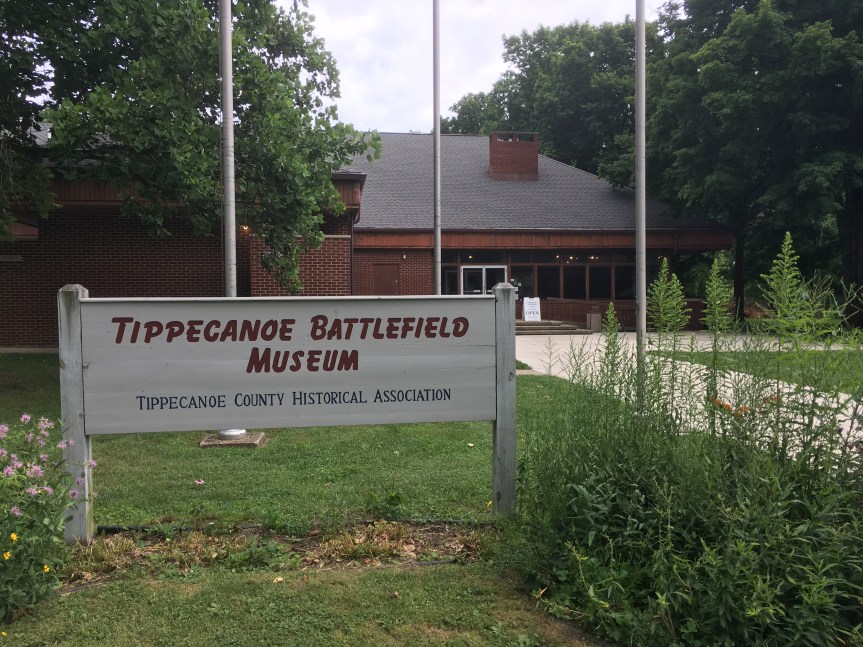
One of the annoying things about this site was, at least with regards to the Native American’s side of the story, you didn’t really learn anything on the inside of the museum (after paying your entry fee) that you hadn’t already learned while reading what was presented on the OUTSIDE of the building from the various signs and plaques.


Adjacent to the museum is this park with a massive monument dedicated to the American Forces, with a uber masculine/sexy statue of what I’m assuming is Harrison, who as I said went on to become our 9th President, in large part because of this battle. (which tells you something of its political relevance in the day). Please note the:
LOSS, Americas Killed 37, wounded 151…. Indian loss unknown …

And then these small off to the side plaques, added in 1996 — about the forced removal of the Potawatomi Native populations in the area, called the Trail of Death that happened to the in Sept – Nov. of 1838… a 660 mile forced march during which many children died.
[An important note which I did NOT see explained ANYWHERE in the museum (DID I MENTION that the museum sucks?) is that, the Potawatomi were the tribes that were traditionally a settled/farming tribe that lived on this land, while the Shawnee Indians — the ones involved in the battle — were actually a semi-migratory nation whose lands overlapped Potawatomi land in Indiana and Illinois (in low numbers), but who had MOSTLY lived in lands that extended EAST as far as Maryland. As such, they had already been pushed off those lands by American settlers, and were regrouping and building permanent settlements in Indiana (Indian land anyone?) before the battle happened (which probably didn’t make the Potawatomi very happy)]
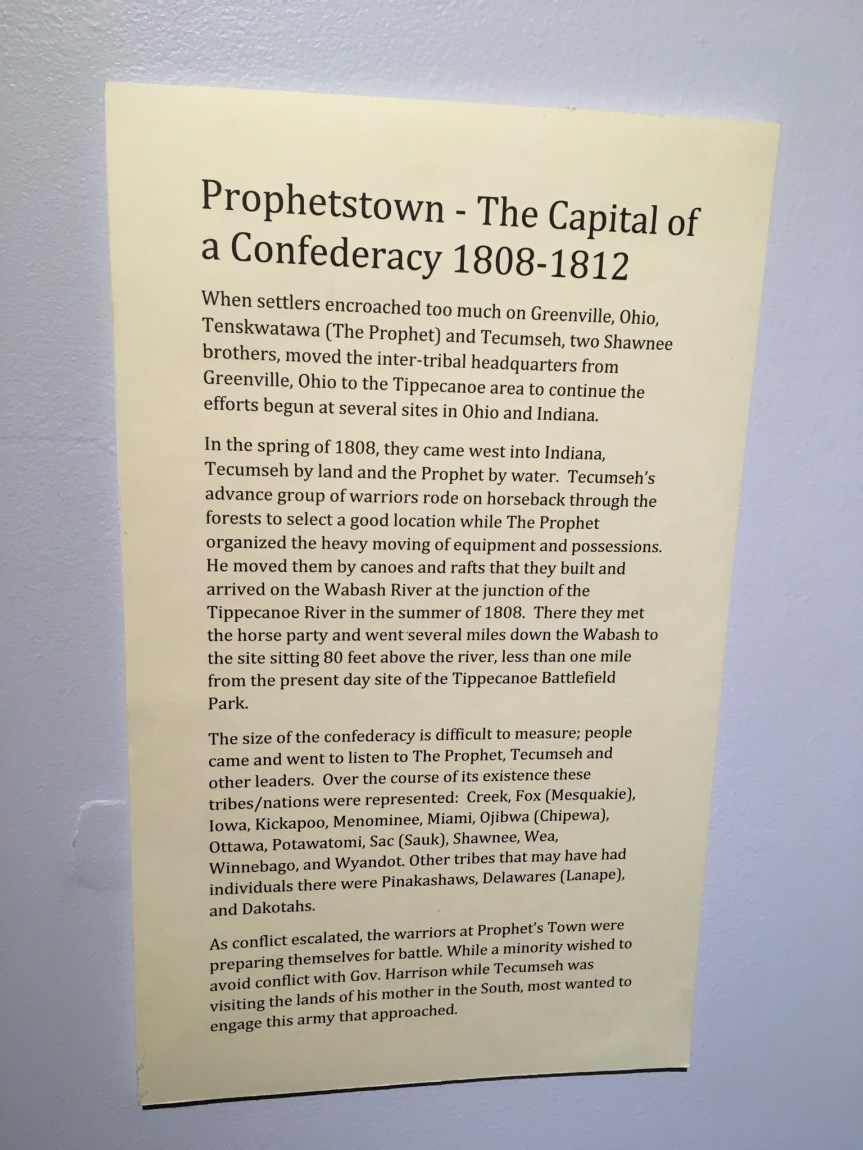
 Once I paid to go inside it become incredibly obvious to me that most of the focus of the museum is firmly on the white people, with the Native Americans only really given lip service as an after thought… to be honest, I didn’t really read the poster (below) that blocks your entrance into the place like a warning sign until AFTER I had left the place… and was paying closer attention to the photos I had taken.
 This attempt at an apology, which as I said was located JUST at the entrance, in the middle of the path, STRONGLY suggests to me that I’m not (by a long shot) the first person to notice this… “Originally preserved as a tribute to the soldiers who fell here. We recognize today the bravery of both the Native American and United States military forces who died here defending their way of life.” So, what they have there was about the Native Americans is almost a “lip service” nod to them, and is presented in the most boring, cost-effective ways possible, so the likelihood of customers ‘taking it in’ was unlikely.

So, even though you’ve walked into a museum that is supposed to be focused on the battle, the first section is devoted to the lesser findings of local archeological digs about a a village where the French and the Miami Indians were living together peacefully… which is more than a bit confusing, largely because it’s not properly segregated nor introduced (to that point, the fact that it was Miami AND French was something I figured out later as I put the disparate pieces from the various signs together — really it was NOT clear). I’m guessing the good stuff went to bigger museums or the University’s museum.) That said, what was presented was a bit scattered and a bit hard to make sense of….
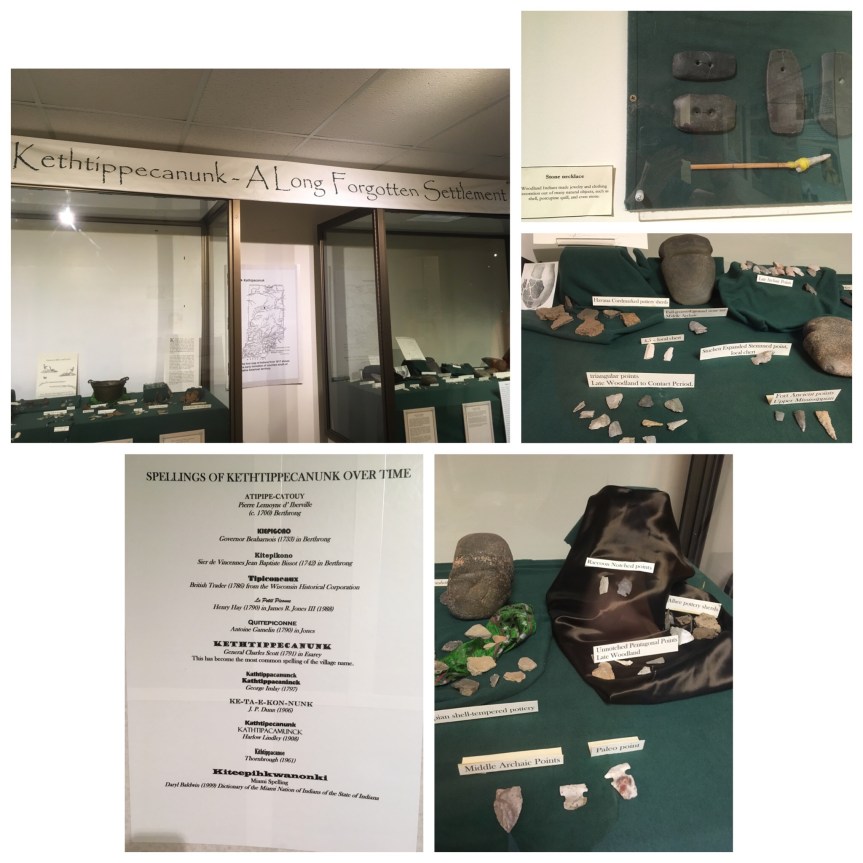

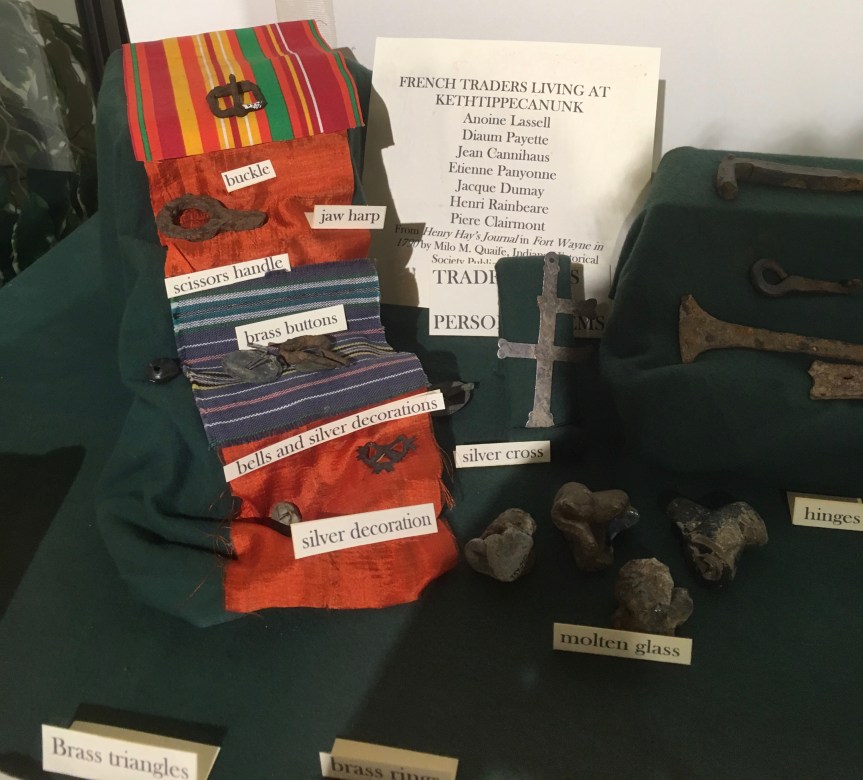
There was VERY little reference to the French traders nor any mention how well they integrated themselves into the local populations, other than by reference (they lived were living side by side)… so NO comments anywhere about how the Native Americans were never threatened by them, and how their presence was almost diametrically opposed to that of the American settlers…. just these few items
and then there is an equally tiny a bit about the later American white settlers who lived in the area other than that they were there (with some bit and pieces of archeological evidence of their lives… ). Again, NO mention or explanation about how they were invaders, from the local populations’ points of view: i.e., the settlers were forcing Native Americans off their ancestral lands, destroying their hunting grounds and converting them to farms. And again, there’s no discussion of how those white settlers got there or why… nor of the Louisiana Purchase of 1803, etc. (I did spot some reference to the Founding Fathers buying land in the area, but it didn’t come with any explanation of how those land speculations — and the fact that the British said, “sorry no, that land belongs to the French so no you can’t claim ownership of it.” Nor was there any good explanation of how this land greed was something that most historians at this point recognize as being part of what motivated the decision to break from Mother England; all I spotted was a one sentence reference to it which most people would likely miss as it wouldn’t make sense to them.
There are a few scattered references to the settlers’ presence being partially responsible for The American, War of 1812, with Britain, (which from the British point of view was a minor theater of what historians argue was actually the first World War) that happened during the same time period as this battle… but very little explanation of what that connection was….
The Native Americans involved in the Tippecanoe battle receive barely enough focus on the Shawnee Indians to make any sense of the motivations of Tecumseh (one of the most famous Native American tribal leaders EVER, whose name is probably better known than Harrison’s) and his brother Tenskwatawa (other wise known as ‘The Prophet”)… that, and their offerings were so badly displayed as to border on nonsensical (it was just stuff, it didn’t tell any sort of story).

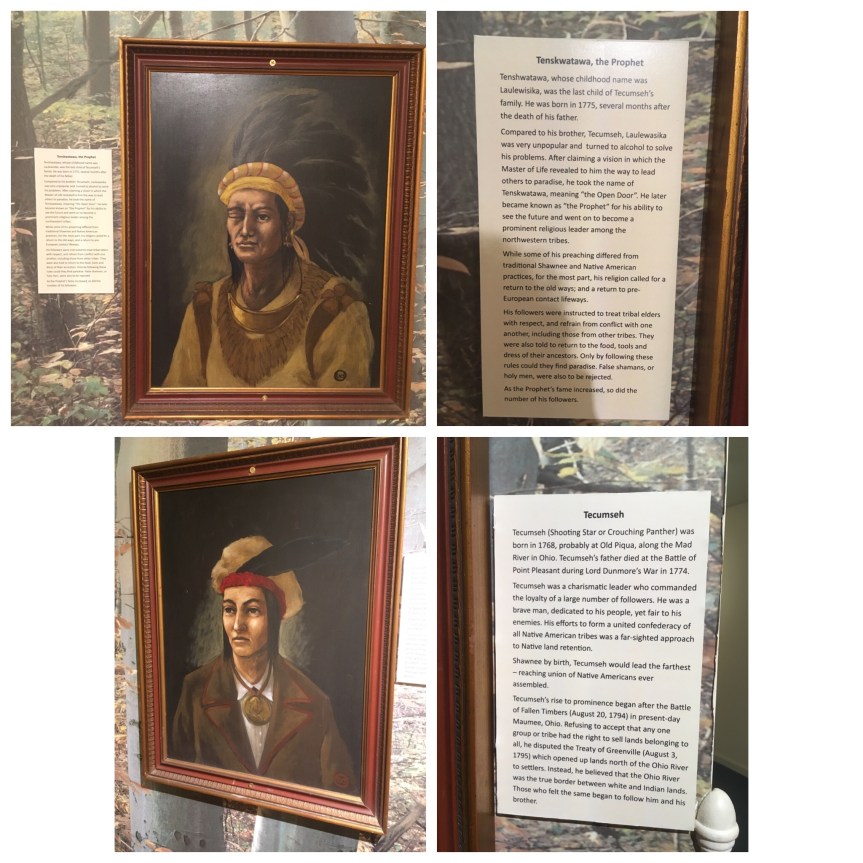

Also, if you DO actually stop and read what’s written on the various posters (make sure you read the one above first) it’s repetitive, and the time lines of the thing are confusing. It’s almost as though they copy and pasted things they found on-line or in books into the various posters scattered almost thoughtlessly on the walls

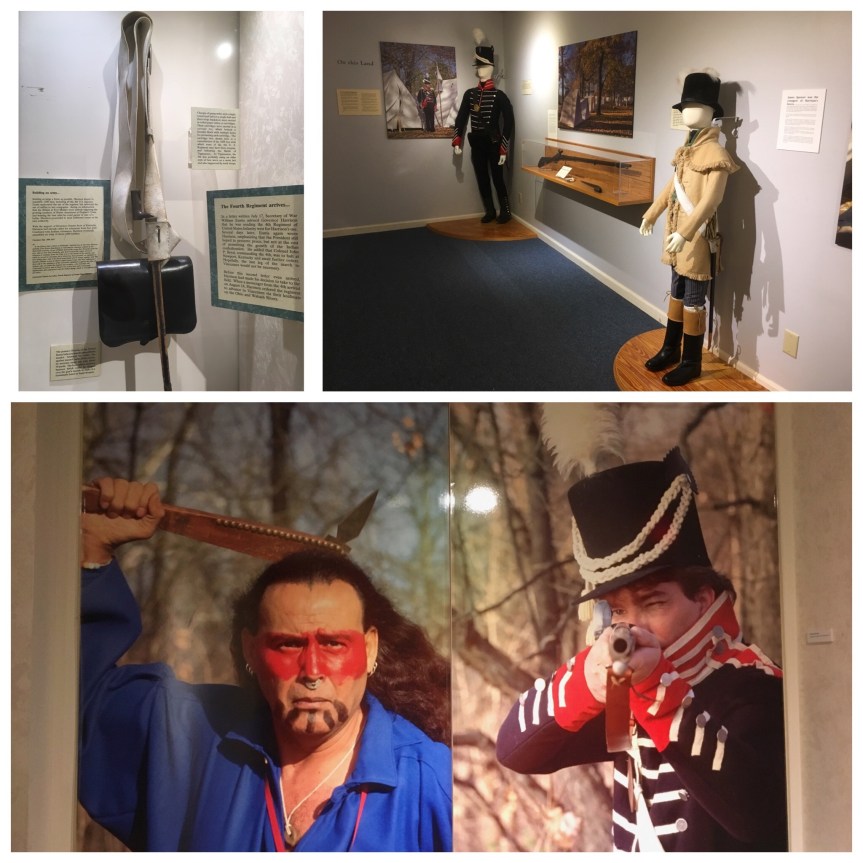
Then, you come to what this museum was CLEARLY intended to be focused upon when first created; it is the section where — by far — most of the money was spent, and actually looks like a serious museum rather than a slap dash attempt at one. This section is a glorification of the American soldiers who arrived for the sole purpose of breaking up any last hope attempt on the part of the Native populations of the area to live peacefully.
Right after this is a multi-media sound and light show devoted to giving you an intricate blow-by-blow of the battle.
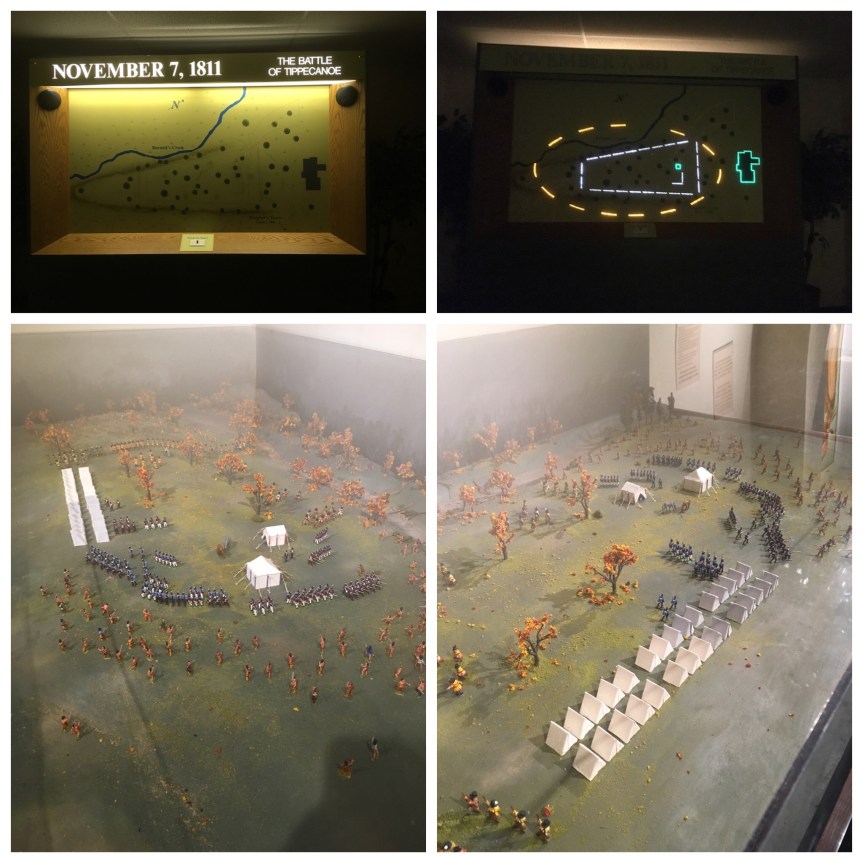
It reminded me of a much smaller, and more affordable version of the Battles for Chattanooga presentation in Tennessee that I love so much that I’ve gone there three times in the last 10 years.
And then back to lip service to the Native Americans… a few posters stuck up on the wall


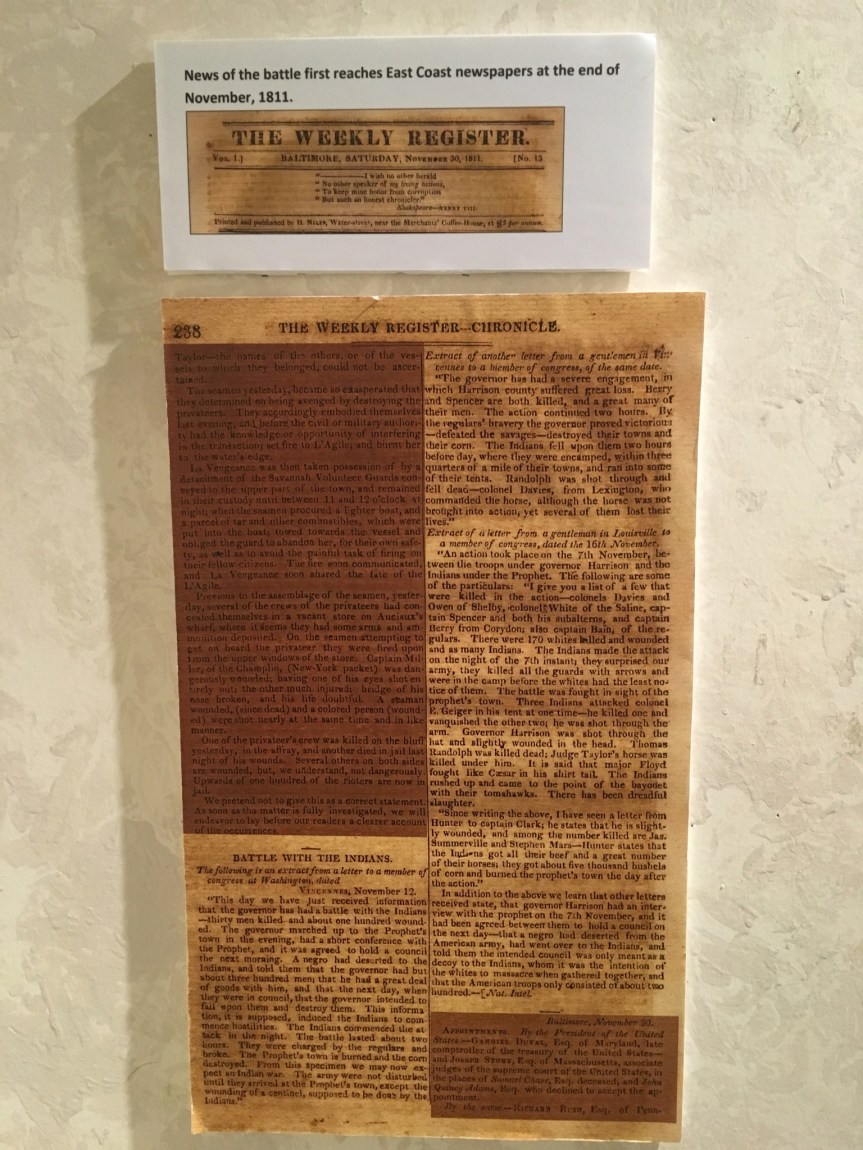
After these few pieces of paper stuck to walls, the exhibit returns to its true love of the U.S. Military and Harrison


As I was leaving the place, the ONE thing the woman running it insisted on leaving her desk to point out to me was the fact that Harrison’s campaign for President was what we today might consider a “modern” one, in that it utilized slogans “Tippecanoe and Tyler Too!” and the media in order to make Harrison popular and promote his candidacy
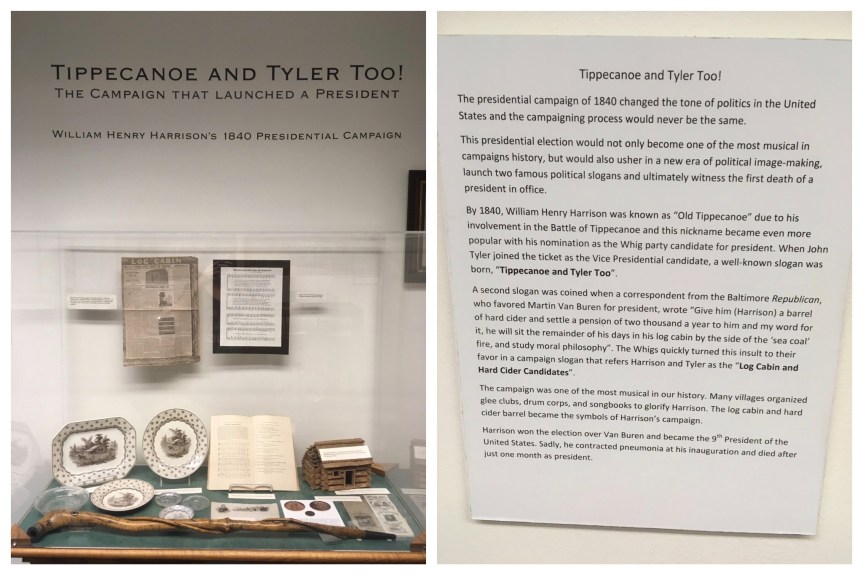

But, let’s talk about the gift store….
… IF you’re searching for a decent source for historic clothing to wear to a historical reenactment of circa 1811, this is the place… 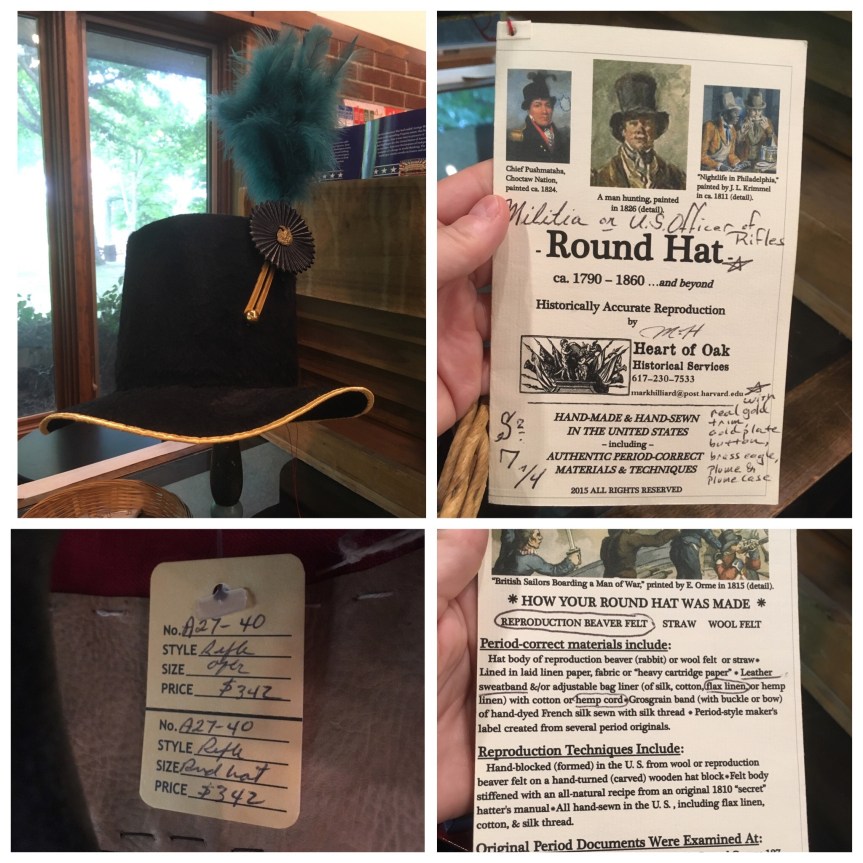 Hand made, historically correct round hats selling for $342 are not the sort of items you normally see for sale in local museum gift stores! While there were some items, cheap knickknacks that are more normal for these sorts of gift stores, the MAJORITY of items this place was selling seemed to be AS focused on historic reenactment. They weren’t selling little rubber Tomahawks for kids, they were selling REAL ones, and historically correct hand-made leather bags, pipes, and either the clothing, or the pattens so you could make them yourself… as in exactly the sorts of goods for sale (but for a different time period) as what I found at the store of the SCA Pennsic event I went to last year — which is a medieval reenactment
APPARENTLY, this is because there are TWO reenactments that happen in the area devoted to this period of history (below is just one of them), one devoted to the pre-revolutionary war period, and one to the Tippecanoe battle.

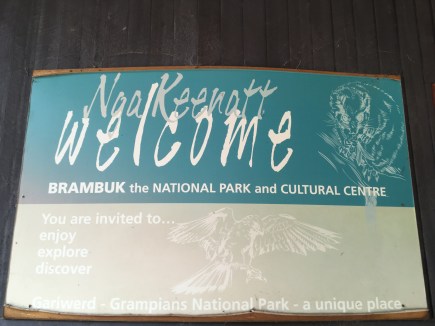
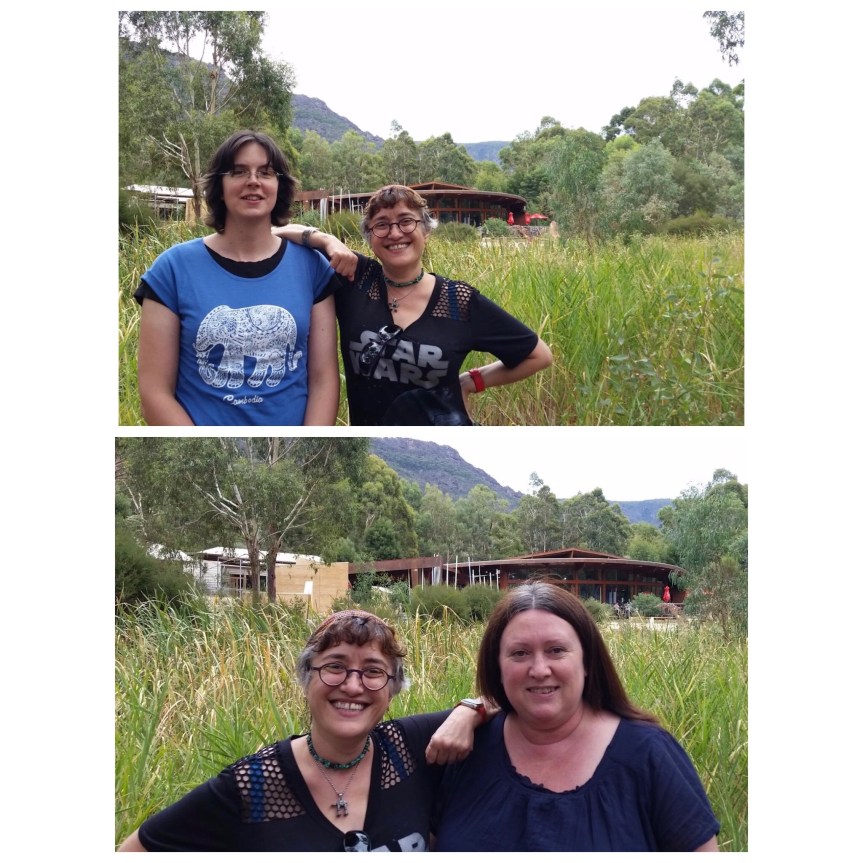
Brambuk National Park & cultural centre is about a 3 to 4 hour drive away from Melbourne, and a 5 hour drive away from Adelaide, so if you haven’t made the effort to road trip between the two (or live in the area), odds are you’ll miss this National Park. Along with the natural wonders of the place, and a host of optional activities (which I will discuss elsewhere), there is a must see but ultimately highly disappointing Aboriginal cultural center, a really wonderful little cafe with very unusual foods, and of course a pretty good gift shop.
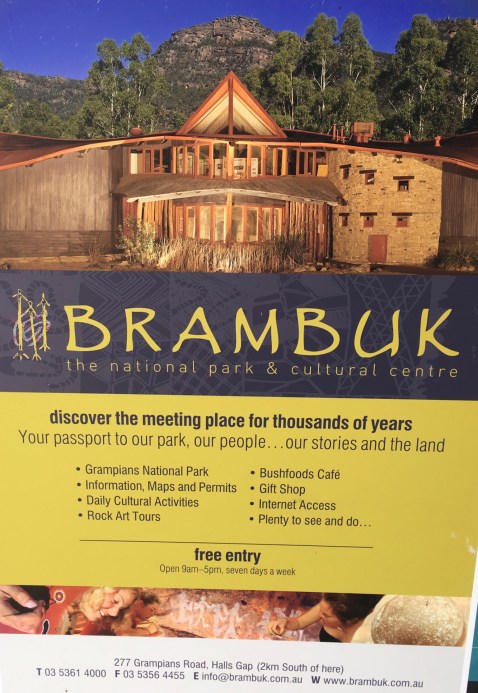
From my first days of planning my trip to Ballarat, my friend who was hosting me had been describing this place to me, and it was one of the things I insisted we had to do, in SPITE of the fact that I was pretty much laid up because of the sever concussion I had suffered not two weeks before.


They have a large selection of gelato available in flavors native to Australia fruits and spices… Golden Wattle seed, Quandong fruit, Strawberry Gum, Desert lime, Macadamia nut (which is actually native to Australia, not Hawaii), Riberry and Davidson Plum
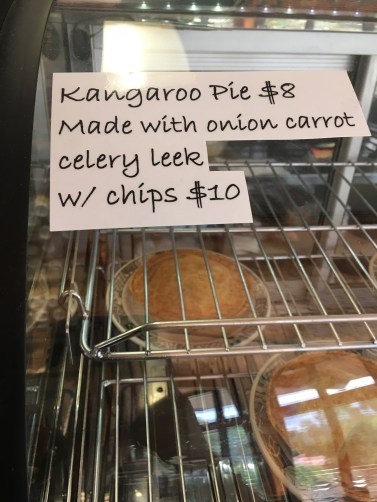
As part of my experiencing Australian pies, I ordered a “Skippy” pie (you have to love the perversity of Aussie humor — check the link), which I shared with my friends (one of whom at 99% of the chips… I only ate two)

we passed on the Lemon Myrtle scones and instead opted for the Wattleseed Damper w/Quandong & Peach Jam and Wattleseed cream (because I had no idea what a Damper was). After checking out their menu, we decided to go for the Bush Food Platter
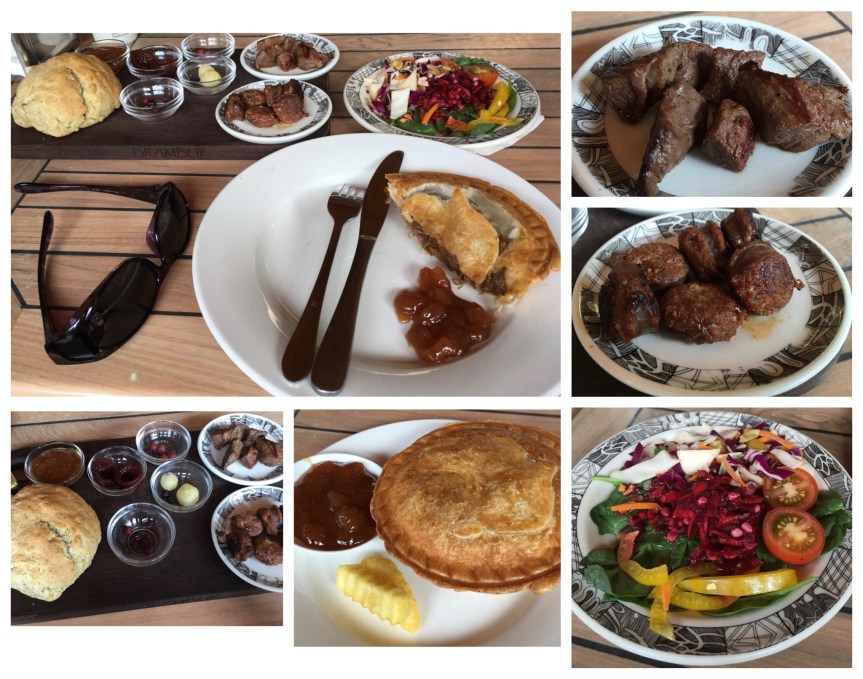
which had a little bit of everything (Kangaroo, Emu sausages, Crocodile, Wild Duck (Australia has a few different breeds, they never told us which one we were eating), 2 Bush Food Chutney’s (again we never found out which flavors) & a Garden Salad w/Bush Tomato & Balsamic Dressing) which is intended for two people, so we shared it between us. DEFINITELY worth trying, if only for all the new flavors. (see below for what some of these things look like)

While waiting for our food we raided the gift shop, which had a very good selection of items (many of which were made by Aboriginals with the proceeds going to them).

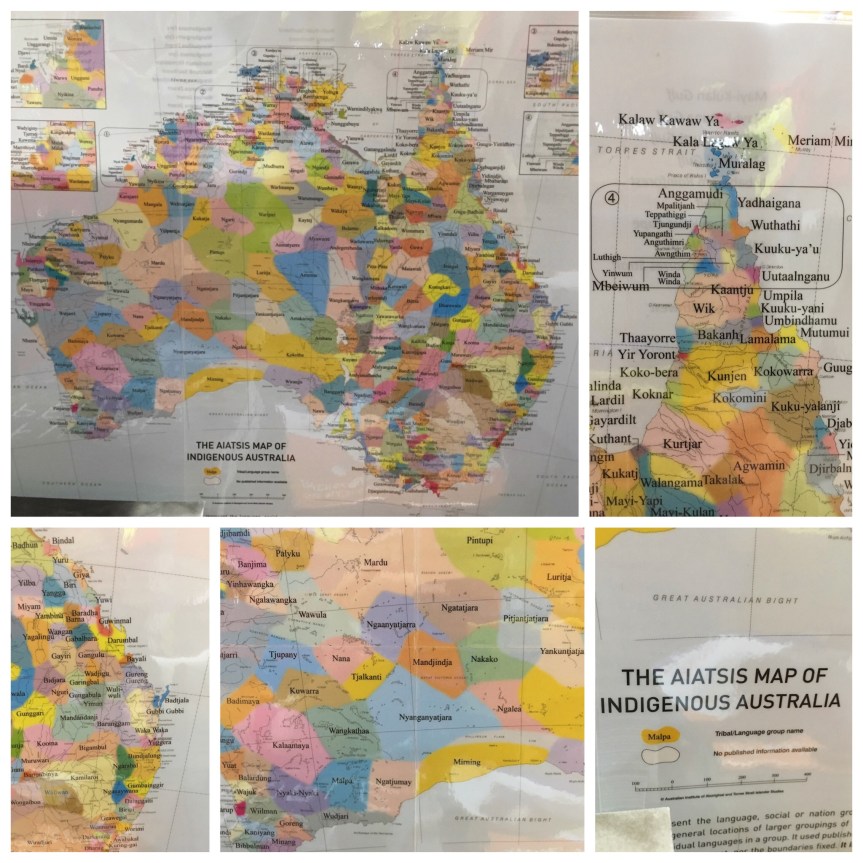
At first I thought left versus right-handed boomerangs was a joke on the tourists, but no, apparently they need to be designed differently. That said, I was tempted to buy this map of Australia (below) showing all the native tribal lands… but didn’t.
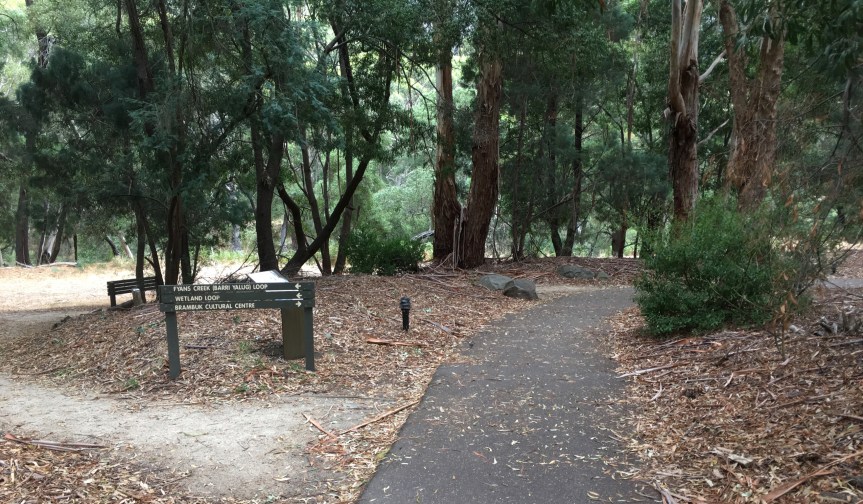
Once done at the first building you walk down a path to the cultural center
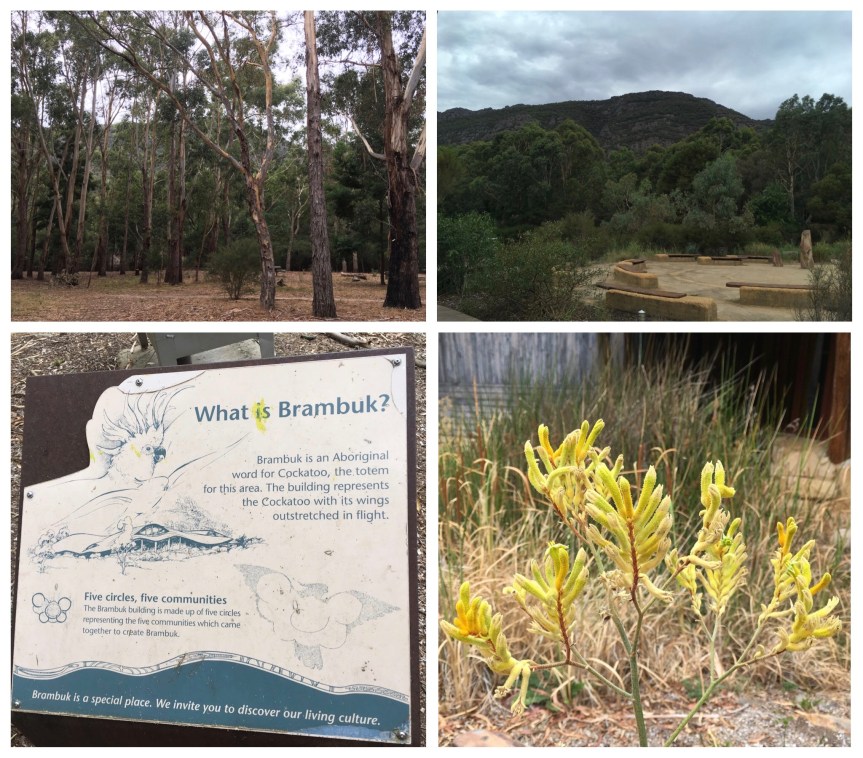
The real disappointment of this visit was the thing that should have been the star, the cultural center. Even though pretty much all they have in there is photographs, we weren’t allowed to take any. There was a movie on Aboriginal culture but you had to pay to see it (and it wasn’t cheap, so we skipped it).
According to their website’s description, “The Brambuk Cultural Centre is the longest running cultural centre still operated by Aboriginal people. Come here to explore the culture, its traditions and various multi-award winning architectural establishments.” So, you’d think this would be a place where politically motivated local Aboriginals would choose to work in order to teach interested visitors about the grandeur of their own culture, and share their love of their own history.
But here’s the thing… the odds are when you get there, you won’t spot a single Aboriginal … not even one with an ancestor four generations back so that all of the distinctive, but also highly recessive, genetic traits have been bred out — lord knows we didn’t find any (and we asked).
[Rant: Firstly, let’s keep in mind that I have spent months of my life, studying, living and working on the Navajo reservation, and to this day still maintain some VERY close friendships with Native Americans I met during that period of my life who are to this day deeply involved with trying to improve things for their people. What I am not is a knee jerk liberal who attends protests and talks the talk, but has never spent more than a day or two being a tourist among said people, and has therefore never really walked the walk, let alone never spent any real-time talking to said people, whose rights they are so moved to protect; and hence doesn’t even really know who they are let alone understand their problems, and what these people might want for themselves vs., what you the privileged white person might want for them. That said, one of the things that kind of annoyed me while visiting was my observation that in the modern-day Australians (who by all appearances as white) seem to take extreme pride in any small amount of Aboriginal heritage they can claim. Keep in mind, in the case of Aboriginal Australians, that by the third generation, such heritage is difficult to identify visually, and unlike with African genes it can’t “pop up” unexpectedly — where two seemingly white parents can give birth to a dark-skinned child, the same way two brown-eyed parents can have a blue-eyed child. So for instance, I, while researching this piece, learned about a European/Anglo member of the Tasmanian government, by the name of Jacqui Lambie, who offended the Aboriginal community by claiming she was one and therefore could represent them, and then went so far as to get her DNA tested to try to prove it. While this on the surface might seem to be not unlike Americans who point to Native American roots that their ancestors would have tried to hide with embarrassment. The difference is that … where as in America that person might take pride in being “part” Cherokee, they rarely if ever have the audacity to claim the state owes them something for prejudice that they themselves never have had to face in their daily lives because of that genetic heritage. In Australia, however, they will; in the current age they will describe themselves as simply Aboriginal, not as ‘part’ Aboriginal, because it is now not only COOL to be Aboriginal, but again it comes with all sorts of benefits designed to provide a ‘leg up’ in a society that has heretofore condemned them. I was for instance more than a little ticked off to see Aboriginal art, which is sold as such rather than just as art, and it’s a big deal to be able to PROVE the authenticity of said art… only for the photo of the artist to be of someone with blond hair and blue eyes. Think Iggy Azalea, the Australian rapper who claims aboriginal heritage who couldn’t understand while Americans took issue to her calling herself, “black” and hence being an ‘authentic’ rapper…
In the US, the TRIBES would never allow such a thing, for the obvious reason that funding is finite and every kid who is part Native, but has suffered none of the deprivations of that ancestry, who takes that funding is in effect taking it out of the mouths of the folks who really need it. And now that the tribes themselves have found creative ways to pull themselves out of poverty, they are getting EVEN FIERCER about who does or does not get to call themselves “Native America” versus, being of Native American ancestry. It would be a bit like the Johnson’s (African American family, founders of Ebony and Jett magazine and first African American to make make the Forbes 400 list), who used to live near me — and walking distance from one of the very best high schools in the country — had mansion on Lake Michigan, with a swimming pool and tennis court, and had the Commodores (Lionel Richie‘s band before he went solo) play for their kids sweet 16 party taking advantage of preferred places and funding at Universities, intended to help cure socioeconomic disparities that exist in the African-American community]
According to the staff member we spoke to, while the Aboriginal community gets the final say on what happens there, and everything is done with difference to them… sadly, their interest sort of ends with that, and is mostly focused on the money generated by the place… although one of the staff members said if we signed up for the classes and performances that we had read about and wanted to see (which weren’t happening at that time, and hadn’t happened in a while, and he wasn’t sure when the next one might be), we MIGHT (but not would) see Aboriginals working those events.
What displays they had were placed kind of hap hazard, so that it didn’t tell any sort of meaningful story. Overall, it was kind of massive waste of time
having trouble embeding the map (follow link to google maps):
 Rebecca Radnor's Personal Blog: Consider yourselves warned!