Who owns Oklahoma? The Monument to the Land Run Of 1889 on Route 66, in Luther, Oklahoma… and Native American Sovereignty

In October, while driving Route 66, I came across this marker/monument in Oklahoma. It denotes the eastern boundary of the Oklahoma Land run of 1889. For those who are unfamiliar with this event, it is yet another one of the many moments in American history where white men feel proud of themselves (there’s a HUGE monument to the event in downtown Oklahoma City), for essentially screwing over the indigenous red man who was there first (please note there is NO reference to them on this monument). HOWEVER, it also has something to do with the Case of Carpenter v. Murphy which is currently before the Supreme Court of the United States!

wcF6eQy7QSKeOhqebKDOSg_thumb_ae3b.jpg

In fact the Run of ’89 was the first of a series of land rushes organized by the Federal Government. These were “organized (HAH!)” events where vast numbers of WHITE settlers, 50,000 of them in this case… lined up with a flags in their hands, and at the sound of a gun were supposed to surge across the UNASSIGNED countryside on horseback or in wagons, racing to outpace the other contestants, find a nice piece of desirable FREE land, drive their flags into said piece and thereby “stake their claim to it.” In reality, the gullible honest people did that… often to find cheaters (usually rich people who had illegally surveyed the land ahead of time) already there (along with all their employees) trying to make it look like they’d actually done the run along with the others… when they had not… and had somehow managed to grab all the best bits of land first. So this was not only White people screwing over Red people, it was also rich white dishonest people screwing honest hardworking poor white people.

ezthI2kbSz2WiL8eZx6DJA_thumb_ae3d.jpg

Of course, all of this screwing was only possible after the government had “legally” screwed the folks who were already there…. the Native Americans…. Initially this was done via the Indian [land] Appropriation Acts where the government gave itself the right to yet again round up the local Native American population, this time to force them into reservations. When I say yet again, you need to keep in mind that the State name, Oklahoma, is derived from what it had been called at that time… i.e., the Oklahoma territory… and that the word Oklahoma is actually a composite of the Choctaw words “okla” and “humma,” which translates quite literally to “red people” … i.e., Red man’s territory.

This was an area that had at first been occupied by the Choctaw Nation (a multi-tribal people that spread from Oklahoma to Florida, and were united by a single language, Choctaw), who were then joined by the Cherokee… who were only there because they had already been moved once. Some came begrudgingly, as a result treaties they had signed, such as that of New Echota — the one made with the leaders of the former capitol of the Cherokee people( which I had visited twice, located about 1.5 hours from my friend home in Dalton, Georgia) with the Federal government; and if individual Cherokee refused to go by choice, they were FORCED to do so, on what later became known as The Trail of Tears. Ultimately, all of the Native Americans living within “Indian Territory” had been members of what the American colonists had referred to as the “Five Civilized Tribes“….Native Americans groups from along the southeast sections of America who had tried to get along with the invaders by going along; groups who had converted to Christianity, adopted centralized forms of government (see my posts about New Echota), were literate (see my post about Sequoyah), participated not just in trade but in the market economies of their areas, AND, to top it all off… OWNED SLAVES (see my post about Chief Vann, who maintained a plantation just north of Echota). All of these tactics of compromise ultimate failed, and now… having already been relocated to Indian Territory — which was supposed to be JUST for them… they were removed yet again, forced into reservations, and what had been their land, was now deemed “unassigned,” was given away to white people… who grabbed it in the mad rush described above.0pX+45bmRsucW8VKKr8e9w_thumb_ae3f.jpg

And the bleeding of the tribal lands in Oklahoma has in fact continued to this day so that only 2% of what had been Cherokee Nation land is still under their own control. Now here’s the good news… AFTER I had already driven past this area, on November 27, 2018 the Supreme court heard a case called Carpenter v. Murphy that calls into question whether the tribes of the Five Civilized Nations STILL have sovereignty over its own people on lands that had sort of bled out of their control within the Indian Territory lands in last 100 years.

See…

Washington Post: Half the land in Oklahoma could be returned to Native Americans. It should be.

New York Times: Is Half of Oklahoma an Indian Reservation? The Supreme Court Sifts the Merits
The Atlantic: Who Owns Oklahoma? The Supreme Court must decide the fate of a murderer—and whether roughly half of Oklahoma is rightfully reservation land.

https://www.washingtonpost.com/outlook/2018/11/28/half-land-oklahoma-could-be-returned-native-americans-it-should-be/?utm_term=.d17222df80b3


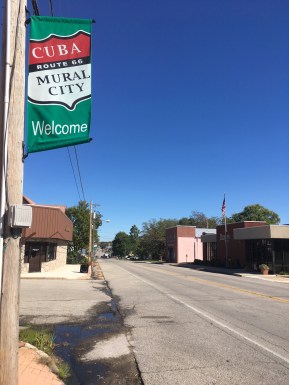
Cuba Missouri, The Mural City of Route 66

Cuba Missouri is yet another small town that has discovered the economic value of public art. It is the largest city in its county, with a population smaller than my high school had when I graduated, and yet it’s on every “MUST SEE” list for travelers traversing Route 66.

IMG_1430.jpg

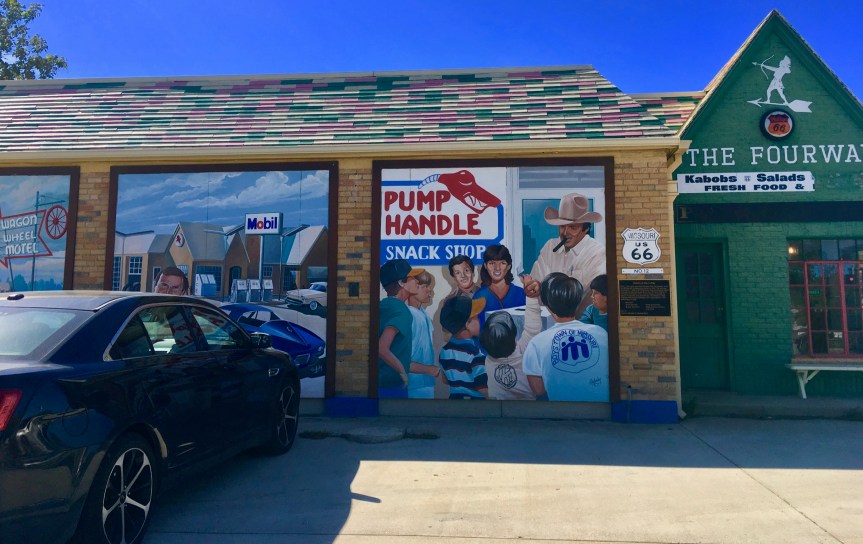
A local bank funded the “Viva Cuba Project” in 1984 because while trying to lure potential investors into the town, that they were being turned off by the high percentage of eyesores… and realized that a city beautification project was needed in order to spur economic growth. This initially involved businesses investing in beautifying their business and the city investing in trees and shrubs and various landscaping projects. So for instance check out this incredibly cute cafe, The Fourway (Kabobs, salads and fresh foods) in what has to be the cutest re-use of a historic gas station that I’ve seen so far.

IMG_1431.jpgIMG_0658IMG_0659

I can’t review it as a restaurant’s food as I didn’t eat here, but I was tempted, SO CUTE

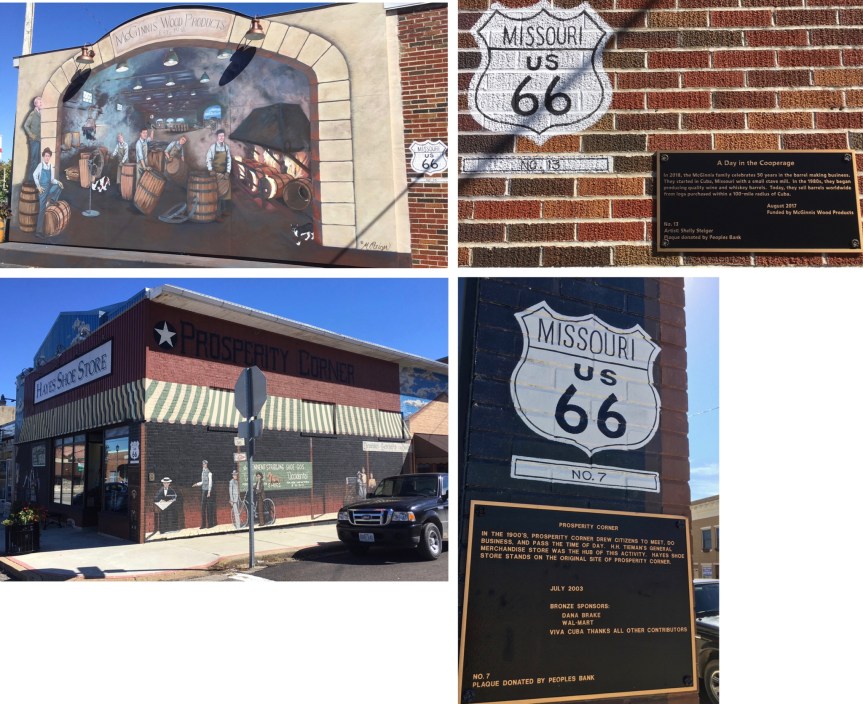
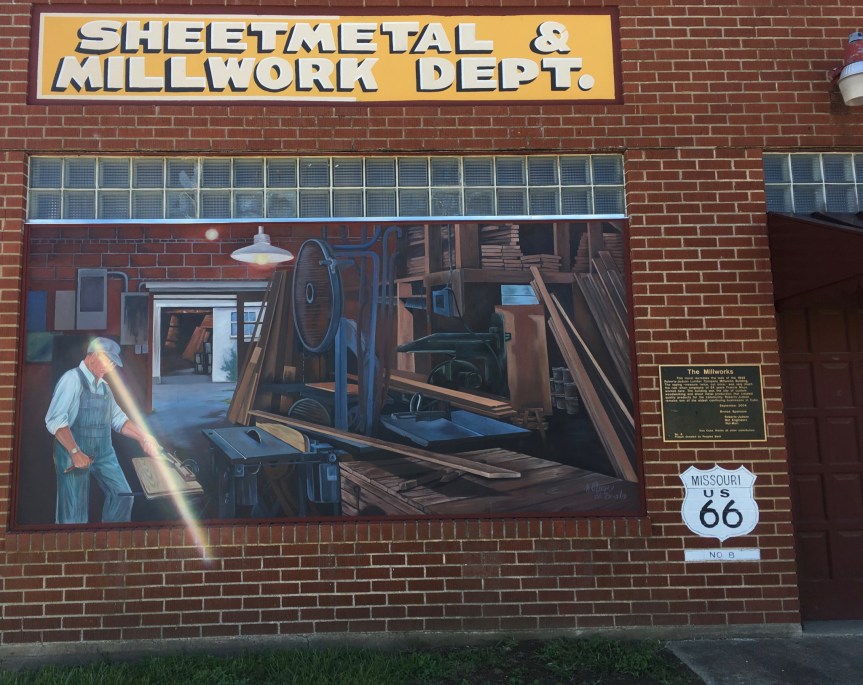
IMG_0660The Mural phase of the city’s beautification project began in 2001 and was completed in 2007. It was the Missouri legislature which designated the city the Mural city or Route 66… which I think a lot of the other small towns on 66 in other states, that have also gone this route, may take issue with.
IMG_1419.jpg

IMG_2715IMG_1422.jpg

I noticed however that the murals, for the most part, face east…. so the artist is assuming that most visitors who are traveling Route 66 are headed west.

IMG_1424.jpg

IMG_1449.jpg
Betty Davis Apparently visited the town once, and this mural honors that visit

IMG_1429.jpg

Ariston Cafe, Litchfield, IL

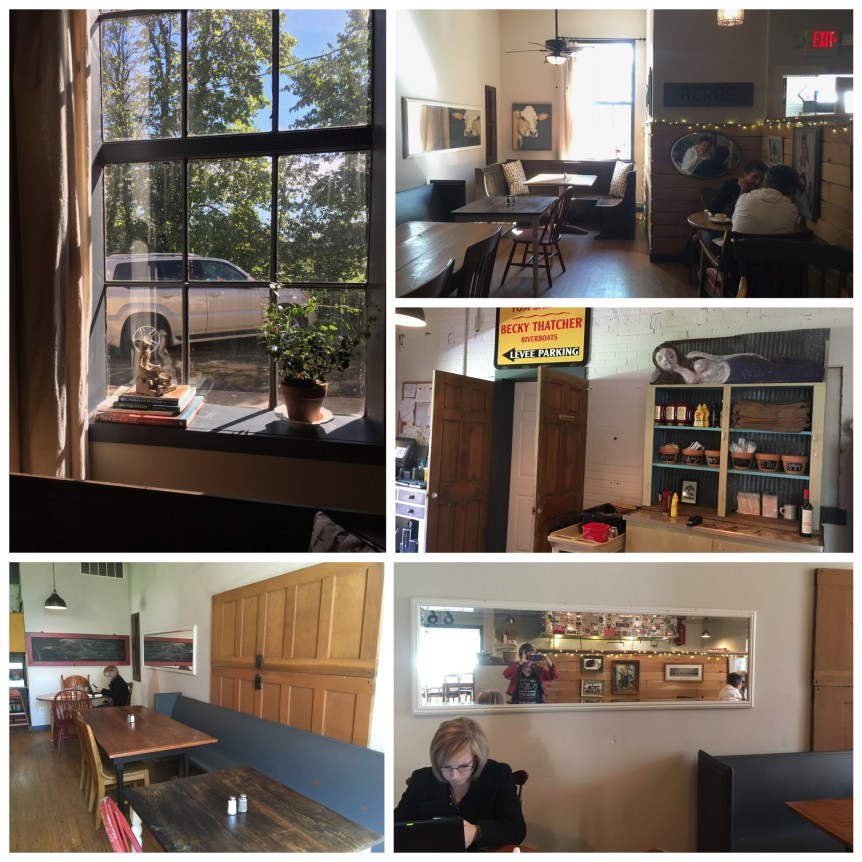
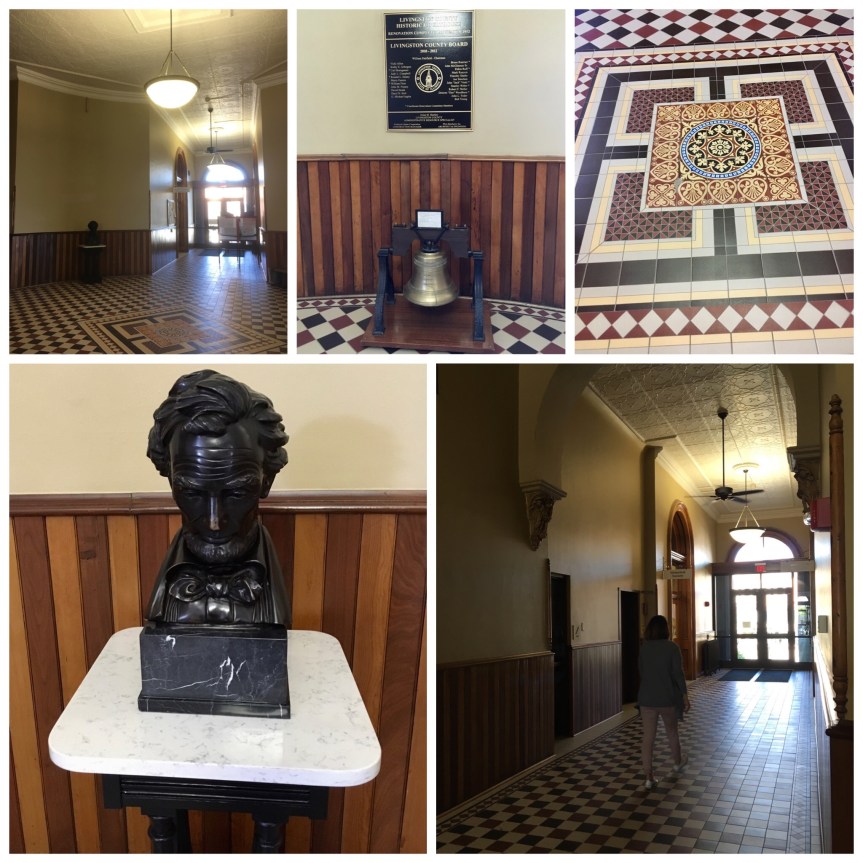
Built in 1935 (and on the National Register of Historic Places), the Ariston Cafe located on Route 66 in Litchfield, Illinois is the longest continuously running cafe along the route’s whole stretch. So I planned my trip so as to include a meal here.
IMG_1890

According to Wikipedia, with the exception of having added a banquet room and a few other minor tweaks, the interior of the Cafe has not been altered substantially since it first opened. In most other locations would be a bad thing, but on Route 66, it’s a selling point.

IMG_2705.JPG

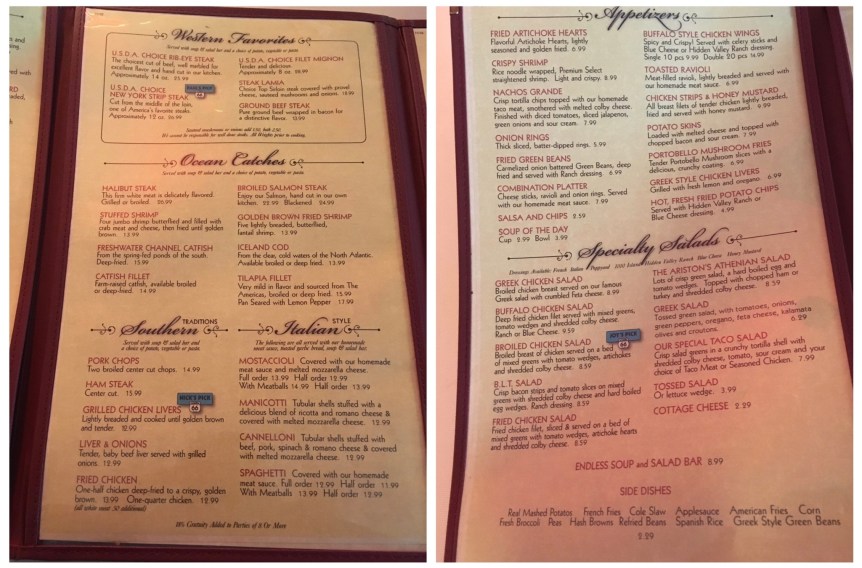
As restaurants go it has a highly confused menu; they have: Mexican, Greek, Deli, classic American, Southern, Italian, Steak, and Seafood … with 7 different kinds of fish — where most places would do one or two

fullsizeoutput_4e73

IMG_1893

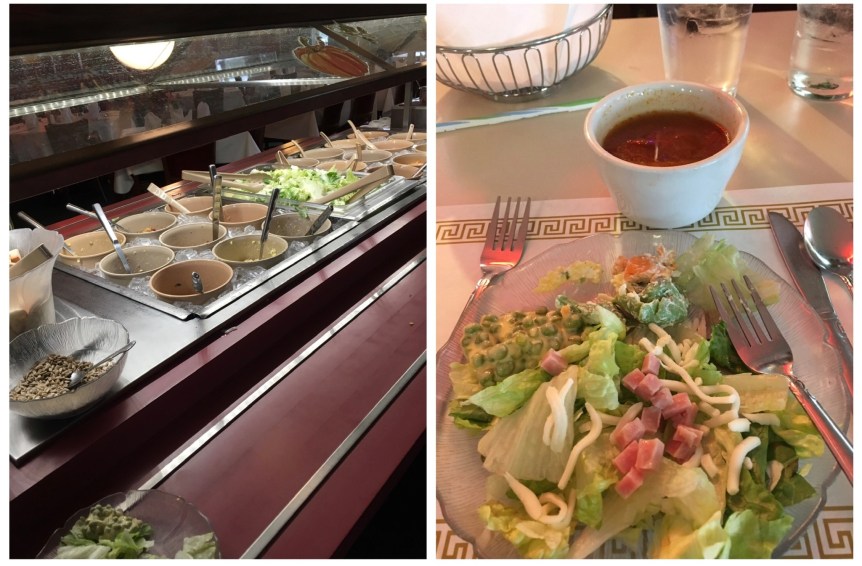
but I guess if you’re a restaurant in a small town you sort of have to be all things to all people. That said, they also have an all you can eat soup and salad bar which had some tasty stuff on it… even if it is kind of seriously old-fashioned.

fullsizeoutput_4e74.jpeg

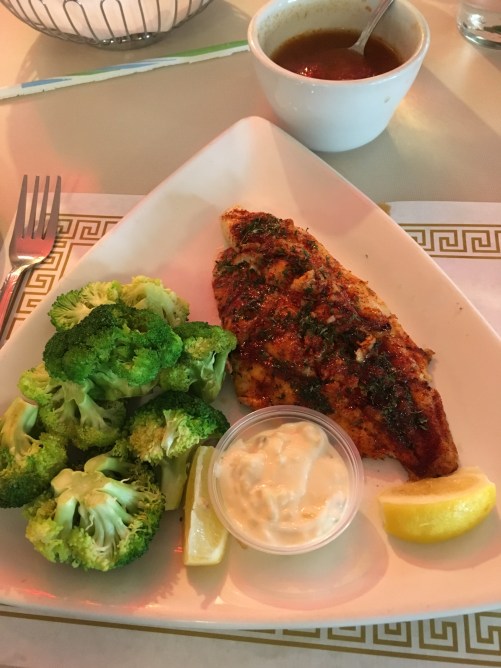
I asked the waitress what the difference was between the pond and fillet catfish dishes. The pond catfish is two big catfish served on the bone for $15, while the fillet is one catfish filleted for $14… as two would have been too much food me, I got the fillet… but if I lived nearby I’d have ordered the pond for $15 and taken home leftovers.

IMG_1902

That said, the Catfish was rubbery and had a funny after taste …which I think the chef was trying to hide with all the spices. But with seven different kinds of fish, unless fish is VERY popular in this town, I don’t see how they can be serving anything remotely close to fresh.

IMG_0582

There was a large selection of HUGE slabs of various kinds of cake… but passed. When the owner noted that I was keeping notes about meal, posting to social media, etc., he came over and gave me two postcards and a refrigerator magnet.

IMG_1898

Route 66’s original Brick Road in Auburn, Illinois

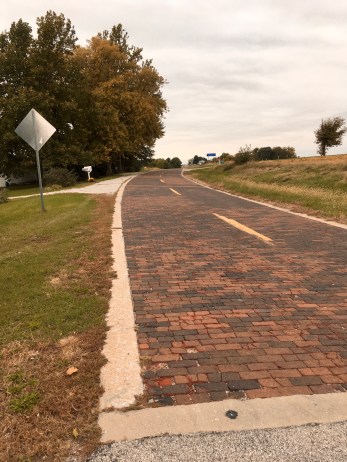
This original bit of, hand-lain in 1931 brick, Route 66 in Auburn, Illinois, is listed on the National Register of Historic Places, and as such is protected from ever being paved over with boring old concrete.

fullsizeoutput_4e54

Interestingly you can in fact drive on it, which is kind of surprising… so they must do regular upkeep to keep it traffic ready.

IMG_0555.JPG

Abe Lincoln and the watermelon baptism, Lincoln IL

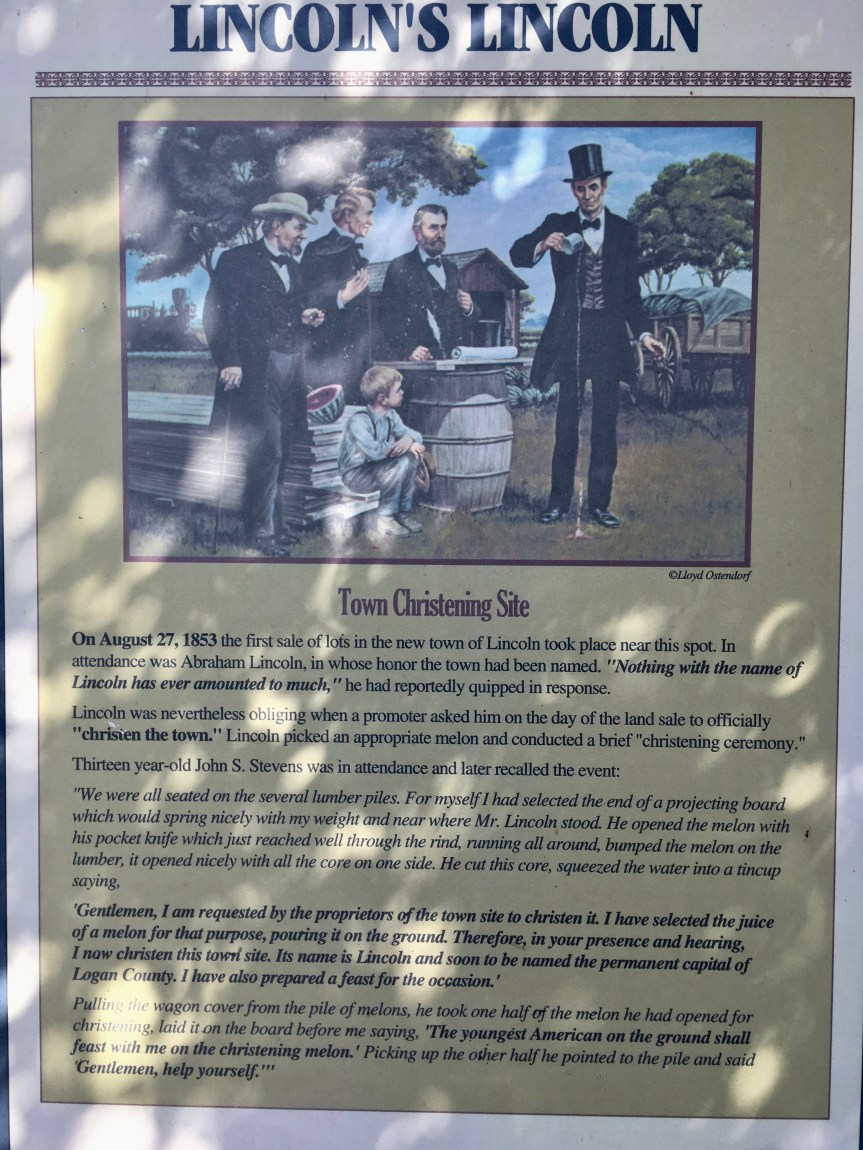
This monument, a few blocks away from Route 66 and in the middle of Lincoln, Illinois marks the spot where Abraham Lincoln himself christened the town with his own name, using the juice of a watermelon to do it.

IMG_2071

Lincoln, IL is in fact the first town in America named after him. He was only a lawyer at time, and it was well before the election. Lincoln had, as lawyer been involved in helping to deal with the legalities of laying out the town’s plans and breaking up the ground into lots for sale. He client was in fact the railway that was laying rail in the area and had decided to put a town at this location. According to tradition he was present at the towns naming, only one hadn’t been chosen yet. So the other men there, for whatever reason, suggested he name it with his own name, which he had at first advised against, with the quote mentioned below…

fullsizeoutput_4e2e

Years later, then President-elect Abraham Lincoln came here to speak, and after his assassination his funeral train stopped here

IMG_2094

Hoito Finnish Restaurant, Thunder Bay, Ontario Canada

The Hoito is an unimpressive looking but historically important Finnish restaurant located in Thunder Bay Ontario Canada.

IMG_5317

It drew my attention both as being one of the highest ranked restaurants in Thunder Bay on all the customer review websites (pulling four or five stars at each), but also because FINNISH food!!! Seriously how often do see that being offered up.

fullsizeoutput_4e04.jpeg

My airbnb host asked where I was intending to go for my meal and when I said “that Finnish place, the Hoito”, he said, “Good choice, I love that place.”

fullsizeoutput_4e06

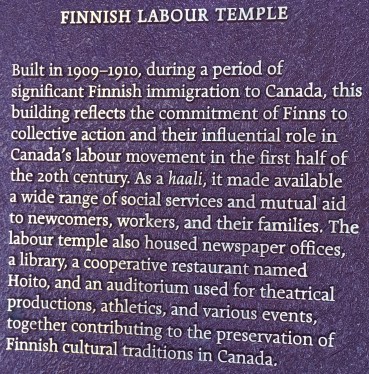
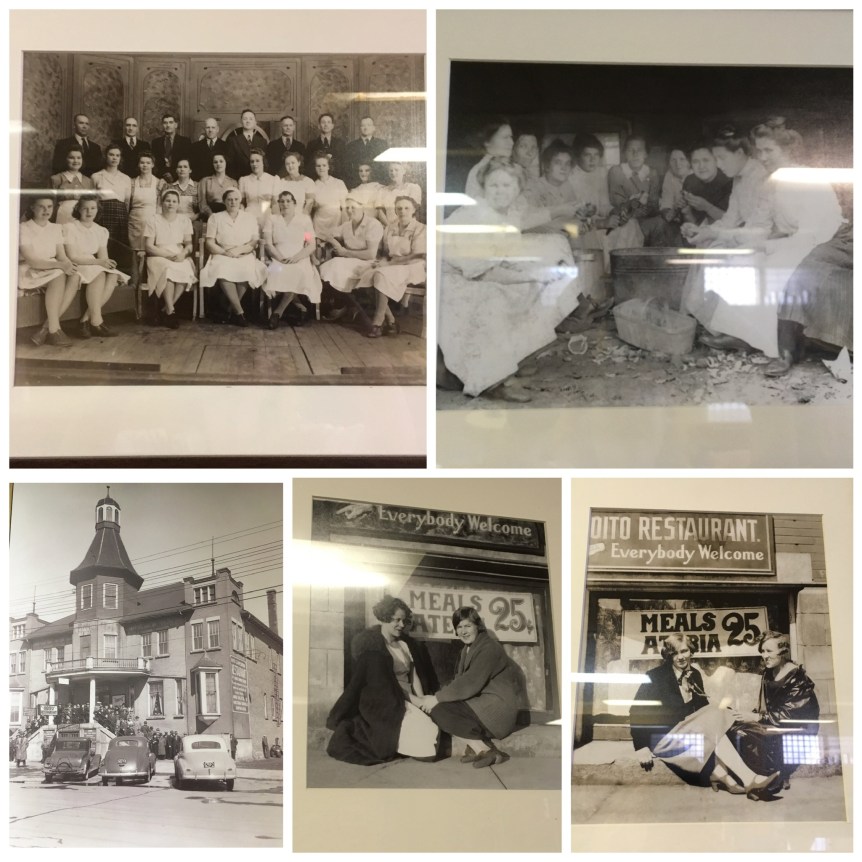
After I arriving there I discovered the Hoito is historically important restaurant, established in 1918 (Wikipedia). Founded by loggers over 100 years ago, and running continuously since then, the restaurant is co-operative and is so deeply embedded in the labor movement that it is considered to be socialist.

IMG_0536.JPG

Regular customers buy membership cards that allow them to vote at the Finnish Labor Temple located directly above the restaurant, and until the 1970’s customers could buy meal tickets too, if they ate here regularly, and the food was served on long communal tables. This restaurant was even written about in the New York Times.

IMG_5306.jpg

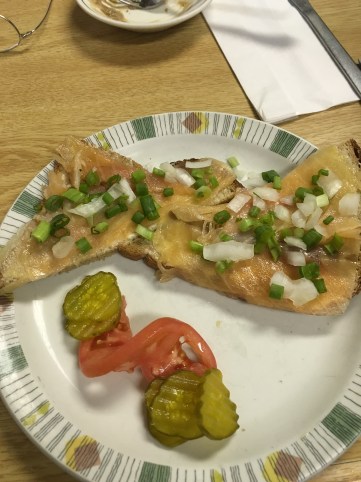
I had suolakala (pronounced soo-la-ka-la) which is described as a salted fish sandwich — open-faced. It’s a bit like gravlox, in that it’s cured salmon… only it’s not smoked. Thing is I eat lox sandwiches almost daily so…

IMG_5304

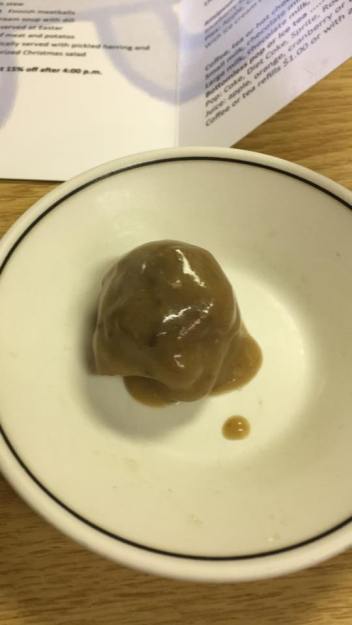
— I HAD wanted kalakeitto (a salmon soup) but they have run out. They also gave me a single Finnish meatball (to try) … because I refused the suggestion to order it as it definitely is NOT on my diet

13906743_10208086080684360_6670930185835158734_n_10208086080684360


IMG_0538.JPG


Yale, British Columbia, Canada

Driving along Canada’s Route 1 (I was heading east, but at the time the road was going due north) I passed through the tiny town of Yale in British Columbia, population 186

IMG_4962.JPG

IMG_4966

IMG_4967

IMG_4968

IMG_4969

IMG_4975


IMG_4976

IMG_0404

I have to admit, there were items for sale at this place that made me drool… IF I had more room in the car I’d have bought the cow’s skull or the carved wooden bear… but I don’t, and I have no where to store any of it anyway… my storage locker is pretty full.

The transformation of the city of Pontiac, Illinois

Located about an hour and a half southwest of Chicago is the small city of Pontiac Illinois. To be honest, the only mentions of this place that I ever heard growing up referred to the state prison located at the south end of town. In recent years however the city has made a concerted to transform itself into a tourism destination, and in my opinion is well on its way.

IMG_2292

Firstly, in the center of town is a very attractive turn of the century styled Town Hall.

fullsizeoutput_4da2.jpeg

Until I approached it I hadn’t known that this was one of the towns included in the National Park Service’s Looking for Lincoln Trek.

IMG_0285.JPG

I also found it was quite attractive on the inside as well, although not quite as nice as on the outside (they need to work on that). It’s a bit too spartan (other than the floors) and why is Lincoln looking at the ground?IMG_0286.JPGAlso, one does not expect with a population of just shy of 12K people to have four museums (I went to two of them, the Auto museum and the Gilding arts one, and they were both worth the visit). In addition, the city has been embracing the tourism tactic of hiring artists to pain murals around the downtown area to beautify itIMG_0284.JPGAnd another very cute thing that they’ve done is to scatter these cars for kids on street corners around townIMG_0287

I really have to give my props to the Mayor and city consul of Pontiac Illinois for transforming their little town from a town whose major employer was a state prison into something worthy of extended visits from those doing the route 66 trek, as well day trips for people living in the Chicagoland area.

Pontiac Oakland Automobile Museum.

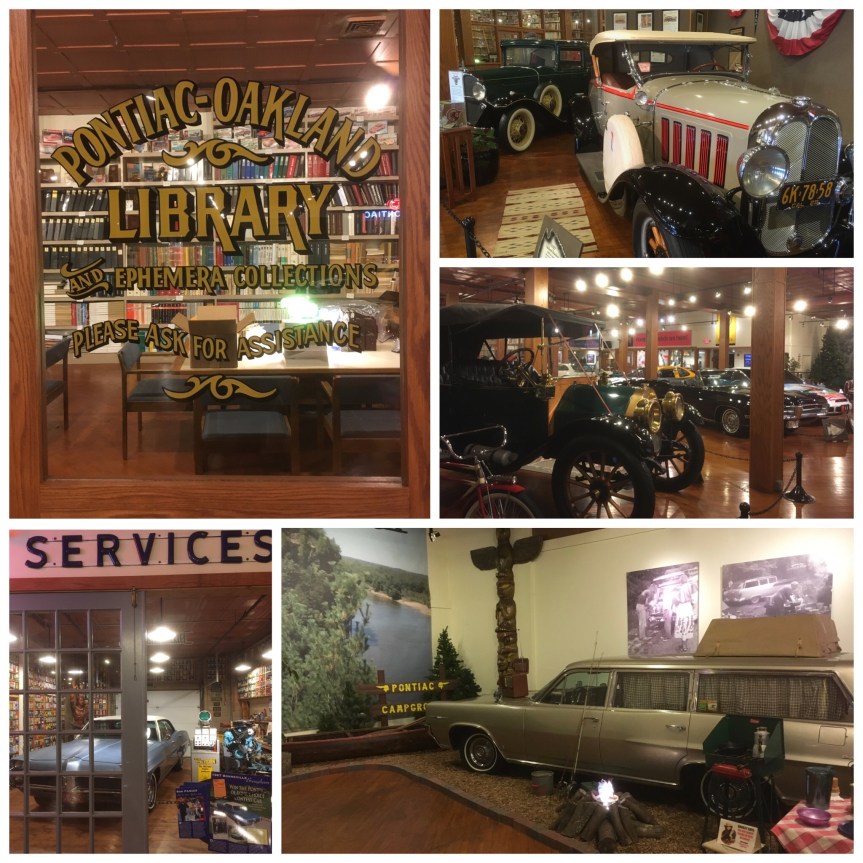
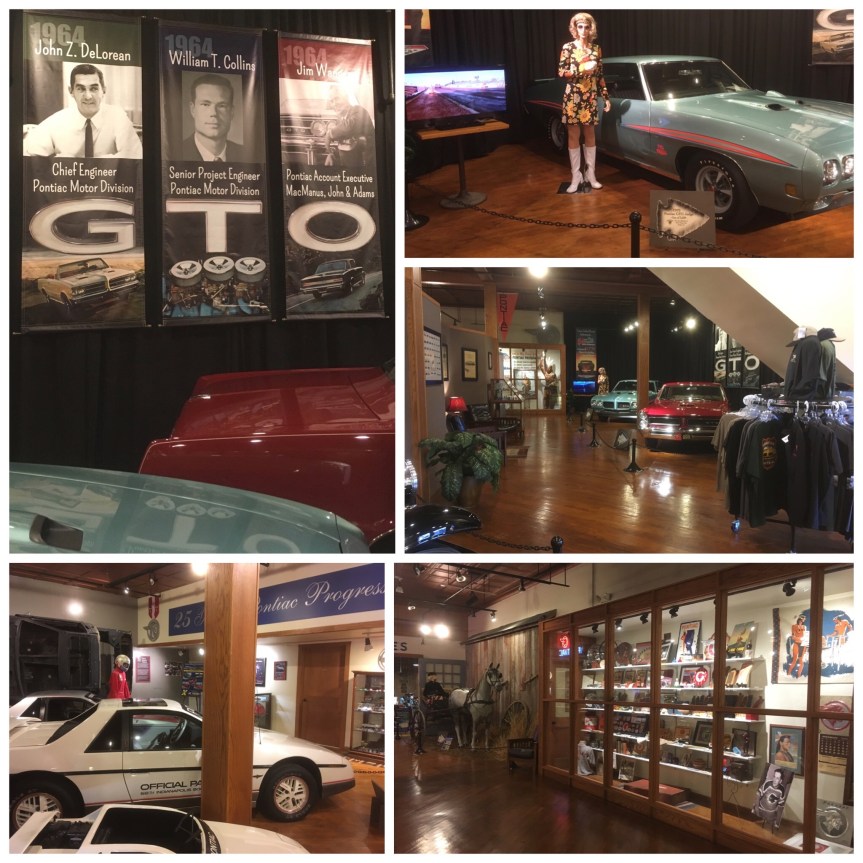
Located just off Route 66 in Pontiac Illinois, is the interestingly named Pontiac Oakland Automobile Museumthe name confused me a lot till I look in Wikipedia and apparently the Pontiac brand was originally called the Oakland, but was produced in Pontiac Michigan, and ultimately the name was dropped in favor of being called Pontiac. IMG_2297As I discussed in the post about the Gilding Museum, Pontiac Illinois has decided to turn itself into a tourist destination that people will actually stop at. To do this, they have offered empty store fronts to people with museum worthy collections, and are hiring people to come in to professionally set up the exhibits. Where gilding actually has nothing to do with the town, what could be more apropos than a museum dedicated to the Pontiac brand of car in Pontiac Illinois?

IMG_0266When you first enter it’s to what seems to be a fairly large gift shop, but one that’s reasonably sized once you realize how bit the museum space is.
IMG_2320

IMG_0268

The woman who owns it was working there and she says they’re opening up a second one in Flint Michigan and her husband also runs a magazine for Pontiac collectors

IMG_0267

If you’re into cars, and even if you are not, this museum is well laid out and well worth a visit.

Museum of the Gilding Arts, Pontiac IL

The Museum of Gilding arts in Pontiac Illinois is a very high quality museum dedicated to Gilding (applying thinly beaten gold to things). Located just off Route 66, It’s located in an abandoned storefront in the city center. The Town of Pontiac, in an attempt to draw tourism offers these locations free to any small high quality museums that are willing to locate their collections here.

fullsizeoutput_4da0.jpeg

I’ll admit a bias, a very old friend of mine helped set this museum up. And when I say old I mean we’ve known each other pretty much our whole lives. When my dad was graduate student he did consulting work for her dad, our families went to the same synagogue, and then in high school we ended up hanging in the same click (I was a Freshman and the rest of them were Juniors. Growing up my friends were almost alway older than I was, and I didn’t tend to fit with kids my own age.)

IMG_0245

The Docent walked me through the whole collection. She was very nice and helpful and probably could have kept talking … but I was on a schedule. First she showed me a very thin sheet of pounded gold, pounded so thin that you could the light through it… and then a box full of sheets of the stuff, where you can turn the box and see thing and light it is. I told her that in fact I’ve spent a lot time in Japan, where gilding is still a very active art, and knew all of this already. (In Japan I have eaten cakes topped with gild — very thin gold — and some where in all my boxes I have a little canister of the stuff should I ever want to put gold on a cake.)

IMG_0246

According to the docent, … The Smithsonian wanted the collection that’s on display in Pontiac…. but they only wanted it for a temporary exhibit and the people who owned it — a family that had owned a now closed gilding company on the east coast — wanted a permanent space.

IMG_0247
A recreation of gilding workshop

Then guilders who live in Pontiac, (hobbyists, there was never a gilding industry here) heard about this and connected the owners with city, like I said before, the town for all intents and purposes gave them that location to put their exhibit into. There’s no real connection between Pontiac and gilding otherwise

IMG_0248

As I’m writing this, I googled the name in this board and found this, W H Coe Mfg Co Inc, Gold Leaf Manufacturer in 10 Love Ln, Hartford, Connecticut 06112. — but I couldn’t find more which makes me think the company really has gone out of business .

IMG_2319

There is also a small gift shop selling goods that I assume are made by the local gilders who helped bring the collection to Pontiac. I bought Chai Magnet, and gave it as a gift to my friend whose home I was going to be staying at as soon as I got back to Chicago.