

A cute enough town with many of its buildings dating back to the 1880’s or 1910, with a lot of top of the line yet affordable resturants; the fact remains that the only real reason to come to Stratford — and MANY people do, is to attend the internationally recognized, Shakespeare festival, which runs yearly from April through October (i.e., not during Canada’s winter).

Normally when I blog, I break up an extended visit like this — 23 days — by the day or by specific things I’ve seen or done, but since Stratford is not that kind of town… people come here for one reason, the theater, I’m going to do it as one extended post …. with the caveate of a day trip I took to Niagra Falls (in part because I had a day off and some business I had to do early the following morning in Toronto, before returning to Stratford that night for another play)
The Town
Originally a railway junction (and you can still hear the train as it passes) Stratford’s main industry (which collapsed) had been furniture making. Today the town has a population of around 31,000 and has a new main industry — theater. The Stratford Shakespeare Festival began in 1952 as a way to stimulate the local economy, with its first production (Richard III, starring Alec Guinness) being staged the following year, the festival is now held in such high regard that they often attract the best of Canada, the US and Britain to take part in their productions, and their company has nurtured Canadian talent that has gone on to be world famous. While the central theme of the festival is to produce the plays of “The Bard of Avon,” they also produce musicals and plays ranging from the ancient Greeks to modern works. In fact this year only half of the shows were by Shakespeare, although one of the non-Shakespeare plays was about him. And they offer all sorts of deals, which vary based on if you are purchasing well in advance, or during the festival, so that if you plan it strategically you don’t have to pay through the nose to see every play (which is exactly what I did).

I was here for slightly over three weeks, I stayed at the home of a friend Dayna Manning, a local musician (and someone whose been successful enough that she’s been able to support herself fairly comfortably just on her music — which is a hell of an achievement). In fact while I was visiting she and a friend put on a ‘test’ concert at a local venue. They’d only played together once before, at the request of a friend, enjoyed it, and decided to work together to build material for a gig to take on the road. This concert was performed mostly in front of friends and family (and local fans), with the aid of some friends who just joined them to jam.

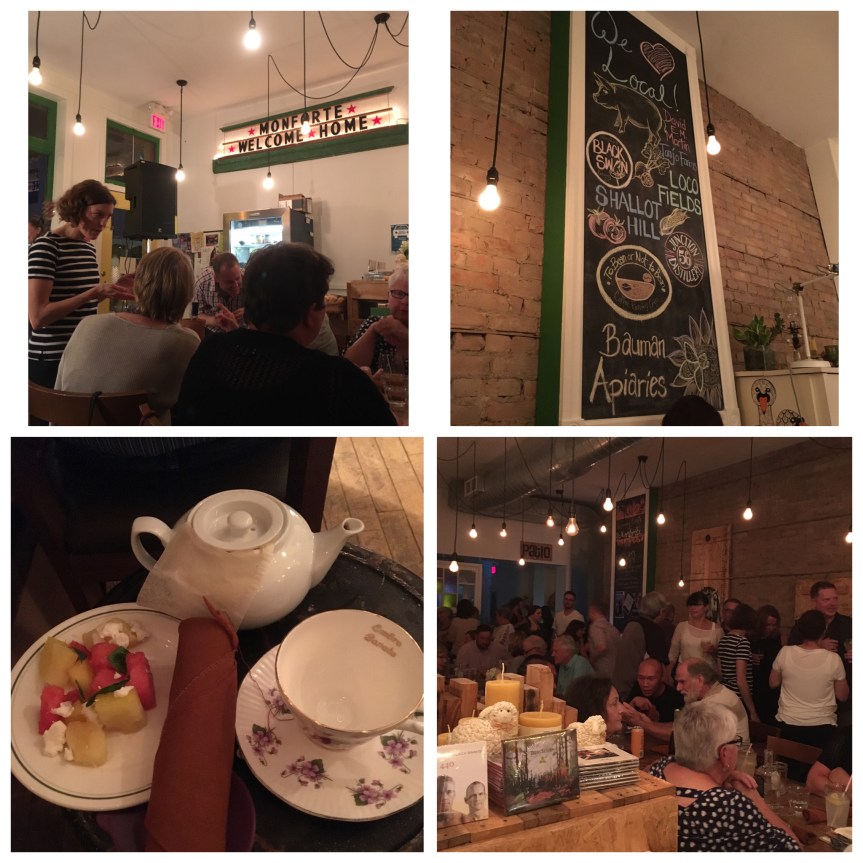
Granted, most people might not have a local friend but not to worry; the town sports plenty of proper B&B‘s & Airbnb‘s — in fact practically every block seems to have one or the other, as well as various hotels (some chain, some historic) serving the town’s visitors. While here I met a LOT of older (usually retired, or semi-retired) people visiting from Chicago. I also discovered that there is in fact a dedicated bus line (of the air conditioned tour bus sort) that runs from Toronto to Stratford that only costs about $25, saving people a drive back late at night.

Like I said, Stratford’s main industry is the Theater, and as a result the local schools have a very STRONG arts mandate. I’m constantly running into packs of local teenagers who all claim to be theater nerds, and the streets are full of VERY YOUNG musicians (most often found providing entertainment to folks waiting for their plays to begin) whose parents can always be found standing guard just across the street or down the block. According to Dayna, Canadians with musically gifted children will in fact move to Stratford, just to take advantage of the musical programs there. The overall quality of the music these kids were preforming was very high.

I did not discover this until about half way through my visit but apparently Justin Bieber hails from Stratford. (There are t-shirts for any visiting Beliebers) when I mentioned it to my friend Dayna, this is actually her home town, she said that his mom was a year ahead of her in high school and had been the only teen mom in their school, and that she used to bring him to class.

Architecturally the historic downtown of Stratford is very cute; most of the building were built in the late 1800’s or early 1900’s, spiral out from the central point of the town hall, and sport a strong emphasis of multicolored brick work as their main form of decoration.



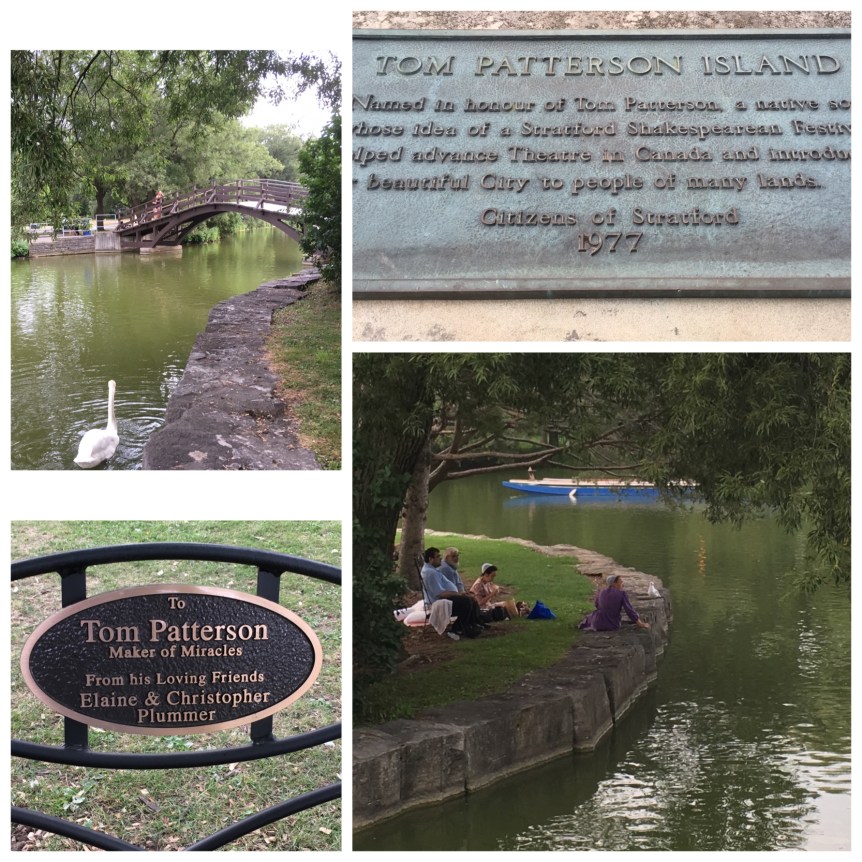
Running through the center of Stratford and offering a pretty walk between the Patterson and Festival theaters is a very cute river, with loads of ducks and swans (not to mention a plethora of Pokemon stops).


Locals and visitors both make active use of the river for boating (rowing), picnicking, and just enjoying it.




Right across from the main (largest) theatrical venue for the festival is Tom Patterson Island, which is a pleasant place to hang out, and had the benefit (from my perspective) of being a Pokemon hub — a place where three poke-stops are so close together that assuming you’ve got active lures in place Pokemon emerge rapidly — and the more players there are taking advantage of the spot at one time the even more rapidly they emerge… its not uncommon to find groups of young adults playing the game there at 3:00am
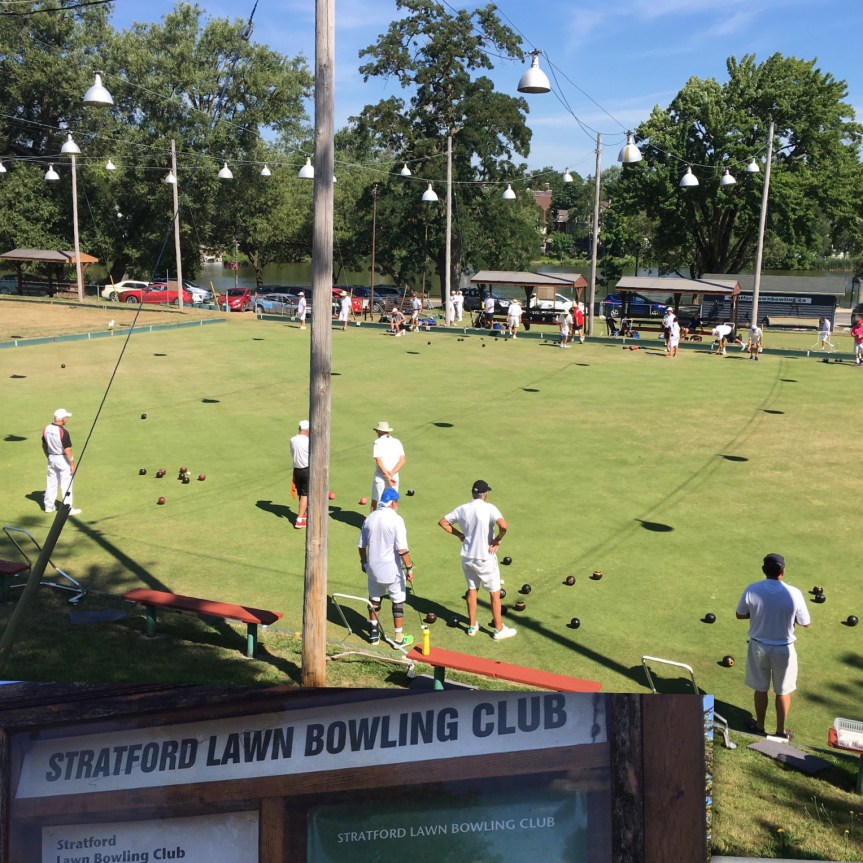
Right along the river along one of my favorite areas — and it was only two blocks from the house where I was staying — was the lawn bowling club.
The Theaters
Currently, the festivals takes place in four venues scattered around the small town: The Festival theater, The Avon theater, The Tom Patterson Theater (named after the guy who had the idea of creating the festival in the first place), and the Studio theater (I will describe each in detail later on). And, if you have the good sense (as I did) to find digs that are centrally located to those, you can quite easily walk to any of them (assuming normal mobility and reasonable weather). There are taxis in the town, but they are few and far between (I’ve rarely seen them), so if you’re going to need one I strongly suggest contacting the companies directly and reserving them in advance (there is no Uber or such in the area, although you think the locals would push for it as a way to earn an extra buck during the festival season). Otherwise, parking at these locations is at a premium, and you will actually have to RESERVE parking in advance if you’re going to need it, or try to find street parking nearby, which won’t be all that easy.

One of the slightly odd things I noticed about the productions here was that extreme ‘Color Blind Casting’ seems to be the rule, to the extent that it can sometimes be disconcerting with absolutely no thought to reality … so that thought of race does not even happen in casting family units, forget about historical likelihood. As such, I saw a Caucasian actress as the mother, with an actress of African decent (who appears to lack any mixed heritage) as her daughter, and then a granddaughter played by an Asian actress (in this case Vietnamese)… whose father was played by a Caucasian actor…. in a play set in the 1850’s in Sweden, a place and time where even brunettes were a rarity. While I appreciate the need and desire for color blind casting, I wish they’d at least integrate some deniable plausibility…. otherwise its much harder for the audience to suspend disbelief and enter into what I refer to as the magical transformation of theater… where you forget it’s a play and stop seeing it as actors on a stage.
I had heard about the Stratford Festival in Canada all my life, but growing up — as much as my family LOVED theater, we never came here. (In fact we never crossed the northern border to Canada… I came once on a business trip as my father’s assistant, and once for an academic conference when I was in grad school, but that was it). We did however go to London almost yearly to visit with relatives (at least until most airlines stopped offering the “kids fly free” deals in the mid 1970’s) and that’s where we would gorge ourselves on government subsidized theater, sometimes seeing as many as three shows a day in our attempt to see EVERY possible production before heading home to Chicago; that, or we’d attend local student productions at Northwestern University (which has always been one of the top ranked drama programs in the country), getting the specially priced for staff tickets (dad was a professor at the business school). So, what drew me to decide to invest almost a full to the Stratford Festival this year? It was a school friend who has been coming here almost yearly with her mother, and listening to her going on and on and on … and on… about how great it was.
As previously stated, four venues make up the festival:
The Avon Theater: Let me admit right now (to my utter embarrassment) that I completely missed the punny nature of this till my cousin by marriage pointed it out… The Avon in Stratford? Get it?
Anyway, it is located in the heart of downtown (which is only about four blocks square), so its very convenient in terms of you go, you eat dinner, and then you wander over to the theater.


This theater seems to get the shows expected to do well, but not SO well that they will require the festival theater; during my stay I saw Shakespeare in Love, The Lion the Witch and the Wardrobe (a musical); and Sondheim’s a Little Night Music.
Festival Theater:

The Festival Theater is the main venue for the Festival; it is where all of the ‘classic’ Shakespeare plays are performed, as well as any performance expected to bring in the crowds — which this year was A Chorus Line.

It is the venue located farthest from the Historic downtown of Stratford, alongside the Tom Patterson Island (located in the river).
Hidden within the building (by the stairs on the way down to the bathroom) is a real find, a chair that is strongly believed to have belonged to the Bard himself.

Tom Patterson Theater:
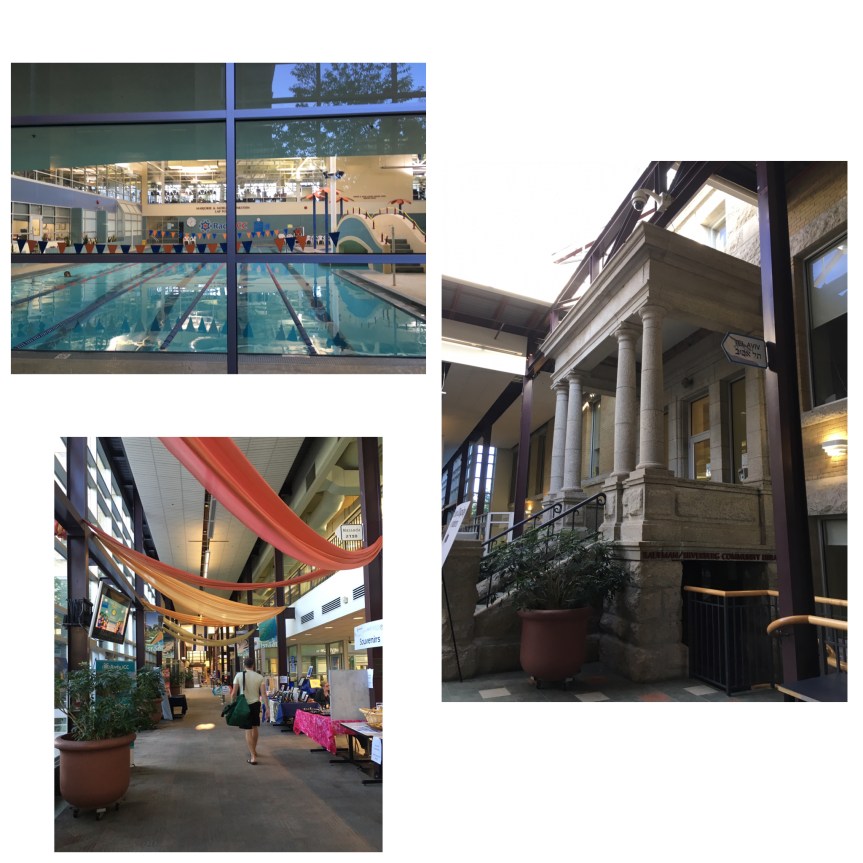
The building that this venue is in doubles as the Kiwanis Community Center. It’s one of the smaller theaters, with a full in the round construction. It’s located directly adjacent to the river, and when there are performances (and good weather) musicians will perform on a small dock.

This is where they host the Shakespeare shows they’re not expecting as much interest in — in this case a mashup of four of the historic plays, as well as serious dramas from top play-writes. In this case I saw “All my Sons” and one of the lessor plays by Ibsen.

Studio Theater:
The studio theater, which is 3/4 in the round, is located directly behind The Avon Theater. It doesn’t even have a proper lounge area, just a little stand which doesn’t even take credit cards. Most of the audience ends up hanging out at a book store located across the street (about where I’m standing when I took this picture).

It is the smallest of the Stratford venues. It’s where they display experimental theater or new plays that have never been seen before. As in, at my high school we had an in the round theater for when we put on Shakespeare plays and the like, which was bigger.

The Eats
The Good:
Bijou (midpriced Farm to table, French gourmet):
Located smack in the center of Stratford’s downtown. The food is French/ Farm to Table & prix fixe… and MOST of what’s on the menu I can’t eat. I explained my dietary issues to the waitress, who GOD BLESS turned out to be a dietician. She immediately agreed I could only eat the main and changed the price to adjust for that. I had trout on a bed of grilled veggies, which was delicious.

And then she brought me a little champagne cup full of fresh blueberries for my desert — and didn’t charge me for them.
CrabbyJoes (chain type):
Located outside of the downtown on the main road from Toronto. I came here under the mistaken assumption that it would include crab… it doesn’t. Its sort of like a TGIFridays, or a Chilies, type place… only the wait staff is actually HELPFUL and KIND and CONSIDERATE. First time I came in I explained my medical conditions and asked for a suggestion. The waiter said, “well to be honest most of what we serve you can’t eat… but there’s this one page in the back of the menu you should look at.” (which had healthy options I decided I would try at some later point — the fish dinner was delicious with lots of raw veggies as the salad, not boring lettuce)


But I wasn’t hungry enough for that at the time, just wanted a snack, so I asked if I could have the grilled chicken breast that comes on the salad… but without the salad. The waiter immediately pointed out that they normally brush it was garlic butter, and should they not do that? HALLELUJAH, the man earned his 20% tip.
I later had their Mediterranean Chicken from the skinny menu, sans the dressing on the salad (because it was pretty much oil). That was NOT as good as the fish, for a lot more calories — 500+ instead of 300+

Foster’s Grill (mid-priced Gastropub):
Center of downtown, almost next door to the Avon & Studio theater: I had tried this place before for dinner and was highly unimpressed with their “healthy” options… ended up eating the mussels which (this being the heart of the Midwest) were uninspiring. However, friend Dayna whose house I’m staying at, suggested that they’d be among the best local place for me to get breakfast, so I gave that a try. BINGO…


The dish is normally two pouched eggs on steamed spinach for $9 (Canadian), but I asked if I could only have one egg as I have high cholesterol, and they accommodated me, dropping the price to $6 … add one slice of dry toast which they didn’t charge me for, and a cup of coffee. Now THAT’S a breakfast! … For a grand total of $6.97 in US currency. The DOWNSIDE is that with the exceptions of Sunday Brunch, the breakfast menu goes away at 11am, and that’s about when I’m waking up — that said I found it pretty easy to get other local breakfast diners to make me the same thing (usually sans the avocado which these other diners don’t seem to ever have on hand) for a few dollars less.
The Prune:
Firstly, reservations are a must. The restaurant is in a converted house, on a street off to the side of downtown (with a bunch of other homes also converted into businesses — you get the feeling downtown is bursting it seams, but that the homes are considered historic so they can’t be torn down and replaced with business appropriate buildings).


This place is a fixed price only, two courses minimum restaurant. As I’m on a diet and have gotten used to small portions, $55 for two small portions and no vedge didn’t bother me, but I could see it pissing off a lot of people wanting US sized portions (see Demetre’s below). That said everything was tasty, and they were able to accommodate my dietary needs. The appetizer was smoked trout on a green apple vinaigrette (the assured me almost no oil), with one little bit of crisp bread with trout row on it (forgot to take a picture before I started eating), there was another large piece of fish where the fork is.

The main was Skate wing, which I’ve only had once before as it is most definitively NOT kosher (it’s a form of shark), so my parents never ordered it for us at restaurants. (I discovered it while eating out with a friend in Brighton, UK). You all know what Skate looks like, there’s barely a major aquarium that hasn’t got them in the main tank… they are the fish who look like they are flying through the water, rather than swimming… The wings are tasty.
 Everything was tasty, but I think it was a bit overpriced (Skate wing is hard to find more because there is little market demand for it, but it’s actually relatively cheap to purchase — it’s by-catch, stuff that gets caught in the net when they are fishing for other things) … I just wished there had been more vedge served with it (all there was was a bit of shaved cucumber underneath it to prop it up above the broth.
Demetre’s Family Eatery (Greek owned Diner)
And in the best bang for your buck (but not necessarily all that tasty) category: Again, located away from downtown, this is a place that apparently all the elderly folks already know about (based on the average age of the customers) and that locals like (according to the person whose home I’m crashing at). They have smaller “elderly” portions, but on average their portions on MASSIVE. Where normally (for the same price) I’d get one blackboard eraser sized portion of grilled fish, here I got four of them. Also, as they have a predominantly elderly clientele they had NO issue with adjusting the dish so that the fish was almost bone dry when it arrive (barely any oil was used while cooking)

Unfortunately what the restaurant seriously lacks is vegetables. The fish came with baked, mashed or fried potato, or rice… no veggies. They didn’t even have them in the kitchen to make compromises with (the girl told me they’d have to unfreeze them, always a ‘good’ sign, NOT). When I explained my situation they compromised and gave me salad. When it arrived the fish tasted frozen…
Looking around EVERY portion for every dish was massive. Additionally I spotted two deals:


So gourmet food it isn’t… but if you want a family owned place comparable to any of the major ‘diner’ chains… think Perkin’s … with a lot of Greek style dishes, this is the place.
Revival House:
This is converted church is the most architecturally “interesting” restaurant in town, and is also a favorite of my friend Dayna (although I found relatively little that I could eat on their menu).

For myself, I thought the food was OK but nothing to write home about…

The bad:
Mercer Hall (mid-priced Japanese influenced Gastropub):
HIGHLY overrated in my humble opinion. Yelp had this listed as one of the best places in town… my experience did not support this. First, they had run out of the mussels and it was barely dinner time. Then I asked them if instead of deep frying the fish option could they bake it or grill it or steam it as I have fatty liver and oil is poison to me …they flatly refused (I should add that this is a request no restaurant has EVER before had an issue with unless they also unblushingly admitted that they’d already fried everything up in advance and are just re-frying it to warm it up — mercer made no such admittance) finally I opted for the only low fat item left on the menu (its a VERY unhealthy menu), which was a smoked salmon appetizer platter, and it was unimpressive and massively over priced. In general the wait staff treated me like “how dare you come to a restaurant if you have medical problems, you’re weird.” (And let’s keep in mind that elderly people are the majority of the tourists that come into this town for the yearly festival.)
Annie’s Seafood Restaurant (Diner):
One of the reviewers on YELP had described this as a greasy spoon fish place, and wasn’t kidding. It’s an inexpensive mom and pop looking place outside of the center of town, but on one of the main roads into town — the one you’d take coming from Toronto. I had come in before actually eating there, to check it out, explaining my health issues and telling the waitress I could only eat there if they ALSO served up the fish as a healthy option, not just fried… she assured me they did and pointed to their grilled and steamed options… When I finally went there to eat I specifically told the waitress I had diabetes and liver disease, and that’s why I was getting the grilled haddock, and I couldn’t eat the potatoes, rice, or bread either … So, for $17 what I got was a tiny sliver of fish sitting in a puddle of fat (and I’m not overstating it), and then a mass of steamed carrots (high glycemic-index — lots of natural sugar, and cooking it breaks down the fiber so you don’t even get the benefit of that) with some broccoli… so, I separate out the carrots … I eat the fish, first letting the oil drip off of it as much as possible and when I get to the broccoli I realized that even though it had been steamed, they then DOUSED IN BUTTER!!!! WHY bother to claim you have healthy options only to serve them up swimming in fat? So I couldn’t eat that either cause its impossible to get fat out of broccoli once it’s doused in it. And then… not even an offer to reduce my bill because the mostly served me food I could not eat after I had been more than clear about my medical condition when ordering.
The Shows: All 13 of them — or at least that was the plan
I’m now going to give my take on the shows I saw, as this will only be helpful to anyone showing up in the 2016 season, I’m putting it at the end of the post. The shows I saw were (in order of viewing):
- A Little Night Music – music and lyrics by Stephen Sondheim, book by Hugh Wheeler (Avon Theater, Tues., August 9th 8pm)
LOVED it! I will admit that the politically correct/racially blind casting threw me for a while, and kept me from turning my brain off and just ‘entering the magic’ created by highly talented and skilled actors. (The grandmother was white, her daughter was pure African Black, and HER daughter.. the granddaughter.. was Vietnamese… and the show was is set in Sweden during the beginning of the industrial revolution, a time and place were even being a brunette was a rarity.) Ultimately however my brain was able to suspend disbelief and I enjoyed this production of the Sondheim classic greatly.
And my $58.50 (achieved by utilizing their half price Tuesday night ticket deal) got me great 4th row/ center orchestra seats…

I think the last time I saw this show I was maybe 14 going on 40, and it was with my mother on the London stage; and, at that time I did NOT enjoy it half as much. I really do think it’s ‘adult’ material, in that you really can’t appreciate the full depth of the humor till you’re a bit older.
- Shakespeare in Love – by Lee Hall, adapted from the screenplay by Tom Stoppard and Marc Norman (Avon Theater, Wed., August 10th 8pm)
It was good. I found the staging of it to be really impressive. They had constructed a stage within a stage where they could move sides back and forth so that sometimes you were looking at the “back stage” events (which were being performed stage front) while the play was being performed (stage back), and visa versa… 
Other than the innovative staging however, it was good but not great, and to be honest, I think the movie was better. One major change from the movie is the increased role of Christopher “Kit” Marlow, who is played as much more Gay (many historical scholars suggest that this is anachronistic, as sexuality was a much more fluid thing back then, with bi-ness being almost normative) — and strongly suggesting to the audience that he was in fact responsible for many of Shakespeare’s best lines, plot ideas, etc. (something that historians argue about — one theory being that Shakespeare’s early works were in fact written by Marlow — which is true in the movie as well, but not to the same degree — here Kit plays a ‘Cyrano’ in the garden to William’s ‘Christian’ with Kit even helping William climb the wall by literally “boosting him on his shoulders” … as Will initially woes Viola — in the balcony scene that will… according to this tale.. later ‘inspire’ the one in Romeo & Juliet…. .
My $32.77 ticket ($29 US, achieved by utilizing a deal where you waited till a specific date, and then bought a ticket where you had no choice as to where you’d be seated) got me a ticket in the upper balcony — the nose bleeds if you will — but once the doors had closed and the “please turn off your ring tone” reminder had been issued, the Jewish couple from Chicago seated in front of me – he was a professor from Loyola – and I all picked up our stuff and moved forward about 6 rows, as almost all of the rows before us were empty seats (they tried to stop us but, hey, they were empty!) … and then during the break the couple had even gone down to see if there were better empty seats in the orchestra level but then decided that where we now were was actually much better, especially considering the fact that 1/2 the play took place elevated up on a balcony
- As You Like It – by William Shakespeare (Festival Theater, August 11th, 8pm)
This was a ‘modern’ interpretation of the show with a high level of audience participation.
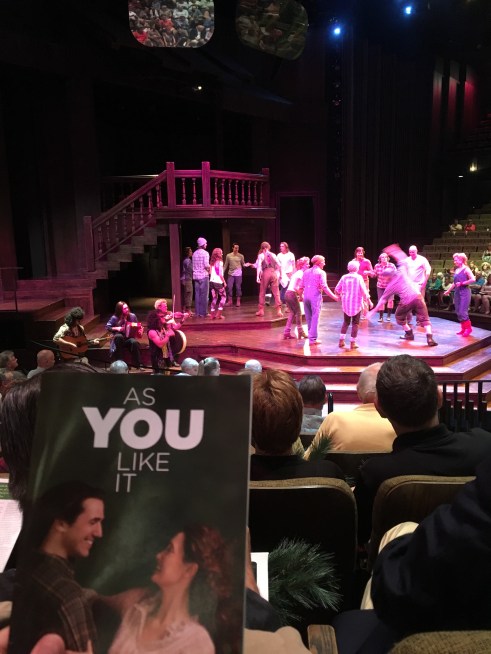
According to the advertising the show was supposed to be set in 1980’s Newfoundland (a part of Canada), a concept that sounded cute in theory but kind of died in execution. To be blunt about it, had I not read the inserts all I could have told you was that the actors seemed a bit confused as to which accents to use, most of them starting off the show as an accent I was unfamiliar with (it sounded garbled, and made it very hard to hear them) but by about 1/2 way through they were all back to their regular accents or something a bit more British sounding. Also, the 1980’s time period was mostly identifiable by the MTV inspired fashions and one character wearing a Walkman. But the whole gender bending aspect of the show, women being able to hide their gender just by wearing pants, kind of dies in a time period where women in men’s clothing is normative. So in my opinion, this switch of location and time period was a bit of a fail.

Other than that, the show was a lot of fun with a lot of physical humor and singing and dancing thrown in. I also enjoyed the interactive elements. As we walked in each of us was given a bag of items. All the people in orchestra seating were given an artificial pine branch, a laundry pin, a poem, and a green party hat; the people in the balcony were given stars instead of branches and some other items but I forget what as I wasn’t sitting there. Any time the scene was set in the forest we were supposed to hold up our branches, and before the scene where the romantic lead Orlando litters the forest with poems to his love we were instructed to pin our poem to our branch, and the actors as they came through plucked various ones off the branches… the fans (where were all blue) were supposed to represent the sea with the audience creating waves… and at one point a massive rabbit was passed around the audience as the characters went shooting for rabbits, etc. And then everyone on the lower level was instructed to put on our green party hats (I noticed only about 1/2 the people were willing to play along with this), and we were bathed in green light… I think we were supposed to be a meadow.


Ticket price: $60.60 ($46.72 US)
- The Lion, the Witch and the Wardrobe‘ – by C.S. Lewis, adapted by Adrian Mitchell (Avon Theater, August 14th, 2pm)
Very cute show; I was expecting it to be a play, but it was a musical and there were some cute songs in it. It is of course an adaptation of Lewis’s children’s book by the same name (while many think of the book as just a harmless piece of fantasy fiction, for those who don’t know, Lewis was lay theologian and story is in fact allegory of the death and the resurrection of Jesus, ‘who died for the sins of man’).
That said, whoever did the set design did a really amazing job; the curved screens altered images as needed, some animated, some not. For the animals they did every thing from hand held puppetry to a massive oversized Aslan the Lion (that looked to be deeply influenced by the oversized puppet-horses that practically breathed, that I saw used in the London production of Warhorse a few years ago), and the little podiums in the photo are constructed of what looks like over sized books — A design touch that I really liked.

… and there were a few more”adult jokes” thrown in — so for instance among the books Lucy spots in fawn’s home in Narnia was “how to train your unicorn” and “50 shades of fun” — followed by, “we don’t have these books in my world”
I was able to snap a few decent images of the show (once I noticed other folks in my row doing the same)


For the White Witch, better known these days as Elsa from Disney’s Frozen, and I think partly to avoid the confusion of one with the other, the same actress who had played the part was same one who had played the actress in A little Night Music (see above), who is most definitely black… as in ebony skinned. (Again, race blind casting, but in this case I think it might have helped distance the character from the Disney version, helping to reduce confusion in little kids.
One thing I found rather odd was while the local candy stores are selling Turkish delight, a confectionery that most American and Canadian kids have probably never tasted… and that is central to the story… it was NOT being sold at the food and drink counter during intermission… MARKETING FAIL!!!
My $32.77 ticket (Again, $29 US, achieved by utilizing a deal where you waited till a specific date, and then bought a ticket where you had no choice as to where you’d be seated) got me a seat in the 2nd row of the balcony, just off center. I overheard a conversation among the folks sitting right next to me. The show was completely sold out and they had been unable to get tickets just a few days before, but had been able to the day before and day of… cancellations I assume. They asked me how much I had paid, and when I told them one of them actually gasped, “we paid three times that amount of our tickets!”
Let’s heard it for planning in advance.
One very cute thing at this show was this couple, I passed them on the stairs before the show started:

“Did you guys just come from a wedding? ”
“Yes ” … light bulb goes on if my head
“Was at your wedding? ”
“yes ”
“You guys are my kind of theater nerds “
- All My Sons – by Arthur Miller (Tom Patterson Theater, Tues Aug. 16th, 8pm) 1/2 price Tuesday/Thurs = $68.48

All my sons (1947) is an Arthur Miller play(author of such crowd ticklers as: Death of a Salesman (1949), The Crucible (1953) and A View from the Bridge (1955) — or Marilyn Monroe’s ex-husband for those of you who know nothing about the theater). It is set in the aftermath of World War II (and costuming and hairstyles placed the piece in the period as written). The central family has a son who died in war, Only the mother refuses to accept it. The surviving son now wants to marry his brother’s “girl” … That is the initial conflict. Over the course of the play we learn that the girl is actually the daughter of the fathers old business partner and that they were next door neighbors, so the kids had grown up together. Then we learn that both fathers had been initially found guilty of producing faulty airplane parts that resulted in the deaths of 21 pilots, they had both gone to jail but the father central to the show (we never see the other one) had on appeal been found not guilty, while the other father is still in jail.
Like I mentioned before, Stratford likes to play fast and loose with the racially blind casting.But a play is not a TV show, if you’re going to change the racial profile of the characters then you are changing backstory and motivation… And you have to do it without actually changing the script, so it has to be far more strategically done in order to work, especially if it’s set in a certain time and place.
In this show, however, it actually worked powerfully. The casting of the show the main in central family is cast with white actors while most of the neighbors are actors and color. This did not bother me, In fact I think it’s made the story line stronger… In that, firstly, the liberalism (for the day) of the relationship between the father and his black neighbors strengthened the inability of the son to believe his father’s guilt, and it brought in modern-day concerns about how the justice system is not in fact colorblind. The white business partner (who we ultimately learn is the guilty party) gets off Scott free, while his black business partner who had actually tried to do the right thing ends up spending years in jail. That brought a modern relevance to the play. That totally worked.
That said, Stratford has in one aspect of the show done the beyond all reason blind racial casting again. This time there’s a black family with a white son and a white family with a black son. Now I can perfectly understand let’s say replacing one of the white families in the show with a black family or a Asian family or a mixed racial family even, but if you were going to cast two black adults as the parents and you’ve got a black kid in the cast wouldn’t make sense to have the black parents have a black child? There is a point where political correctness becomes absurd.
That said, at least they cast a black actor to play the brother for the black actress– I was seriously worried till he came out that he’d be white, like in a little night music. That said its a very good production. In fact, in this play I think most of the actors of color acted the pants off of the white actors.
The woman sitting next to me was really bothered that there was an interracial relationship going on in the 1940s and nobody said boo about it. I don’t agree with her; as Arthur Miller wrote the script these families have a backstory that goes back years and the deceased brother was involved with his African American Neighbor — if there had been any race issues it stands to reason that these families would’ve already worked all of that shit out years ago, before the son who died had even gone off to war. So that I’m not saying anything about it now is utterly reasonable.
However, the fact that the African-American couple (that had moved into the house that used to be the home of the family whose father is now imprisoned) have a white son…. That’s just lazy casting. You’re casting a kid who basically runs across the stage II or three times and has no lines…. They could’ve picked up anybody to do that.
After I got home I bounced this off my friend Dayna, the local woman whose home I’m staying at, and she laughed and said, “Rebecca, this is the whitest town I’ve ever seen, they probably couldn’t find two black 8-year-olds to play the parts.” So she might be right, it may have just been a practicality issue.
- The Hypochondriac – a new version of Molière‘s play (by Richard Bean)
(Festival Theater, August 18th, 8pm, 1/2 price Tuesday/Thurs = $68.48)

Molière is considered by many to be the creator of modern French comedy. He was successful enough in his day that his troupe performed for the king, but his works didn’t really become popular with the public and the critics until the 19th century. Known for comedies that so scathing in their criticism of social norms (as to border on impossible to not realize that “respected members” of the highly class structured, and patrilineal french society were being made to look like fools), in his day he was often getting into trouble with censors (French media back then was HIGHLY censored — which basically meant the ONLY way you could publicly criticize the status quo was via humor, etc.).
The Hypochondriac, which premiered in 1673, or to use its original French title, “The Imaginary Invalid” is a three-act comédie/ballet by the French playwright Molière with dance sequences and musical interludes (which is NOT an innovation of the festival but rather is true to its original design). The story centers around a very rich, but miserly, merchant who produces all of the carpet pads for King Louise XIV’s carpets, and his hypochondria. Add to the mix a much younger unfaithful wife, who is a professional black-widow, who is constantly conniving to disinherit his daughter while refusing him sex… and is just waiting for him to die, who he none the less loves blindly; a daughter he uses as a tool, who none-the-less loves him dearly, but is also completely in love with one of his apprentices (who is also smitten with her); a maid who treats her boss with a completely disrespectful tough love… so more like a son than her boss; and the father’s obsession with marrying off his daughter to a doctor (no matter how much of an idiot) so he doesn’t have to pay doctors bills (and Molière’s complete disrespect for pre-Enlightenment doctors) and what you have is silly farce whose real objective was probably to function as a revolutionary document intended to upend many of the values of French cultural norms during the reign of Louise XIV (who reigned from 1643 until his death in 1715), otherwise known as the Sun King.
Now to put this in context, I have a post graduate certificate in history and one of the courses I took was on French history, specifically the years leading up to the french revolution (and got an A) … So I’m well versed in the culture of the time and how the Enlightenment reversed a lot of it… which means when I was watching the show my brain, rather than perceiving it based on current social norms (and laughing along with the audience, who were laughing a lot) was busy interpreting it based on what the author was trying to communicate to the audience of his day… and just how radical and sociopolitical a lot of what was happening in the scenes would have been to them (which is why it was fine comedy for the court to see these shows, but not “appropriate” fare for the common man).
When intermission rolled around I started to try to discuss what I was thinking with the British woman seated next to me. At that point, even though she admitted she couldn’t actually hear what the actors had been saying, and had been enjoying it more for the physical comedy than because of any of the ideas hidden in the text… so I got her to follow me (she required a cane and some assistance), and took her to where they passed out the hearing aid devices. Apparently, she and her Hubbie had been coming to the festival for years and didn’t know they were even available, let alone that they were free. She got one for both her and her husband (thanked me repeatedly) and they were both laughing the whole way through the second part and thanked me a lot after the show was done for pointing out the hearing aid option
One of the really CUTE touches was how they reminded the audience to turn off their phones… At all the theaters in Stratford what they do is play this recording of highly annoying ring tones right before the play starts, often followed by a voice saying “thank you.” Here they had some actors dressed in the doctor’s robes of the time, examining this odd thing they had found and trying to identify it… (a smart phone)… and they’re arguing about it in a sort of mini play when suddenly it starts to ring … freaking them out, and they start attacking it and claiming it is a devil item, or demon spawn, or what have you… and stomping on it trying to kill it… The audience all enjoyed this a lot and gave them a round of applause.
- Macbeth – by William Shakespeare (Festival theater, Aug. 20th, 8pm — $32.77)
Very well done, very scary and spooky from first special effects of lightning and fog, and very well acted… and I had great seats (2nd row balcony just off center)

I am a bit embarrased to admit this but….
… I left at intermission. I packed up my stuff, returned my heard of hearing headphones and went home.
To be honest, I bought the ticket more as a “any self respecting adult going to see the Bard should of course want see his master work The Scottish Play … it’s expected. It’s adult.” Not, to be honest, because I “wanted” to see it… That and I had decided to see EVERY play, and that included the ones I had not enjoyed as a kid.
I blame this on a certain degree of intellectual pomposity and lack of self awareness on my part … As a kid, my parents took me to ALL the Shakespeare plays (Dad was British, and we went to London every year), and as part of my ‘education’ I got heavy douses of Shakespearean theater; and, at a certain point I began to realize that there were certain plays they just stopped taking me to and I knew it was because I didn’t like them … I just didn’t remember why I didn’t like them (assuming that at that age I would have even been able to understand why I didn’t like them). They did however supplement this with repeated viewings of the shows I did like, “As you like it,” “Midsummer’s night dream,” Etc… There’s even a family story of my being like maybe 7 and attending one of the comedies at a Shakespeare in the park performance in London, my laughing to it… and a stranger commenting to my dad, “she can’t possibly understand it, she’s too young.” So my dad had him quiz me about what was happening and to his amazement I TOTALLY understood it… I had by then been exposed to so much Shakespeare that I had no difficulty following the language.
So … when buying my tickets for the festival I figured, “hey, it’s ONLY $35,”… I’d give it a try. Basically, I’m 51 now and I think the last time I was the Bard’s Play I was maybe 8… So …
Anyway, all through the first half while intellectually appreciating the acting and the staging, and the special effects (of which there are many) I was uncomfortable and uncontrollably yawning through the whole thing… I disliked it for the same reason I don’t go to see horror films and fast forward through the star trek episodes that are all about violence… To be blunt I am quite simply NOT a fan of blood and gore and violence, no matter how well written
— A few days later, watching A Chorus Line, the woman next to me told me that in fact the reviews for Macbeth had NOT been good, and as such, that I shouldn’t based my feelings on this production… we’ll see
- The Aeneid – adapted by Olivier Kemeid, translated by Maureen Labonté (Studio Theater, Aug. 21, 8pm — $71.34 …. WTF??? What was I thinking?)

I didn’t like Aeneid either, but mostly because they veered away from the original story of the founding of Rome, and made it into a really pompous and self indulgent lecture to the audience on the current refugee crisis. I had known when I bought the tickets (based on the description) that they were going to modernize it and play on it’s parallels to refugee crisis… I just had no comprehension of how heavyhandedly they were going to be about doing it. At half time, while struggling with the decision of should I stick it out or leave (as I had the night before with Macbeth) I walked around looking at the audiences’ dour faces and overheard bits of conversations by multiple folks, each trying to convince their friend or partner that, yes, they really were in fact enjoying it (and sounding like they were really working hard at also convincing themselves). Personally, I think it fell more in the category of they didn’t want to admit they didn’t like it — more than a bit of the Emperor’s New Cloths (only smart and wise people can in fact appreciate how beautiful and fine his clothes were).
At the very end of intermission, and walking around the crowd and hearing the same sorts of comments from multiple directions — I decided I wasn’t enough of a masochist to slog it out till the end, went home and loaded the romantic comedy NottingHill into my Netflix in order to clear my brain of my annoyance before going to sleep.
That said, the play was sort of a cross between 1930’s modern theater (the type Hollywood movies love making fun of because of how self indulgent it was – often is more about making actors feel important than about entertaining customers) and traditional Greek theater. I did notice that 90% of the lines were delivered by men, which I found ironic considering how hard they were pushing liberal politics. When I got home, I had decided to pull up reviews of the show (I had purchased my tickets WAY before the season had even started, so I couldn’t check reviews then) and found this inconsistency noted by a few of the reviewers who didn’t like the show either.
**As a side note, one of the things I’ve noticed during my stay north of the US border is that Netflix while your Netflix account works across borders, the options of what is available changes; and in Canada there are fewer TV series available, but a lot more/better movies on streaming, including stuff that in the US you’d actually have to get a DVD shipped to you in order to see).
- John Gabriel Borkman – by Henrik Ibsen (Tom Patterson Theater, Aug. 23rd, 8pm, $68.46)

No one familiar with Ibsen attends one of his plays expecting to do any laughing. Ibsen, sort of by definition is about dysfunctional people behaving dysfunction-ally, hence his designation as “the father of realism” in that he put skeletons onto the stage of the sort of stuff most families kept stuffed firmly in the closet — a tendency that in 1896 (when this play was written) was pretty radical stuff. The fact is without Ibsen you might never have had plays like Arthur Miller’s “All My Sons” which I had seen on the same stage back on August 16th — which in a way runs thematic parallels to this show (both have fathers who had been thrown in jail for committing fraud that destroyed the lives of others, both involve adult children breaking free from parents who want to live through them, etc.)
Also, this is pretty much by any standard one of Ibsen’s lessor plays (most folks probably haven’t ever heard of it, unlike A Doll’s House, Hedda Gabler, or Peer Gynt) and as such you just can’t expect it to be a great play, even if it was by a great playwright…. and this wasn’t. But, that said, it was OK. It dragged a bit in places, and they managed to make the audience laugh in a few others, but to be honest it was bit like going to the dentist to get your teeth cleaned, you go because you know it’s good for you rather than because you expect to enjoy it.
The only racially blind casting in this show was the son’s girlfriend was black — in turn of the century Norway (again, a place and time where just having dark hair would make you stand out).
- A Chorus Line – music by Marvin Hamlisch, lyrics by Edward Kleban, book by James Kirkwood, Jr. and Nicholas Dante (Festival theater, August 25th, 8pm, $78.76 — 1/2 price)

Good thing I went to the bathroom before the show. Apparently, there will be no intermission; that, and they warned us that if we left for any reason we would not be allowed back in.
So here is an admission, I forget who introduced me to a chorus line in high school (1980?), but my girlfriends and I, we all, as a group, memorized ALL the songs and used to walk around singing them. However this is the first time I’ve actually seen the show in its entirety on the stage. I remember there was a movie version (1985) and I saw that, but I’ve never seen it on the stage before this.
That said, I was mouthing along to every song. And felt that this is a great production (although I would have recast about three of the characters). The girl who performed “Tits and Ass” one of my favorite songs stole the show… the only weak point was the girl who played Cassie couldn’t dance.
Both me and the woman sitting next to me bonded over this; we agreed that Cassie had all the grace of a bouncing elephant. — When I got home my friend Dayna (who had already seen the production although she wants to see it again) said it was because they had updated the whole show, but NOT that one dance… so the dance was really outdated, but personally I also think it was also that the girl playing the character lacked grace
- Breath of Kings — (part 2 redemption) – adapted by Graham Abbey, based on the Henriad plays by William Shakespeare (Aug., 26th, Tom Patterson Theater, 8pm)

This play is a mashup if you will of Shakespeare’s Henry IV part 2 and Henry V (think Battle of Agincourt). You’re supposed to see the part 1 ‘Rebellion’ play before you see the part 2 ‘Redemption’ one, but I had set a low priority on seeing this one, and bought the tickets last (at the $35 sale), and had been unable to fit it into my schedule in the correct order — I HAVE to leave here on the 31st of August because I have two friends getting married on the 4th in Chicago, and needed to leave myself spare time (in case) for the drive there.
2 min before show — place is 1/2 empty

Intermission — I slept through most of the first 1/2, just couldn’t keep my eyes open.
Freezing ! I think the Aircon was set to accommodate twice as many people it’s freezing in here — I did not sleep through the second half, battle of Agincourt
During the show last night there was a scene where actors walk through the stands and sit on the lapse of audience members in the far right corner (the part elevated above the doorway); I now realize, looking at the photos, that only four of the five seats had audience members seated in them when the show started, but were full when the actors showed up there; so the staff must’ve moved people into the empty ones right after intermission so that the gag would work.
- Bunny – by Hannah Moscovitch (Studio Theater, Aug., 28th, 8pm $71.34)
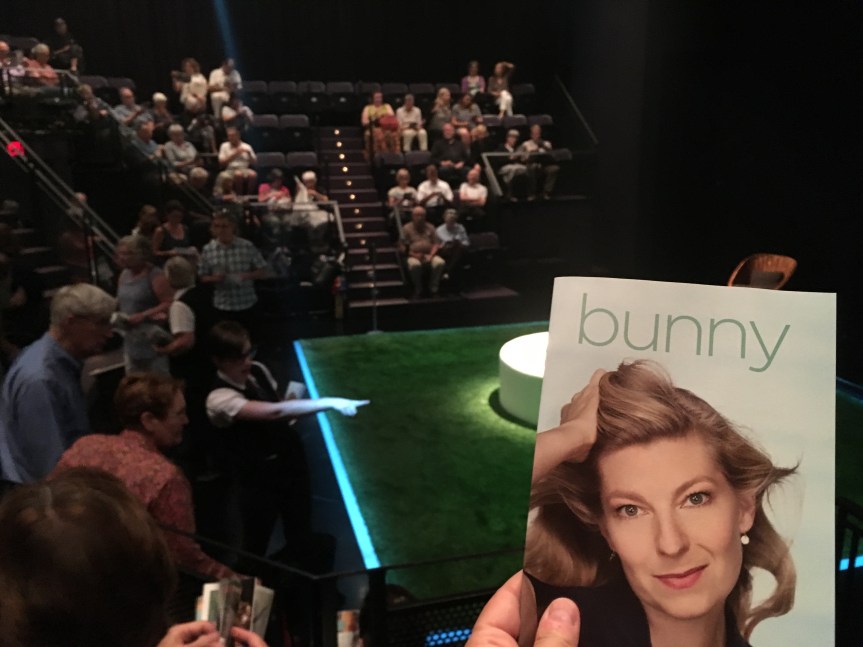
Dayna, the friend whose home I stayed at, and I discovered we both had tickets to the same show tonight so we decided to do dinner together. Granted we are almost on opposite sides of the theater. That said, according to Dayna our next door neighbor is playing the title character, and is a very nice woman. Apparently that home is rented out by the festival as housing for visiting artists, so that Dayna has met quite a few of the actors that way.
That said, I think bunny was probably the best play I’ve seen so far from all of the plays at Stratford. The title character, Bunny, was an incredibly relatable character, both Dayna and I were like, “we know this woman we would be friends with this woman.” The character seems to be ever so slightly autistic, but cursed with the looks of a model. Women don’t like her and she doesn’t understand why, men drool over her. She is the daughter of two academics, and ultimately becomes a professor of romantic period literature. The story begins with a confused scene that in retrospect is her running an event over in her mind trying to come to grips with it, and then jumps to her childhood, running through the major events of her life (often in soliloquy) so that we can get to know her and understand her when the events happen again at the end of the play.
It was very funny, very well acted, and poignant.
- Breath of Kings — (part 1 rebellion) – adapted by Graham Abbey, based on the Henriad plays by William Shakespeare

Yes, I know, I should have seen part 1 before viewing part 2, but I just couldn’t work it out in my schedule. As thing evolved I didn’t actually get to see this one either. Essentially the night started with an illness, and ended with one… mine
Before the show started one of the staff members apparently collapsed, and had to be taken away. What was sort of ‘interesting’ was that most of the people waiting outside were more concerned about getting into the theater, than the guy who collapsed. When they reopened the doors to bring his body out they were more concerned with pushing their way in than allowing the emergency staff to bring him out… it was not a pretty picture.

Finally they let us in, but not long after it started my stomach started to cramp, and I was forced to disturb my neighbors, get up and get out as quickly as possible. Ah the joys of irritable bowl syndrome… spent the next 20 minutes or so in the bathroom, and then staggered home. The staff was all worried about me since I was in there for so long. But this has become one of the downsides of my life, … Growing older, it’s not for wimps.










































 Rebecca Radnor's Personal Blog: Consider yourselves warned!